深度学习工具包
Deprecation notice.
-----
This toolbox is outdated and no longer maintained.
There are much better tools available for deep learning than this toolbox, e.g. [Theano](http://deeplearning.net/software/theano/), [torch](http://torch.ch/) or [tensorflow](http://www.tensorflow.org/)
I would suggest you use one of the tools mentioned above rather than use this toolbox.
Best, Rasmus.
DeepLearnToolbox
================
A Matlab toolbox for Deep Learning.
Deep Learning is a new subfield of machine learning that focuses on learning deep hierarchical models of data.
It is inspired by the human brain's apparent deep (layered, hierarchical) architecture.
A good overview of the theory of Deep Learning theory is
[Learning Deep Architectures for AI](http://www.iro.umontreal.ca/~bengioy/papers/ftml_book.pdf)
For a more informal introduction, see the following videos by Geoffrey Hinton and Andrew Ng.
* [The Next Generation of Neural Networks](http://www.youtube.com/watch?v=AyzOUbkUf3M) (Hinton, 2007)
* [Recent Developments in Deep Learning](http://www.youtube.com/watch?v=VdIURAu1-aU) (Hinton, 2010)
* [Unsupervised Feature Learning and Deep Learning](http://www.youtube.com/watch?v=ZmNOAtZIgIk) (Ng, 2011)
If you use this toolbox in your research please cite [Prediction as a candidate for learning deep hierarchical models of data](http://www2.imm.dtu.dk/pubdb/views/publication_details.php?id=6284)
```
@MASTERSTHESIS\{IMM2012-06284,
author = "R. B. Palm",
title = "Prediction as a candidate for learning deep hierarchical models of data",
year = "2012",
}
```
Contact: rasmusbergpalm at gmail dot com
Directories included in the toolbox
-----------------------------------
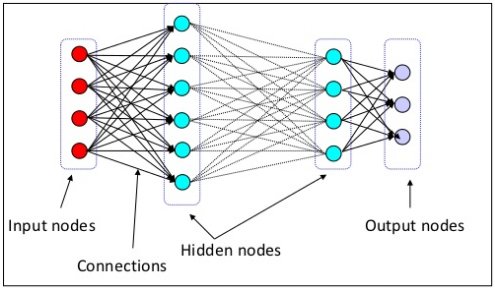
`NN/` - A library for Feedforward Backpropagation Neural Networks
`CNN/` - A library for Convolutional Neural Networks
`DBN/` - A library for Deep Belief Networks
`SAE/` - A library for Stacked Auto-Encoders
`CAE/` - A library for Convolutional Auto-Encoders
`util/` - Utility functions used by the libraries
`data/` - Data used by the examples
`tests/` - unit tests to verify toolbox is working
For references on each library check REFS.md
Setup
-----
1. Download.
2. addpath(genpath('DeepLearnToolbox'));
Example: Deep Belief Network
---------------------
```matlab
function test_example_DBN
load mnist_uint8;
train_x = double(train_x) / 255;
test_x = double(test_x) / 255;
train_y = double(train_y);
test_y = double(test_y);
%% ex1 train a 100 hidden unit RBM and visualize its weights
rand('state',0)
dbn.sizes = [100];
opts.numepochs = 1;
opts.batchsize = 100;
opts.momentum = 0;
opts.alpha = 1;
dbn = dbnsetup(dbn, train_x, opts);
dbn = dbntrain(dbn, train_x, opts);
figure; visualize(dbn.rbm{1}.W'); % Visualize the RBM weights
%% ex2 train a 100-100 hidden unit DBN and use its weights to initialize a NN
rand('state',0)
%train dbn
dbn.sizes = [100 100];
opts.numepochs = 1;
opts.batchsize = 100;
opts.momentum = 0;
opts.alpha = 1;
dbn = dbnsetup(dbn, train_x, opts);
dbn = dbntrain(dbn, train_x, opts);
%unfold dbn to nn
nn = dbnunfoldtonn(dbn, 10);
nn.activation_function = 'sigm';
%train nn
opts.numepochs = 1;
opts.batchsize = 100;
nn = nntrain(nn, train_x, train_y, opts);
[er, bad] = nntest(nn, test_x, test_y);
assert(er < 0.10, 'Too big error');
```
Example: Stacked Auto-Encoders
---------------------
```matlab
function test_example_SAE
load mnist_uint8;
train_x = double(train_x)/255;
test_x = double(test_x)/255;
train_y = double(train_y);
test_y = double(test_y);
%% ex1 train a 100 hidden unit SDAE and use it to initialize a FFNN
% Setup and train a stacked denoising autoencoder (SDAE)
rand('state',0)
sae = saesetup([784 100]);
sae.ae{1}.activation_function = 'sigm';
sae.ae{1}.learningRate = 1;
sae.ae{1}.inputZeroMaskedFraction = 0.5;
opts.numepochs = 1;
opts.batchsize = 100;
sae = saetrain(sae, train_x, opts);
visualize(sae.ae{1}.W{1}(:,2:end)')
% Use the SDAE to initialize a FFNN
nn = nnsetup([784 100 10]);
nn.activation_function = 'sigm';
nn.learningRate = 1;
nn.W{1} = sae.ae{1}.W{1};
% Train the FFNN
opts.numepochs = 1;
opts.batchsize = 100;
nn = nntrain(nn, train_x, train_y, opts);
[er, bad] = nntest(nn, test_x, test_y);
assert(er < 0.16, 'Too big error');
```
Example: Convolutional Neural Nets
---------------------
```matlab
function test_example_CNN
load mnist_uint8;
train_x = double(reshape(train_x',28,28,60000))/255;
test_x = double(reshape(test_x',28,28,10000))/255;
train_y = double(train_y');
test_y = double(test_y');
%% ex1 Train a 6c-2s-12c-2s Convolutional neural network
%will run 1 epoch in about 200 second and get around 11% error.
%With 100 epochs you'll get around 1.2% error
rand('state',0)
cnn.layers = {
struct('type', 'i') %input layer
struct('type', 'c', 'outputmaps', 6, 'kernelsize', 5) %convolution layer
struct('type', 's', 'scale', 2) %sub sampling layer
struct('type', 'c', 'outputmaps', 12, 'kernelsize', 5) %convolution layer
struct('type', 's', 'scale', 2) %subsampling layer
};
cnn = cnnsetup(cnn, train_x, train_y);
opts.alpha = 1;
opts.batchsize = 50;
opts.numepochs = 1;
cnn = cnntrain(cnn, train_x, train_y, opts);
[er, bad] = cnntest(cnn, test_x, test_y);
%plot mean squared error
figure; plot(cnn.rL);
assert(er<0.12, 'Too big error');
```
Example: Neural Networks
---------------------
```matlab
function test_example_NN
load mnist_uint8;
train_x = double(train_x) / 255;
test_x = double(test_x) / 255;
train_y = double(train_y);
test_y = double(test_y);
% normalize
[train_x, mu, sigma] = zscore(train_x);
test_x = normalize(test_x, mu, sigma);
%% ex1 vanilla neural net
rand('state',0)
nn = nnsetup([784 100 10]);
opts.numepochs = 1; % Number of full sweeps through data
opts.batchsize = 100; % Take a mean gradient step over this many samples
[nn, L] = nntrain(nn, train_x, train_y, opts);
[er, bad] = nntest(nn, test_x, test_y);
assert(er < 0.08, 'Too big error');
%% ex2 neural net with L2 weight decay
rand('state',0)
nn = nnsetup([784 100 10]);
nn.weightPenaltyL2 = 1e-4; % L2 weight decay
opts.numepochs = 1; % Number of full sweeps through data
opts.batchsize = 100; % Take a mean gradient step over this many samples
nn = nntrain(nn, train_x, train_y, opts);
[er, bad] = nntest(nn, test_x, test_y);
assert(er < 0.1, 'Too big error');
%% ex3 neural net with dropout
rand('state',0)
nn = nnsetup([784 100 10]);
nn.dropoutFraction = 0.5; % Dropout fraction
opts.numepochs = 1; % Number of full sweeps through data
opts.batchsize = 100; % Take a mean gradient step over this many samples
nn = nntrain(nn, train_x, train_y, opts);
[er, bad] = nntest(nn, test_x, test_y);
assert(er < 0.1, 'Too big error');
%% ex4 neural net with sigmoid activation function
rand('state',0)
nn = nnsetup([784 100 10]);
nn.activation_function = 'sigm'; % Sigmoid activation function
nn.learningRate = 1; % Sigm require a lower learning rate
opts.numepochs = 1; % Number of full sweeps through data
opts.batchsize = 100; % Take a mean gradient step over this many samples
nn = nntrain(nn, train_x, train_y, opts);
[er, bad] = nntest(nn, test_x, test_y);
assert(er < 0.1, 'Too big error');
%% ex5 plotting functionality
rand('state',0)
nn = nnsetup([784 20 10]);
opts.numepochs = 5; % Number of full sweeps through data
nn.output = 'softmax'; % use softmax output
opts.batchsize = 1000; % Take a mean gradient step over this many samples
opts.plot = 1; % enable plotting
nn = nntrain(nn, train_x, train_y, opts);
[er, bad] = nntest(nn, test_x, test_y);
assert(er < 0.1, 'Too big error');
%% ex6 neural net with sigmoid activation and plotting of validation and training error
% split training data into training and validation data
vx = train_x(1:10000,:);
tx = train_x(10001:end,:);
vy = train_y(1:10000,:);
ty = train_y(10001:end,:);
rand('state',0)
nn = nnsetup([784 20 10]);
nn.output = 'softmax'; % use softmax output
opts.numepochs = 5; % Number of full sweeps through data
opts.batchsize = 1000; % Take a mean gradient step over this many samples
opts.plot = 1; % enable plotting
nn = nntrain(nn, tx, ty, opts, vx, vy); % nntrain takes validation set as last two arguments (optionally)
[er, bad] = nntest(nn, test_x, test_y);
assert(er < 0.1, 'Too big error');
```
[](https://bitdeli.com/free "Bitdeli Badge")



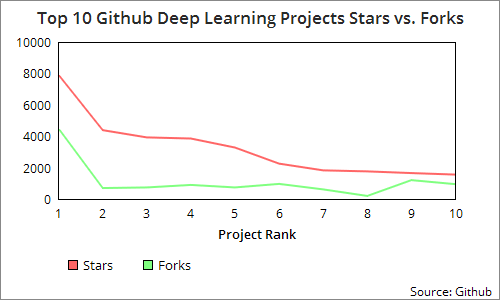
 本文介绍了GitHub上十个最受欢迎的深度学习项目,涵盖了从Caffe到Deeplearning4j的各种工具和框架,这些项目不仅提供了丰富的学习资源,还展示了当前深度学习领域的前沿技术和实践。








 扫一扫
扫一扫


 547
547

 被折叠的 条评论
为什么被折叠?
被折叠的 条评论
为什么被折叠?
 到【灌水乐园】发言





