



VL23 ROM的简单实现
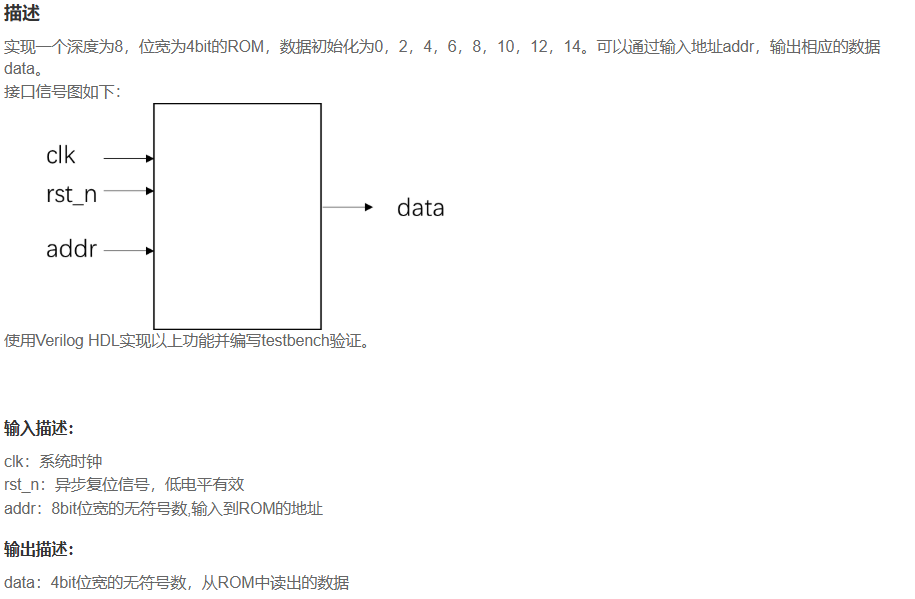
ROM的深度是什么
深度表示 ROM 有多少个独立的存储位置(地址)。
例子:
举例说明:
一个 ROM 的规格为 1K × 8:
“1K” 表示深度 = 1024(即有 1024 个地址);
“×8” 表示宽度 = 8 位(每个地址输出 8 位数据);
总容量 = 深度 × 宽度 = 1024 × 8 = 8192 位 = 1 KB。
思路一:使用case
`timescale 1ns/1ns
module rom(
	input clk,
	input rst_n,
	input [7:0]addr,

	output [3:0]data
);
reg [3:0] out;
always @(posedge clk , negedge clk ,negedge rst_n) begin
	if(!rst_n)
		out <= 4'd0;
	else
		case(addr)
			8'd7: out <= 4'd14;
			8'd6: out <= 4'd12;
			8'd5: out <= 4'd10;
			8'd4: out <= 4'd8;
			8'd3: out <= 4'd6;
			8'd2: out <= 4'd4;
			8'd1: out <= 4'd2;
			8'd0: out <= 4'd0;
			default: out <= 4'd0;
		endcase
end
assign data = out;
endmodule
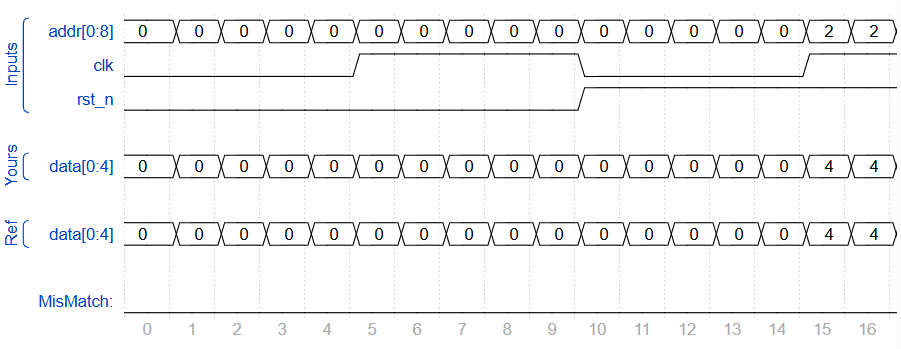
输出波形:
思路二:
`timescale 1ns/1ns
module rom(
	input clk,
	input rst_n,
	input [7:0]addr,

	output [3:0]data
);

reg [3:0] out ;

reg [3:0] rom [7:0];

always @(posedge clk , negedge rst_n) begin
	if(!rst_n)  begin
		rom[0] <= 4'd0;
		rom[1] <= 4'd2;
		rom[2] <= 4'd4;
		rom[3] <= 4'd6;
		rom[4] <= 4'd8;
		rom[5] <= 4'd10;
		rom[6] <= 4'd12;
		rom[7] <= 4'd14;
	end
	else begin
		rom[0] <= 4'd0;
		rom[1] <= 4'd2;
		rom[2] <= 4'd4;
		rom[3] <= 4'd6;
		rom[4] <= 4'd8;
		rom[5] <= 4'd10;
		rom[6] <= 4'd12;
		rom[7] <= 4'd14;
	end

end

always @(posedge clk , negedge clk , negedge rst_n)
	if(!rst_n)
		out <= 4'd0;
	else
		out <= rom[addr];

assign data = out ;
endmodule
这种写法有问题:
1.rom的赋值冗余,分析其目的就是想把rom的值保持为{0,2,4,6,8,10,12,14},可以考虑使用initial
2.设置reg变量out,当初是为了解决data为wire型无法在always块里被赋值,但是现在是:现将rom[addr]赋值给out,out再赋值给data,为何不去掉中间商呢?
最终改为:
`timescale 1ns/1ns
module rom(
    input clk,
    input rst_n,
    input [7:0]addr,

    output [3:0]data
);


reg [3:0] rom [7:0];

initial begin
        rom[0] <= 4'd0;
        rom[1] <= 4'd2;
        rom[2] <= 4'd4;
        rom[3] <= 4'd6;
        rom[4] <= 4'd8;
        rom[5] <= 4'd10;
        rom[6] <= 4'd12;
        rom[7] <= 4'd14;
    end


assign data = rom[addr] ;
endmodule





 扫一扫
扫一扫


 137
137

 被折叠的 条评论
为什么被折叠?
被折叠的 条评论
为什么被折叠?
 到【灌水乐园】发言





