回溯法经典例题--求解图的m着色问题--C语言

无向图的3着色问题(C语言) 无向图的3-着色(C语言)代码 #include<stdio.h> #define INITIAL -1 int graph[100][100]; //图的邻接矩阵 int N,M; //顶点数&边数 int colour[100]; int sum=0; int initial(){ //对整个图形初始化 for(int i=0;i<100;i++){ colour[i]=0; //0代表每个顶点没涂颜色 for(int j=0;j<100; 阅读详情

问题描述:

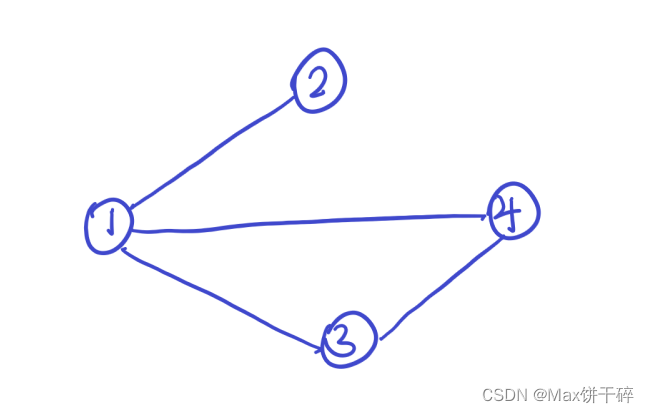
        给定无向连通图G和m种不同的颜色,用这些颜色为图G的个顶点着色,每个顶点一种颜色。如果有一种着色法使G中每条边的两个顶点不同颜色,则称这个图是m可着色的。图的m着色问题是对于给定图G和m种颜色,找出所有不同的着色法。

求解:

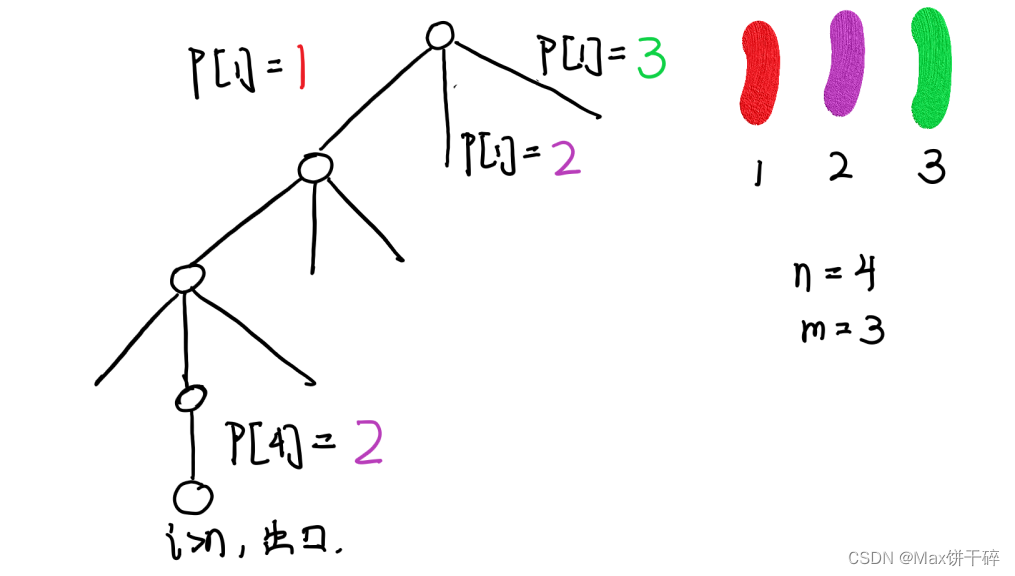
        给无向图上色且相邻顶点不能上同样的色,把它看作m叉树后,类似于红黑树。


        我们把颜色用数字代替。有多少种颜色,每个节点就有多少个孩子,每一层对应当前节点选择上的色.

        当到达叶子节点时,表示所有节点已经按照要求选好了颜色,也就是出口。


代码:

        g是图的邻接矩阵,p存储i节点涂的颜色代号,n为节点个数,i为当前递归节点,m颜色数量

#include<stdio.h>
#include<iostream>
using namespace std;
#define max 10
int num = 0;
bool paintable(int g[max][max], int p[max], int n,int i) {
	for (int j = 1; j <= n; j++) {
		if (g[i][j] == 1 && p[i] == p[j])
			return false;
	}
	return true;
}
void dfs(int g[max][max],int p[max], int n, int m,int i) {
	if (i > n) {
		num++;
	}
	else {
		for (int j = 1; j <= m; j++) {
			p[i] = j;
			if (paintable(g, p, n, i))
				dfs(g, p, n, m, i + 1);
			p[i] = 0;
		}
	}
}
int main() {
	int n = 4;
	int m = 3;
	int g[max][max];
	int paint[max];
	memset(paint, 0, sizeof(paint));
	memset(g, 0, sizeof(g));
	g[1][2] = 1;g[1][3] = 1;g[1][4] = 1;
	g[2][1] = 1;
	g[3][1] = 1; g[3][4] = 1;
	g[4][1] = 1; g[4][3] = 1;
	dfs(g, paint, n, m, 1);
	cout << num;
	return 0;
}

图的m着色问题(回溯法) 图的m着色问题 阅读详情

相关推荐

图的m着色问题(回溯法)(C++)

• 我们检查顶点 vertex 的所有邻接顶点(在 adj[vertex] 中),如果某个邻接顶点已经着了相同的颜色,则当前选择的颜色 color 就不合法,返回 false。需要注意的是,输入的顶点编号是从 1 开始的,但是数组的索引从 0 开始,因此我们将顶点编号减 1。:对于每个顶点,尝试所有 1 到 的颜色。• 每个顶点有 种可能的颜色选择,因此在最坏情况下,回溯算法的时间复杂度是 ,其中 是顶点数, 是颜色数。:递归调用结束后,恢复当前顶点的颜色为 0,即撤销颜色的选择,以尝试其他可能的选择。

m0_62598860的博客 1497

C/C++回溯法-图着色问题

问题描述:给定无向连通图G=(V,E)和正整数m,求最小的整数m,使得用m种颜色对G中的顶点着色,使得任意两个相邻顶点着色不同。 约束条件: 相邻顶点着色不同 对第k+1个顶点进行着色,若与该顶点相连的且已着色顶点的着色与该顶点的着色不同,则着色成功,若着所有颜色都不满足约束条件,则返回第k个节点,重复上述过程,对其重新着色。 例:若只有1,2,3三种色号 完整代码: #include<stdio.h> void gc() { int n; printf("请输入节点数:");

qq_44375810的博客 6211

关于图着色问题(GCP)的优化算法及启发式算法求解过程——沐雨先生

关于图着色问题(GCP)的优化算法及启发式算法求解过程

Movrain的博客 6930

计算机算法分析与设计(21)---回溯法(图着色问题)

(2)长期以来,数学家无法证明四种颜色就够了,或者无法找到需要四种以上颜色的地图。直到1976年德国数学家沃尔夫冈·哈肯(Wolfgang Haken,生于1928年)和肯尼斯·阿佩尔(Kenneth Appel,1932年-2013年)使用计算机证明了四色定理,他们将无数种可能的地图缩减为1936种特殊情况,每种情况都由一台计算机进行了总计超过1000个小时的检查。一些简单的“地图”(例如棋盘)仅需要两种颜色(黑白),但是大多数复杂的地图需要更多的颜色。表示没有可用的颜色。,用于存储图中的边。

m0_62881487的博客 4527

算法设计与分析:第五章 回溯法 5.3图的着色问题

/* 图的着色问题: 给定无向图G(V,E),用m种颜色为图中每个 顶点着色,要求每个顶点着一种颜色,并 且使得相邻两个顶点之间的颜色不同 分析: 用一个n元组描述图的一种颜色(x1,x2,...,xn),xi属于[1,m],1<=i<=n 为了用m种颜色对n个顶点着色,就有m^n中可能颜色组合,状态空间树是高度为n 的完全m叉树 约束方程: x[i] != x[j],若顶点i与顶点j相邻

qingyuanluofeng的专栏 6337

C语言实现图的着色问题与回溯法解题

回溯法是一种通过探索所有可能的候选解来找出所有解的算法。如果候选解被确认不是一个解(或者至少不是最后一个解),回溯算法会通过在上一步进行一些变化来丢弃该解,即回退并尝试另一个新的候选解。回溯法是一种系统地搜索问题解决方案的方法。它尝试分步去解决一个问题。在分步解决问题的过程中,当它通过尝试发现现有的分步答案不能得到有效的正确的解答的时候,它将取消上一步甚至是上几步的计算,再通过其他的可能的分步解答再次尝试寻找问题的答案。

weixin_35995661的博客 378

图的m着色问题回溯法求解

问题描述 给定无向连通图G和m种不同的颜色。 用这些颜色为图G的各顶点着色,每个顶点着一种颜色。是否有一种着色法使G中每条边的2个顶点着不同颜色。这个问题是图的m可着色判定问题。 若一个图最少需要m种颜色才能使图中每条边连接的2个顶点着不同颜色,则称这个数m为该图的色数。 求一个图的色数m的问题称为图的m可着色优化问题。 连通图的可着色问题 给定图G=(V,E)和m重颜色,若这个图不是m可着色,...

practical_sharp的博客 1万+

C语言图的着色问题回溯法

C语言图的着色问题回溯法,用的是排列树的框架,里面的代码可以直接运行。

回溯法-图的m着色问题

给定一个无向连通图 ( G = (V, E) ) 和 ( m ) 种颜色,我们的任务是为图 ( G ) 的每个顶点着色,使得相邻的顶点颜色不同。如果存在这样的着色方案,我们称之为图 ( G ) 的 ( m ) 可着色问题。

qq_52291558的博客 2714

实验12图m的着色问题.doc

给定 无向连通图G=(V,E) 和 c种不同的颜色,用这些颜色为图G的各顶点着色,每个顶点着一种颜色。如果一个图最少需要c种颜色才能使图中每条边连接的2个顶点着不同颜色,则称c为该图的色数。  著名的 四色定理 就是指每个平面地图都可以只用四种颜色来染色,而且没有两个邻接的区域颜色相同。

【CV论文精读】【协同感知综述】Collaborative Perception for Autonomous Driving :Current Status and Future Trend

感知是自动驾驶系统的关键模块之一,近年来取得了很大进展。然而,单个车辆的有限能力导致感知性能提高的瓶颈。为了突破个体感知的局限,协作感知被提出,它使车辆能够共享信息来感知视线和视野之外的环境。本文综述了有前途的协作感知技术的相关工作,包括介绍了基本概念,概括了协作模式,总结了协作感知的关键要素和应用。最后,我们讨论了这一研究领域面临的挑战和问题,并给出了一些潜在的进一步方向。

weixin_44184852的博客 4689

回溯法之图的m着色问题(着色问题、算法)

四色问题:任何一张地图只用四种颜色就能使具有共同边界的国家着上不同的颜色。 图的m着色问题由四色问题引申而来,研究如何用m种颜色为地图着色。给定无向连通图G和m种不同的颜色,用这些颜色为图G的各顶点着色,每个顶点着一种颜色,如果有一种着色方案使中种每条边的两个顶点着不同的颜色,则称图是m可着色的,求出所有不同的着色方案。 数据结构设计: 1.用二维数组A[N]N[]存储图G,A[i][j]=1,表示节点i和节点j之间连通. 2.用一位数组colors[N]存储图的一种着色方案,colors[t]=i,表示节

weixin_43827397的博客 3295

解决ADS1.2报错Cannot obtain license

报错如下 将licenses文件下的license内容进行修改: 修改为如下内容即可。 # # Generated on 2021-dec-1 by licwizard # PACKAGE ads armlmd 1.200 E32F0DE5161D COMPONENTS="armasm compiler bats armulate axd adwu fromelf armlink codewarrior armsd" INCREMENT ads armlmd 1.200 permanent uncounte

qq_46110320的博客 3462

图的m可着色优化回溯法c语言,回溯法实验(图的m着色问题)

算法分析与设计实验报告第 六 次附加实验姓名学号班级时间12.26上午地点工训楼309实验名称回溯法实验(图的m着色问题)实验目的1. 掌握回溯法求解问题的思想2. 学会利用其原理求解图的m着色问题实验原理问题描述:给定无向连通图G和m种不同的颜色。用这些颜色为图G的各顶点着色,每个顶点着一种颜色。是否有一种着色法使G中每条边的2个顶点着不同颜色。这个问题是图的m可着色判定问题。若一个图最少需要m...

weixin_42352453的博客 1742

YOLOv11的QAT(训练感知量化)实战

本文总结了YOLO模型量化感知训练(QAT)的实践要点:QAT通过模拟量化噪声训练模型,比训练后量化(PTQ)更适合密集预测任务。关键实现包括:1)配置对称/非对称量化器;2)排除检测头量化;3)调整学习率策略并添加量化正则;4)选择困难样本校准;5)转换前稳定BN统计量。调试时需检查量化范围、数值分布和逐层突变,并注意SPP等敏感层。建议小模型使用QAT,大模型可能适得其反,且TensorRT的FP16模式可能优于INT8-QAT。量化应以功能正确为前提,避免过度优化。

as1225120794的博客 510

python爬虫项目(一百九十八):电商平台用户行为数据分析与推荐系统、爬取电商平台用户行为数据

本文详细介绍了如何通过爬虫技术抓取电商平台的用户行为数据,并结合数据分析技术,构建一个简单的推荐系统。使用Selenium模拟用户操作抓取动态网页数据,并通过API接口直接获取用户行为数据,能够为后续的用户行为分析提供基础数据。我们结合了基于用户协同过滤、基于商品协同过滤和矩阵分解等方法,构建了不同的推荐系统。实际应用中,可以进一步优化推荐算法,利用更复杂的深度学习技术和更高效的数据处理方法,提升推荐的准确性和个性化程度。

斌擎科技 2361

图的m着色问题(回溯)

图的m着色问题(回溯) 1.问题描述: 给定无向连通图G和m种不同的颜色。用这些颜色为图G的各顶点着色,每个顶点着一种颜色。是否有一种着色法,使G中每条边的2个顶点着有不同颜色? 这个问题是图的m可着色判定问题。若一个图最少需要m种颜色才能使图中每条边连接的2个顶点着不同颜色,则称这个数m为该图的色数。求一个图的色数m的问题称为图的m可着色优化问题。 2.问题分析: ●图着色问题描述为: 给定无向连通图G=(V, E)和正整数m,求最小的整数m,使得用m种颜色对G中的顶点着色.使得任.

哈哈哈哈哈哈哈哈的博客 3631

【QNX+Android虚拟化方案】129 - USB眼图参数配置

【QNX+Android虚拟化方案】129 - USB眼图参数配置

|~~~热爱生活、努力学习的小伙汁~~~| 821

图着色问题 —— 【算法设计】回溯法

给定图的顶点v,顶点间的边邻接关系Graph[ ][ ],颜色的数量m,一共有多少种着色方法?

Ve99tr’s Blog 8116

基于STM32L4XX、HAL库的 ATGM336H GPS定位模块驱动程序设计

/ 转换为km/h。// 定位状态: 0=无效, 1=GPS定位, 2=差分定位。// GPS解析数据。支持GPS/BeiDou/GLONASS/Galileo/QZSS多系统联合定位。// 回调函数(需要在HAL_UART_RxCpltCallback中调用)// 地面速度(km/h)// 海拔高度(m)

zhusl6688的博客 794

【Autoware】Autoware.universe安装过程与问题记录

Autoware.universe安装过程与问题记录

DevFrank的博客 2739

算法(c++)——地图着色问题

算法(c++)——地图着色问题:地图着色问题:如果把每一个区域收缩为一个顶点,把相邻两个区域用一条边相连接,就可以把一个区域图抽象为一个平面图。用m种颜色为图中的每个顶点着色,要求每个顶点着一种颜色,并使相邻两顶点之间有着不同的颜色。运用回溯法解决该问题。

高冷男孩不吃苹果的博客 8618

使用 Simulink 进行电力电子系统的小信号模型仿真

电力电子系统(Power Electronics System)包括各种功率转换器(如 DC-DC 转换器、逆变器等)。这些设备中的关键组件(如 MOSFET、IGBT、电容器、电感器等)不仅影响系统的性能,还直接关系到系统的稳定性、效率和可靠性。因此,在设计阶段进行详细的建模和仿真至关重要。小信号模型仿真的目的是通过线性化非线性系统来评估其动态特性,包括增益、相位裕度、带宽等指标。通过本教程,我们介绍了如何使用 Simulink 进行电力电子系统的小信号模型仿真。背景介绍。

xiaoheshang_123的博客 480

回溯法解决图的m着色问题-思考

题干见于李春葆算法分析与设计的P193 这段代码不能跑出示例中的数据,但大体思路看上去毫无破绽。 先分析其中的原因 #include<stdio.h> #include<string.h> int adjMatrix[30][30]; int col[10]; int solN=0; int nodeN,vexN,colN; bool isSame(int x) { fo...

weixin_44811885的博客 1078

Devexpress16.2.6破解工具

Devexpress16.2.6破解工具Devexpress16.2.6破解工具Devexpress16.2.6破解工具Devexpress16.2.6破解工具

深度学习工具包 DeepLearningToolbox

深度学习工具包Deprecation notice.-----This toolbox is outdated and no longer maintained.There are much better tools available for deep learning than this toolbox, e.g. [Theano](http://deeplearning.net/software/theano/), [torch](http://torch.ch/) or [tensorflow](http://www.tensorflow.org/)I would suggest you use one of the tools mentioned above rather than use this toolbox.Best, Rasmus.DeepLearnToolbox================A Matlab toolbox for Deep Learning.Deep Learning is a new subfield of machine learning that focuses on learning deep hierarchical models of data.It is inspired by the human brain's apparent deep (layered, hierarchical) architecture.A good overview of the theory of Deep Learning theory is[Learning Deep Architectures for AI](http://www.iro.umontreal.ca/~bengioy/papers/ftml_book.pdf)For a more informal introduction, see the following videos by Geoffrey Hinton and Andrew Ng.* [The Next Generation of Neural Networks](http://www.youtube.com/watch?v=AyzOUbkUf3M) (Hinton, 2007)* [Recent Developments in Deep Learning](http://www.youtube.com/watch?v=VdIURAu1-aU) (Hinton, 2010)* [Unsupervised Feature Learning and Deep Learning](http://www.youtube.com/watch?v=ZmNOAtZIgIk) (Ng, 2011)If you use this toolbox in your research please cite [Prediction as a candidate for learning deep hierarchical models of data](http://www2.imm.dtu.dk/pubdb/views/publication_details.php?id=6284)```@MASTERSTHESIS\{IMM2012-06284, author = "R. B. Palm", title = "Prediction as a candidate for learning deep hierarchical models of data", year = "2012",}```Contact: rasmusbergpalm at gmail dot comDirectories included in the toolbox-----------------------------------`NN/` - A library for Feedforward Backpropagation Neural Networks`CNN/` - A library for Convolutional Neural Networks`DBN/` - A library for Deep Belief Networks`SAE/` - A library for Stacked Auto-Encoders`CAE/` - A library for Convolutional Auto-Encoders`util/` - Utility functions used by the libraries`data/` - Data used by the examples`tests/` - unit tests to verify toolbox is workingFor references on each library check REFS.mdSetup-----1. Download.2. addpath(genpath('DeepLearnToolbox'));Example: Deep Belief Network---------------------```matlabfunction test_example_DBNload mnist_uint8;train_x = double(train_x) / 255;test_x = double(test_x) / 255;train_y = double(train_y);test_y = double(test_y);%% ex1 train a 100 hidden unit RBM and visualize its weightsrand('state',0)dbn.sizes = [100];opts.numepochs = 1;opts.batchsize = 100;opts.momentum = 0;opts.alpha = 1;dbn = dbnsetup(dbn, train_x, opts);dbn = dbntrain(dbn, train_x, opts);figure; visualize(dbn.rbm{1}.W'); % Visualize the RBM weights%% ex2 train a 100-100 hidden unit DBN and use its weights to initialize a NNrand('state',0)%train dbndbn.sizes = [100 100];opts.numepochs = 1;opts.batchsize = 100;opts.momentum = 0;opts.alpha = 1;dbn = dbnsetup(dbn, train_x, opts);dbn = dbntrain(dbn, train_x, opts);%unfold dbn to nnnn = dbnunfoldtonn(dbn, 10);nn.activation_function = 'sigm';%train nnopts.numepochs = 1;opts.batchsize = 100;nn = nntrain(nn, train_x, train_y, opts);[er, bad] = nntest(nn, test_x, test_y);assert(er < 0.10, 'Too big error');```Example: Stacked Auto-Encoders---------------------```matlabfunction test_example_SAEload mnist_uint8;train_x = double(train_x)/255;test_x = double(test_x)/255;train_y = double(train_y);test_y = double(test_y);%% ex1 train a 100 hidden unit SDAE and use it to initialize a FFNN% Setup and train a stacked denoising autoencoder (SDAE)rand('state',0)sae = saesetup([784 100]);sae.ae{1}.activation_function = 'sigm';sae.ae{1}.learningRate = 1;sae.ae{1}.inputZeroMaskedFraction = 0.5;opts.numepochs = 1;opts.batchsize = 100;sae = saetrain(sae, train_x, opts);visualize(sae.ae{1}.W{1}(:,2:end)')% Use the SDAE to initialize a FFNNnn = nnsetup([784 100 10]);nn.activation_function = 'sigm';nn.learningRate = 1;nn.W{1} = sae.ae{1}.W{1};% Train the FFNNopts.numepochs = 1;opts.batchsize = 100;nn = nntrain(nn, train_x, train_y, opts);[er, bad] = nntest(nn, test_x, test_y);assert(er < 0.16, 'Too big error');```Example: Convolutional Neural Nets---------------------```matlabfunction test_example_CNNload mnist_uint8;train_x = double(reshape(train_x',28,28,60000))/255;test_x = double(reshape(test_x',28,28,10000))/255;train_y = double(train_y');test_y = double(test_y');%% ex1 Train a 6c-2s-12c-2s Convolutional neural network %will run 1 epoch in about 200 second and get around 11% error. %With 100 epochs you'll get around 1.2% errorrand('state',0)cnn.layers = { struct('type', 'i') %input layer struct('type', 'c', 'outputmaps', 6, 'kernelsize', 5) %convolution layer struct('type', 's', 'scale', 2) %sub sampling layer struct('type', 'c', 'outputmaps', 12, 'kernelsize', 5) %convolution layer struct('type', 's', 'scale', 2) %subsampling layer};cnn = cnnsetup(cnn, train_x, train_y);opts.alpha = 1;opts.batchsize = 50;opts.numepochs = 1;cnn = cnntrain(cnn, train_x, train_y, opts);[er, bad] = cnntest(cnn, test_x, test_y);%plot mean squared errorfigure; plot(cnn.rL);assert(er<0.12, 'Too big error');```Example: Neural Networks---------------------```matlabfunction test_example_NNload mnist_uint8;train_x = double(train_x) / 255;test_x = double(test_x) / 255;train_y = double(train_y);test_y = double(test_y);% normalize[train_x, mu, sigma] = zscore(train_x);test_x = normalize(test_x, mu, sigma);%% ex1 vanilla neural netrand('state',0)nn = nnsetup([784 100 10]);opts.numepochs = 1; % Number of full sweeps through dataopts.batchsize = 100; % Take a mean gradient step over this many samples[nn, L] = nntrain(nn, train_x, train_y, opts);[er, bad] = nntest(nn, test_x, test_y);assert(er < 0.08, 'Too big error');%% ex2 neural net with L2 weight decayrand('state',0)nn = nnsetup([784 100 10]);nn.weightPenaltyL2 = 1e-4; % L2 weight decayopts.numepochs = 1; % Number of full sweeps through dataopts.batchsize = 100; % Take a mean gradient step over this many samplesnn = nntrain(nn, train_x, train_y, opts);[er, bad] = nntest(nn, test_x, test_y);assert(er < 0.1, 'Too big error');%% ex3 neural net with dropoutrand('state',0)nn = nnsetup([784 100 10]);nn.dropoutFraction = 0.5; % Dropout fraction opts.numepochs = 1; % Number of full sweeps through dataopts.batchsize = 100; % Take a mean gradient step over this many samplesnn = nntrain(nn, train_x, train_y, opts);[er, bad] = nntest(nn, test_x, test_y);assert(er < 0.1, 'Too big error');%% ex4 neural net with sigmoid activation functionrand('state',0)nn = nnsetup([784 100 10]);nn.activation_function = 'sigm'; % Sigmoid activation functionnn.learningRate = 1; % Sigm require a lower learning rateopts.numepochs = 1; % Number of full sweeps through dataopts.batchsize = 100; % Take a mean gradient step over this many samplesnn = nntrain(nn, train_x, train_y, opts);[er, bad] = nntest(nn, test_x, test_y);assert(er < 0.1, 'Too big error');%% ex5 plotting functionalityrand('state',0)nn = nnsetup([784 20 10]);opts.numepochs = 5; % Number of full sweeps through datann.output = 'softmax'; % use softmax outputopts.batchsize = 1000; % Take a mean gradient step over this many samplesopts.plot = 1; % enable plottingnn = nntrain(nn, train_x, train_y, opts);[er, bad] = nntest(nn, test_x, test_y);assert(er < 0.1, 'Too big error');%% ex6 neural net with sigmoid activation and plotting of validation and training error% split training data into training and validation datavx = train_x(1:10000,:);tx = train_x(10001:end,:);vy = train_y(1:10000,:);ty = train_y(10001:end,:);rand('state',0)nn = nnsetup([784 20 10]); nn.output = 'softmax'; % use softmax outputopts.numepochs = 5; % Number of full sweeps through dataopts.batchsize = 1000; % Take a mean gradient step over this many samplesopts.plot = 1; % enable plottingnn = nntrain(nn, tx, ty, opts, vx, vy); % nntrain takes validation set as last two arguments (optionally)[er, bad] = nntest(nn, test_x, test_y);assert(er < 0.1, 'Too big error');```[![Bitdeli Badge](https://d2weczhvl823v0.cloudfront.net/rasmusbergpalm/deeplearntoolbox/trend.png)](https://bitdeli.com/free "Bitdeli Badge")

c语言编程实现图的着色问题,回溯法--图的m着色问题 C语言

使用编译器 CodeBlock17.12 算法实验课根据课本Java代码写的C语言代码#include "stdio.h"int n,m;//顶点数,可用颜色数int a[100][100];//图的邻接矩阵int x[100];//当前解int sum=0;//找到的找色方案void input(){printf("输入顶点数n和着色数m:\n");scanf("%d %d",&n,&a...

weixin_39988779的博客 2017

android 蓝牙通讯demo

android 下蓝牙通讯demo,实现了发现蓝牙,使能蓝牙,通过蓝牙发送消息。

回溯法实战:如何高效解决图的m着色问题

本文深入解析了如何使用回溯法高效解决图的m着色问题。通过将地图着色等实际问题抽象为图论模型,详细阐述了回溯法的核心思想与递归步骤,并提供了C++与Python双版本代码实现。文章还探讨了算法复杂度、优化技巧及在频谱分配、寄存器分配等领域的实际应用,帮助读者从理论到实践全面掌握这一经典算法。

weixin_29263201的博客 398

Data-Structures-and-Algorithm-Analysis-in-Java.pdf

作者: Weiss, Mark A. 出版社: Addison Wesley Data Structures and Algorithm Analysis in Java is an “advanced algorithms” book that fits between traditional CS2 and Algorithms Analysis courses. In the old ACM Curriculum Guidelines, this course was known as CS7. This text is for readers who want to learn good programming and algorithm analysis skills simultaneously so that they can develop such programs with the maximum amo...

上一篇: 回溯法经典例题--n皇后问题--C语言
下一篇: 回溯法经典例题--任务分配问题--C语言
Max饼干碎
博客等级 码龄5年 28粉丝 19原创
评论
成就一亿技术人!
拼手气红包6.0元
还能输入1000个字符
 
 条评论被折叠 查看
添加红包

请填写红包祝福语或标题

个

红包个数最小为10个

元

红包金额最低5元

当前余额3.43元 前往充值 >
需支付:10.00元
成就一亿技术人!
领取后你会自动成为博主和红包主的粉丝 规则
hope_wisdom
发出的红包
实付元
使用余额支付
点击重新获取
扫码支付
钱包余额 0

抵扣说明:

1.余额是钱包充值的虚拟货币,按照1:1的比例进行支付金额的抵扣。
2.余额无法直接购买下载,可以购买VIP、付费专栏及课程。

余额充值