CMU 11-785 L04 Backpropagation

CMU 11-785 L22 Revisiting EM algorithm and generative models Key points EM: An iterative technique to estimate probability models for data with missing components or information By iteratively “completing” the data and reestimating parameters PCA: Is actually a generative model for Gaussian data Data lie close 阅读详情

Problem setup

  • Input-output pairs: not to mention

  • Representing the output: one-hot vector

    • yi=exp⁡(zi)∑jexp⁡(zj) y_{i}=\frac{\exp \left(z_{i}\right)}{\sum_{j} \exp \left(z_{j}\right)} yi​=∑j​exp(zj​)exp(zi​)​

    • two classes of softmax = sigmoid

  • Divergence: must be differentiable

    • For real-valued output vectors, the (scaled) L2L_2L2​ divergence

      • Div⁡(Y,d)=12∥Y−d∥2=12∑i(yi−di)2 \operatorname{Div}(Y, d)=\frac{1}{2}\|Y-d\|^{2}=\frac{1}{2} \sum_{i}\left(y_{i}-d_{i}\right)^{2} Div(Y,d)=21​∥Y−d∥2=21​i∑​(yi​−di​)2
    • For binary classifier

      • Div⁡(Y,d)=−dlog⁡Y−(1−d)log⁡(1−Y) \operatorname{Div}(Y, d)=-\operatorname{dlog} Y-(1-d) \log (1-Y) Div(Y,d)=−dlogY−(1−d)log(1−Y)

      • Note: the derivative is not zero even d=Yd = Yd=Y, but it can converge very quickly

    • For multi-class classification

      • Div⁡(Y,d)=−∑idilog⁡yi=−log⁡yc \operatorname{Div}(Y, d)=-\sum_{i} d_{i} \log y_{i}=-\log y_{c} Div(Y,d)=−i∑​di​logyi​=−logyc​

      • If yc<1y_c < 1yc​<1 , the slope is negative w.r.t. ycy_cyc​, indicates increasing ycy_cyc​ will reduce divergence

Train the network

Distributed Chain rule

y=f(g1(x),g1(x),…,gM(x)) y=f\left(g_{1}(x), g_{1}(x), \ldots, g_{M}(x)\right) y=f(g1​(x),g1​(x),…,gM​(x))

dydx=∂f∂g1(x)dg1(x)dx+∂f∂g2(x)dg2(x)dx+⋯+∂f∂gM(x)dgM(x)dx \frac{d y}{d x}=\frac{\partial f}{\partial g_{1}(x)} \frac{d g_{1}(x)}{d x}+\frac{\partial f}{\partial g_{2}(x)} \frac{d g_{2}(x)}{d x}+\cdots+\frac{\partial f}{\partial g_{M}(x)} \frac{d g_{M}(x)}{d x} dxdy​=∂g1​(x)∂f​dxdg1​(x)​+∂g2​(x)∂f​dxdg2​(x)​+⋯+∂gM​(x)∂f​dxdgM​(x)​

Backpropagation

在这里插入图片描述

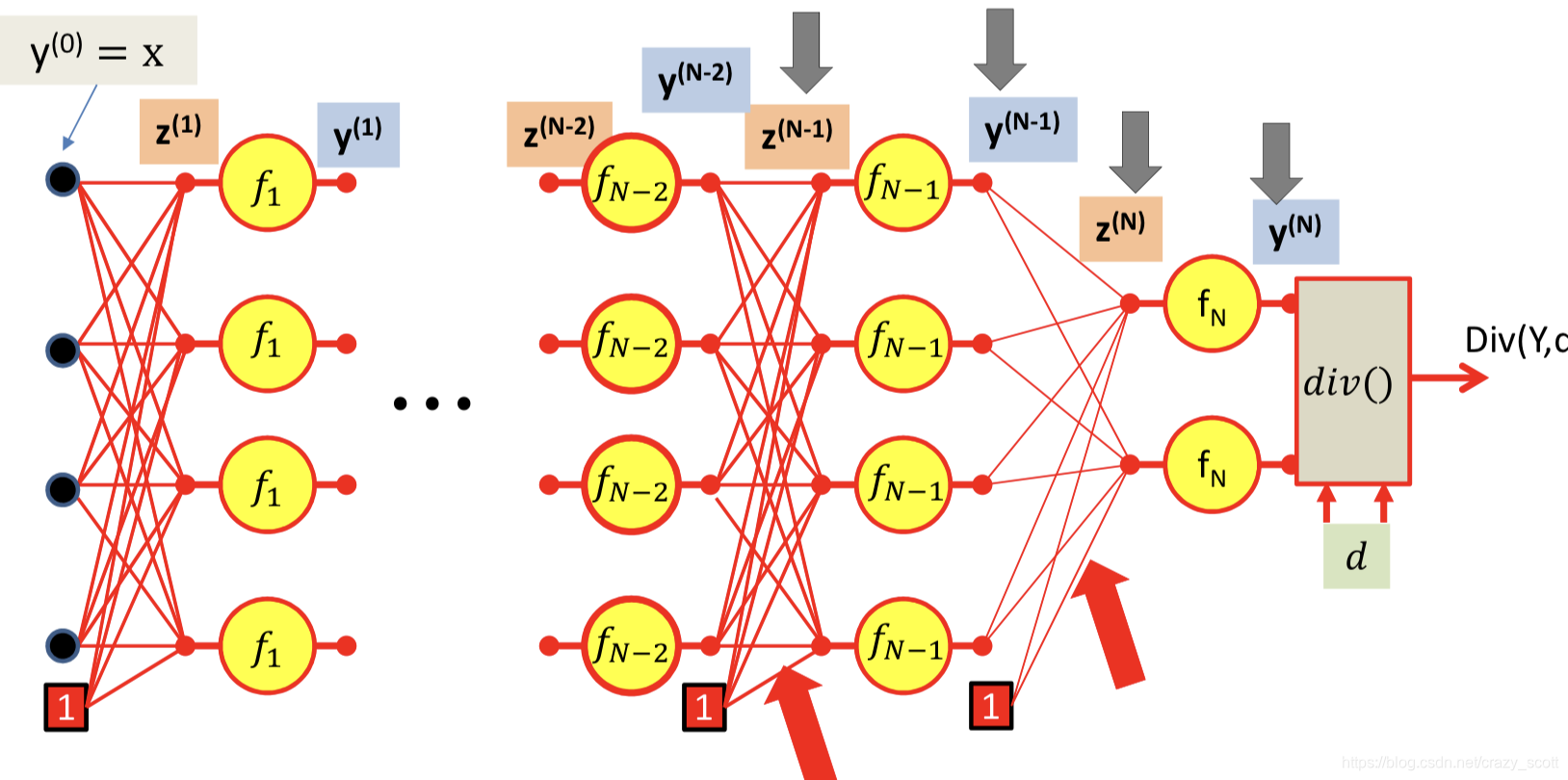
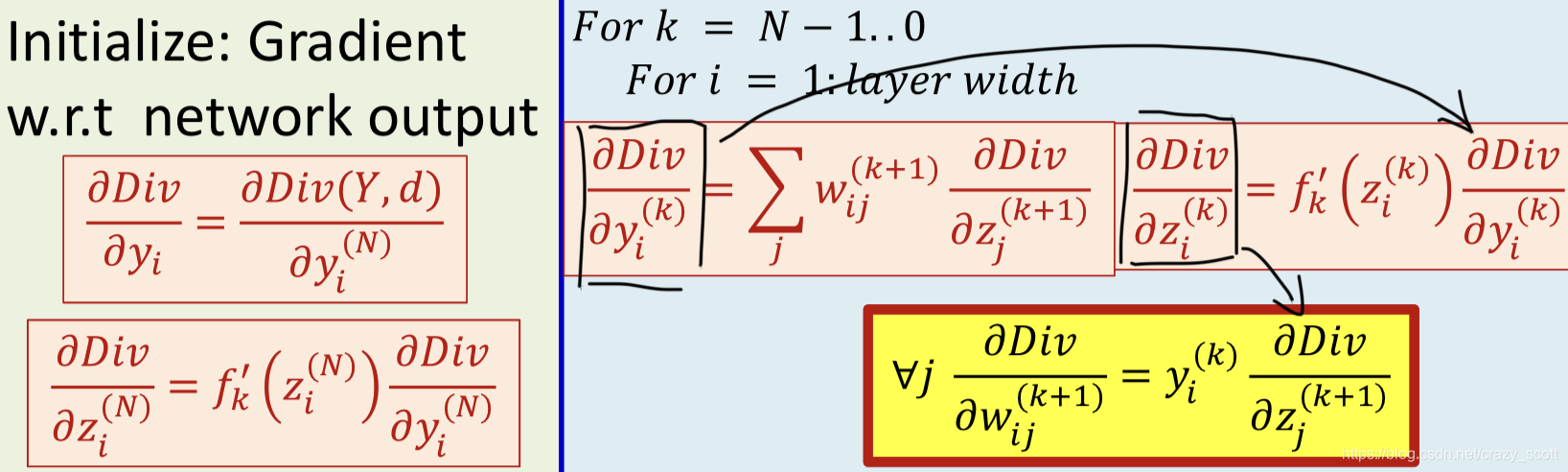
  • For each layer: we caculate ∂Div∂yi\frac{\partial D i v}{\partial y_{i}}∂yi​∂Div​,∂Dicv∂z\frac{\partial Dicv}{\partial z}∂z∂Dicv​, and ∂Div∂wij\frac{\partial Div}{\partial w_{ij}}∂wij​∂Div​

  • For ouput layer

    • It is easy to caculate ∂Div∂yi(N)\frac{\partial D i v}{\partial y_{i}^{(N)}}∂yi(N)​∂Div​
    • So: ∂Div∂zi(N)=fN′(zi(N))∂Div∂yi(N)\frac{\partial D i v}{\partial z_{i}^{(N)}}=f_{N}^{\prime}\left(z_{i}^{(N)}\right) \frac{\partial D i v}{\partial y_{i}^{(N)}}∂zi(N)​∂Div​=fN′​(zi(N)​)∂yi(N)​∂Div​
    • ∂Div∂wij(N)=∂zj(N)∂wij(N)∂Div∂zj(N)\frac{\partial D i v}{\partial w_{ij}^{(N)}}=\frac{\partial z_{j}^{(N)}}{\partial w_{ij}^{(N)}} \frac{\partial D i v}{\partial z_{j}^{(N)}}∂wij(N)​∂Div​=∂wij(N)​∂zj(N)​​∂zj(N)​∂Div​, where ∂zj(N)∂wij(N)=yi(N)\frac{\partial z_{j}^{(N)}}{\partial w_{ij}^{(N)}} = y_i^{(N)}∂wij(N)​∂zj(N)​​=yi(N)​
  • Pass on

    • zj(N)=∑iwij(2)yi(v−1)z_{j}^{(N)}=\sum_{i} w_{i j}^{(2)} y_{i}^{(v-1)}zj(N)​=∑i​wij(2)​yi(v−1)​, so ∂zj(N)∂y1(N−1)=wij(N)\frac{\partial z_{j}^{(N)}}{\partial y_{1}^{(N-1)}} = w_{ij}^{(N)}∂y1(N−1)​∂zj(N)​​=wij(N)​
    • ∂Div∂yi(N−1)=∑jwij(N)∂Div∂zj(N)\frac{\partial D i v}{\partial y_{i}^{(N-1)}}=\sum_{j} w_{i j}^{(N)} \frac{\partial D i v}{\partial z_{j}^{(N)}}∂yi(N−1)​∂Div​=∑j​wij(N)​∂zj(N)​∂Div​
    • ∂Div∂zi(N−1)=fN−1′(zi(N−1))∂Div∂yi(N−1)\frac{\partial D i v}{\partial z_{i}^{(N-1)}}=f_{N-1}^{\prime}(z_{i}^{(N-1)}) \frac{\partial D i v}{\partial y_{i}^{(N-1)}}∂zi(N−1)​∂Div​=fN−1′​(zi(N−1)​)∂yi(N−1)​∂Div​
    • ∂Div∂wij(N−1)=yi(N−2)∂Div∂zj(N−1)\frac{\partial D i v}{\partial w_{i j}^{(N-1)}}=y_{i}^{(N-2)} \frac{\partial D i v}{\partial z_{j}^{(N-1)}}∂wij(N−1)​∂Div​=yi(N−2)​∂zj(N−1)​∂Div​

在这里插入图片描述

在这里插入图片描述

Special case

Vector activations

  • Vector activations: all outputs are functions of all inputs
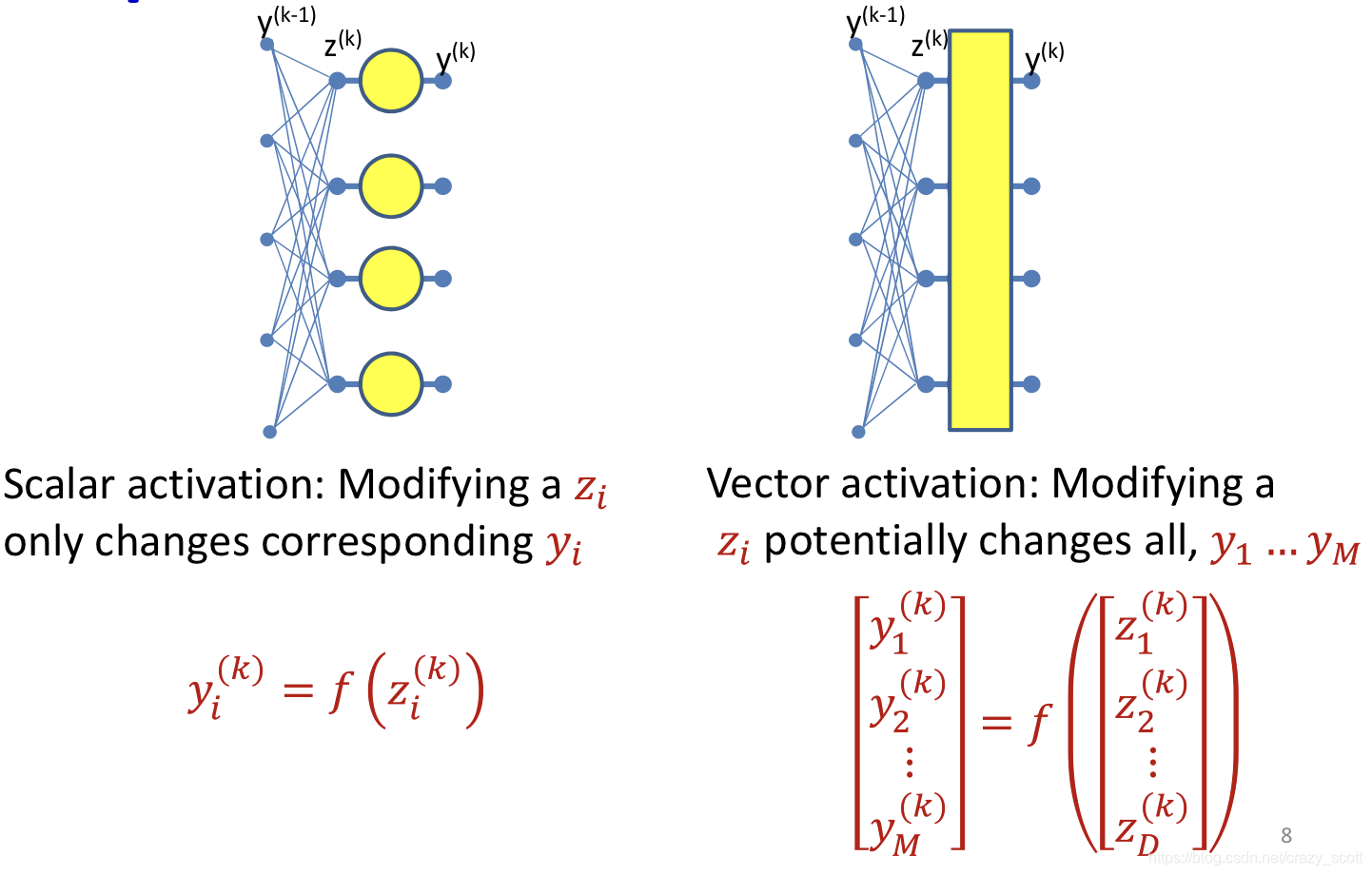
在这里插入图片描述

  • So the derivatives need to change a little

  • ∂Div∂zi(k)=∑j∂Div∂yj(k)∂yj(k)∂zi(k) \frac{\partial D i v}{\partial z_{i}^{(k)}}=\sum_{j} \frac{\partial D i v}{\partial y_{j}^{(k)}} \frac{\partial y_{j}^{(k)}}{\partial z_{i}^{(k)}} ∂zi(k)​∂Div​=j∑​∂yj(k)​∂Div​∂zi(k)​∂yj(k)​​

  • Note: derivatives of scalar activations are just a special case of vector activations:

  • ∂yj(k)∂zi(k)=0 for i≠j \frac{\partial y_{j}^{(k)}}{\partial z_{i}^{(k)}}=0 \text { for } i \neq j ∂zi(k)​∂yj(k)​​=0 for i​=j

  • For example, Softmax:

yi(k)=exp⁡(zi(k))∑jexp⁡(zj(k)) y_{i}^{(k)}=\frac{\exp \left(z_{i}^{(k)}\right)}{\sum_{j} \exp \left(z_{j}^{(k)}\right)} yi(k)​=∑j​exp(zj(k)​)exp(zi(k)​)​

∂Div∂zi(k)=∑j∂Div∂yj(k)∂yj(k)∂zi(k) \frac{\partial D i v}{\partial z_{i}^{(k)}}=\sum_{j} \frac{\partial D i v}{\partial y_{j}^{(k)}} \frac{\partial y_{j}^{(k)}}{\partial z_{i}^{(k)}} ∂zi(k)​∂Div​=j∑​∂yj(k)​∂Div​∂zi(k)​∂yj(k)​​

KaTeX parse error: Got function '\newline' with no arguments as argument to '\left' at position 1: \̲n̲e̲w̲l̲i̲n̲e̲

  • Using Keonecker delta δij=1\delta_{i j}=1δij​=1 if i=j,0i=j, \quad 0i=j,0 if i≠ji \neq ji​=j

∂Div∂zi(k)=∑j∂Div∂yj(k)yi(k)(δij−yj(k)) \frac{\partial D i v}{\partial z_{i}^{(k)}}=\sum_{j} \frac{\partial D i v}{\partial y_{j}^{(k)}} y_{i}^{(k)}\left(\delta_{i j}-y_{j}^{(k)}\right) ∂zi(k)​∂Div​=j∑​∂yj(k)​∂Div​yi(k)​(δij​−yj(k)​)

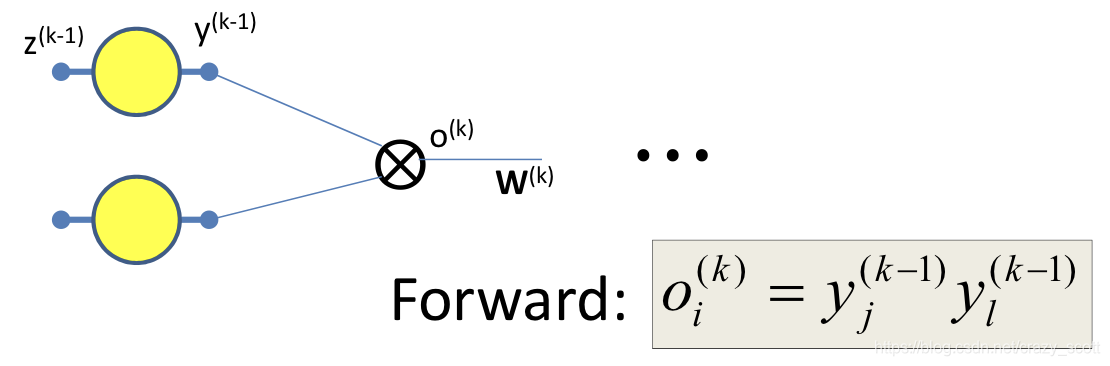
Multiplicative networks

  • Some types of networks have multiplicative combination(instead of additive combination)
  • Seen in networks such as LSTMs, GRUs, attention models, etc.
在这里插入图片描述

  • So the derivatives need to change

∂Div∂oi(k)=∑jwij(k+1)∂Div∂zj(k+1) \frac{\partial D i v}{\partial o_{i}^{(k)}}=\sum_{j} w_{i j}^{(k+1)} \frac{\partial D i v}{\partial z_{j}^{(k+1)}} ∂oi(k)​∂Div​=j∑​wij(k+1)​∂zj(k+1)​∂Div​

∂Div∂yj(k−1)=∂oi(k)∂yj(k−1)∂Div∂oi(k)=yl(k−1)∂Div∂oi(k) \frac{\partial D i v}{\partial y_{j}^{(k-1)}}=\frac{\partial o_{i}^{(k)}}{\partial y_{j}^{(k-1)}} \frac{\partial D i v}{\partial o_{i}^{(k)}}=y_{l}^{(k-1)} \frac{\partial D i v}{\partial o_{i}^{(k)}} ∂yj(k−1)​∂Div​=∂yj(k−1)​∂oi(k)​​∂oi(k)​∂Div​=yl(k−1)​∂oi(k)​∂Div​

  • A layer of multiplicative combination is a special case of vector activation

Non-differentiable activations

  • Activation functions are sometimes not actually differentiable

    • The RELU (Rectified Linear Unit)
      • And its variants: leaky RELU, randomized leaky RELU
    • The “max” function
  • Subgradient

    • (f(x)−f(x0))≥vT(x−x0) \left(f(x)-f\left(x_{0}\right)\right) \geq v^{T}\left(x-x_{0}\right) (f(x)−f(x0​))≥vT(x−x0​)

    • The subgradient is a direction in which the function is guaranteed to increase

    • If the function is differentiable at xxx , the subgradient is the gradient

    • But gradient is not always the subgradient though

Vector formulation

  • Define the vectors:

在这里插入图片描述

Forward pass

在这里插入图片描述

Backward pass

  • Chain rule
    • y=f(g(x))\mathbf{y}=\boldsymbol{f}(\boldsymbol{g}(\mathbf{x}))y=f(g(x))
    • Let z=g(x)z = g(x)z=g(x),y=f(z)y = f(z)y=f(z)
    • So Jy(x)=Jy(z)Jz(x)J_{\mathbf{y}}(\mathbf{x})=J_{\mathbf{y}}(\mathbf{z}) J_{\mathbf{z}}(\mathbf{x})Jy​(x)=Jy​(z)Jz​(x)
  • For scalar functions:
    • D=f(Wy+b)D = f(Wy + b)D=f(Wy+b)
    • Let z=Wy+bz = Wy + bz=Wy+b, D=f(z)D = f(z)D=f(z)
    • ∇xD=∇z(D)Jz(x)\nabla_{x} D = \nabla_z(D)J_z(x)∇x​D=∇z​(D)Jz​(x)
  • So for backward process
    • ∇ZNDiv=∇YDiv∇ZNY\nabla_{Z_N} Div = \nabla_Y Div \nabla_{Z_N}Y∇ZN​​Div=∇Y​Div∇ZN​​Y
    • $\nabla_{y_{N-1}}Div = \nabla_{Z_N} Div \nabla_{y_{N-1}} z_N $
    • ∇WNDiv=yN−1∇ZNDiv\nabla_{W_N} Div = y_{N-1} \nabla_{Z_N} Div∇WN​​Div=yN−1​∇ZN​​Div
    • ∇bNDiv=∇ZNDiv\nabla_{b_N} Div = \nabla_{Z_N} Div∇bN​​Div=∇ZN​​Div
  • For each layer
    • First compute ∇yDiv\nabla_{y} Div∇y​Div
    • Then compute ∇zDiv\nabla_{z}Div∇z​Div
    • Finally ∇WDiv\nabla_{W} Div∇W​Div, ∇WDiv\nabla_{W} Div∇W​Div

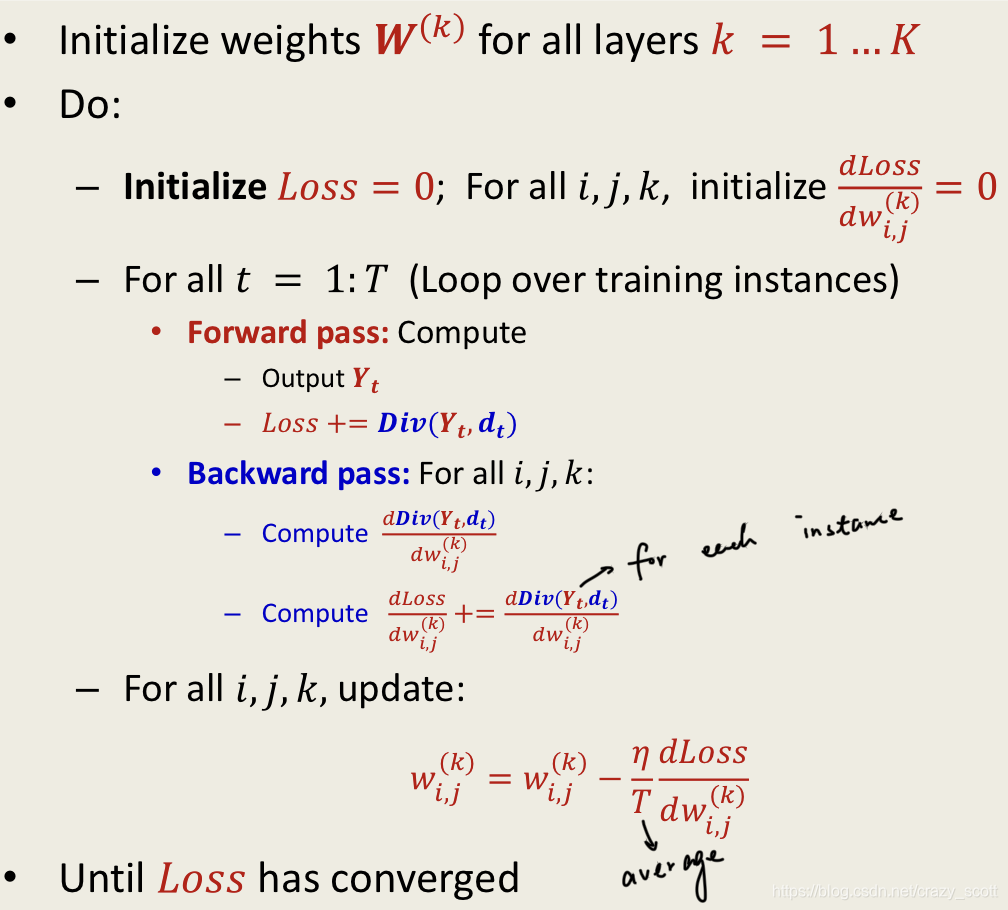
Training

Analogy to forward pass

在这里插入图片描述

CMU11785 Intro2DL HW0p1-fundamentals 1. Colab安装旧版pytorch+numpy:(记得要restart) 2. Colab连接google账号: Google colab使用教学 - xiaowei的文章 - 知乎 https://zhuanlan.zhihu.com/p/367893594 3. numpy&pytorch 1D外积计算: torch没有outer函数,且torch.dot只能对1D进行点乘,1D以上只能使用torch.mm矩阵乘法; 其中,, 输出的维度是。该函数一般只用... 阅读详情

相关推荐

CMU 11-785 L23 Variational Autoencoders

EM for PCA With complete information If we knew zzz for each xxx, estimating AAA and DDD would be simple x=Az+E x=A z+E x=Az+E P(x∣z)=N(Az,D) P(x \mid z)=N(A z, D) P(x∣z)=N(Az,D) Given complete information (x1,z1),(x2,z2)\left(x_{1}, z_{1}\right),\lef

crazy_scott的博客 504

CMU 11-785 recitation numpy操作

import numpy as np ''' https://github.com/cmudeeplearning11785/Spring2019_Tutorials/blob/master/recitation-0/Numpy%20%26%20PyTorch.ipynb 在python中调用numpy package主要是为了实现vectorization向量化的操作 假设现在要实现 y=wx...

WYXHAHAHA123的博客 401

CMU 11-785 L16 Connectionist Temporal Classification

Sequence to sequence Sequence goes in, sequence comes out No notion of “time synchrony” between input and output May even nots maintain order of symbols (from one language to another) With order synchrony The input and output sequences happen in the

crazy_scott的博客 356

Apple Creator Studio:AI驱动的创意套件功能解析与使用指南

Apple Creator Studio 是苹果推出的创意应用套件订阅服务,集成了视频剪辑、音乐制作、图像设计和生产力工具的全家桶解决方案。最新更新重点强化了AI智能功能、跨设备工作流和批量处理能力,让创作者能够在Mac、iPad和iPhone上无缝衔接创作流程。如果你经常需要处理视频、音频或图像内容,这个套件值得重点关注。 这次更新最核心的改进是深度整合了Apple Intelligence智能功能,比如Final Cut Pro的视觉搜索和转录搜索、Pixelmator Pro的智能修图、Logic P

weixin_30326515的博客 6220

stado:cmu11785项目

时空行为检测与遮挡 Pytorch实现。 以(MOC)为骨干。 概述 通过将动作实例视为移动点的轨迹,提出一种新的动作细管检测框架,称为“ MoveCenterCenter检测器”(MOC-detector) 。 MOC检测器被分解为三个关键的头分支: (1)中心分支,例如中心检测和动作识别。 (2)运动分支,用于在相邻帧处估计运动,以形成运动点轨迹。 (3)通过直接回归每个帧的估计中心点处的边界框大小来进行空间范围检测的Box Branch 。 用法 1.安装 请参阅以获取安装说明。 2.数据集 请参阅以获取数据集设置说明。 3.评估 您可以按照的说明评估我们的模型并在原始论文中复制结果。 4.火车 您可以按照的说明来训练我们的模型。 5.可视化 您可以按照的说明获取可视化结果。 参考 来自MOC的骨干码。 来自ACT的数据扩充代码。 ACT的评估代码。 从DLA-34骨架

LiveKit 本地部署实战:从零搭建安全实时通信环境(Caddy+HTTPS)

本文详细介绍了如何从零开始搭建LiveKit本地部署环境,结合Caddy服务器实现HTTPS安全通信。通过环境准备、证书生成、服务配置到前端客户端集成的完整流程,帮助开发者快速构建实时音视频应用,特别适合需要安全实时通信的场景。

weixin_29227585的博客 673

CMU 11-785 recitation python中的list类型操作

import torch import numpy as np ''' https://github.com/cmudeeplearning11785/Spring2019_Tutorials/blob/master/recitation-0/Numpy%20%26%20PyTorch.ipynb http://deeplearning.cs.cmu.edu/ recitation 0 '...

WYXHAHAHA123的博客 317

linux基线检查、基线加固、安全漏扫、系统漏洞、centos7、文尾部附脚本

等保三级-CentOS Linux 7合规基线检查 风险分类:系统-等保三级-CentOS Linux 7合规基线检查 检测项说明: CentOS Linux 7合规基线检查,对标中国等保2.0第三级等级保护基本要求部分检查项目,仅供参考 检查项目 : 应对登录的用户进行身份标识和鉴别,身份标识具有唯一性,身份鉴别信息具有复杂度要求并定期更换 加固建议: 1、执行`cat /etc/shadow | awk -F: '($2 == "" ) { print $1}' `, 查看空密码账户并处理; 2、

swindy博客 5622

深度学习BP算法 BackPropagation以及详细例子解析

反向传播算法是多层神经网络的训练中举足轻重的算法,本文着重讲解方向传播算法的原理和推导过程。因此对于一些基本的神经网络的知识,本文不做介绍。在理解反向传播算法前,先要理解神经网络中的前馈神经网络算法。 前馈神经网络 如下图,是一个多层神经网络的简单示意图:    给定一个前馈神经网络,我们用下面的记号来描述这个网络:  L:表示神经网络的层数;  nl:表示第l层神经元的个数;

win_in_action的专栏 1万+

如何在windows电脑上搭建Linux环境(手把手教安装虚拟机软件和使用云服务器)

手把手教学如何搭建Linux环境

纪宁的博客 1万+

视频动作识别、行为识别、时空动作检测数据集整理(持续更新)

动作、行为、事件 在计算机视觉的相关研究中,人体的动作、行为识别是一个基础研究问题。但目前识别、检测人类的动作/行为仍然是一个巨大的挑战。这里整理下当前相关的细分任务、数据集和开源代码(持续更新中)。

人工智能算法与工程实践 3万+

CMU 11-785 L13 Recurrent Networks

Modelling Series In many situations one must consider a series of inputs to produce an output Outputs too may be a series Finite response model Can use convolutional neural net applied to series data (slide) Also called a Time-Delay neural network

crazy_scott的博客 382

论文解读——YOLOv11(目标检测)

YOLOv11提供了多种型号和功能,以满足不同应用场景的需求。对象检测对象检测是YOLOv11的基本功能之一。在训练时,YOLOv11能够检测图像中的对象,并输出对象的边界框和类别信息。这一功能在自动驾驶、智能安防等领域具有广泛应用。图像分割图像分割是YOLOv11的另一个重要功能。与对象检测不同,图像分割不仅检测对象的边界框,还能够对图像中的对象进行像素级别的分割。这使得YOLOv11在医疗影像分析、工业制造等领域具有更高的应用价值。姿态检测姿态检测是YOLOv11的一个独特功能。

qq_38220914的博客 4457

Backpropagation

Source: https://en.wikipedia.org/wiki/Backpropagation Backpropagation From Wikipedia, the free encyclopedia This article is about the computer algorithm. For the biological process, s

omnispace的博客 1922

MATLAB库函数unwrap(相位解卷绕)的C语言实现

什么是相位解卷绕 Q = unwrap(P) Q = unwrap(P) corrects the radian phase angles in a vector P by adding multiples of ±2π when absolute jumps between consecutive elements of P are greater than or equal to the default jump tolerance of π radians. If P is a matrix, unw

业精于勤,荒于嬉 4247

2026 企查查/天眼查:IP频率限制 + 验证码策略,企业工商数据采集实战

企业工商数据采集技术解析与解决方案 本文深度剖析了2026年企查查和天眼查平台的反爬机制与技术对抗方案。主要内容包括: 反爬机制分析: 采用JA4+ TLS指纹识别、极验v6验证码等多层防护 IP限制策略严格区分未登录/普通/VIP账号 精准识别并封禁数据中心IP 核心解决方案: 构建高可用住宅代理池,动态轮换真实用户IP 基于YOLOv8的验证码缺口识别技术(准确率99%) 分布式架构设计,支持千万级数据采集 多账号池管理与行为模拟技术 技术亮点: 动态住宅IP池实现1%以下封禁率 Playwright浏

专注于Python爬虫开发,分享爬虫技巧、项目实战与反爬经验,使用Scrapy、BeautifulSoup等工具,解决数据抓取难题。 1323

CMU 11-785 L19 Hopfield network

Hopfield Net So far, neural networks for computation are all feedforward structures Loopy network Each neuron is a perceptron with +1/-1 output Every neuron receives input from every other neuron Every neuron outputs signals to every other neuron

crazy_scott的博客 337

[AI] 本地部署 Dify 遇到 Internal Error?一文彻底解决密码不一致引发的问题

摘要:Dify本地部署常见InternalError错误主要由配置残留或密码不一致导致,特别是修改.env文件后未同步清除数据库记录。彻底解决方案包括:1)清理Docker数据;2)删除旧配置和数据库;3)还原源代码;4)重建.env文件;5)重新初始化部署。关键提醒:记录部署路径、备份.env文件并妥善保存密码。该错误本质是配置冲突,最有效方法是完全重置而非调试,保持清晰的部署管理可避免多数InternalError问题。(149字)

技术小甜甜:传播可落地技术,帮助个人和企业降低解决真实场景问题的成本 432

CMU 11-785 L14 Stability analysis and LSTMs

Stability Will this necessarily be「Bounded Input Bounded Output」? Guaranteed if output and hidden activations are bounded But will it saturate? Analyzing Recursion Sufficient to analyze the behavior of the hidden layer since it carries the relevant

crazy_scott的博客 569

数学建模模型总结

这是本人在两年内准备参加数学建模竞赛搜集到的模型资料,已经经过了本人的筛选和整理,希望能够对准备参加数学建模竞赛的学弟学妹们提供一些帮助!

STM32F407中文手册

STM32f407中文手册 本参考手册面向应用开发人员,提供有关使用 STM32F405xx/07xx、STM32F415xx/17xx、 STM32F42xxx 和 STM32F43xxx 微控制器存储器与外设的完整信息。STM32F405xx/07xx、STM32F415xx/17xx、STM32F42xxx 和 STM32F43xxx 构成一个微 控制器系列,各产品具有不同的存储器大小、封装和外设。有关订购信息以及器件的机械与电气特性,请参见数据手册。有关 ARM Cortex™-M4F 内核的信息,请参见《Cortex™-M4F 技术参考手册》。

CMU 11-785 L21 Boltzmann machines2

The Hopfield net as a distribution The Helmholtz Free Energy of a System At any time, the probability of finding the system in state sss at temperature TTT is PT(s)P_T(s)PT​(s) At each state it has a potential energy EsE_sEs​ The internal energy of t

crazy_scott的博客 541

android 蓝牙通讯demo

android 下蓝牙通讯demo,实现了发现蓝牙,使能蓝牙,通过蓝牙发送消息。

CMU 11-785 L12 Back propagation through a CNN

Convolution Each position in zzz consists of convolution result in previous map Way for shrinking the maps Stride greater than 1 Downsampling (not necessary) Typically performed with strides > 1 Pooling Maxpooling Note: keep tracking of loc

crazy_scott的博客 501

华为的C语言编程规范.pdf

华为技术有限公司内部技术规范。本规范制定了编写C语言程序的基本原则、规则和建议。从代码的清晰、简洁、可测试、安全、程序效率、可移植各个方面对C语言编程作出了具体指导。

CMU 11-785 L15 Divergence of RNN

Variants on recurrent nets Architectures How to train recurrent networks of different architectures Synchrony The target output is time-synchronous with the input The target output is order-synchronous, but not time synchronous One to one No rec

crazy_scott的博客 481

CMU 11-785 L02 What can a network represent

Preliminary Perceptron Threshold unit “Fires” if the weighted sum of inputs exceeds a threshold Soft perceptron Using sigmoid function instead of a threshold at the output Activation: The functio...

crazy_scott的博客 386

CMU 11-785 L06 Optimization

Problems Decaying learning rates provide googd compromise between escaping poor local minima and convergence Many of the convergence issues arise because we force the same learning rate on all parame...

crazy_scott的博客 377

CMU 11-785 L09 Cascade-Correlation and Deep Learning

Cascade-Correlation Algorithm Start with direct I/O connections only. No hidden units. Train output-layer weights using BP or Quickprop. If error is now acceptable, quit. Else, Create one new hidden unit offline. Create a pool of candidate units. Each ge

crazy_scott的博客 366

CMU 11-785 L17 Seq2seq and attention model

Generating Language Synthesis Input: symbols as one-hot vectors Dimensionality of the vector is the size of the 「vocabulary」 Projected down to lower-dimensional “embeddings” The hidden units are (one or more layers of) LSTM units Output at each time:

crazy_scott的博客 335
上一篇: CMU 11-785 L03 Learning the network
下一篇: CMU 11-785 L03.5 A brief note on derivatives
zealscott
博客等级 码龄9年 327粉丝 196原创
评论
成就一亿技术人!
拼手气红包6.0元
还能输入1000个字符
 
 条评论被折叠 查看
添加红包

请填写红包祝福语或标题

个

红包个数最小为10个

元

红包金额最低5元

当前余额3.43元 前往充值 >
需支付:10.00元
成就一亿技术人!
领取后你会自动成为博主和红包主的粉丝 规则
hope_wisdom
发出的红包
实付元
使用余额支付
点击重新获取
扫码支付
钱包余额 0

抵扣说明:

1.余额是钱包充值的虚拟货币,按照1:1的比例进行支付金额的抵扣。
2.余额无法直接购买下载,可以购买VIP、付费专栏及课程。

余额充值