



Example 1: The unit complex numbers group S^1
Our first example of Lie group, which is the easiest to visualize, is the group of unit complex numbers under complex multiplication (Fig. 3). Unit complex numbers take the form z = cos θ + isin θ.
– Action: Vectors x = x + iy rotate in the plane by an angle θ, through complex multiplication, x0 = zx.
– Group facts: The product of unit complex numbers is a unit complex number, the identity is 1, and the inverse is the conjugate z∗.
– Manifold facts: The unit norm constraint defines the unit circle in the complex plane (which can be viewed as the 1-sphere, and hence the name S1). This is a 1-DoF curve in 2-dimensional space. Unit complex numbers evolve with time on this circle. The group (the circle) ressembles the linear space (the tangent line) locally, but not globally.
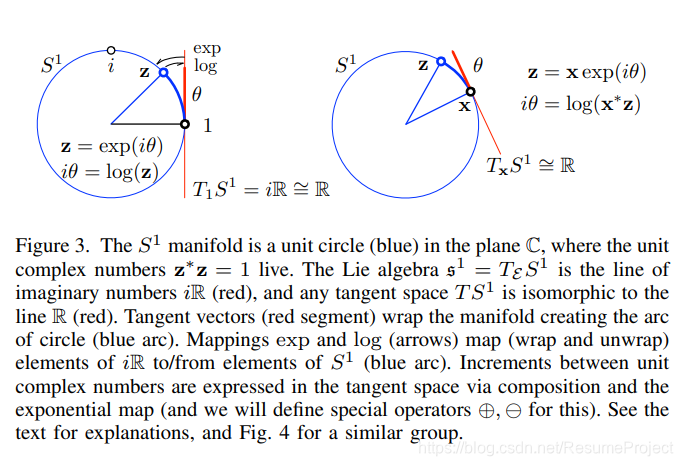
S1流形是平面C中的单位圆(蓝色),其中单位复数z∗z=1活。李代数s1=TES1是虚数线iR(红色),任何切空间TS1与线R(红色)同构。切线向量(红色段)包裹流形创建圆弧(蓝色弧)。映射exp和log(箭头)将iR的元素映射(包裹和展开)到/来自S1(蓝色弧线)的元素。单位复数之间的增量通过复合指数映射在切线空间中表示(为此我们将定义特殊运算符⊕和⊝)。解释见正文,类似组见图4。\tiny S^1 流形是平面 C 中的单位圆(蓝色),其中单位
复数 z^∗z = 1 活。 李代数 s^1 = T_ES^1 是虚数线 iR(红色),任何切空间 T S1 与线 R(红色)同构。 \\切线向量(红色段)包裹流形创建圆弧(蓝色弧)。 映射 exp 和 log(箭头)将 iR 的元素映射(包裹和展开)到/来自 S1(蓝色弧线)的元素。\\ 单位复数之间的增量通过复合指数映射在切线空间中表示(为此我们将定义特殊运算符⊕和\circleddash)。 解释见正文,类似组见图4。 S1流形是平面C中的单位圆(蓝色),其中单位复数z∗z=1活。李代数s1=TES1是虚数线iR(红色),任何切空间TS1与线R(红色)同构。切线向量(红色段)包裹流形创建圆弧(蓝色弧)。映射exp和log(箭头)将iR的元素映射(包裹和展开)到/来自S1(蓝色弧线)的元素。单位复数之间的增量通过复合指数映射在切线空间中表示(为此我们将定义特殊运算符⊕和⊝)。解释见正文,类似组见图4。
我们最容易形象化的李群的第一个例子是复数乘法下的单位复数群(图 3)。 单位复数采用 z = cos θ + isin θ 的形式。
– Action:向量 x = x + iy 在平面中旋转角度 θ,通过复数乘法,x0 = zx。
– Group facts:单位复数的乘积为单位复数,单位为1,逆为共轭z∗。
– Manifold facts:单位范数约束定义了复平面中的单位圆(可以将其视为 1 球体,因此得名 S1)。 这是二维空间中的 1-DoF 曲线。 单位复数在这个圆上随时间演变。 该群(圆)在局部类似于线性空间(切线),但在全局上不相似。
Example 2: The unit quaternions group S3S^3S3
quaternion multiplication (Fig. 4).
Unit quaternions take the form q = cos(θ/2) + u sin(θ/2), with u = iux +juy + kuz a unitary axis and θ a rotation angle.
– Action: Vectors x = ix + jy + kz rotate in 3D space by an angle θ around the unit axis u through the double quaternion product x’ = q x q∗
– Group facts: The product of unit quaternions is a unit quaternion, the identity is 1, and the inverse is the conjugate q∗
– Manifold facts: The unit norm constraint defines the 3-sphere S^3
, a spherical 3-dimensional surface or manifold in 4-dimensional space. Unit quaternions evolve with time on this surface. The group (the sphere) ressembles the linear space (the tangent hyperplane R
3 ⊂ R4)locally, but not globally.
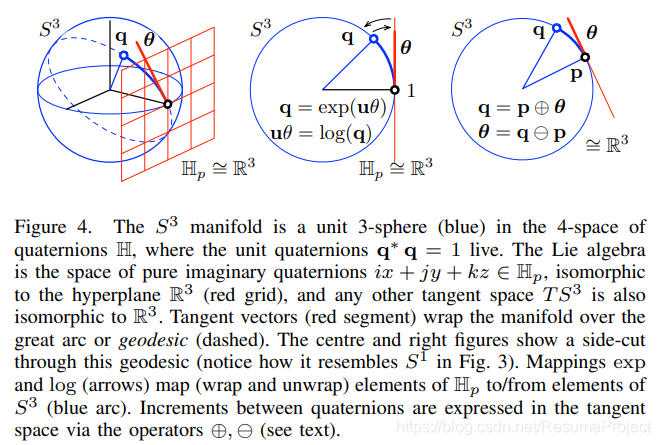
四元数乘法(图4)。
单位四元数的形式为 q = cos(θ/2) + u sin(θ/2),其中 u = iux +juy + kuz 是单一轴,θ 是旋转角。
– 动作:向量 x = ix + jy + kz 在 3D 空间中通过双四元数积 x’ = q x q∗ 围绕单位轴 u 旋转角度 θ
– Group Facts:单位四元数的乘积为单位四元数,恒等式为1,逆为共轭q∗
– 流形事实:单位范数约束定义了 3 球体 S^3
,球面 3 维表面或 4 维空间中的流形。 单位四元数在这个表面上随时间演变。 群(球体)类似于线性空间(切线超平面 R
3 ⊂ R4) 局部,但不是全局。





 扫一扫
扫一扫


 被折叠的 条评论
为什么被折叠?
被折叠的 条评论
为什么被折叠?
 到【灌水乐园】发言





