



参考文章:
委托简介
委托本质上是一个函数指针的封装,它可以绑定一个函数,之后在某个时刻调用这个函数。
主要作用是将实时监测的逻辑转换为触发式逻辑,同时降低代码之间的耦合性
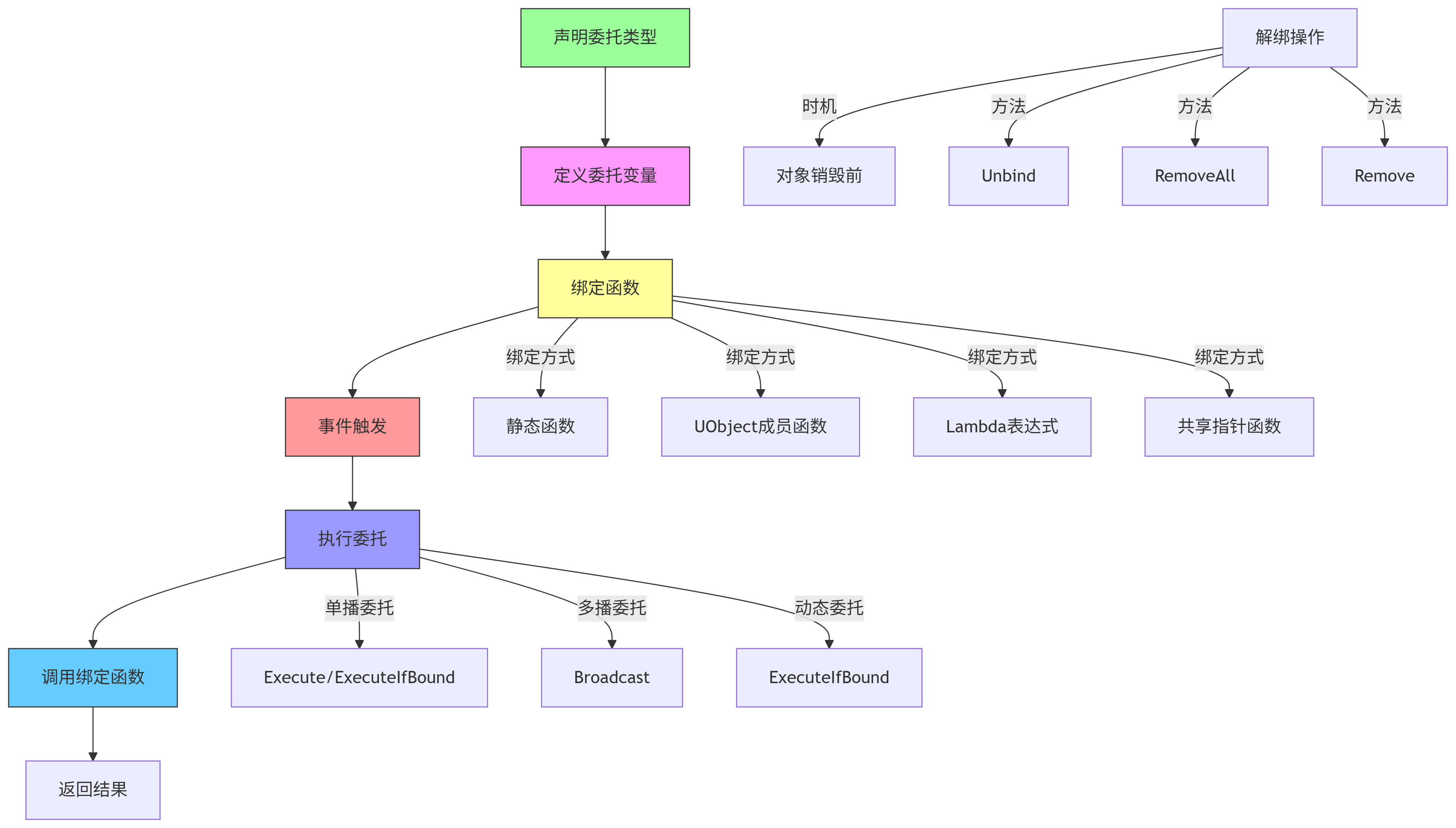
常用的委托有单播、多播、动态多播和事件等;
上述委托的概念不在赘述,详细请参考UE官方文档和一文理解透UE委托Delegate以及上面提及的视频连接
委托的使用
由于每种委托的使用方法几乎一样,在此只使用单播作为介绍委托的使用。
委托使用的原理
下图是委托的整个事件类型
下图是使用委托的三个基本类
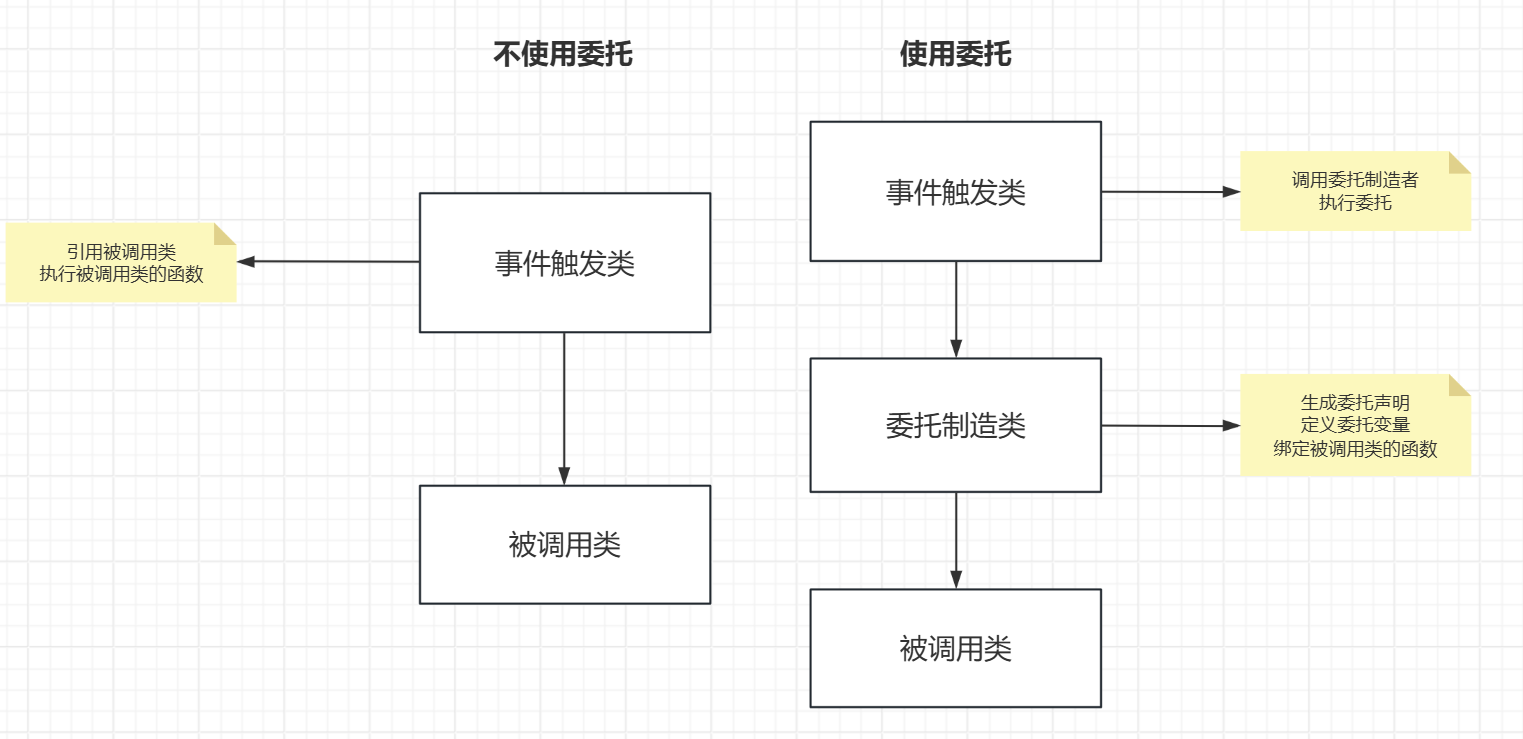
从上图可以看到,使用委托和不使用委托的区别,使用委托可以降低事件触发类和被调用类之间的耦合,将这两个类的操作放在委托制造类里面进行操作,这对于大型项目十分重要。
这里做个比喻就是:你点了一家饭店的吃饭,你要吃的饭汇报给饭店,饭店指定厨师做饭并将饭端给你。这里的你就是事件触发类,饭店就是委托制造类,厨师就是被调用类。
代码实现
这里的代码修改了 UEC++实现人物按照A星路线移动 里面的算法,有需要可以去参考
事件触发类
AStar_test2Character.h
// 获取委托
UMyDelegateMaker* Maker;
AStar_test2Character.cpp
void AAStar_test2Character::SpineSet()
{
	UWorld* World = GetWorld();
	if (Maker == nullptr)
	{
		Maker = NewObject<UMyDelegateMaker>();
	}
    // 绑定并执行委托
	Maker->BindSpineSet(World).Execute();

}

void AAStar_test2Character::AIMove()
{
	UE_LOG(LogTemp, Warning, TEXT("按下3,开始执行AIMOVE"));
	UWorld* World = GetWorld();
	if (!World) return;

	if (Maker == nullptr)
	{
		Maker = NewObject<UMyDelegateMaker>();
	}
    // 绑定并执行委托
	Maker->BindAIMove(World).Execute();
}
委托制造类(重点)
MyDelegateMaker.h
// Fill out your copyright notice in the Description page of Project Settings.

#pragma once

#include "CoreMinimal.h"
#include "UObject/NoExportTypes.h"
#include "MyDelegateMaker.generated.h"

// 声明 委托/代理 类型
DECLARE_DELEGATE(FDelegateNoParam)
/**
 *
 */
UCLASS()
class ASTAR_TEST2_API UMyDelegateMaker : public UObject
{
	GENERATED_BODY()

public:
    //定义委托变量
	FDelegateNoParam Delegate;
	FDelegateNoParam Delegate_AIMove;

    // 绑定委托函数

	// 绑定样条点设置 由于委托类并不存在于真实蓝图世界中,故其需要外部传入的world
	FDelegateNoParam& BindSpineSet(UWorld*  World);
	// 绑定AI移动
	FDelegateNoParam& BindAIMove(UWorld*  World);

	class ASpine* USpineRef = nullptr;

	class AMyAIController* AIControllerRef = nullptr;

};
MyDelegateMaker.cpp
#include "MyDelegateMaker.h"

#include "EngineUtils.h"
#include "MyAIController.h"
#include "Spine.h"
#include "Kismet/GameplayStatics.h"

FDelegateNoParam& UMyDelegateMaker::BindSpineSet(UWorld*  World)
{
	// 若已经绑定,则解绑
	if (Delegate.IsBound())
	{
		Delegate.Unbind();
	}

    //
	if (USpineRef == nullptr)
	{
		if(World == nullptr)  {
			UE_LOG(LogTemp, Error, TEXT("World is nullptr"));
		}
		else
		{
			for (TActorIterator<ASpine> It(World); It; ++It)
			{
				USpineRef = *It;
				// 可添加if判断是否满足条件
			}
		}

	}
    // 绑定函数
	Delegate.BindUObject(USpineRef, &ASpine::setSpine);

	return Delegate;
}

FDelegateNoParam& UMyDelegateMaker::BindAIMove(UWorld* World)
{
	if (Delegate.IsBound())
	{
		Delegate.Unbind();
	}

	if (AIControllerRef == nullptr)
	{
		if (World)
		{
			for (TActorIterator<AMyAIController> It(World); It; ++It)
			{
				AIControllerRef = *It;
			}
			Delegate_AIMove.BindUObject(AIControllerRef, &AMyAIController::goAIMove);
		}
	}

	return Delegate_AIMove;
}
被调用类
该类中的方法主要是依据A星路线动态生成样条点,可以掠过不看,注意使用方法即可
Spine.h
	// 创建样条点路径
	UFUNCTION()
	void setSpine() const;
Spine.cpp
// 创建样条点路径
void ASpine::setSpine() const
{
	UWorld* World = GetWorld();

	// 获取样条组件
	USplineComponent* SplineComp = this -> FindComponentByClass<USplineComponent>();
	if (!SplineComp) return;

	// 获取样条点数组中所有点的位置
	APlayerController* PlayerController = UGameplayStatics::GetPlayerController(World, 0);
	if (!PlayerController) return;
	AAStar_test2Character* Character = Cast<AAStar_test2Character>(PlayerController->GetPawn());
	if (!Character) return;
	TArray<FVector> Vectors = Character->AllPositions;

	// 遍历所有位置并添加样条点
	for (const FVector& Position : Vectors)
	{
		SplineComp->AddSplinePoint(Position, ESplineCoordinateSpace::World);
	}

	// 更新样条
	SplineComp->UpdateSpline();

}





 扫一扫
扫一扫


 1477
1477

 被折叠的 条评论
为什么被折叠?
被折叠的 条评论
为什么被折叠?
 到【灌水乐园】发言





