



 这篇博客详细介绍了1-D脉冲耦合神经网络(Pulse-Coupled Neural Network, PCNN)的实现过程,通过Matlab代码展示了如何计算各个状态变量的变化,并提供了初始化参数和仿真结果。作者分享了PCNN在图像分割压缩编码中的应用实例,适合对神经网络和信号处理感兴趣的读者。
1 简介


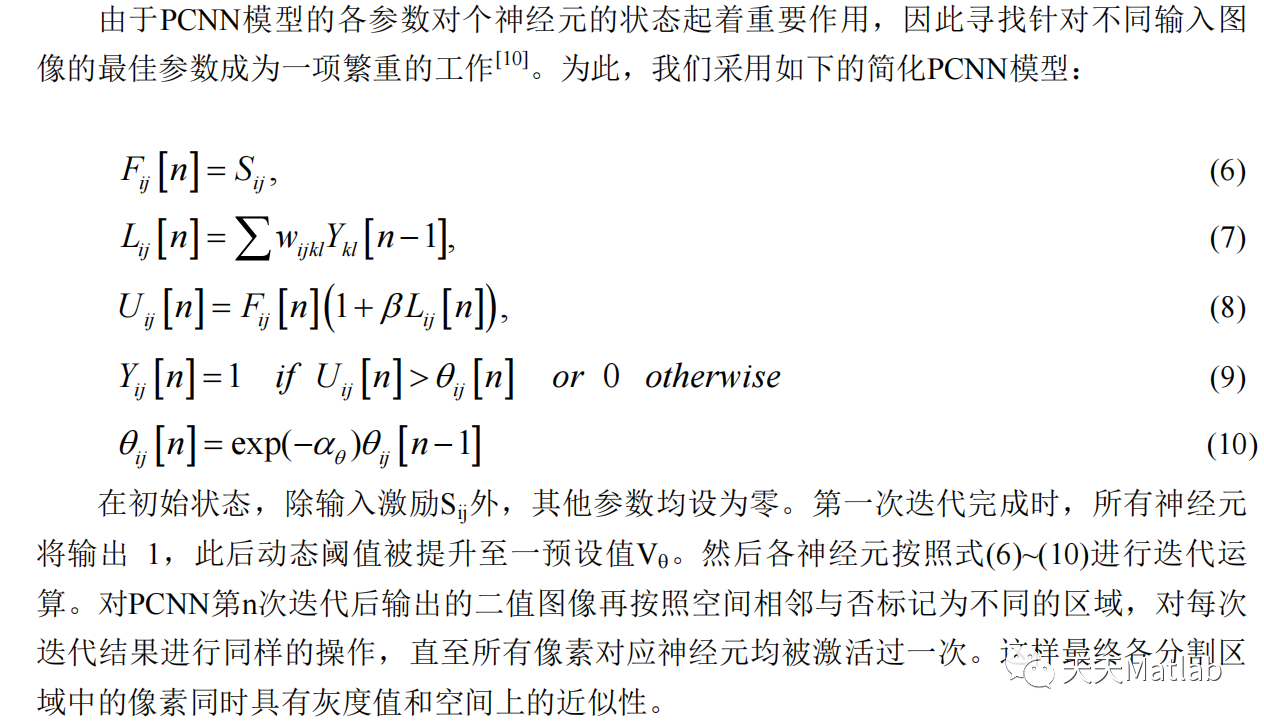
2 部分代码
% The PCNN 1-D demo code was written by Kun Zhan% $Revision: 1.0.0.0 $ $Date: 2016/03/25 $ 20:25:48 $% Reference:% K Zhan, J Shi, H Wang, Y Xie, Q Li,% "Computational Mechanisms of% Pulse-Coupled Neural Networks: A Comprehensive Review,"% Archives of Computational Methods in Engineering, 2016.clearT = 40;s = [0.5 0.35 0.5 0.8 0.63 0.5 0.99];[~, n] = size(s);Y = zeros(T+1,n); F = Y; L = F; E = F + 1; U = F;for t = 1:T;K = conv(Y(t,:),[0.707 1 0.707],'same');F(t+1,:) = exp(-0.2).*F(t,:) + 0.1*K + s;L(t+1,:) = exp(-0.5).*L(t,:) + 0.2.*K;U(t+1,:) = F(t+1,:).*(1+0.5*L(t+1,:));E(t+1,:) = exp(-0.2).*E(t,:) + 6.*Y(t,:);Y(t+1,:) = double(U(t+1,:)>E(t+1,:));endt = [0:1:T];c = (n+1)./2;figure(1)plot(t,E(:,c),'k-d',...t,U(:,c),'b-s',...t,F(:,c),'g*-',...t,L(:,c),'m+-')axis square, axis([0 40 0 15])h = legend('$\Theta_{ij}(n)$','$U_{ij}(n)$',...'$F_{ij}(n)$','$L_{ij}(n)$',1);set(h,'Interpreter','latex')title('$f=0.8,g=0.8,\Theta_{ij}(0)=1, U_{ij}(0)=0,\forall i,j$','Interpreter','latex')xlabel('Iterative time \it{n}')figure(2),stem(t,Y(:,c))axis([0 40 0 1.2])
3 仿真结果

4 参考文献
[1]马义德, 钱志柏, 史飞,等. 基于PCNN的分割图像压缩编码[J]. 2004.
博主简介:擅长智能优化算法、神经网络预测、信号处理、元胞自动机、图像处理、路径规划、无人机等多种领域的Matlab仿真,相关matlab代码问题可私信交流。
部分理论引用网络文献,若有侵权联系博主删除。





 扫一扫
扫一扫


 822
822

 被折叠的 条评论
为什么被折叠?
被折叠的 条评论
为什么被折叠?
 到【灌水乐园】发言





