



1 简介
大容量、高速率的信息传输需求极大地推动了认知无线电领域的技术发展,其中,复杂电磁环境中信道均衡及通信调制类型识别技术,是该领域重要组成之一。传统的均衡处理主要是利用梯度下降法逼近信道特征,在时域或频域对信号进行逆卷积运算,以抑制信道干扰和畸变,改善系统响应;而传统的调制识别方法主要通过提取信号的专家特征,选择合适的分类器进行识别。近年来,许多先进的卷积神经网络架构及优化算法相继提出,深度学习在多个领域都取得了突破性的成果。基于卷积神经网络对原始输入的抽象特征学习能力,本文对其在信号去噪、信道均衡及调制识别等方面的应用进行了深入研究。
2 部分代码
classdef helperModClassFrameStore < handle%helperModClassFrameStore Manage data for modulation classification% FS = helperModClassFrameStore creates a frame store object, FS, that% stores the complex baseband signals in a format usable in machine% learning algorithms.%% FS = helperModClassFrameStore(MAXFR,SPF,LABELS) creates a frame store% object, FH, with the maximum number of frames, MAXFR, samples per% frame, SPF, and expected labels, LABELS.%% Methods:%% add(FS,FRAMES,LABEL) adds frame(s), FRAMES, with label, LABEL, to the% frame store.%% [FRAMES,LABELS] = get(FS) returns stored frames and corresponding% labels from frame store, FS.%% See also ModulationClassificationWithDeepLearningExample.propertiesOutputFormat = FrameStoreOutputFormat.IQAsRowsendproperties (SetAccess=private)%NumFrames Number of frames in the frame storeNumFrames = 0%MaximumNumFrames Capacity of frame storeMaximumNumFrames%SamplesPerFrame Samples per frameSamplesPerFrame%Labels Set of expected labelsLabelsendproperties (Access=private)FramesLabelendmethodsfunction obj = helperModClassFrameStore(varargin)%helperModClassFrameStore Store complex I/Q frames% FS = helperModClassFrameStore(MAXFR,SPF,LABELS) returns a frame% store object, FS, to store complex I/Q baseband frames of type% LABEL with frame size of SPF. Frame are stored as a% [SPFxNUMFRAMES] array.inputs = inputParser;addRequired(inputs, 'MaximumNumFrames')addRequired(inputs, 'SamplesPerFrame')addRequired(inputs, 'Labels')parse(inputs, varargin{:})obj.SamplesPerFrame = inputs.Results.SamplesPerFrame;obj.MaximumNumFrames = inputs.Results.MaximumNumFrames;obj.Labels = inputs.Results.Labels;obj.Frames = ...zeros(obj.SamplesPerFrame,obj.MaximumNumFrames);obj.Label = repmat(obj.Labels(1),obj.MaximumNumFrames,1);endfunction add(obj,frames,label,varargin)%add Add baseband frames to frame store% add(FS,FRAMES,LABEL) adds frame(s), FRAMES, with label, LABEL, to% frame store FS.numNewFrames = size(frames,2);if (~isscalar(label) && numNewFrames ~= length(label)) ...&& (size(frames,1) ~= obj.SamplesPerFrame)error(message('comm_demos:helperModClassFrameStore:MismatchedInputSize'));end% Add framesstartIdx = obj.NumFrames+1;endIdx = obj.NumFrames+numNewFrames;obj.Frames(:,startIdx:endIdx) = frames;% Add labels typesif all(ismember(label,obj.Labels))obj.Label(startIdx:endIdx,1) = label;elseerror(message('comm_demos:helperModClassFrameStore:UnknownLabel',...label(~ismember(label,obj.Labels))))endobj.NumFrames = obj.NumFrames + numNewFrames;endfunction [frames,labels] = get(obj)%get Return frames and labels% [FRAMES,LABELS]=get(FS) returns the frames and corresponding% labels in the frame store, FS.%% If OutputFormat is IQAsRows, then FRAMES is an array of size% [2xSPFx1xNUMFRAMES], where the first row is the in-phase% component and the second row is the quadrature component.%% If OutputFormat is IQAsPages, then FRAMES is an array of size% [1xSPFx2xNUMFRAMES], where the first page (3rd dimension) is the% in-phase component and the second page is the quadrature% component.switch obj.OutputFormatcase FrameStoreOutputFormat.IQAsRowsI = real(obj.Frames(:,1:obj.NumFrames));Q = imag(obj.Frames(:,1:obj.NumFrames));I = permute(I,[3 1 4 2]);Q = permute(Q,[3 1 4 2]);frames = cat(1,I,Q);case FrameStoreOutputFormat.IQAsPagesI = real(obj.Frames(:,1:obj.NumFrames));Q = imag(obj.Frames(:,1:obj.NumFrames));I = permute(I,[3 1 4 2]);Q = permute(Q,[3 1 4 2]);frames = cat(3,I,Q);endlabels = obj.Label(1:obj.NumFrames,1);endfunction [fsTraining,fsValidation,fsTest] = ...splitData(obj,splitPercentages)%splitData Split data into training, validation and test% [FSTRAIN,FSVALID,FSTEST]=splitData(FS,PER) splits the stored% frames into training, validation, and test groups based on the% percentages, PER. PER is a three-element vector,% [PERTRAIN,PERVALID,PERTEST], which specifies training,% validation, and test percentages. FSTRAIN, FSVALID, and FSTEST% are the frame stores for training, validation, and test frames.fsTraining = helperModClassFrameStore(...ceil(obj.MaximumNumFrames*splitPercentages(1)/100), ...obj.SamplesPerFrame, obj.Labels);fsValidation = helperModClassFrameStore(...ceil(obj.MaximumNumFrames*splitPercentages(2)/100), ...obj.SamplesPerFrame, obj.Labels);fsTest = helperModClassFrameStore(...ceil(obj.MaximumNumFrames*splitPercentages(3)/100), ...obj.SamplesPerFrame, obj.Labels);for modType = 1:length(obj.Labels)rawIdx = find(obj.Label == obj.Labels(modType));numFrames = length(rawIdx);% First shuffle the framesshuffleIdx = randperm(numFrames);frames = obj.Frames(:,rawIdx);frames = frames(:,shuffleIdx);numTrainingFrames = round(numFrames*splitPercentages(1)/100);numValidationFrames = round(numFrames*splitPercentages(2)/100);numTestFrames = round(numFrames*splitPercentages(3)/100);extraFrames = sum([numTrainingFrames,numValidationFrames,numTestFrames]) - numFrames;if (extraFrames > 0)numTestFrames = numTestFrames - extraFrames;endadd(fsTraining, ...frames(:,1:numTrainingFrames), ...obj.Labels(modType));add(fsValidation, ...frames(:,numTrainingFrames+(1:numValidationFrames)), ...obj.Labels(modType));add(fsTest, ...frames(:,numTrainingFrames+numValidationFrames+(1:numTestFrames)), ...obj.Labels(modType));end% Shuffle new frame storesshuffle(fsTraining);shuffle(fsValidation);shuffle(fsTest);endfunction shuffle(obj)%shuffle Shuffle stored frames% shuffle(FS) shuffles the order of stored frames.shuffleIdx = randperm(obj.NumFrames);obj.Frames = obj.Frames(:,shuffleIdx);obj.Label = obj.Label(shuffleIdx,1);endendend
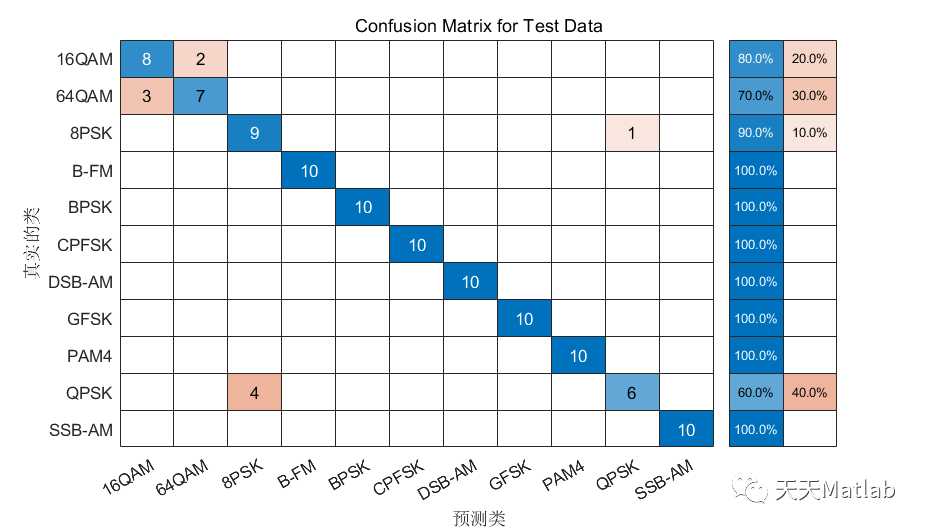
3 仿真结果

4 参考文献
[1]周煜. 基于深度学习的无线信号调制方式识别技术研究[D]. 北京邮电大学, 2019.
博主简介:擅长智能优化算法、神经网络预测、信号处理、元胞自动机、图像处理、路径规划、无人机等多种领域的Matlab仿真,相关matlab代码问题可私信交流。
部分理论引用网络文献,若有侵权联系博主删除。





 扫一扫
扫一扫


 2546
2546

 被折叠的 条评论
为什么被折叠?
被折叠的 条评论
为什么被折叠?
 到【灌水乐园】发言





