


 本文探讨了C++中vector容器的内存管理机制,包括自动扩展、内存分配与回收,以及shrink_to_fit()的使用。通过实例展示了vector的动态增长和容量调整,并对比了其与C风格数组的差异。
学习的程序如下:
#include <iostream>
#include <array>
#include <vector>

void foo(int *p, int len) {
    for (int i = 0; i != len; ++i) {
        std::cout << p[i] << std::endl;
    }
}

int main() {
    std::vector<int> v;
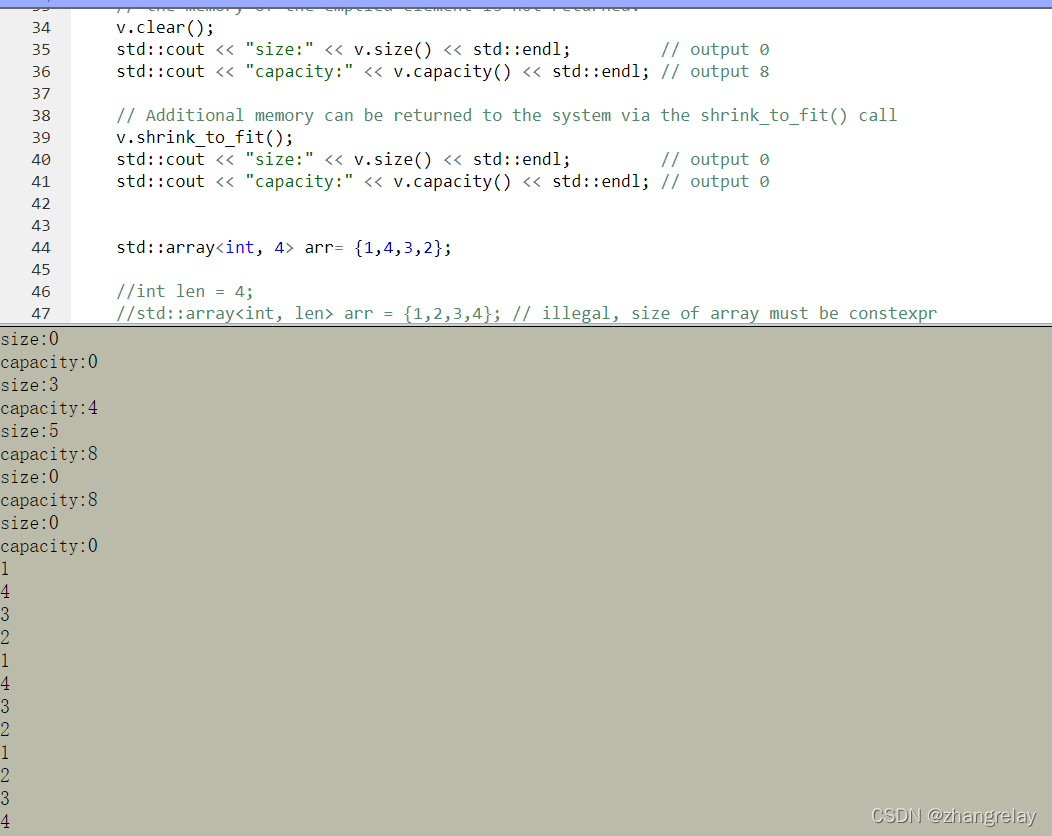
    std::cout << "size:" << v.size() << std::endl;         // output 0
    std::cout << "capacity:" << v.capacity() << std::endl; // output 0

    // As you can see, the storage of std::vector is automatically managed and
    // automatically expanded as needed.
    // But if there is not enough space, you need to redistribute more memory,
    // and reallocating memory is usually a performance-intensive operation.
    v.push_back(1);
    v.push_back(2);
    v.push_back(3);
    std::cout << "size:" << v.size() << std::endl;         // output 3
    std::cout << "capacity:" << v.capacity() << std::endl; // output 4

    // The auto-expansion logic here is very similar to Golang's slice.
    v.push_back(4);
    v.push_back(5);
    std::cout << "size:" << v.size() << std::endl;         // output 5
    std::cout << "capacity:" << v.capacity() << std::endl; // output 8

    // As can be seen below, although the container empties the element,
    // the memory of the emptied element is not returned.
    v.clear();
    std::cout << "size:" << v.size() << std::endl;         // output 0
    std::cout << "capacity:" << v.capacity() << std::endl; // output 8

    // Additional memory can be returned to the system via the shrink_to_fit() call
    v.shrink_to_fit();
    std::cout << "size:" << v.size() << std::endl;         // output 0
    std::cout << "capacity:" << v.capacity() << std::endl; // output 0


    std::array<int, 4> arr= {1,4,3,2};

    //int len = 4;
    //std::array<int, len> arr = {1,2,3,4}; // illegal, size of array must be constexpr

    // C style parameter passing
    // foo(arr, arr.size());           // illegal, cannot convert implicitly
    foo(&arr[0], arr.size());
    foo(arr.data(), arr.size());

    // more usage
    std::sort(arr.begin(), arr.end());
    for(auto &i : arr)
        std::cout << i << std::endl;

    return 0;
}
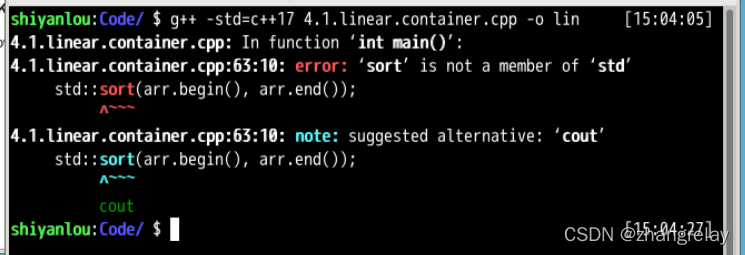
看了C++版本还是要更新支持到c++20才行。





 扫一扫
扫一扫


 1061
1061

 被折叠的 条评论
为什么被折叠?
被折叠的 条评论
为什么被折叠?
 到【灌水乐园】发言





