


 这篇博客通过一个C++程序示例,展示了函数指针、lambda表达式和std::function的使用。程序中定义了不同类型的函数,包括普通函数、lambda和接受参数的成员函数。然后,使用函数指针调用函数,并通过std::function创建可调用对象。还演示了如何使用std::bind部分绑定函数参数。最后,展示了运行结果。
程序示例如下:
#include <functional>
#include <iostream>

using foo = void(int);  // function pointer
void functional(foo f) {
    f(1);
}

int foo2(int para) {
    return para;
}

int foo3(int a, int b, int c) {
    return 0;
}

int main() {

    auto f = [](int value) {
        std::cout << value << std::endl;
    };
    functional(f);  // call by function pointer
    f(1);           // call by lambda expression

    // std::function wraps a function that take int paremeter and returns int value
    std::function<int(int)> func = foo2;

    int important = 10;
    std::function<int(int)> func2 = [&](int value) -> int {
        return 1+value+important;
    };
    std::cout << func(10) << std::endl;
    std::cout << func2(10) << std::endl;

    // bind parameter 1, 2 on function foo, and use std::placeholders::_1 as placeholder
    // for the first parameter.
    auto bindFoo = std::bind(foo3, std::placeholders::_1, 1,2);
    // when call bindFoo, we only need one param left
    bindFoo(1);

    return 0;
}
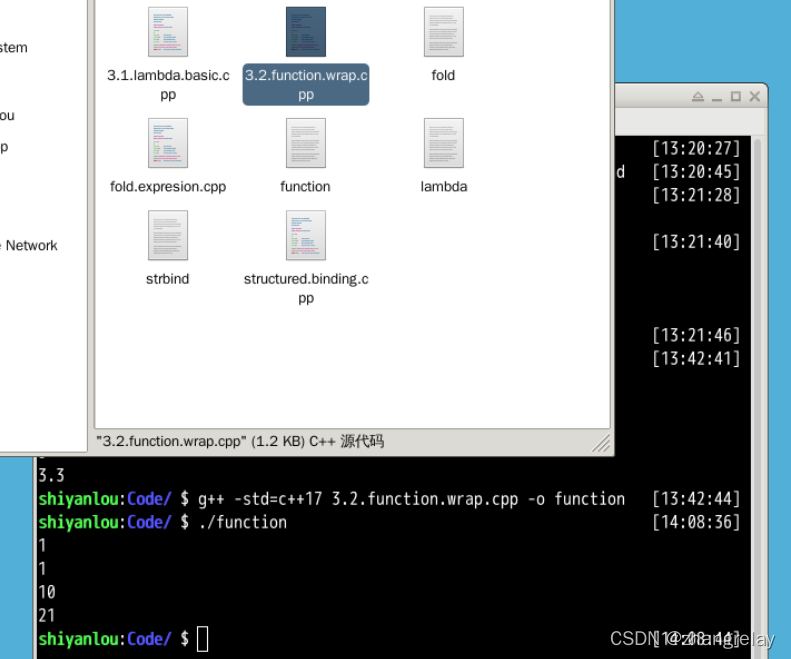
输出结果如下:
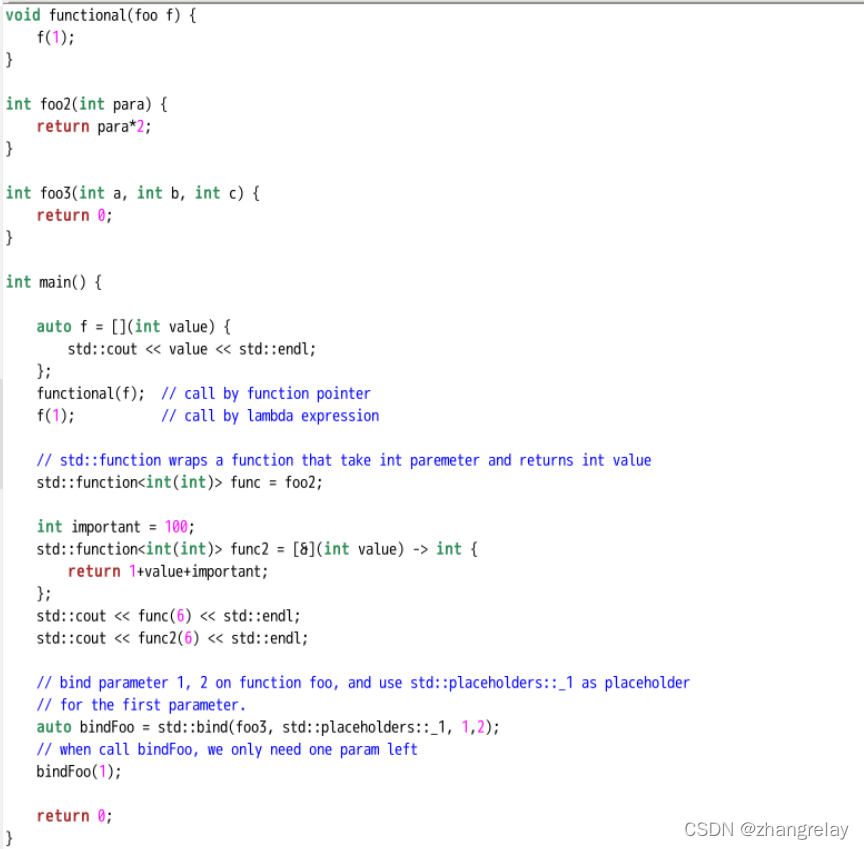
修改一些参数如下:
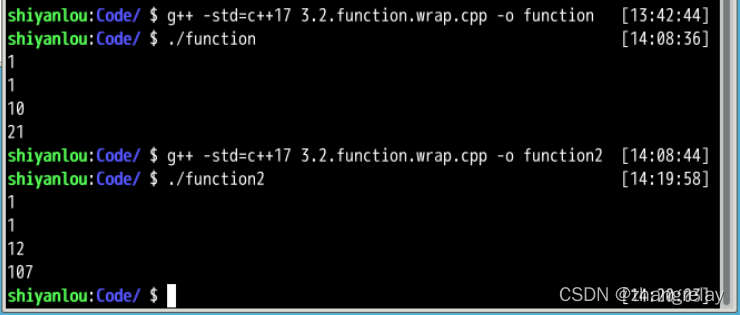
再看一下运行结果,是否与如下对应,是否理解这些。





 扫一扫
扫一扫


 1056
1056

 被折叠的 条评论
为什么被折叠?
被折叠的 条评论
为什么被折叠?
 到【灌水乐园】发言





