


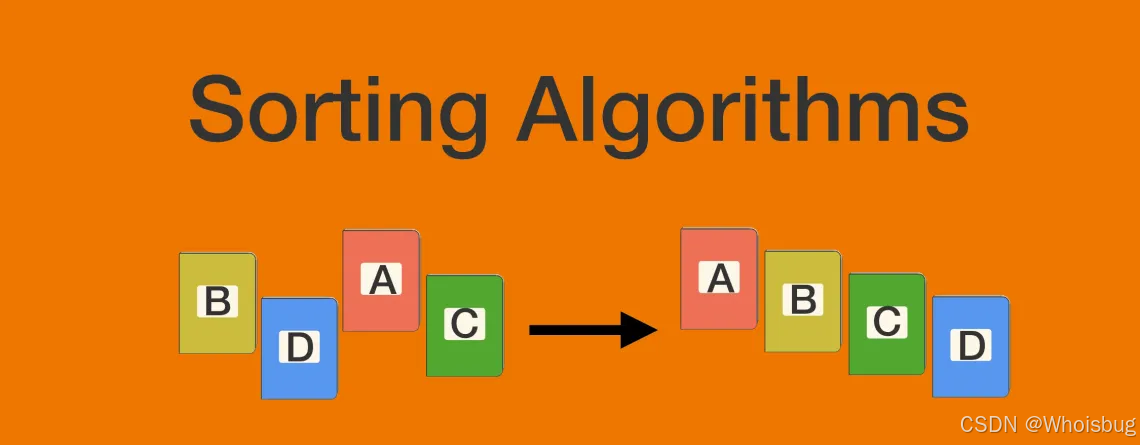
排序算法是计算机科学中最基本且重要的算法之一。它们用于将数据元素按照特定顺序排列,通常是升序或降序。本章将详细介绍各种排序算法,包括它们的工作原理、时间复杂度和适用场景。
什么是排序?
排序是将一系列数据元素按照特定顺序排列的过程。排序算法可以分为内部排序和外部排序。内部排序在内存中完成,而外部排序需要使用外部存储设备。
为什么需要排序?
排序在许多应用中都非常有用,例如:
-
数据库查询优化
-
搜索算法的加速
-
数据分析和处理
排序算法的分类
排序算法可以根据不同的标准进行分类,例如:
-
基于比较的排序算法(如冒泡排序、选择排序、插入排序)
-
非比较排序算法(如计数排序、基数排序、桶排序)
其他分类
排序算法还可以根据其他特性进行分类,例如:
-
稳定性(是否保持相等元素的原始顺序)
-
适应性(是否对已排序数据有优化)
冒泡排序
冒泡排序是一种简单的排序算法,通过重复遍历要排序的数列,比较每对相邻元素,如果它们的顺序错误就把它们交换过来。
代码示例
void bubbleSort(int arr[], int n) {
    int i, j, temp;
    for (i = 0; i < n-1; i++) {
        for (j = 0; j < n-i-1; j++) {
            if (arr[j] > arr[j+1]) {
                temp = arr[j];
                arr[j] = arr[j+1];
                arr[j+1] = temp;
            }
        }
    }
}
输入输出示例
假设我们有以下数组:
5 3 8 4 2
排序后:
2 3 4 5 8
选择排序
选择排序是一种简单直观的排序算法,它的工作原理是每一次从待排序的数据元素中选出最小(或最大)的一个元素,存放在序列的起始位置。
代码示例
void selectionSort(int arr[], int n) {
    int i, j, min_idx, temp;
    for (i = 0; i < n-1; i++) {
        min_idx = i;
        for (j = i+1; j < n; j++) {
            if (arr[j] < arr[min_idx]) {
                min_idx = j;
            }
        }
        temp = arr[min_idx];
        arr[min_idx] = arr[i];
        arr[i] = temp;
    }
}
输入输出示例
假设我们有以下数组:
64 34 25 12 22 11 90
排序后:
11 12 22 25 34 64 90
插入排序
插入排序是一种简单直观的排序算法,它的工作原理是通过构建有序序列,对于未排序数据,在已排序序列中从后向前扫描,找到相应位置并插入。
代码示例
void insertionSort(int arr[], int n) {
    int i, key, j;
    for (i = 1; i < n; i++) {
        key = arr[i];
        j = i - 1;
        while (j >= 0 && arr[j] > key) {
            arr[j + 1] = arr[j];
            j = j - 1;
        }
        arr[j + 1] = key;
    }
}
输入输出示例
假设我们有以下数组:
12 11 13 5 6
排序后:
5 6 11 12 13
希尔排序
希尔排序是插入排序的一种改进版本,它通过比较距离一定间隔的元素来工作,然后逐步减小间隔。
代码示例
void shellSort(int arr[], int n) {
    int gap, i, j, temp;
    for (gap = n/2; gap > 0; gap /= 2) {
        for (i = gap; i < n; i += 1) {
            temp = arr[i];
            for (j = i; j >= gap && arr[j - gap] > temp; j -= gap) {
                arr[j] = arr[j - gap];
            }
            arr[j] = temp;
        }
    }
}
输入输出示例
假设我们有以下数组:
9 8 3 7 5 6 4 1
排序后:
1 3 4 5 6 7 8 9
归并排序
归并排序是一种有效的排序算法,采用分治法的思想。它将数组分成两半,分别排序,然后合并。
代码示例
void merge(int arr[], int l, int m, int r) {
    int i, j, k;
    int n1 = m - l + 1;
    int n2 = r - m;

    int L[n1], R[n2];

    for (i = 0; i < n1; i++)
        L[i] = arr[l + i];
    for (j = 0; j < n2; j++)
        R[j] = arr[m + 1 + j];

    i = 0;
    j = 0;
    k = l;
    while (i < n1 && j < n2) {
        if (L[i] <= R[j]) {
            arr[k] = L[i];
            i++;
        } else {
            arr[k] = R[j];
            j++;
        }
        k++;
    }

    while (i < n1) {
        arr[k] = L[i];
        i++;
        k++;
    }

    while (j < n2) {
        arr[k] = R[j];
        j++;
        k++;
    }
}

void mergeSort(int arr[], int l, int r) {
    if (l < r) {
        int m = l + (r - l) / 2;
        mergeSort(arr, l, m);
        mergeSort(arr, m + 1, r);
        merge(arr, l, m, r);
    }
}
输入输出示例
假设我们有以下数组:
38 27 43 3 9 82 10
排序后:
3 9 10 27 38 43 82
堆排序
堆排序是一种基于堆数据结构的排序算法。它首先将数组构建成一个最大堆,然后逐步将堆顶元素与最后一个元素交换,然后重新调整堆。
代码示例
void heapify(int arr[], int n, int i) {
    int largest = i;
    int l = 2*i + 1;
    int r = 2*i + 2;

    if (l < n && arr[l] > arr[largest])
        largest = l;

    if (r < n && arr[r] > arr[largest])
        largest = r;

    if (largest != i) {
        int swap = arr[i];
        arr[i] = arr[largest];
        arr[largest] = swap;

        heapify(arr, n, largest);
    }
}

void heapSort(int arr[], int n) {
    for (int i = n / 2 - 1; i >= 0; i--)
        heapify(arr, n, i);

    for (int i = n-1; i >= 0; i--) {
        int temp = arr[0];
        arr[0] = arr[i];
        arr[i] = temp;

        heapify(arr, i, 0);
    }
}
输入输出示例
假设我们有以下数组:
12 11 13 5 6 7
排序后:
5 6 7 11 12 13
快速排序
快速排序是一种高效的排序算法,采用分治法的思想。它选择一个元素作为基准,然后将数组分为两部分,一部分包含比基准小的元素,另一部分包含比基准大的元素。
代码示例
int partition(int arr[], int low, int high) {
    int pivot = arr[high];
    int i = (low - 1);

    for (int j = low; j <= high- 1; j++) {
        if (arr[j] < pivot) {
            i++;
            int temp = arr[i];
            arr[i] = arr[j];
            arr[j] = temp;
        }
    }
    int temp = arr[i + 1];
    arr[i + 1] = arr[high];
    arr[high] = temp;
    return (i + 1);
}

void quickSort(int arr[], int low, int high) {
    if (low < high) {
        int pi = partition(arr, low, high);

        quickSort(arr, low, pi - 1);
        quickSort(arr, pi + 1, high);
    }
}
输入输出示例
假设我们有以下数组:
10 7 8 9 1 5
排序后:
1 5 7 8 9 10
树排序
树排序是一种基于二叉搜索树的排序算法。它首先将数组元素插入到二叉搜索树中,然后进行中序遍历以获取排序后的数组。
代码示例
typedef struct TreeNode {
    int data;
    struct TreeNode *left, *right;
} TreeNode;

TreeNode* createTreeNode(int data) {
    TreeNode *newNode = (TreeNode*)malloc(sizeof(TreeNode));
    newNode->data = data;
    newNode->left = newNode->right = NULL;
    return newNode;
}

TreeNode* insertTreeNode(TreeNode *root, int data) {
    if (root == NULL) {
        return createTreeNode(data);
    }
    if (data < root->data) {
        root->left = insertTreeNode(root->left, data);
    } else if (data > root->data) {
        root->right = insertTreeNode(root->right, data);
    }
    return root;
}

void inorderTraversal(TreeNode *root, int arr[], int *index) {
    if (root != NULL) {
        inorderTraversal(root->left, arr, index);
        arr[(*index)++] = root->data;
        inorderTraversal(root->right, arr, index);
    }
}

void treeSort(int arr[], int n) {
    TreeNode *root = NULL;
    for (int i = 0; i < n; i++) {
        root = insertTreeNode(root, arr[i]);
    }
    int index = 0;
    inorderTraversal(root, arr, &index);
}
输入输出示例
假设我们有以下数组:
7 4 1 8 5 2 9
排序后:
1 2 4 5 7 8 9
比较排序算法
不同的排序算法有不同的性能特点。以下是一些常见排序算法的比较:
| 算法 | 最佳时间复杂度 | 平均时间复杂度 | 最坏时间复杂度 | 空间复杂度 | 稳定性 |
|---|---|---|---|---|---|
| 冒泡排序 | O(n) | O(n^2) | O(n^2) | O(1) | 稳定 |
| 选择排序 | O(n^2) | O(n^2) | O(n^2) | O(1) | 不稳定 |
| 插入排序 | O(n) | O(n^2) | O(n^2) | O(1) | 稳定 |
| 希尔排序 | O(n log n) | O(n(log n)^2) | O(n(log n)^2) | O(1) | 不稳定 |
| 归并排序 | O(n log n) | O(n log n) | O(n log n) | O(n) | 稳定 |
| 堆排序 | O(n log n) | O(n log n) | O(n log n) | O(1) | 不稳定 |
| 快速排序 | O(n log n) | O(n log n) | O(n^2) | O(log n) | 不稳定 |
| 树排序 | O(n log n) | O(n log n) | O(n^2) | O(n) | 稳定 |
线性排序算法
线性排序算法的时间复杂度为 O(n),适用于特定类型的数据。常见的线性排序算法包括计数排序、基数排序和桶排序。
计数排序
计数排序适用于整数排序,通过计数每个整数出现的次数来排序。
代码示例
void countingSort(int arr[], int n, int exp) {
    int output[n];
    int i, count[10] = {0};

    for (i = 0; i < n; i++)
        count[ (arr[i]/exp)%10 ]++;

    for (i = 1; i < 10; i++)
        count[i] += count[i - 1];

    for (i = n - 1; i >= 0; i--) {
        output[count[ (arr[i]/exp)%10 ] - 1] = arr[i];
        count[ (arr[i]/exp)%10 ]--;
    }

    for (i = 0; i < n; i++)
        arr[i] = output[i];
}

void radixsort(int arr[], int n) {
    int max1 = arr[0];
    for (int i = 1; i < n; i++)
        if (arr[i] > max1)
            max1 = arr[i];

    for (int exp = 1; max1/exp > 0; exp *= 10)
        countingSort(arr, n, exp);
}
输入输出示例
假设我们有以下数组:
170 45 75 90 802 24 2 66
排序后:
2 24 45 66 75 90 170 802
基数排序
基数排序适用于整数排序,通过按位排序来排序。
代码示例
void countingSort(int arr[], int n, int exp) {
    int output[n];
    int i, count[10] = {0};

    for (i = 0; i < n; i++)
        count[ (arr[i]/exp)%10 ]++;

    for (i = 1; i < 10; i++)
        count[i] += count[i - 1];

    for (i = n - 1; i >= 0; i--) {
        output[count[ (arr[i]/exp)%10 ] - 1] = arr[i];
        count[ (arr[i]/exp)%10 ]--;
    }

    for (i = 0; i < n; i++)
        arr[i] = output[i];
}

void radixsort(int arr[], int n) {
    int max1 = arr[0];
    for (int i = 1; i < n; i++)
        if (arr[i] > max1)
            max1 = arr[i];

    for (int exp = 1; max1/exp > 0; exp *= 10)
        countingSort(arr, n, exp);
}
输入输出示例
假设我们有以下数组:
170 45 75 90 802 24 2 66
排序后:
2 24 45 66 75 90 170 802
桶排序
桶排序适用于浮点数排序,通过将数据分配到不同的桶中来排序。
代码示例
void bucketSort(float arr[], int n) {
    float max_val = arr[0];
    for (int i = 1; i < n; i++)
        if (arr[i] > max_val)
            max_val = arr[i];

    int bucket[n];
    for (int i = 0; i < n; i++)
        bucket[i] = 0;

    for (int i = 0; i < n; i++)
        bucket[(int)(n*arr[i]/(max_val+1))]++;

    int index = 0;
    for (int i = 0; i < n; i++)
        for (int j = 0; j < bucket[i]; j++)
            arr[index++] = i*(max_val+1)/n;
}
输入输出示例
假设我们有以下数组:
0.897 0.565 0.656 0.1234 0.665 0.3434
排序后:
0.1234 0.3434 0.565 0.656 0.665 0.897
外部排序
外部排序用于处理无法全部加载到内存中的大规模数据。常见的外部排序算法包括多路平衡归并排序和置换-选择排序。
多路平衡归并排序
多路平衡归并排序将大规模数据分成多个小文件,对每个小文件进行内部排序,然后进行多路归并。
置换-选择排序
置换-选择排序通过选择最小的元素并将其移动到前面来排序。
排序算法的问题与解决方案
问题 1:如何选择合适的排序算法?
解决方案:选择排序算法时需要考虑以下因素:
-
数据规模
-
数据的初始状态(是否部分排序)
-
内存使用情况
-
稳定性要求
问题 2:如何优化排序算法?
解决方案:可以通过以下方式优化排序算法:
-
使用更高效的数据结构
-
减少不必要的比较和交换操作
-
利用多线程或并行计算
问题 3:如何处理大规模数据排序?
解决方案:对于大规模数据,可以使用外部排序算法,如多路平衡归并排序。具体步骤如下:
-
将数据分成多个小文件。
-
对每个小文件进行内部排序。
-
进行多路归并。
代码示例
void externalSort(char* filename, int memorySize) {
    FILE *file = fopen(filename, "r");
    if (file == NULL) {
        printf("无法打开文件\n");
        return;
    }

    // 读取数据并分成多个小文件
    int fileSize = getFileSize(file);
    int numFiles = fileSize / memorySize + 1;
    FILE **tempFiles = (FILE**)malloc(numFiles * sizeof(FILE*));
    for (int i = 0; i < numFiles; i++) {
        char tempFilename[100];
        sprintf(tempFilename, "temp%d.txt", i);
        tempFiles[i] = fopen(tempFilename, "w");
        if (tempFiles[i] == NULL) {
            printf("无法创建临时文件\n");
            return;
        }
    }

    int buffer[memorySize];
    int bufferIndex = 0;
    int value;
    while (fscanf(file, "%d", &value) != EOF) {
        buffer[bufferIndex++] = value;
        if (bufferIndex == memorySize) {
            qsort(buffer, memorySize, sizeof(int), compare);
            for (int i = 0; i < memorySize; i++) {
                fprintf(tempFiles[bufferIndex / memorySize], "%d\n", buffer[i]);
            }
            bufferIndex = 0;
        }
    }
    if (bufferIndex > 0) {
        qsort(buffer, bufferIndex, sizeof(int), compare);
        for (int i = 0; i < bufferIndex; i++) {
            fprintf(tempFiles[numFiles - 1], "%d\n", buffer[i]);
        }
    }

    // 关闭文件
    fclose(file);
    for (int i = 0; i < numFiles; i++) {
        fclose(tempFiles[i]);
    }

    // 多路归并
    FILE *outputFile = fopen("sorted.txt", "w");
    if (outputFile == NULL) {
        printf("无法创建输出文件\n");
        return;
    }

    int *fileBuffers = (int*)malloc(numFiles * memorySize * sizeof(int));
    int *fileBufferIndices = (int*)malloc(numFiles * sizeof(int));
    for (int i = 0; i < numFiles; i++) {
        tempFiles[i] = fopen(tempFilename, "r");
        for (int j = 0; j < memorySize; j++) {
            if (fscanf(tempFiles[i], "%d", &fileBuffers[i * memorySize + j]) == EOF) {
                break;
            }
            fileBufferIndices[i]++;
        }
    }

    while (1) {
        int minIndex = -1;
        int minValue = INT_MAX;
        for (int i = 0; i < numFiles; i++) {
            if (fileBufferIndices[i] > 0 && fileBuffers[i * memorySize + fileBufferIndices[i] - 1] < minValue) {
                minIndex = i;
                minValue = fileBuffers[i * memorySize + fileBufferIndices[i] - 1];
            }
        }
        if (minIndex == -1) {
            break;
        }
        fprintf(outputFile, "%d\n", minValue);
        fileBufferIndices[minIndex]--;
        if (fileBufferIndices[minIndex] == 0) {
            for (int j = 0; j < memorySize; j++) {
                if (fscanf(tempFiles[minIndex], "%d", &fileBuffers[minIndex * memorySize + j]) == EOF) {
                    break;
                }
                fileBufferIndices[minIndex]++;
            }
        }
    }

    // 关闭文件
    fclose(outputFile);
    for (int i = 0; i < numFiles; i++) {
        fclose(tempFiles[i]);
        remove(tempFilename);
    }

    free(tempFiles);
    free(fileBuffers);
    free(fileBufferIndices);
}
输入输出示例
假设我们有以下文件 data.txt:
5 3 8 4 2 9 1 7 6
排序后,输出文件 sorted.txt:
1 2 3 4 5 6 7 8 9
总结
通过以上对排序算法的深入探讨,我们可以看到这些算法在计算机科学的各个领域都有着广泛的应用。无论是在算法设计、数据存储还是网络通信中,排序算法都扮演着不可或缺的角色。希望这篇文章能帮助你更好地理解和应用这些强大的算法。





 扫一扫
扫一扫


 被折叠的 条评论
为什么被折叠?
被折叠的 条评论
为什么被折叠?
 到【灌水乐园】发言





