


 本文介绍了一种使用深度优先搜索(DFS)算法来实现二叉树的序列化与反序列化的方法。通过DFS遍历,将二叉树转化为字符串,再将字符串还原为二叉树结构。该方法适用于需要在网络上传输或存储二叉树结构的场景。
题目链接
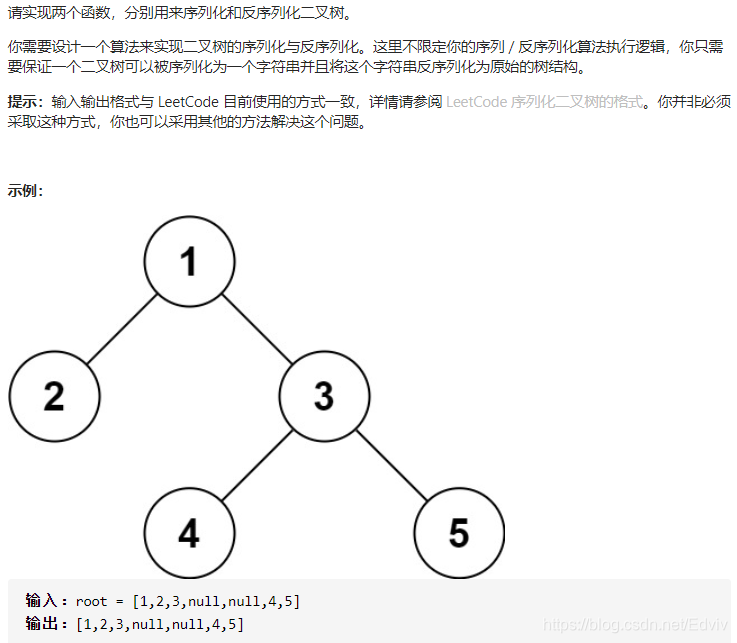
DFS实现序列化和反序列化二叉树
/**
 * Definition for a binary tree node.
 * struct TreeNode {
 *     int val;
 *     TreeNode *left;
 *     TreeNode *right;
 *     TreeNode(int x) : val(x), left(NULL), right(NULL) {}
 * };
 */
class Codec {
public:
    string path="";
    // Encodes a tree to a single string.
    string serialize(TreeNode* root) {
        dfs_1(root);
        return path;
    }

    void dfs_1(TreeNode* root)
    {
        if(!root) path += "@,";
        else
        {
            path += to_string(root->val) + ',';
            dfs_1(root->left);
            dfs_1(root->right);
        }
    }
    // Decodes your encoded data to tree.

    TreeNode* deserialize(string data) {
        int u = 0;
        return dfs_2(data,u);
    }
    TreeNode* dfs_2(string& data,int& u)
    {
        if(data[u] == '@')
        {
            u += 2;
            return NULL;
        }
        else
        {
            int k = u;
            while(data[u] != ',') u++;
            TreeNode* root = new TreeNode(stoi(data.substr(k,u-k)));
            u++;
            root->left = dfs_2(data,u);
            root->right = dfs_2(data,u);
            return root;
        }
    }
};

// Your Codec object will be instantiated and called as such:
// Codec codec;
// codec.deserialize(codec.serialize(root));






 扫一扫
扫一扫


 被折叠的 条评论
为什么被折叠?
被折叠的 条评论
为什么被折叠?
 到【灌水乐园】发言





