



- 缺省参数是声明或定义函数时为函数的参数指定⼀个缺省值。在调⽤该函数时,如果没有指定实参 则采⽤该形参的缺省值,否则使⽤指定的实参,缺省参数分为全缺省和半缺省参数。(有些地⽅把 缺省参数也叫默认参数)
#include <iostream>
#include <assert.h>
using namespace std;
void Func(int a = 0)
{
cout << a << endl;
}
int main()
{
Func(); // 没有传参时,使⽤参数的默认值
Func(10); // 传参时,使⽤指定的实参
return 0;
}
- 全缺省就是全部形参给缺省值,半缺省就是部分形参给缺省值。
#include <iostream>
using namespace std;
// 全缺省
void Func1(int a = 10, int b = 20, int c = 30)
{
cout << "a = " << a << endl;
cout << "b = " << b << endl;
cout << "c = " << c << endl << endl;
}
// 半缺省
void Func2(int a, int b = 10, int c = 20)
{
cout << "a = " << a << endl;
cout << "b = " << b << endl;
cout << "c = " << c << endl << endl;
}
int main()
{
Func1();
Func1(1);
Func1(1,2);
Func1(1,2,3);
Func2(100);
Func2(100, 200);
Func2(100, 200, 300);
return 0;
}
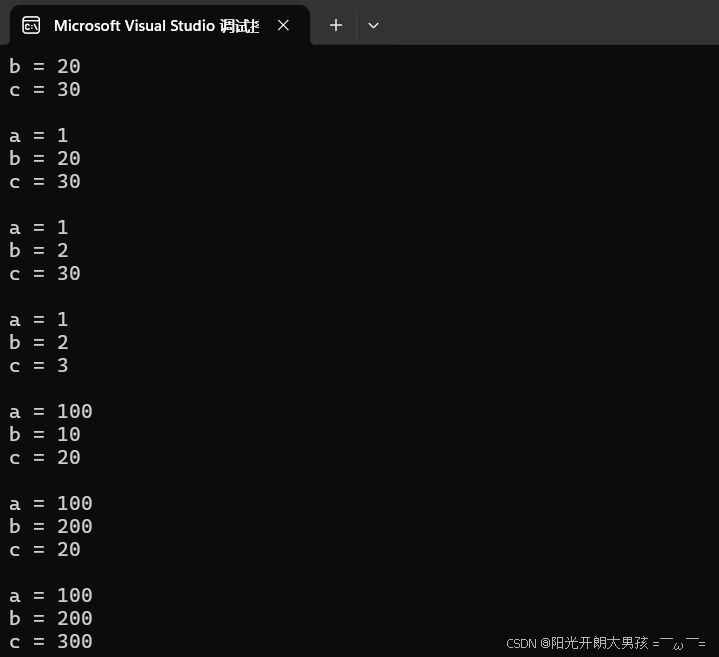
- C++规定半缺省参数必须从右往左 依次连续缺省,不能间隔跳跃给缺省值。
#include <iostream>
using namespace std;
// 半缺省
void Func2(int a = 10, int b, int c = 20)
{
cout << "a = " << a << endl;
cout << "b = " << b << endl;
cout << "c = " << c << endl << endl;
}
int main()
{
Func2(100);
Func2(100, 200);
Func2(100, 200, 300);
return 0;
}
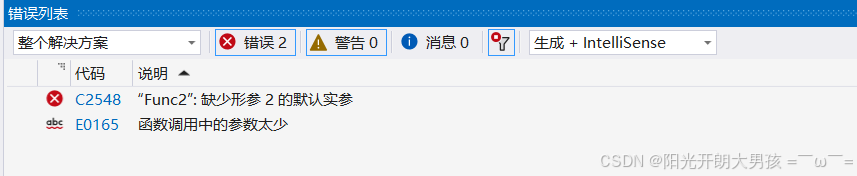
- 带缺省参数的函数调⽤,C++规定必须从左到右依次给实参,不能跳跃给实参。
#include <iostream>
using namespace std;
// 半缺省
void Func2(int a , int b = 10, int c = 20)
{
	cout << "a = " << a << endl;
	cout << "b = " << b << endl;
	cout << "c = " << c << endl << endl;
}
int main()
{
	Func2(100);
	Func2(, 200);
	Func2(, 200, );
	return 0;
}
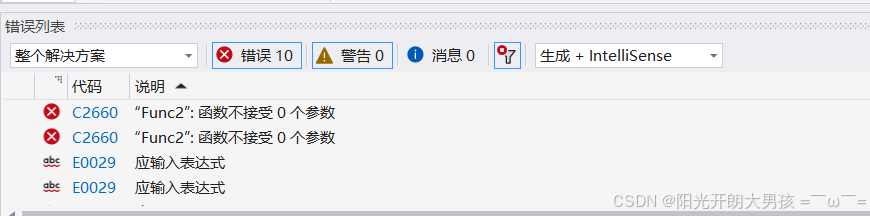
- 函数声明和定义分离时,缺省参数不能在函数声明和定义中同时出现,规定必须函数声明给缺省 值。
// Stack.h
#include <iostream>
#include <assert.h>
using namespace std;
typedef int STDataType;
typedef struct Stack
{
STDataType* a;
int top;
int capacity;
}ST;
void STInit(ST* ps, int n = 4);
// Stack.cpp
#include"Stack.h"
// 缺省参数不能声明和定义同时给
void STInit(ST* ps, int n)
{
assert(ps && n > 0);
ps->a = (STDataType*)malloc(n * sizeof(STDataType));
ps->top = 0;
ps->capacity = n;
}
// test.cpp
#include"Stack.h"
int main()
{
ST s1;
STInit(&s1);
// 确定知道要插⼊1000个数据,初始化时⼀把开好,避免扩容
ST s2;
STInit(&s2, 1000);
return 0;
}





 扫一扫
扫一扫


 624
624

 被折叠的 条评论
为什么被折叠?
被折叠的 条评论
为什么被折叠?
 到【灌水乐园】发言





