


 这篇博客详细介绍了Verilog中的过程化语法,包括Alwaysblock的使用,如combinational和clocked类型,以及if语句和case语句的应用。通过实践例子,解释了如何构建AND、XOR门以及2-to-1和6-to-1多路复用器。同时,强调了避免产生锁存器的重要性和正确使用non-blocking和blocking赋值的规则。
Alwaysblock1:
Since digital circuits are composed of logic gates connected with wires, any circuit can be expressed as some combination of modules and assign statements. However, sometimes this is not the most convenient way to describe the circuit. Procedures (of which always blocks are one example) provide an alternative syntax for describing circuits.
For synthesizing hardware, two types of always blocks are relevant:
- Combinational: always @(*)
- Clocked: always @(posedge clk)
Combinational always blocks are equivalent to assign statements, thus there is always a way to express a combinational circuit both ways. The choice between which to use is mainly an issue of which syntax is more convenient. The syntax for code inside a procedural block is different from code that is outside. Procedural blocks have a richer set of statements (e.g., if-then, case), cannot contain continuous assignments*, but also introduces many new non-intuitive ways of making errors. (*Procedural continuous assignments do exist, but are somewhat different from continuous assignments, and are not synthesizable.)
For example, the assign and combinational always block describe the same circuit. Both create the same blob of combinational logic. Both will recompute the output whenever any of the inputs (right side) changes value.
assign out1 = a & b | c ^ d;
always @(*) out2 = a & b | c ^ d; 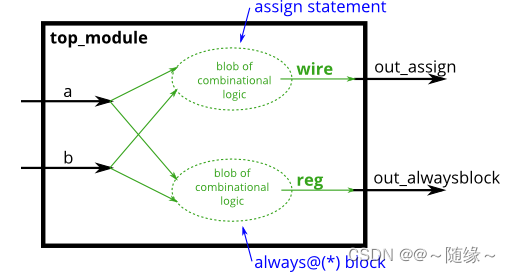
For combinational always blocks, always use a sensitivity list of (*). Explicitly listing out the signals is error-prone (if you miss one), and is ignored for hardware synthesis. If you explicitly specify the sensitivity list and miss a signal, the synthesized hardware will still behave as though (*) was specified, but the simulation will not and not match the hardware's behaviour. (In SystemVerilog, use always_comb.)
A note on wire vs. reg: The left-hand-side of an assign statement must be a net type (e.g., wire), while the left-hand-side of a procedural assignment (in an always block) must be a variable type (e.g., reg). These types (wire vs. reg) have nothing to do with what hardware is synthesized, and is just syntax left over from Verilog's use as a hardware simulation language.
A bit of practice
Build an AND gate using both an assign statement and a combinational always block. (Since assign statements and combinational always blocks function identically, there is no way to enforce that you're using both methods. But you're here for practice, right?...)
module top_module(
input a,
input b,
output wire out_assign,
output reg out_alwaysblock
);
assign out_assign= a & b ;
always @(*) out_alwaysblock=a & b ;
endmodule 最低0.47元/天 解锁文章






 扫一扫
扫一扫


 3182
3182

 被折叠的 条评论
为什么被折叠?
被折叠的 条评论
为什么被折叠?
 到【灌水乐园】发言





