
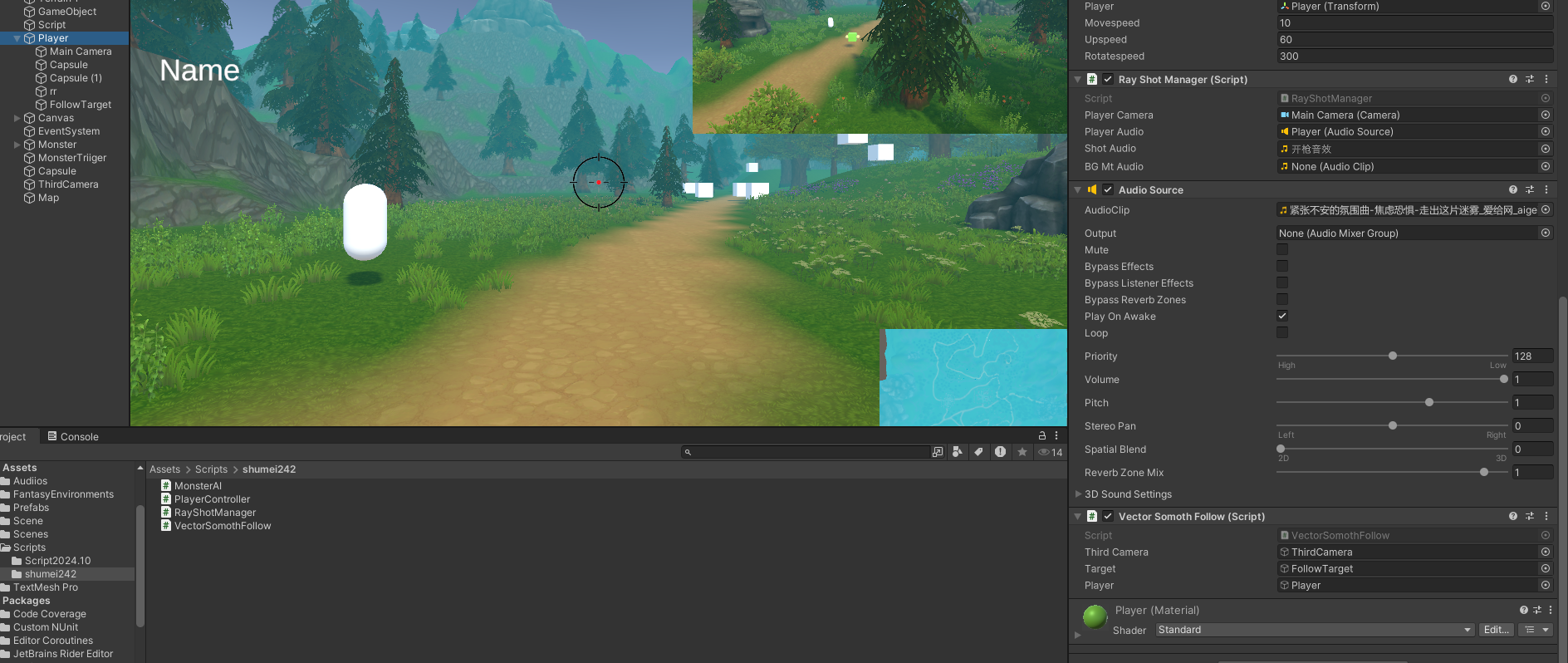
射击游戏第三人称视角平滑追踪(Vector.lerp)

源代码

using System.Collections;
using System.Collections.Generic;
using UnityEngine;

public class VectorSomothFollow : MonoBehaviour
{
    // 声明公共变量,可在Unity编辑器中赋值
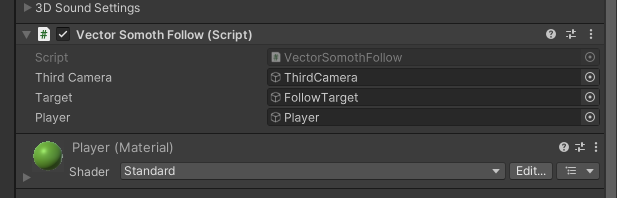
    public GameObject ThirdCamera;    // 需要移动的摄像机对象
    public GameObject Target;         // 摄像机要移动到的目标位置
    public GameObject Player;         // 摄像机要朝向的玩家对象

    private void Update()
    {
        // 每帧调用FollowObj函数,实现摄像机的平滑跟随
        FollowObj(ThirdCamera, Target, Player);
    }

    /// <summary>
    /// 这个函数实现让Moveder平滑追踪followed
    /// 功能:让摄像机平滑移动到目标位置并始终朝向玩家
    /// </summary>
    /// <param name="Moveder">需要移动的摄像机对象</param>
    /// <param name="Target">摄像机要移动到的目标位置</param>
    /// <param name="Player">摄像机要朝向的玩家对象</param>
    void FollowObj(GameObject Moveder, GameObject Target, GameObject Player)
    {
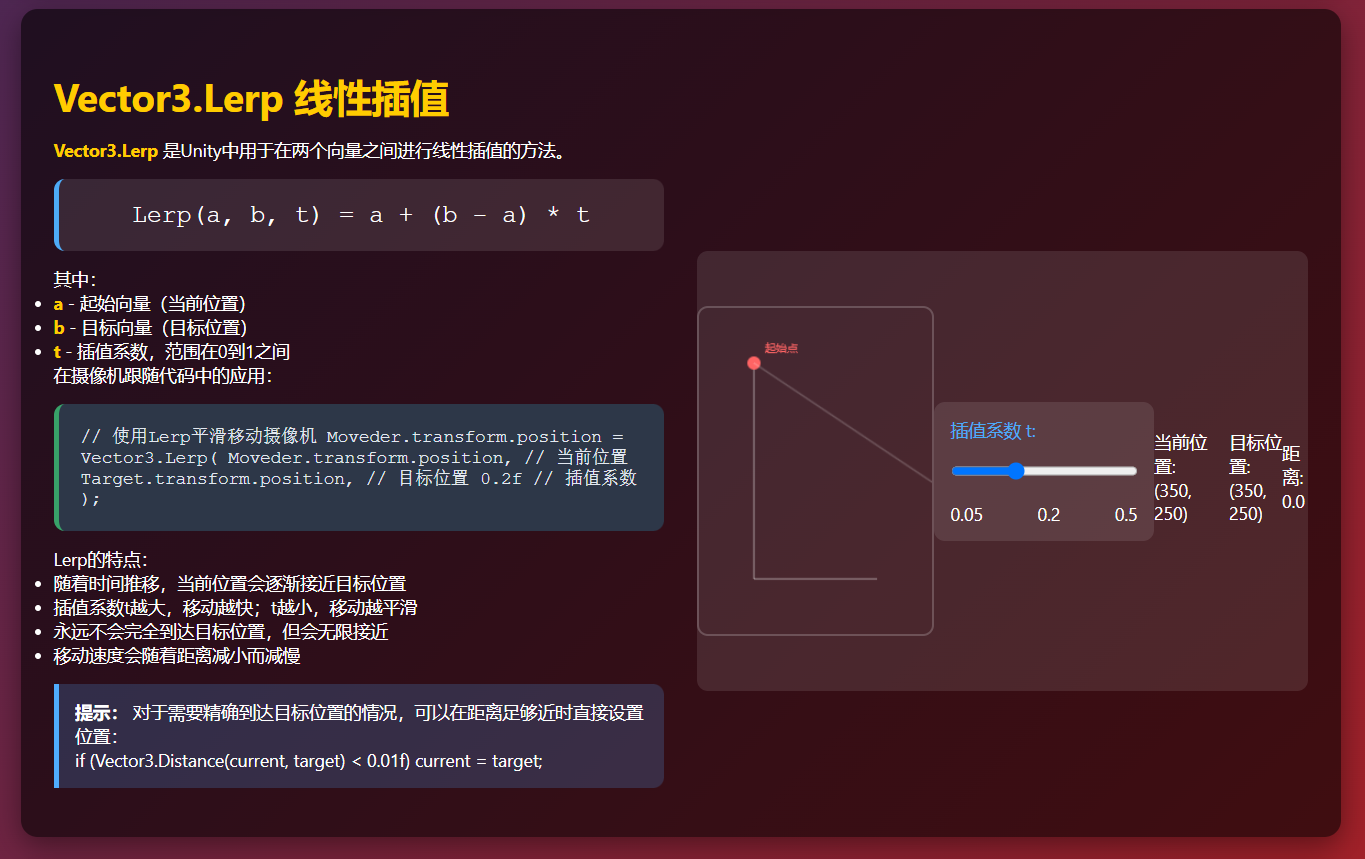
        // 使用线性插值(Lerp)平滑移动摄像机位置
        // 从当前位置平滑过渡到目标位置,0.2f是插值系数,值越小移动越平滑
        Moveder.transform.position = Vector3.Lerp(Moveder.transform.position, Target.transform.position, 0.2f);

        // 让摄像机始终朝向玩家对象,保持玩家在视野中心
        Moveder.transform.LookAt(Player.transform);
    }
}

04-12
### LERP Function in Programming The **Linear Interpolation (LERP)** function is widely used in computer graphics, game development, and other computational fields where smooth transitions or interpolations are necessary. In the context of programming, `lerp` computes a value that lies between two endpoints based on a given parameter \( t \), which typically ranges from 0 to 1. In mathematical terms, linear interpolation can be expressed as: \[ L(t) = A + t(B - A) \] Where: - \( A \): Starting point. - \( B \): Ending point. - \( t \): Parameter controlling how far along the line segment we want to compute the result (\( t=0 \) gives \( A \), while \( t=1 \) results in \( B \)). This formula smoothly blends values such as colors, positions, scalars, vectors, etc., depending upon their data types. For instance, within pixel shaders like HLSL or GLSL, this operation facilitates blending effects by transitioning one color into another gradually over time. A practical example provided earlier demonstrates its application inside Direct3D's High-Level Shader Language (HLSL): ```hlsl float4 PS(VertexOut pin) : SV_Target { const float pi = 3.14159; // Oscillate a value in [0,1] over time using a sine function. float s = 0.5f * sin(2*gTime - 0.25f*pi) + 0.5f; // Linearly interpolate between pin.Color and gPulseColor based on parameter 's'. float4 c = lerp(pin.Color, gPulseColor, s); return c; } ``` Here, `lerp()` takes three arguments—two input floats/float4 representing start (`pin.Color`) and end points (`gPulseColor`), plus an intermediate factor derived via sinusoidal oscillation controlled through global variable `gTime`. This approach creates visually appealing animations involving periodic changes among vertex attributes during rendering processes[^1]. Additionally, when comparing performance aspects against alternatives like spherical interpolation (**Spherical Linear Interpolation**, SLERP), normalizing before applying LERP often proves sufficient unless specific requirements demand exactness regarding rotational velocities around axes[^2]. Therefore, normalized LERP (nlerp) serves adequately most times due to being computationally less expensive yet still providing near-equivalent outcomes compared with full-fledged SLERP implementations. For OpenGL-based applications utilizing buffers alongside accessors structures, understanding these concepts becomes crucial since they directly influence resource management strategies employed throughout pipeline stages including but not limited to setting up attribute pointers pointing towards relevant memory regions containing vertices' information prior drawing calls execution phase commencement[^3].
评论
添加红包

请填写红包祝福语或标题

红包个数最小为10个

红包金额最低5元

当前余额3.43前往充值 >
需支付:10.00
成就一亿技术人!
领取后你会自动成为博主和红包主的粉丝 规则
hope_wisdom
发出的红包

打赏作者

Unity青子

难题的解决使成本节约,求打赏

¥1 ¥2 ¥4 ¥6 ¥10 ¥20
扫码支付:¥1
获取中
扫码支付

您的余额不足,请更换扫码支付或充值

打赏作者

实付
使用余额支付
点击重新获取
扫码支付
钱包余额 0

抵扣说明:

1.余额是钱包充值的虚拟货币,按照1:1的比例进行支付金额的抵扣。
2.余额无法直接购买下载,可以购买VIP、付费专栏及课程。

余额充值


