


 本文详细介绍了在ZYNQ PL部分通过EMC连接NOR FLASH的方法,包括地址空间配置、读写擦除步骤及代码实现,并提供了基于/dev/mem访问物理地址的示例,展示了如何在Linux下实现flash操作。
1、 背景介绍
在板上,ZYNQ PL部分通过EMC连接一片NOR FLASH,地址空间如下:
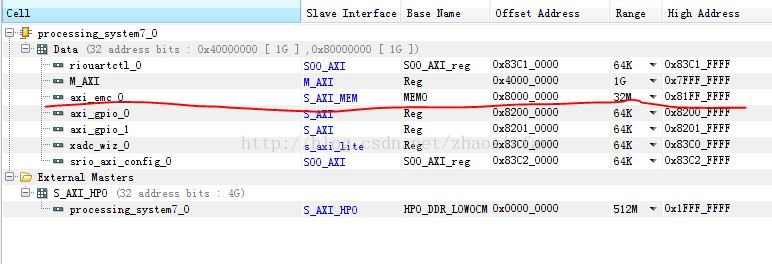
可以看到NOR FLASH的起始地址为0x80000000,这是物理地址,可以把数据存放在以该地址起始的一段区域。
需要注意的是,在对NOR FLASH进行读写数据时,需要参考对应的datasheet,例如这里选用的NOR FLASH读、写、擦除步骤如下:
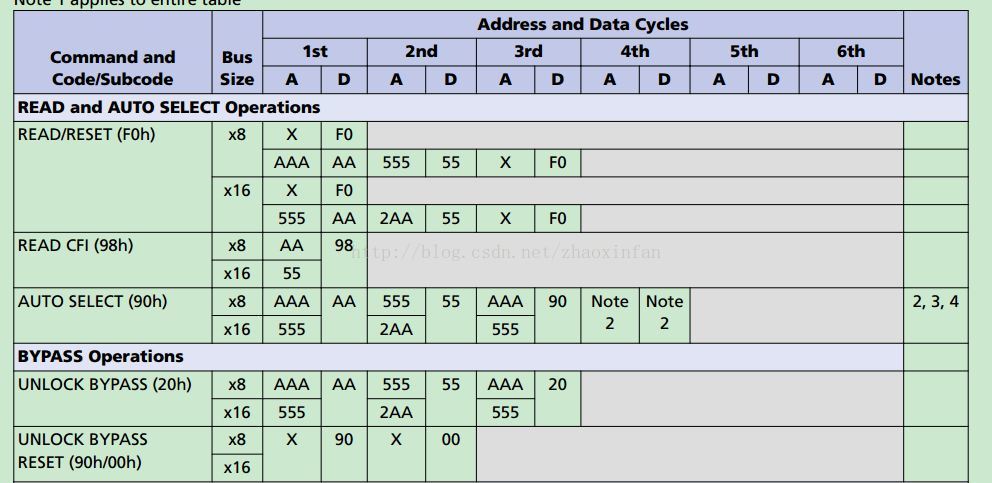
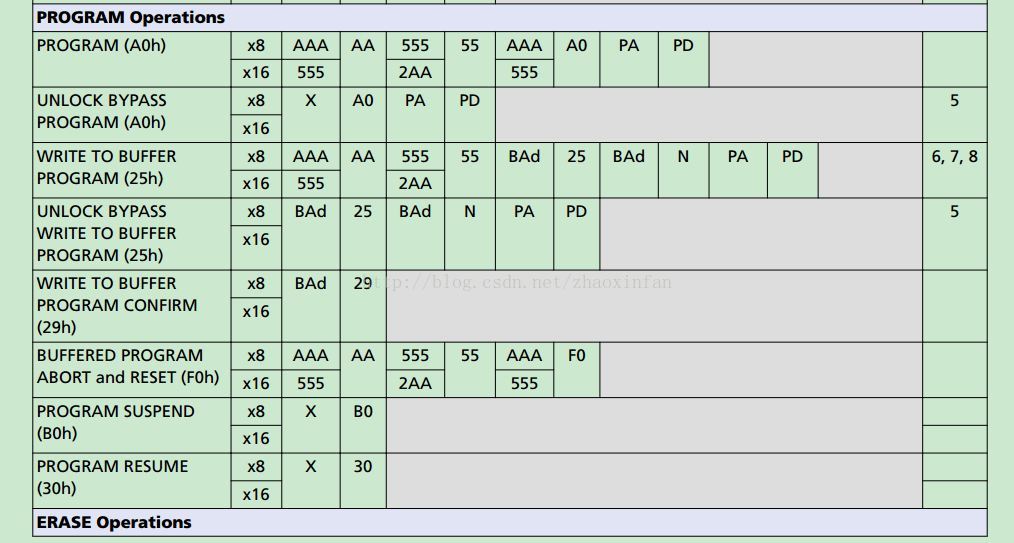
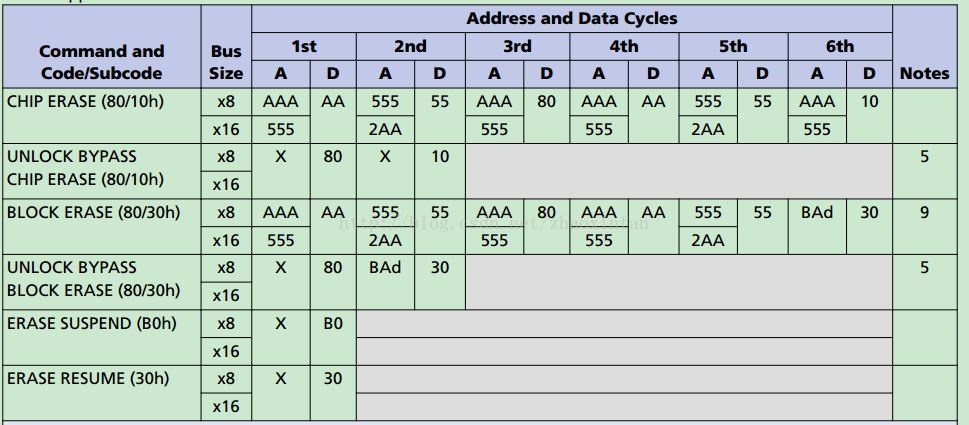

通过上面的表格就知道进行相应操作每一步该做什么,可以转换为SDK中裸奔程序的C代码。
2、 Linux下flash操作
之前提到过zynq中Linux用户应用程序可以通过/dev/mem访问到物理地址,xil_in32和xil_out32等裸奔程序中常见的函数可以通过这一机制移植到linux下。于是,对flash的操作其实就是基于xil_in和xil_out对物理地址进行读写。
这里只需要实现三个函数,erase,write_sector以及read_sector.代码如下:
- //xil_io.h
-
- #include <stdio.h>
- #include <stdlib.h>
- #include <stdint.h>
- #include <string.h>
- #include <sys/types.h>
- #include <sys/stat.h>
- #include <sys/mman.h>
-
- #include <unistd.h>
- #include <fcntl.h>
-
- #define PAGE_SIZE ((size_t)getpagesize())
- #define PAGE_MASK ((uint64_t) (long)~(PAGE_SIZE - 1))
-
- void Xil_Out32(uint64_t phyaddr, uint32_t val)
- {
- int fd;
- volatile uint8_t *map_base;
- uint64_t base = phyaddr & PAGE_MASK;
- uint64_t pgoffset = phyaddr & (~PAGE_MASK);
-
- if((fd = open("/dev/mem", O_RDWR | O_SYNC)) == -1)
- {
- perror("open /dev/mem:");
- }
-
- map_base = mmap(NULL, PAGE_SIZE, PROT_READ | PROT_WRITE, MAP_SHARED,
- fd, base);
- if(map_base == MAP_FAILED)
- {
- perror("mmap:");
- }
- *(volatile uint32_t *)(map_base + pgoffset) = val;
- close(fd);
- munmap((void *)map_base, PAGE_SIZE);
- }
-
- int Xil_In32(uint64_t phyaddr)
- {
- int fd;
- uint32_t val;
- volatile uint8_t *map_base;
- uint64_t base = phyaddr & PAGE_MASK;
- uint64_t pgoffset = phyaddr & (~PAGE_MASK);
- //open /dev/mem
- if((fd = open("/dev/mem", O_RDWR | O_SYNC)) == -1)
- {
- perror("open /dev/mem:");
- }
- //mmap
- map_base = mmap(NULL, PAGE_SIZE, PROT_READ | PROT_WRITE, MAP_SHARED,
- fd, base);
- if(map_base == MAP_FAILED)
- {
- perror("mmap:");
- }
- val = *(volatile uint32_t *)(map_base + pgoffset);
- close(fd);
- munmap((void *)map_base, PAGE_SIZE);
-
- return val;
- }
-
- void Xil_Out16(uint64_t phyaddr, uint16_t val)
- {
- int fd;
- volatile uint8_t *map_base;
- uint64_t base = phyaddr & PAGE_MASK;
- uint64_t pgoffset = phyaddr & (~PAGE_MASK);
-
- if((fd = open("/dev/mem", O_RDWR | O_SYNC)) == -1)
- {
- perror("open /dev/mem:");
- }
-
- map_base = mmap(NULL, PAGE_SIZE, PROT_READ | PROT_WRITE, MAP_SHARED,
- fd, base);
- if(map_base == MAP_FAILED)
- {
- perror("mmap:");
- }
- *(volatile uint16_t *)(map_base + pgoffset) = val;
- close(fd);
- munmap((void *)map_base, PAGE_SIZE);
- }
-
- int Xil_In16(uint64_t phyaddr)
- {
- int fd;
- uint16_t val;
- volatile uint8_t *map_base;
- uint64_t base = phyaddr & PAGE_MASK;
- uint64_t pgoffset = phyaddr & (~PAGE_MASK);
- //open /dev/mem
- if((fd = open("/dev/mem", O_RDWR | O_SYNC)) == -1)
- {
- perror("open /dev/mem:");
- }
- //mmap
- map_base = mmap(NULL, PAGE_SIZE, PROT_READ | PROT_WRITE, MAP_SHARED,
- fd, base);
- if(map_base == MAP_FAILED)
- {
- perror("mmap:");
- }
- val = *(volatile uint16_t *)(map_base + pgoffset);
- close(fd);
- munmap((void *)map_base, PAGE_SIZE);
-
- return val;
- }
-
- void Xil_Out8(uint64_t phyaddr, uint16_t val)
- {
- int fd;
- volatile uint8_t *map_base;
- uint64_t base = phyaddr & PAGE_MASK;
- uint64_t pgoffset = phyaddr & (~PAGE_MASK);
-
- if((fd = open("/dev/mem", O_RDWR | O_SYNC)) == -1)
- {
- perror("open /dev/mem:");
- }
-
- map_base = mmap(NULL, PAGE_SIZE, PROT_READ | PROT_WRITE, MAP_SHARED,
- fd, base);
- if(map_base == MAP_FAILED)
- {
- perror("mmap:");
- }
- *(volatile uint8_t *)(map_base + pgoffset) = val;
- close(fd);
- munmap((void *)map_base, PAGE_SIZE);
- }
-
- int Xil_In8(uint64_t phyaddr)
- {
- int fd;
- uint8_t val;
- volatile uint8_t *map_base;
- uint64_t base = phyaddr & PAGE_MASK;
- uint64_t pgoffset = phyaddr & (~PAGE_MASK);
- //open /dev/mem
- if((fd = open("/dev/mem", O_RDWR | O_SYNC)) == -1)
- {
- perror("open /dev/mem:");
- }
- //mmap
- map_base = mmap(NULL, PAGE_SIZE, PROT_READ | PROT_WRITE, MAP_SHARED,
- fd, base);
- if(map_base == MAP_FAILED)
- {
- perror("mmap:");
- }
- val = *(volatile uint8_t *)(map_base + pgoffset);
- close(fd);
- munmap((void *)map_base, PAGE_SIZE);
-
- return val;
- }
- //move.h
-
- #ifndef SMARTCARMOVE_H
- #define SMARTCARMOVE_H
-
- #include <stdio.h>
- #include <fcntl.h>
- #include <unistd.h>
- #include <string.h>
- #include <sys/time.h>
- #include <sys/stat.h>
- #include <sys/types.h>
- #include <syslog.h>
- #include <memory.h>
-
- static int fd;
-
- #define MODE (O_WRONLY | O_TRUNC)
-
- #define SECSIZE 65536
- #define XPAR_AXI_EMC_0_S_AXI_MEM0_BASEADDR 0x80000000
- #define WAIT_TICKS 0xffffffff
-
- typedef unsigned short u16;
-
- extern void flash_set16(unsigned int addrBase,unsigned int addrOffset,unsigned int value);
- extern int flash_get16(unsigned int addrBase,unsigned int addrOffset);
-
- extern int Erase_Flash(int sectorNum);
- extern int Write_Sector(int sectorNum,int offset,u16 *src_addr,int wr_num);
- extern int Read_Sector(int sectorNum,int rd_num,unsigned short *buf);
-
-
- #endif
- #include "xil_io.h"
- #include "move.h"
-
-
- /**
- read and write phy mem
- * */
- void flash_set16(unsigned int addrBase,unsigned int addrOffset,unsigned int value)
- {
- Xil_Out16(addrBase+2*addrOffset, value);
- //printf("flash set reg 0x%x value is 0x%x\n",addrBase+2*addrOffset,value);
- }
-
- int flash_get16(unsigned int addrBase,unsigned int addrOffset)
- {
- int ans=0;
- ans=Xil_In16(addrBase+2*addrOffset);
- return ans;
- }
-
- int Erase_Flash(int sectorNum)
- {
- unsigned short flag;
- int i=0;
- int val=0;
- unsigned short *base_addr;
- base_addr = (unsigned short*)(XPAR_AXI_EMC_0_S_AXI_MEM0_BASEADDR+SECSIZE*sectorNum*2);
- printf("erase start addr 0x%x\n",base_addr);
-
- flash_set16(base_addr,0x555,0x00AA);
- flash_set16(base_addr,0x2AA,0x0055);
- flash_set16(base_addr,0x555,0x0080);
- flash_set16(base_addr,0x555,0x00AA);
- flash_set16(base_addr,0x2AA,0x0055);
- flash_set16(base_addr,0,0x0030);
-
- val=flash_get16(base_addr,0);
- printf("base addr 0x%x val is 0x%x\n",base_addr,val);
-
- while((val&0x80)!=0x80)
- {
- i++;
- if( i>=WAIT_TICKS)
- {
- printf("addr %x Erase_Flash failed!\n",base_addr);
- flash_set16(base_addr,0x555,0x0090);
- flash_set16(base_addr,0x000,0x0000);
- return -1;
- }
- //flag = base_addr;
- val=flash_get16(base_addr,0);
- }
- flash_set16(base_addr,0x555,0x0090);
- flash_set16(base_addr,0x000,0x0000);
-
- printf("erase end addr %x\n",base_addr+SECSIZE);
- return 0;
- }
-
- int Write_Sector(int sectorNum,int offset,u16 *src_addr,int wr_num)
- {
- int i,j;
- u16 *dst_addr;
- int val=0;
- int ans=0;
- dst_addr = (u16*)(XPAR_AXI_EMC_0_S_AXI_MEM0_BASEADDR+SECSIZE*sectorNum*2+offset);
-
- /* Unlock Bypass program */
-
- flash_set16(dst_addr,0x555,0x00AA);
- flash_set16(dst_addr,0x2AA,0x0055);
-
- printf("dst addr is 0x%x\n",dst_addr);
- for(i=0;i<wr_num;i++)
- {
-
- flash_set16(dst_addr,0x555,0x0020);
- flash_set16(dst_addr,0x000,0x00A0);
- // printf("i is %d\n",i);
-
- val=src_addr[i];
- printf("val is 0x%x\n",val);
- flash_set16(dst_addr,i,val);
-
- ans=flash_get16(dst_addr,i);
- //printf("ans is 0x%x\n",ans);
- j=0;
- while( ans!= val)
- {
- j++;
- if(j>=WAIT_TICKS)
- {
- flash_set16(dst_addr,0x555,0x0090);
- flash_set16(dst_addr,0x000,0x0000);
- return -1;
- }
- ans=flash_get16(dst_addr,i);
- }
- }
- flash_set16(dst_addr,0x555,0x0090);
- flash_set16(dst_addr,0x000,0x0000);
- return 0;
- }
-
- int Read_Sector(int sectorNum,int rd_num,unsigned short *buf)
- {
- unsigned short *sector_addr;
- int i;
- int val=0;
-
- if( rd_num <= 0)
- {
- return -1;
- }
- printf("flash read start--sectorNum= %d rd_num= %d\n",sectorNum,rd_num);
- sector_addr = (u16*)(XPAR_AXI_EMC_0_S_AXI_MEM0_BASEADDR+SECSIZE*sectorNum*2);
-
- printf("sector addr is 0x%x\n",sector_addr);
- if( rd_num <= SECSIZE )
- {
- for(i=0;i<rd_num;i++)
- {
- printf("val is 0x%x\n",flash_get16(sector_addr,0));
- val = flash_get16(sector_addr,0);
- *buf=val;
- buf++;
- sector_addr++;
- }
- }
- else
- {
- printf("error\n");
- }
- return 0;
- }
-
-
- int main(int argc, char *argv[])
- {
-
- //Erase_Flash(1);
-
- u16 dat[100];
- int i;
- Read_Sector(0,10,dat);
- for(i=0;i<10;i++)
- {
- printf("0x%x\n",dat[i]);
- }
- /*
- for(i=0;i<100;i++)
- {
- dat[i]=10+i;
- }
- Erase_Flash(0);
- Write_Sector(0,0,dat,10);
- */
- return 0;
- }
3、 测试
这里没有驱动的概念,一切都放在用户态执行,编译产生flash应用程序,放到板子上执行程序进行测试即可。注意,写之前要擦除。
下图为写文件的测试,这里写了10个数:
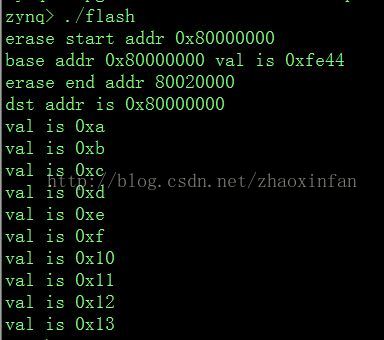
写完以后再读
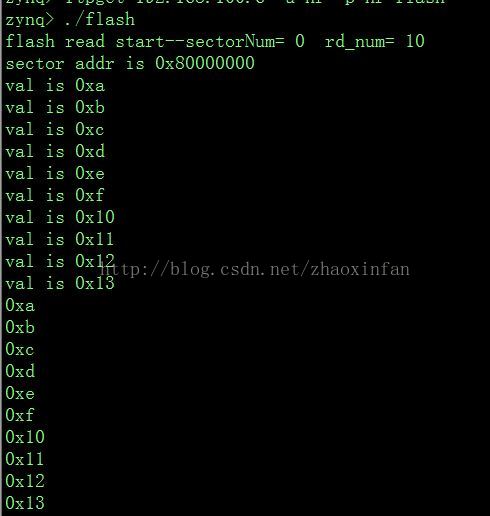
可以看到,读出来的和写入的值一样,测试通过。
4、 补充
关于/dev/mem可以看看下面这段代码,写的很详细,用户态直接访问物理地址,对于ZYNQ中PL部分的操作确实帮助极大。
- /*
- * devmem2.c: Simple program to read/write from/to any location in memory.
- *
- * Copyright (C) 2000, Jan-Derk Bakker (J.D.Bakker@its.tudelft.nl)
- *
- *
- * This software has been developed for the LART computing board
- * (http://www.lart.tudelft.nl/). The development has been sponsored by
- * the Mobile MultiMedia Communications (http://www.mmc.tudelft.nl/)
- * and Ubiquitous Communications (http://www.ubicom.tudelft.nl/)
- * projects.
- *
- * The author can be reached at:
- *
- * Jan-Derk Bakker
- * Information and Communication Theory Group
- * Faculty of Information Technology and Systems
- * Delft University of Technology
- * P.O. Box 5031
- * 2600 GA Delft
- * The Netherlands
- *
- *
- * This program is free software; you can redistribute it and/or modify
- * it under the terms of the GNU General Public License as published by
- * the Free Software Foundation; either version 2 of the License, or
- * (at your option) any later version.
- *
- * This program is distributed in the hope that it will be useful,
- * but WITHOUT ANY WARRANTY; without even the implied warranty of
- * MERCHANTABILITY or FITNESS FOR A PARTICULAR PURPOSE. See the
- * GNU General Public License for more details.
- *
- * You should have received a copy of the GNU General Public License
- * along with this program; if not, write to the Free Software
- * Foundation, Inc., 59 Temple Place, Suite 330, Boston, MA 02111-1307 USA
- *
- */
-
- #include <stdio.h>
- #include <stdlib.h>
- #include <unistd.h>
- #include <string.h>
- #include <errno.h>
- #include <signal.h>
- #include <fcntl.h>
- #include <ctype.h>
- #include <termios.h>
- #include <sys/types.h>
- #include <sys/mman.h>
-
- #define FATAL do { fprintf(stderr, "Error at line %d, file %s (%d) [%s]\n", \
- __LINE__, __FILE__, errno, strerror(errno)); exit(1); } while(0)
-
- #define MAP_SIZE 4096UL
- #define MAP_MASK (MAP_SIZE - 1)
-
- int main(int argc, char **argv) {
- int fd;
- void *map_base, *virt_addr;
- unsigned long read_result, writeval;
- off_t target;
- int access_type = 'w';
-
- if(argc < 2) {
- fprintf(stderr, "\nUsage:\t%s { address } [ type [ data ] ]\n"
- "\taddress : memory address to act upon\n"
- "\ttype : access operation type : [b]yte, [h]alfword, [w]ord\n"
- "\tdata : data to be written\n\n",
- argv[0]);
- exit(1);
- }
- target = strtoul(argv[1], 0, 0);
-
- if(argc > 2)
- access_type = tolower(argv[2][0]);
-
-
- if((fd = open("/dev/mem", O_RDWR | O_SYNC)) == -1) FATAL;
- printf("/dev/mem opened.\n");
- fflush(stdout);
-
- /* Map one page */
- map_base = mmap(0, MAP_SIZE, PROT_READ | PROT_WRITE, MAP_SHARED, fd, target & ~MAP_MASK);
- if(map_base == (void *) -1) FATAL;
- printf("Memory mapped at address %p.\n", map_base);
- fflush(stdout);
-
- virt_addr = map_base + (target & MAP_MASK);
- switch(access_type) {
- case 'b':
- read_result = *((unsigned char *) virt_addr);
- break;
- case 'h':
- read_result = *((unsigned short *) virt_addr);
- break;
- case 'w':
- read_result = *((unsigned long *) virt_addr);
- break;
- default:
- fprintf(stderr, "Illegal data type '%c'.\n", access_type);
- exit(2);
- }
- printf("Value at address 0x%X (%p): 0x%X\n", target, virt_addr, read_result);
- fflush(stdout);
-
- if(argc > 3) {
- writeval = strtoul(argv[3], 0, 0);
- switch(access_type) {
- case 'b':
- *((unsigned char *) virt_addr) = writeval;
- read_result = *((unsigned char *) virt_addr);
- break;
- case 'h':
- *((unsigned short *) virt_addr) = writeval;
- read_result = *((unsigned short *) virt_addr);
- break;
- case 'w':
- *((unsigned long *) virt_addr) = writeval;
- read_result = *((unsigned long *) virt_addr);
- break;
- }
- printf("Written 0x%X; readback 0x%X\n", writeval, read_result);
- fflush(stdout);
- }
-
- if(munmap(map_base, MAP_SIZE) == -1) FATAL;
- close(fd);
- return 0;
- }
-
运行截图如下:
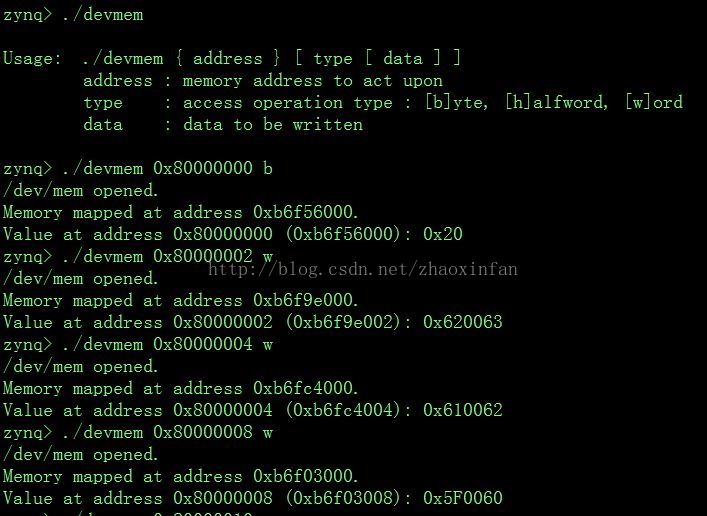
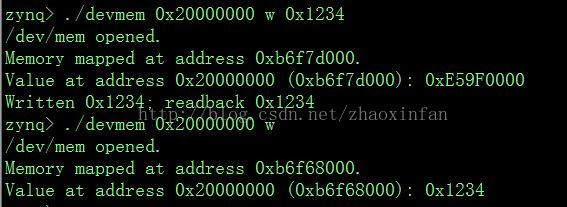





 扫一扫
扫一扫


 2011
2011

 被折叠的 条评论
为什么被折叠?
被折叠的 条评论
为什么被折叠?
 到【灌水乐园】发言





