



自定义矩阵
from math import *
import random

class matrix:

    def __init__(self, value):
        self.value = value
        self.dimx = len(value)
        self.dimy = len(value[0])
        if value == [[]]:
            self.dimx = 0

    def zero(self, dimx, dimy):
        # check if valid dimensions
        if dimx < 1 or dimy < 1:
            raise ValueError("Invalid size of matrix")
        else:
            self.dimx = dimx
            self.dimy = dimy
            self.value = [[0 for row in range(dimy)] for col in range(dimx)]

    def identity(self, dim):
        # check if valid dimension
        if dim < 1:
            raise ValueError("Invalid size of matrix")
        else:
            self.dimx = dim
            self.dimy = dim
            self.value = [[0 for row in range(dim)] for col in range(dim)]
            for i in range(dim):
                self.value[i][i] = 1

    def __add__(self, other):
        # check if correct dimensions
        if self.dimx != other.dimx or self.dimy != other.dimy:
            raise ValueError("Matrices must be of equal dimension to add")
        else:
            # add if correct dimensions
            res = matrix([[]])
            res.zero(self.dimx, self.dimy)
            for i in range(self.dimx):
                for j in range(self.dimy):
                    res.value[i][j] = self.value[i][j] + other.value[i][j]
            return res

    def __sub__(self, other):
        # check if correct dimensions
        if self.dimx != other.dimx or self.dimy != other.dimy:
            raise ValueError("Matrices must be of equal dimension to subtract")
        else:
            # subtract if correct dimensions
            res = matrix([[]])
            res.zero(self.dimx, self.dimy)
            for i in range(self.dimx):
                for j in range(self.dimy):
                    res.value[i][j] = self.value[i][j] - other.value[i][j]
            return res

    def __mul__(self, other):
        # check if correct dimensions
        if self.dimy != other.dimx:
            raise ValueError("Matrices must be m*n and n*p to multiply")
        else:
            # multiply if correct dimensions
            res = matrix([[]])
            res.zero(self.dimx, other.dimy)
            for i in range(self.dimx):
                for j in range(other.dimy):
                    for k in range(self.dimy):
                        res.value[i][j] += self.value[i][k] * other.value[k][j]
        return res

    def transpose(self):
        # compute transpose
        res = matrix([[]])
        res.zero(self.dimy, self.dimx)
        for i in range(self.dimx):
            for j in range(self.dimy):
                res.value[j][i] = self.value[i][j]
        return res

    def Cholesky(self, ztol=1.0e-5):
        # Computes the upper triangular Cholesky factorization of
        # a positive definite matrix.
        # This code is based on http://adorio-research.org/wordpress/?p=4560
        res = matrix([[]])
        res.zero(self.dimx, self.dimx)

        for i in range(self.dimx):
            S = sum([(res.value[k][i]) ** 2 for k in range(i)])
            d = self.value[i][i] - S
            if abs(d) < ztol:
                res.value[i][i] = 0.0
            else:
                if d < 0.0:
                    raise ValueError("Matrix not positive-definite")
                res.value[i][i] = sqrt(d)
            for j in range(i + 1, self.dimx):
                S = sum([res.value[k][i] * res.value[k][j] for k in range(i)])
                if abs(S) < ztol:
                    S = 0.0
                try:
                    res.value[i][j] = (self.value[i][j] - S) / res.value[i][i]
                except:
                    raise ValueError("Zero diagonal")
        return res

    def CholeskyInverse(self):
        # Computes inverse of matrix given its Cholesky upper Triangular
        # decomposition of matrix.
        # This code is based on http://adorio-research.org/wordpress/?p=4560

        res = matrix([[]])
        res.zero(self.dimx, self.dimx)

        # Backward step for inverse.
        for j in reversed(list(range(self.dimx))):
            tjj = self.value[j][j]
            S = sum([self.value[j][k] * res.value[j][k] for k in range(j + 1, self.dimx)])
            res.value[j][j] = 1.0 / tjj ** 2 - S / tjj
            for i in reversed(list(range(j))):
                res.value[j][i] = res.value[i][j] = -sum(
                    [self.value[i][k] * res.value[k][j] for k in range(i + 1, self.dimx)]) / self.value[i][i]
        return res

    def inverse(self):
        aux = self.Cholesky()
        res = aux.CholeskyInverse()
        return res

    def __repr__(self):
        return repr(self.value)
自定义 robot
质点模型:x、y 坐标 + 方向
from math import *
import random

class robot:

    def __init__(self, x = 0.0, y = 0.0, heading = 0.0, turning = 2*pi/10, distance = 1.0):
        """This function is called when you create a new robot. It sets some of
        the attributes of the robot, either to their default values or to the values
        specified when it is created."""
        self.x = x
        self.y = y
        self.heading = heading
        self.turning = turning # only applies to target robots who constantly move in a circle
        self.distance = distance # only applies to target bot, who always moves at same speed.
        self.turning_noise    = 0.0
        self.distance_noise    = 0.0
        self.measurement_noise = 0.0


    def set_noise(self, new_t_noise, new_d_noise, new_m_noise):
        """This lets us change the noise parameters, which can be very
        helpful when using particle filters."""
        self.turning_noise    = float(new_t_noise)
        self.distance_noise    = float(new_d_noise)
        self.measurement_noise = float(new_m_noise)


    def move(self, turning, distance, tolerance = 0.001, max_turning_angle = pi/4):
        """This function turns the robot and then moves it forward."""
        # apply noise, this doesn't change anything if turning_noise
        # and distance_noise are zero.
        turning = random.gauss(turning, self.turning_noise)
        distance = random.gauss(distance, self.distance_noise)

        # truncate to fit physical limitations
        turning = max(-max_turning_angle, turning)
        turning = min( max_turning_angle, turning)
        distance = max(0.0, distance)

        # Execute motion
        self.heading += turning
        self.heading = angle_trunc(self.heading)
        self.x += distance * cos(self.heading)
        self.y += distance * sin(self.heading)

    def move_in_circle(self):
        """This function is used to advance the runaway target bot."""
        self.move(self.turning, self.distance)

    def sense(self):
        """This function represents the robot sensing its location. When
        measurements are noisy, this will return a value that is close to,
        but not necessarily equal to, the robot's (x, y) position."""
        return (random.gauss(self.x, self.measurement_noise),
                random.gauss(self.y, self.measurement_noise))

    def __repr__(self):
        """This allows us to print a robot's position"""
        return '[%.5f, %.5f]'  % (self.x, self.y)
跟踪环形轨道上的目标
绿色为目标的轨迹, 红色为每个时间间隔的带有高斯误差的目标位置,需要根据历史的目标位置,预测下一时刻的目标位置并将其捕获
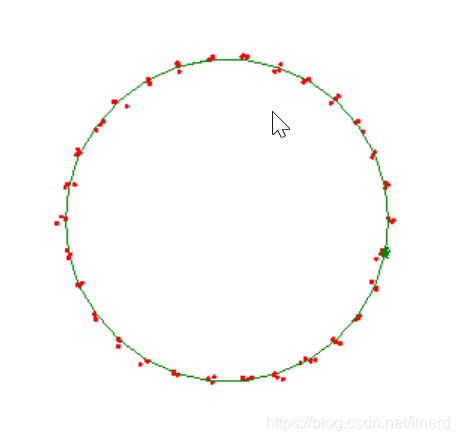
预测目标位置时另辟蹊径,假设目标在 N 个单位时间后会出现在原来某个相同位置上,即具有周期 N,先把周期求出来。
然后得到同一位置在不同时刻的数据,取平均消去高斯误差,得到更准确的位置估计。
# 环形轨道上预测 K 个单位时间后的目标位置
def estimate_next_k_pos(measurement, K, OTHER=None):
    """Estimate the next (x, y) position of the wandering Traxbot
    based on noisy (x, y) measurements."""

    def find_nearist(hist, target):
        nearist = 0
        min_dist = distance_between(hist[nearist], target)
        for i in range(len(hist)):
            dist = distance_between(hist[i], target)
            if dist < min_dist:
                nearist = i
                min_dist = dist
        return nearist

    def next_k_pos(history, period, K):
        estimate = history[-1]
        if period == int(period):
            aver_x, aver_y = 0, 0
            count = 0
            for i in range(len(history)):
                if i%period == (len(history)+K)%period:
                    count += 1
                    aver_x += history[i][0]
                    aver_y += history[i][1]
            if count > 0:
                estimate = (aver_x/count, aver_y/count)
        return estimate

    next_estimate = measurement # 返回下一时刻的目标位置
    next_k_estimate = measurement # 返回下K个时刻的目标位置

    if not OTHER: # 第一次执行时的初始化
        OTHER = [[measurement], [[0, pi]]]
    else:
        history = OTHER[0]
        period_support_list = OTHER[1]
        period_list = [i[1] for i in period_support_list]

        nearist = find_nearist(history, measurement)
        if not nearist == len(history)-1:
            p = len(history)- nearist
            if sum([p%x==0 for x in period_list]) == 0:
                period_support_list.append([1, p])
            else:
                for i in range(len(period_list)):
                    if p%period_list[i] == 0:
                        period_support_list[i][0] += 1

        period_support_list.sort()
        period = period_support_list[-1][1]

        next_estimate = next_k_pos(history, period, 1)
        next_k_estimate = next_k_pos(history, period, K)

        history.append(measurement)
        OTHER = [history, period_support_list]

    return next_estimate, next_k_estimate, OTHER

# 给出 hunter 的下一步动作
def next_move(hunter_position, hunter_heading, target_measurement, max_distance, OTHER = None):
    # This function will be called after each time the target moves.

    # The OTHER variable is a place for you to store any historical information about
    # the progress of the hunt (or maybe some localization information). Your return format
    # must be as follows in order to be graded properly.
    next_estimate, next_k_estimate, OTHER = estimate_next_k_pos(target_measurement, 3, OTHER)

    if distance_between(next_estimate, hunter_position) < 0.9*max_distance:
        estimate = next_estimate
    else:
        estimate = next_k_estimate

    heading_to_target = get_heading(hunter_position, estimate)
    heading_difference = heading_to_target - hunter_heading
    turning =  angle_trunc(heading_difference) # turn towards the target
    distance = distance_between(hunter_position, estimate) # full speed ahead!

    return turning, distance, OTHER

def distance_between(point1, point2):
    """Computes distance between point1 and point2. Points are (x, y) pairs."""
    x1, y1 = point1
    x2, y2 = point2
    return sqrt((x2 - x1) ** 2 + (y2 - y1) ** 2)


def get_heading(hunter_position, target_position):
    """Returns the angle, in radians, between the target and hunter positions"""
    hunter_x, hunter_y = hunter_position
    target_x, target_y = target_position
    heading = atan2(target_y - hunter_y, target_x - hunter_x)
    return angle_trunc(heading)
可视化跟踪过程
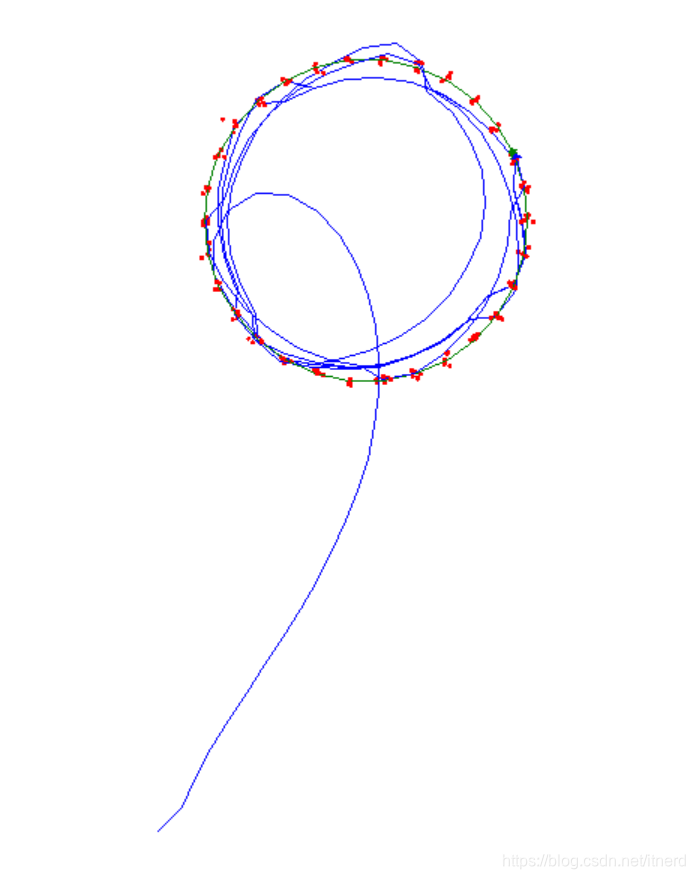
You got it right! It took you 158 steps to catch the target.
def demo_grading(hunter_bot, target_bot, next_move_fcn, OTHER = None):
    """Returns True if your next_move_fcn successfully guides the hunter_bot
    to the target_bot. This function is here to help you understand how we
    will grade your submission."""
    max_distance = 0.98 * target_bot.distance
    separation_tolerance = 0.02 * target_bot.distance # hunter must be within 0.02 step size to catch target
    caught = False
    ctr = 0
    #For Visualization
    import turtle
    window = turtle.Screen()
    window.bgcolor('white')
    chaser_robot = turtle.Turtle()
    chaser_robot.shape('arrow')
    chaser_robot.color('blue')
    chaser_robot.resizemode('user')
    chaser_robot.shapesize(0.3, 0.3, 0.3)
    broken_robot = turtle.Turtle()
    broken_robot.shape('turtle')
    broken_robot.color('green')
    broken_robot.resizemode('user')
    broken_robot.shapesize(0.3, 0.3, 0.3)
    size_multiplier = 15.0 #change Size of animation
    chaser_robot.hideturtle()
    chaser_robot.penup()
    chaser_robot.goto(hunter_bot.x*size_multiplier, hunter_bot.y*size_multiplier-100)
    chaser_robot.showturtle()
    broken_robot.hideturtle()
    broken_robot.penup()
    broken_robot.goto(target_bot.x*size_multiplier, target_bot.y*size_multiplier-100)
    broken_robot.showturtle()
    measuredbroken_robot = turtle.Turtle()
    measuredbroken_robot.shape('circle')
    measuredbroken_robot.color('red')
    measuredbroken_robot.penup()
    measuredbroken_robot.resizemode('user')
    measuredbroken_robot.shapesize(0.1, 0.1, 0.1)
    broken_robot.pendown()
    chaser_robot.pendown()
    #End of Visualization
    # We will use your next_move_fcn until we catch the target or time expires.
    while not caught and ctr < 1000:
        # Check to see if the hunter has caught the target.
        hunter_position = (hunter_bot.x, hunter_bot.y)
        target_position = (target_bot.x, target_bot.y)
        separation = distance_between(hunter_position, target_position)
        if separation < separation_tolerance:
            print("You got it right! It took you ", ctr, " steps to catch the target.")
            caught = True

        # The target broadcasts its noisy measurement
        target_measurement = target_bot.sense()

        # This is where YOUR function will be called.
        turning, distance, OTHER = next_move_fcn(hunter_position, hunter_bot.heading, target_measurement, max_distance, OTHER)

        # Don't try to move faster than allowed!
        if distance > max_distance:
            distance = max_distance

        # We move the hunter according to your instructions
        hunter_bot.move(turning, distance)

        # The target continues its (nearly) circular motion.
        target_bot.move_in_circle()
        #Visualize it
        measuredbroken_robot.setheading(target_bot.heading*180/pi)
        measuredbroken_robot.goto(target_measurement[0]*size_multiplier, target_measurement[1]*size_multiplier-100)
        measuredbroken_robot.stamp()
        broken_robot.setheading(target_bot.heading*180/pi)
        broken_robot.goto(target_bot.x*size_multiplier, target_bot.y*size_multiplier-100)
        chaser_robot.setheading(hunter_bot.heading*180/pi)
        chaser_robot.goto(hunter_bot.x*size_multiplier, hunter_bot.y*size_multiplier-100)
        #End of visualization
        ctr += 1
        if ctr >= 1000:
            print("It took too many steps to catch the target.")
    turtle.done()
    try:
        turtle.bye()
    except turtle.Terminator:
        pass

    return caught





 扫一扫
扫一扫


 1525
1525

 被折叠的 条评论
为什么被折叠?
被折叠的 条评论
为什么被折叠?
 到【灌水乐园】发言





