


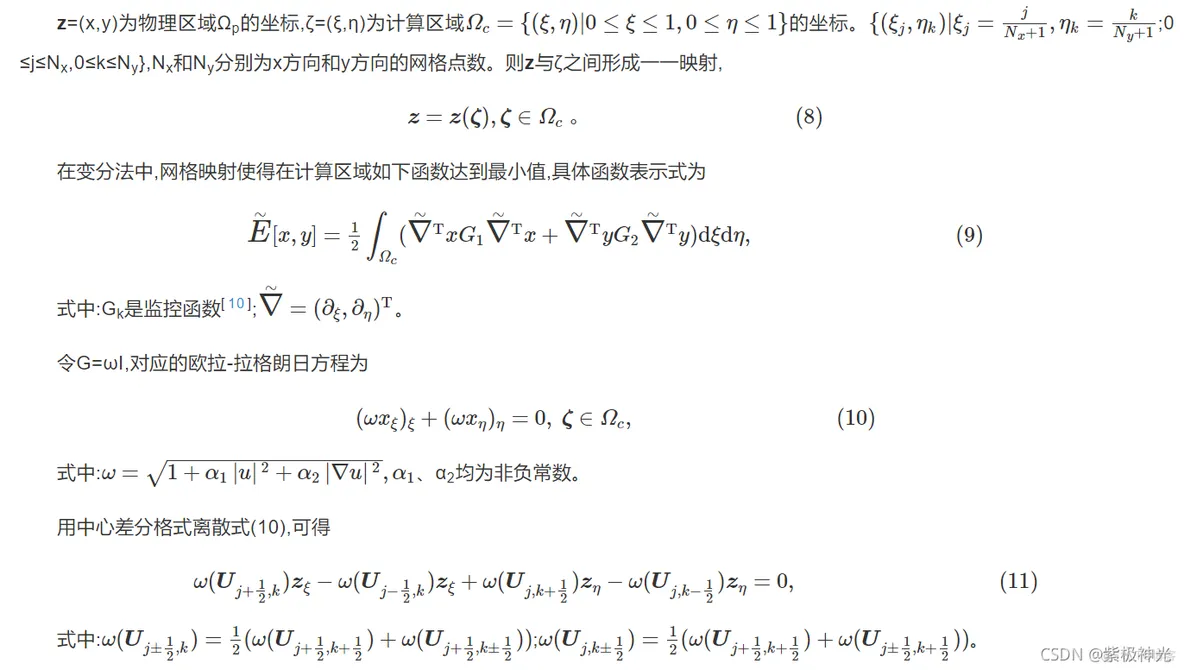
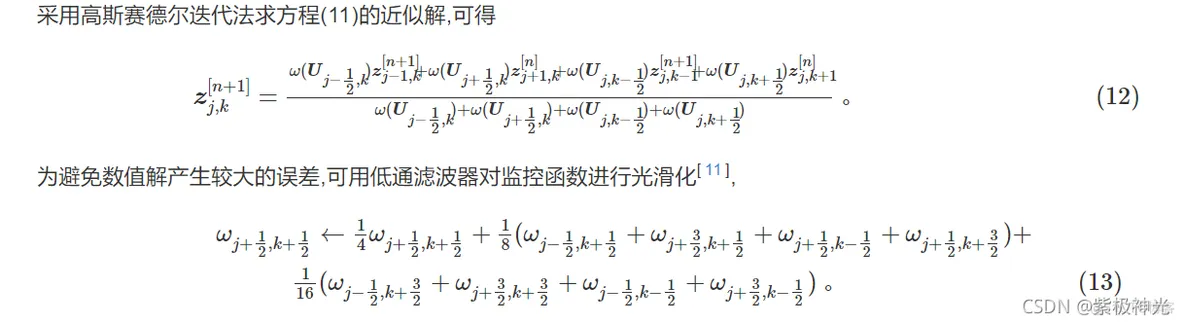
一、二维移动网格法简介

二、部分源代码
%% Program Start
%清零
clc ;clear all;close all;
%设定通信半径为5
global Rc;
Rc = 5;

%设定覆盖区域为L=40的正方形
global L;
L = 5*Rc*sqrt(2);
S = L^2;

%初始化一个5*5的0矩阵,用来保存随机部署后每个网格中的节点个数
initnode_num = zeros(5,5);
node_num = 0;    %用于保存节点个数


%设定网格权重
grid_weight = [2,1,3,1,1;3,2,2,1,2;4,1,2,2,1;1,2,2,3,1;2,5,1,2,1];

%计算总权重
total_weight = 0;
for i = 1:5
    for j = 1:5
        total_weight_temp =  grid_weight(i,j);
        total_weight = total_weight + total_weight_temp;
    end
end

%输出总权重
total_weight
grid_weight
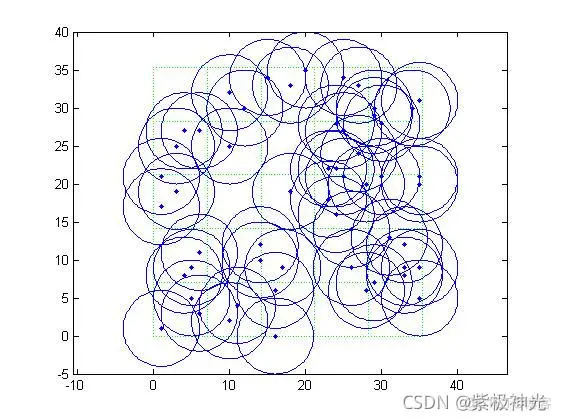
%% Random Deployment
%随机产生坐标,作为节点的初始位置
random_x = randi([0,ceil(L)],1,(total_weight+10));
random_y = randi([0,ceil(L)],1,(total_weight+10));
figure(1);
draw_grid(L);  %画网格
for i = 1:(total_weight+10)
    x1 = random_x(i);
    y1 = random_y(i);
    draw_round(x1,y1);  %节点随机部署图
end

%% Count Initial Nodes
%计算初始化后每个单元格中的节点个数
for i = 1:(total_weight+10)
    temp_x = random_x(i);
    temp_y = random_y(i);
    %首先判断坐标轴上的点
    if temp_x == 0   %y轴上的点
        if temp_y == 0
            initnode_num(1,1) = initnode_num(1,1) + 1;
        else
            for n = 1:L/(Rc*sqrt(2))
                if (temp_y>(n-1)*Rc*sqrt(2))&&((temp_y<n*Rc*sqrt(2))||(temp_y==n*Rc*sqrt(2)))
                    initnode_num(1,n) = initnode_num(1,n)+1;
                end
            end
        end
    end

    if temp_y == 0   %x轴上的点
        for n = 1:L/(Rc*sqrt(2))
            if (temp_x>(n-1)*Rc*sqrt(2))&&((temp_x<n*Rc*sqrt(2))||(temp_x==n*Rc*sqrt(2)))
                initnode_num(n,1) = initnode_num(n,1)+1;
            end
        end
    end

    %非坐标轴上的点
    if (temp_x~=0)||(temp_y~=0)
        for m = 1:L/(Rc*sqrt(2))
            for n = 1:L/(Rc*sqrt(2))
                if ((temp_x>(m-1)*Rc*sqrt(2))&&((temp_x<m*Rc*sqrt(2))||(temp_x==m*Rc*sqrt(2))))&&((temp_y>(n-1)*Rc*sqrt(2))&&((temp_y<n*Rc*sqrt(2))||(temp_y==n*Rc*sqrt(2))))
                 initnode_num(m,n) = initnode_num(m,n)+1;
                end
            end
        end
    end
end
initnode_num

%% Calculate Reject Force
%计算斥力
rejectforce = zeros(5,5);   %初始化5*5的矩阵用于存放网格斥力
for i = 1:5
    for j = 1:5
        %如果网格中的节点数多于网格权重,则斥力等于两者之差,否则斥力为0
        if initnode_num(i,j)>grid_weight(i,j)
           rejectforce(i,j) = initnode_num(i,j)-grid_weight(i,j);
        else
            rejectforce(i,j) = 0;
        end
       %rejectforce(i,j) = initnode_num(i,j)-grid_weight(i,j);
    end
end
grid_weight
initnode_num
rejectforce

%% Calculate Attractive Force
%计算引力
attractiveforce = zeros(25,4);  %初始化25*4的矩阵,存放每个网格受到的引力,由于每个网格周围有四个网格
                                %列坐标从小到大表示左、上、右、下,处在边缘的网格若周围没有其他网格,用0表示,即不受
                                %此方向的引力。另外,第一行代表(1,1)网格,第二行代表(1,2),……,第六行代表
                                %(2,1)网格,第七行代表(2,2)网格,……,最后一行代表(5,5)网格
for m = 1:5             %m为x轴坐标
    for n = 1:5         %n为y轴坐标
        j = 1;
        i = add1;       %i自动加1,从1到25
        if (m-1)>0      %算左边网格
            if grid_weight(m-1,n)>initnode_num(m-1,n)
               attractiveforce(i,j) = grid_weight(m-1,n)-initnode_num(m-1,n);
            else
               attractiveforce(i,j) = 0;
            end
        else
           attractiveforce(i,j) = 0;
        end
        %算上边网格
        j = j+1;
        if (n+1)<6
            if grid_weight(m,n+1)>initnode_num(m,n+1)
               attractiveforce(i,j) = grid_weight(m,n+1)-initnode_num(m,n+1);
            else
               attractiveforce(i,j) = 0;
            end
        else
           attractiveforce(i,j) = 0;
        end
        %算右边网格
        j = j+1;
        if (m+1)<6
            if grid_weight(m+1,n)>initnode_num(m+1,n)
               attractiveforce(i,j) = grid_weight(m+1,n)-initnode_num(m+1,n);
            else
               attractiveforce(i,j) = 0;
            end
        else
           attractiveforce(i,j) = 0;
        end
        %算下边网格
        j = j+1;
        if (n-1)>0
            if grid_weight(m,n-1)>initnode_num(m,n-1)
               attractiveforce(i,j) = grid_weight(m,n-1)-initnode_num(m,n-1);
            else
               attractiveforce(i,j) = 0;
            end
        else
           attractiveforce(i,j) = 0;
        end
    end
end
attractiveforce

%% Calculate Moving Probability and Move Nodes
%计算移动概率并移动节点同时将网格中的节点移动到网格中心
for m = 1:5
    for n = 1:5
        k = add1;
        j = 1;
        while ((rejectforce(m,n)>0)&&((attractiveforce(k,1)~=0)||(attractiveforce(k,2)~=0)||(attractiveforce(k,3)~=0)||(attractiveforce(k,4)~=0)))
            %当中心网格斥力大于0&&周围引力至少有一个非0时成立
            j = 1;
            attractiveforce_max = attractiveforce(k,j);
            row = k;
            col = j;
            for j = 2:4    %求最大引力,即求得最大移动概率
                if attractiveforce(k,j)>attractiveforce_max
                    attractiveforce_max = attractiveforce(k,j);
                    row = k;
                    col = j;
                end
            end
            initnode_num(m,n) = initnode_num(m,n)-1;  %相应网格节点减1
            rejectforce(m,n) = rejectforce(m,n)-1;    %相应的斥力也减1
            attractiveforce(row,col) = attractiveforce(row,col)-1; %相应网格引力减1
            %下面进行坐标转换,使通过引力获得节点的网格节点数加1
            m1 = m;
            n1 = n;
            if col == 1
                m1 = m1-1;
            elseif col == 2
                n1 = n1+1;
            elseif col == 3
                m1 = m1+1;
            elseif col == 4
                n1 = n1-1;
            end
            initnode_num(m1,n1) = initnode_num(m1,n1)+1;
        end
    end
end
grid_weight
initnode_num
rejectforce

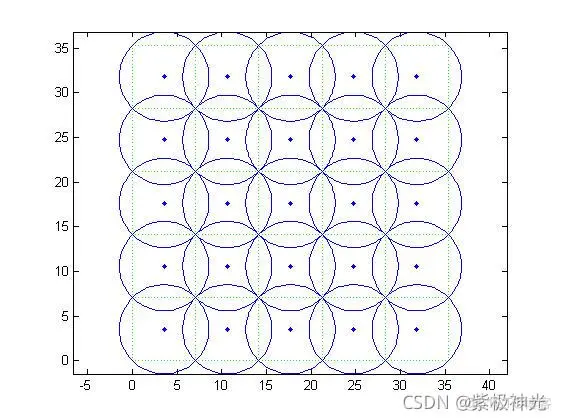
figure(2);     %动态调整后的节点部署
draw_grid(L);  %画网格
for i = 1:5
    for j = 1:5
        if initnode_num(i,j)~=0
        draw_round(((i-0.5)*Rc*sqrt(2)),((j-0.5)*Rc*sqrt(2)));
        end
    end
end
%--------------------------------------------
%程序名  :  i = add1()
%参数说明:  无参数
%功能    :  实现加1功能
%调用方式:  i = add1
%--------------------------------------------
function i = add1()
persistent a
if isempty(a)  %判断a是否已经赋值(初始化)
    a=0;
end
    a=a+1;
    if a >25;
        a = 1;
    end
i=a;- 1.
- 2.
- 3.
- 4.
- 5.
- 6.
- 7.
- 8.
- 9.
- 10.
- 11.
- 12.
- 13.
- 14.
- 15.
- 16.
- 17.
- 18.
- 19.
- 20.
- 21.
- 22.
- 23.
- 24.
- 25.
- 26.
- 27.
- 28.
- 29.
- 30.
- 31.
- 32.
- 33.
- 34.
- 35.
- 36.
- 37.
- 38.
- 39.
- 40.
- 41.
- 42.
- 43.
- 44.
- 45.
- 46.
- 47.
- 48.
- 49.
- 50.
- 51.
- 52.
- 53.
- 54.
- 55.
- 56.
- 57.
- 58.
- 59.
- 60.
- 61.
- 62.
- 63.
- 64.
- 65.
- 66.
- 67.
- 68.
- 69.
- 70.
- 71.
- 72.
- 73.
- 74.
- 75.
- 76.
- 77.
- 78.
- 79.
- 80.
- 81.
- 82.
- 83.
- 84.
- 85.
- 86.
- 87.
- 88.
- 89.
- 90.
- 91.
- 92.
- 93.
- 94.
- 95.
- 96.
- 97.
- 98.
- 99.
- 100.
- 101.
- 102.
- 103.
- 104.
- 105.
- 106.
- 107.
- 108.
- 109.
- 110.
- 111.
- 112.
- 113.
- 114.
- 115.
- 116.
- 117.
- 118.
- 119.
- 120.
- 121.
- 122.
- 123.
- 124.
- 125.
- 126.
- 127.
- 128.
- 129.
- 130.
- 131.
- 132.
- 133.
- 134.
- 135.
- 136.
- 137.
- 138.
- 139.
- 140.
- 141.
- 142.
- 143.
- 144.
- 145.
- 146.
- 147.
- 148.
- 149.
- 150.
- 151.
- 152.
- 153.
- 154.
- 155.
- 156.
- 157.
- 158.
- 159.
- 160.
- 161.
- 162.
- 163.
- 164.
- 165.
- 166.
- 167.
- 168.
- 169.
- 170.
- 171.
- 172.
- 173.
- 174.
- 175.
- 176.
- 177.
- 178.
- 179.
- 180.
- 181.
- 182.
- 183.
- 184.
- 185.
- 186.
- 187.
- 188.
- 189.
- 190.
- 191.
- 192.
- 193.
- 194.
- 195.
- 196.
- 197.
- 198.
- 199.
- 200.
- 201.
- 202.
- 203.
- 204.
- 205.
- 206.
- 207.
- 208.
- 209.
- 210.
- 211.
- 212.
- 213.
- 214.
- 215.
- 216.
- 217.
- 218.
- 219.
- 220.
- 221.
- 222.
- 223.
- 224.
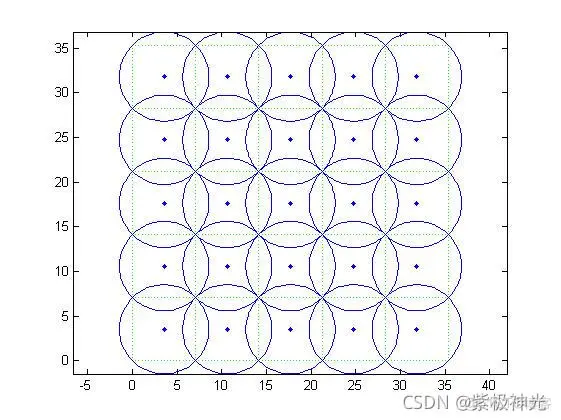
三、运行结果
四、matlab版本及参考文献
1 matlab版本
2014a
2 参考文献
[1] 包子阳,余继周,杨杉.智能优化算法及其MATLAB实例(第2版)[M].电子工业出版社,2016.
[2]张岩,吴水根.MATLAB优化算法源代码[M].清华大学出版社,2017.






 扫一扫
扫一扫


 227
227

 被折叠的 条评论
为什么被折叠?
被折叠的 条评论
为什么被折叠?
 到【灌水乐园】发言





