



链表是一种动态数据结构,通过节点间的指针连接实现数据存储。队列是一种先进先出的线性结构,链表实现队列可以避免数组实现时的空间限制问题。
-
入队:从队尾加入
-
出队:从队首移除
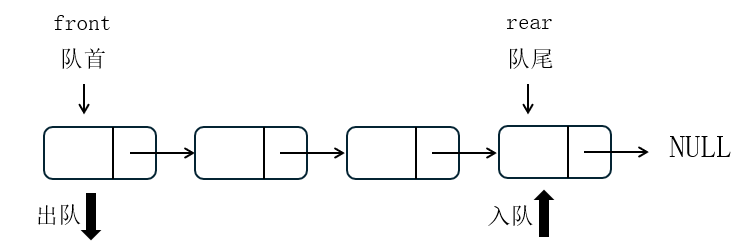
一、数据结构定义
两个节点:
-
front:总指向第一个节点(出队端) -
rear:总指向最后一个节点(入队端)
#include <stdio.h>
#include <stdlib.h>

typedef struct Node {
    int data;
    struct Node* next;
}Node;   //取别名

Node* front = NULL;  // 队首指针
Node* rear = NULL;   // 队尾指针
二、代码详解
2.1 入队操作(add_queue)
步骤:创建新节点 → 连接队尾 → 更新rear
void add_queue(int value) {
    // 步骤1:创建新节点
    // malloc分配内存,类似:新建一个"盒子"
    Node* new_node = (Node*)malloc(sizeof(Node));
    new_node->data = value;
    new_node->next = NULL;

    // 步骤2:判断队列是否为空
    if (rear == NULL) {
        // 队列为空时,新节点既是队首也是队尾
        front = new_node;  // 队首指向新节点
        rear = new_node;   // 队尾也指向新节点
    } else {
        // 队列不为空时
        rear->next = new_node;  // 当前队尾的下一个指向新节点
        rear = new_node;        // 队尾指针更新为新节点
    }
}
2.2 出队操作(del_queue)
步骤:保存front → 移动front → 检查是否变空 → 释放内存
int del_queue() {
    // 步骤1:检查队列是否为空
    if (front == NULL) {
        return -1;     // 队列为空
    }

    // 步骤2:保存要删除的节点
    Node* temp = front;         // temp指向队首
    int value = temp->data;     // 保存数据

    // 步骤3:移动front指针
    front = front->next;        // front指向下一个节点

    // 步骤4:如果出队后队列为空,重置rear
    if (front == NULL) {
        rear = NULL;
    }

    // 步骤5:释放内存
    free(temp);

    return value;
}
2.3 打印队列(print_queue)
void print_queue() {
    if (front == NULL) {
        printf("队列为空!\n");
        return;
    }

    Node* current = front;      // 从队首开始
    while (current != NULL) {
        printf("%d ", current->data);
        current = current->next;   // 移动到下一个节点
    }
    printf("\n");
}
2.4 清空队列(clear_queue)
void clear_queue() {
    while (front != NULL) {
        del_queue();
    }
    printf("队列已清空!\n");
}
2.4 主函数main
int main() {
    int a, b, c;
    a = 10;
    b = 20;
    c = 30;

    printf("=== 链表实现队列测试 ===\n\n");

    // 测试入队
    printf("1. 测试入队操作:\n");
    add_queue(a);
    add_queue(b);
    add_queue(c);
    print_queue();

    // 测试获取队首
    printf("\n2. 获取队首元素:%d\n", get_front());

    // 测试出队
    printf("\n3. 测试出队操作:\n");
    del_queue();
    print_queue();

    // 继续入队
    printf("\n4. 继续入队:\n");
    add_queue(40);
    add_queue(50);
    print_queue();

    // 出队所有元素
    printf("\n5. 出队所有元素:\n");
    while (front != NULL) {
        del_queue();
    }
    print_queue();

    // 测试空队列操作
    printf("\n6. 测试空队列操作:\n");
    del_queue();  // 应该提示队列为空

    return 0;
}
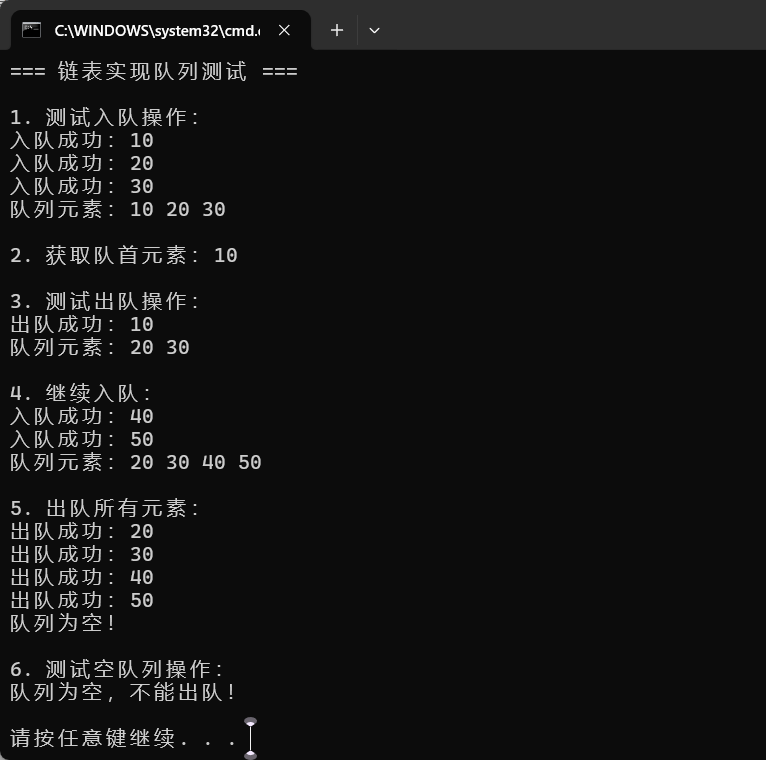
三、运行结果





 扫一扫
扫一扫


 1334
1334

 被折叠的 条评论
为什么被折叠?
被折叠的 条评论
为什么被折叠?
 到【灌水乐园】发言





