


目录
引言
在C++编程中,字符串处理是日常开发中必不可少的一部分。C++标准模板库(STL)中的string类提供了强大而灵活的字符串操作功能,相比传统的C风格字符串(字符数组),string更加安全、易用且功能丰富。本文将详细介绍string类的常用方法,并通过实际示例展示其用法。
1. 字符串的创建和初始化
#include <iostream>
#include <string>

int main() {
    // 1. 默认构造函数,创建空字符串
    std::string str1;

    // 2. 使用C风格字符串初始化
    std::string str2 = "Hello, World!";
    std::string str3("Hello, C++");

    // 3. 使用另一个string对象初始化
    std::string str4(str3);
    std::string str5 = str2;

    // 4. 使用部分字符序列初始化
    std::string str6("Hello, World!", 5);  // 只取前5个字符: "Hello"

    // 5. 使用多个相同字符初始化
    std::string str7(10, '*');  // "**********"

    // 6. 使用迭代器初始化
    std::string str8(str2.begin(), str2.begin() + 5);  // "Hello"

    std::cout << str1 << std::endl;
    std::cout << str2 << std::endl;
    std::cout << str3 << std::endl;
    std::cout << str4 << std::endl;
    std::cout << str5 << std::endl;
    std::cout << str6 << std::endl;
    std::cout << str7 << std::endl;
    std::cout << str8 << std::endl;

    return 0;
}
结果: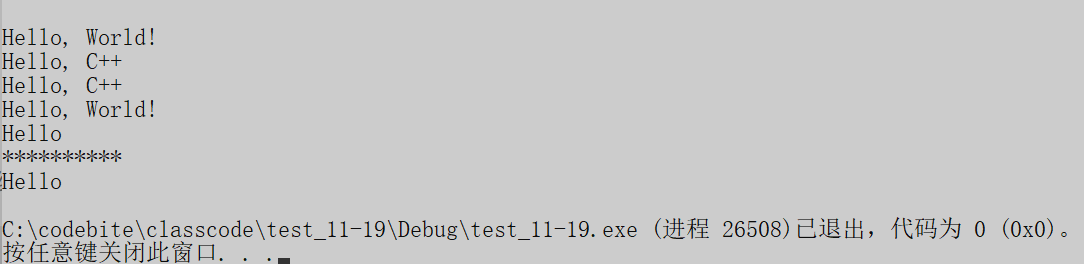
2. 字符串基本操作
2.1 获取字符串信息
#include <iostream>
#include <string>

int main() {
    std::string str = "Hello, C++ STL!......";

    // 获取字符串长度
    std::cout << "Length: " << str.length() << std::endl;
    std::cout << "Size: " << str.size() << std::endl;
    std::cout << "Capacity: " << str.capacity() << std::endl;

    // 检查字符串是否为空
    std::string emptyStr;
    std::cout << "Is empty? " << emptyStr.empty() << std::endl;  // 1 (true)
    std::cout << "Is str empty? " << str.empty() << std::endl;   // 0 (false)

    // 获取C风格字符串
    const char* cstr = str.c_str();
    std::cout << "C-string: " << cstr << std::endl;

    return 0;
}
结果:

补充:
1. size()和length()在功能上完全相同,它们都返回字符串当前包含的字符数。
为什么有两个相同的函数?
string类的诞生是早于STL容器的,早期的string类用length来表示字符数,后来为了与STL容器接口保持一致,所以添加了size()函数,我个人更推荐使用size(),既方便记忆,也更能体现STL容器设计理念的一致性。
2. capacity()返回的是当前为字符串分配的内存空间(以字符数为单位),这个空间可以容纳的字符数。这个值通常大于或等于size()。
当向字符串添加字符时,如果size()小于capacity(),则不需要重新分配内存。只有当size()达到capacity()时,再添加字符就会触发内存重新分配,增加capacity(),以便容纳更多的字符。
为了减少重新分配内存所造成的性能开销,通常扩容的逻辑为按原来容量的1.5倍到2倍进行扩容。
3.c_str()的存在打通了C语言的字符串与C++字符串之间的隔阂,实现了向下兼容,事实上string类的底层就是管理了一个动态数组,c_str()就是返回这个数组的首元素地址。
2.2 访问和修改字符
#include <iostream>
#include <string>

int main() {
    std::string str = "Hello";

    // 使用下标访问
    std::cout << "str[0] = " << str[0] << std::endl;   // 'H'
    std::cout << "str[1] = " << str[1] << std::endl;   // 'e'
    // 使用at()访问(会检查边界)
    std::cout << "str.at(2) = " << str.at(2) << std::endl;  // 'l'

    // 修改字符
    str[0] = 'h';
    str.at(1) = 'E';
    std::cout << "After modification: " << str << std::endl;  // "hello"

    // 获取第一个和最后一个字符
    std::cout << "Front: " << str.front() << std::endl;  // 'h'
    std::cout << "Back: " << str.back() << std::endl;    // 'o'

    return 0;
}
结果:
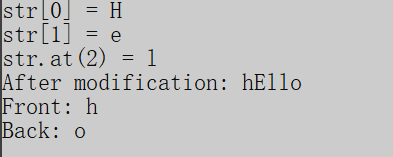
补充:
1. at()访问元素和[]访问元素的核心区别总结
| 特性 |
|
|
|---|---|---|
| 边界检查 | 不进行边界检查 | 进行边界检查 |
| 越界行为 | 未定义行为(可能导致崩溃) | 抛出 |
| 性能 | 更高效(无检查开销) | 稍慢(有检查开销) |
| 适用场景 | 已知索引安全的快速访问 | 需要安全检查的情况 |
| 异常安全 | 不抛出异常 | 抛出异常 |
3. 字符串修改操作
3.1 追加字符串
#include <iostream>
#include <string>

int main() {
    std::string str = "Hello";

    // 使用+=运算符
    str += ", World";
    std::cout << "After +=: " << str << std::endl;  // "Hello, World"

    // 使用append()函数
    str.append("!");
    std::cout << "After append: " << str << std::endl;  // "Hello, World!"

    str.append(" Welcome to C++", 9);  // 只追加前9个字符
    std::cout << "After append with length: " << str << std::endl;  // "Hello, World! Welcome"

    // 追加多个相同字符
    str.append(3, '!');
    std::cout << "After append chars: " << str << std::endl;  // "Hello, World! Welcome!!!"

    return 0;
}
结果:

3.2 插入字符串
#include <iostream>
#include <string>

int main() {
    std::string str = "Hello World!";

    // 在指定位置插入
    str.insert(6, "Beautiful ");
    std::cout << "After insert: " << str << std::endl;  // "Hello Beautiful World!"

    // 插入部分字符串
    std::string insertStr = "Amazing and ";
    str.insert(6, insertStr, 0, 8);  // 从insertStr的第0个位置开始插入8个字符
    std::cout << "After partial insert: " << str << std::endl;  // "Hello Amazing Beautiful World!"

    // 插入多个相同字符
    str.insert(0, 3, '*');  // 在开头插入3个*
    std::cout << "After inserting chars: " << str << std::endl;  // "***Hello Amazing Beautiful World!"

    return 0;
}
结果:
3.3 删除字串内容
#include <iostream>
#include <string>

int main() {
    std::string str = "Hello, World! This is C++.";

    // 删除从位置7开始的5个字符
    str.erase(7, 5);
    std::cout << "After erase: " << str << std::endl;  // "Hello, ! This is C++."

    // 删除从位置7到末尾的所有字符
    std::string str2 = "Hello, World!";
    str2.erase(7);
    std::cout << "After erase to end: " << str2 << std::endl;  // "Hello, "

    // 删除最后一个字符
    str2.pop_back();
    std::cout << "After pop_back: " << str2 << std::endl;  // "Hello,"

    // 清空整个字符串
    str2.clear();
    std::cout << "After clear, is empty? " << str2.empty() << std::endl;  // 1 (true)

    return 0;
}
结果:
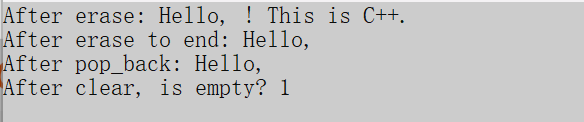
3.4 替换字符串
#include <iostream>
#include <string>

int main() {
    std::string str = "Hello, World!";

    // 替换从位置7开始的5个字符
    str.replace(7, 5, "C++");
    std::cout << "After replace: " << str << std::endl;  // "Hello, C++!"

    // 使用子字符串替换
    std::string newStr = "Amazing cpp";
    str.replace(7, 3, newStr, 8, 3);  // 用newStr中从8开始的3个字符替换
    std::cout << "After replace with substring: " << str << std::endl;  // "Hello, cpp!"

    return 0;
}
结果:

4. 字符串查找和子字符串
4.1 查找操作
#include <iostream>
#include <string>

int main() {
    std::string str = "Hello, World! Hello, C++!";

    // 查找子字符串
    size_t pos = str.find("Hello");
    if (pos != std::string::npos) {
        std::cout << "Found 'Hello' at position: " << pos << std::endl;  // 0
    }

    // 从指定位置开始查找
    pos = str.find("Hello", 1);
    if (pos != std::string::npos) {
        std::cout << "Found second 'Hello' at position: " << pos << std::endl;  // 14
    }

    // 查找字符
    pos = str.find('W');
    if (pos != std::string::npos) {
        std::cout << "Found 'W' at position: " << pos << std::endl;  // 7
    }

    // 反向查找
    pos = str.rfind("Hello");
    if (pos != std::string::npos) {
        std::cout << "Found last 'Hello' at position: " << pos << std::endl;  // 14
    }

    // 查找字符集中任意字符首次出现的位置
    pos = str.find_first_of(" ,!");//字符集就是(" ,!")
    if (pos != std::string::npos) {
        std::cout << "First of ', !' at position: " << pos << std::endl;  // 5
    }

    // 查找不在字符集中的字符首次出现的位置
    pos = str.find_first_not_of("Helo");//字符集就是("Helo")
    if (pos != std::string::npos) {
        std::cout << "First not of 'Helo' at position: " << pos << std::endl;  // 4 (,)
    }

    return 0;
}
结果:

补充:
1. 上面的这些查找函数,如果找到了目标字符或字符串,则返回字符下标或字符串首元素下标,如果没有找到目标字符或字符串,则返回string::npos表示"没有找到"或"无效位置"。std::string::npos是C++中std::string类的一个静态常量成员。
// npos的定义
static const size_t npos = -1;尽管它被定义为-1,但由于size_t是无符号整型,-1会被转换为该类型的最大值
4.2 提取子字符串
#include <iostream>
#include <string>

int main() {
    std::string str = "Hello, World! Welcome to C++ Programming.";

    // 提取子字符串
    std::string sub1 = str.substr(7, 5);//返回从下标7开始的5个字符
    std::cout << "Substring 1: " << sub1 << std::endl;  // "World"

    // 从指定位置到末尾
    std::string sub2 = str.substr(7);//返回从下标7开始后面所有字符
    std::cout << "Substring 2: " << sub2 << std::endl;  // "World! Welcome to C++ Programming."

    // 结合find使用
    size_t commaPos = str.find(',');
    if (commaPos != std::string::npos) {
        std::string beforeComma = str.substr(0, commaPos);
        std::cout << "Before comma: " << beforeComma << std::endl;  // "Hello"
    }

    return 0;
}
结果:

5. 字符串比较
#include <iostream>
#include <string>

int main() {
    std::string str1 = "apple";
    std::string str2 = "banana";
    std::string str3 = "apple";

    // 使用比较运算符
    std::cout << std::boolalpha;
    std::cout << "str1 == str2: " << (str1 == str2) << std::endl;  // false
    std::cout << "str1 == str3: " << (str1 == str3) << std::endl;  // true
    std::cout << "str1 < str2: " << (str1 < str2) << std::endl;    // true
    std::cout << "str1 > str2: " << (str1 > str2) << std::endl;    // false

    // 使用compare()函数
    int result = str1.compare(str2);
    if (result < 0) {
        std::cout << "str1 is less than str2" << std::endl;
    }
    else if (result > 0) {
        std::cout << "str1 is greater than str2" << std::endl;
    }
    else {
        std::cout << "str1 is equal to str2" << std::endl;
    }

    // 比较子字符串
    std::string str4 = "Hello, World!";
    std::string str5 = "Hello, C++!";
    result = str4.compare(0, 5, str5, 0, 5);  // 比较前5个字符
    std::cout << "Compare first 5 chars: " << result << std::endl;  // 0 (相等)

    return 0;
}
结果:
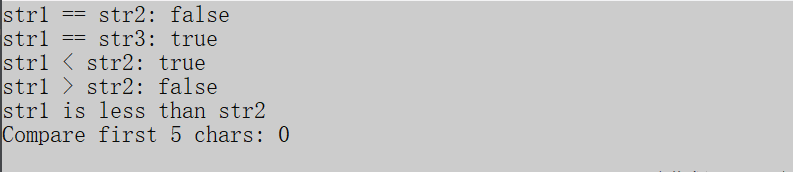
补充:
1. 注意:比较运算符的返回结果与字符串长度无关,字符串的比较逻辑为,从左到右依次比较每一个字符的ASCII码,>和<比较运算符,当遇到第一个ASCII码不相等的字符时,进行ASCII码比较,然后返回结果,比较结束。
2. compare()函数,例如:a.compare(b), a>b则返回值大于0,a<b则返回值小于0,a==b则返回值等于0.
6. 字符串与数值转换
6.1 数值转换为字符串
#include <iostream>
#include <string>

int main() {
    // C++11之后可以使用to_string函数
    int num = 123;
    double pi = 3.14159;

    std::string str1 = std::to_string(num);
    std::string str2 = std::to_string(pi);

    std::cout << "Integer to string: " << str1 << std::endl;  // "123"
    std::cout << "Double to string: " << str2 << std::endl;   // "3.141590"

    return 0;
}
结果:

6.2 字符串转换为数值
#include <iostream>
#include <string>

int main() {
    std::string str1 = "123";
    std::string str2 = "3.14159";
    std::string str3 = "100";

    // 字符串转整数
    int num1 = std::stoi(str1);
    std::cout << "String to int: " << num1 << std::endl;  // 123

    // 字符串转浮点数
    double num2 = std::stod(str2);
    std::cout << "String to double: " << num2 << std::endl;  // 3.14159

    // 指定进制转换
    int num3 = std::stoi(str3, nullptr, 2);  // 二进制
    std::cout << "Binary string to int: " << num3 << std::endl;  // 4

    // 获取转换停止的位置
    std::string str4 = "123abc";
    size_t pos;
    int num4 = std::stoi(str4, &pos);
    std::cout << "Number: " << num4 << ", Stopped at position: " << pos << std::endl;  // 123, 3

    return 0;
}
结果:

7. 字符串输入输出
7.1 输入输出操作
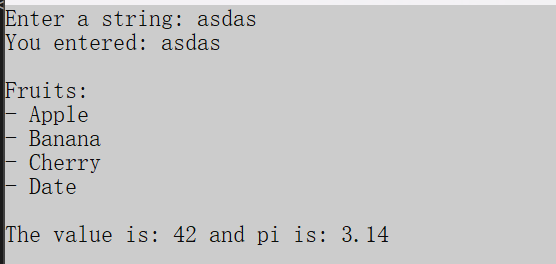
#include <iostream>
#include <string>
#include <sstream>

int main() {
    // 从标准输入读取
    std::string input;
    std::cout << "Enter a string: ";
    std::getline(std::cin, input);
    std::cout << "You entered: " << input << std::endl;

    // 使用stringstream进行字符串分割
    std::string data = "Apple Banana Cherry Date";
    std::stringstream ss(data);
    std::string fruit;

    std::cout << "\nFruits:" << std::endl;
    while (std::getline(ss, fruit, ' ')) {
        std::cout << "- " << fruit << std::endl;
    }

    // 使用stringstream进行字符串拼接
    std::stringstream ss2;
    ss2 << "The value is: " << 42 << " and pi is: " << 3.14;
    std::cout << "\n" << ss2.str() << std::endl;

    return 0;
}
结果:
补充:
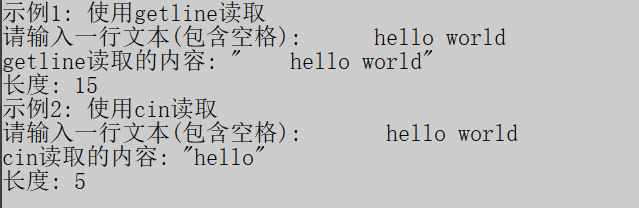
cin和getline获取字符串的区别
| 特性 |
|
|
|---|---|---|
| 读取方式 | 读取到空白字符(空格、制表符、换行符)停止 | 读取到换行符停止 |
| 处理空白字符 | 跳过前导空白,遇到空白停止读取 | 不跳过空白,读取所有字符直到换行符 |
| 换行符处理 | 留在输入缓冲区中 | 从输入缓冲区读取并丢弃 |
| 读取整行 | 不能直接读取整行(遇到空格会停止) | 专门用于读取整行 |
| 使用场景 | 读取单词、数字等以空白分隔的数据 | 读取包含空格的整行文本 |
#include <iostream>
#include <string>

int main() {
    std::string input1, input2;

    // 示例1: 使用getline读取
    std::cout << "\n示例1: 使用getline读取" << std::endl;
    std::cout << "请输入一行文本(包含空格): ";
    std::cin.ignore();  // 清除上一个输入留下的换行符
    std::getline(std::cin, input2);  // 用户输入: Hello World
    std::cout << "getline读取的内容: \"" << input2 << "\"" << std::endl;
    std::cout << "长度: " << input2.length() << std::endl;


    // 示例2: 使用cin读取
    std::cout << "示例2: 使用cin读取" << std::endl;
    std::cout << "请输入一行文本(包含空格): ";
    std::cin >> input1;  // 用户输入: Hello World
    std::cout << "cin读取的内容: \"" << input1 << "\"" << std::endl;
    std::cout << "长度: " << input1.length() << std::endl;


    return 0;
}
8. 其他有用操作
8.1 调整字符串大小
#include <iostream>
#include <string>

int main() {
    std::string str = "Hello";
    std::string str2;
    str2.reserve(64);
    //如果提前知道要写入的字符串的长度,可以使用reserve()函数,
    //提前分配好足够的空间,减少后续重新分配内存造成的性能损失
    std::cout <<"str2 Capacity: "<< str2.capacity() << std::endl;

    // 调整大小,如果新大小大于当前大小,用指定字符填充
    str.resize(10, '!');
    std::cout << "After resize to 10: " << str << std::endl;  // "Hello!!!!!"

    // 调整大小,如果新大小小于当前大小,截断
    str.resize(3);
    std::cout << "After resize to 3: " << str << std::endl;  // "Hel"

    // 保留容量
    std::string longStr = "This is a long string for testing capacity";
    std::cout << "Capacity before: " << longStr.capacity() << std::endl;
    longStr.shrink_to_fit();  // 请求减少容量以适应大小,建议性请求,编译器不一定会执行
    std::cout << "Capacity after shrink_to_fit: " << longStr.capacity() << std::endl;

    return 0;
}
结果:

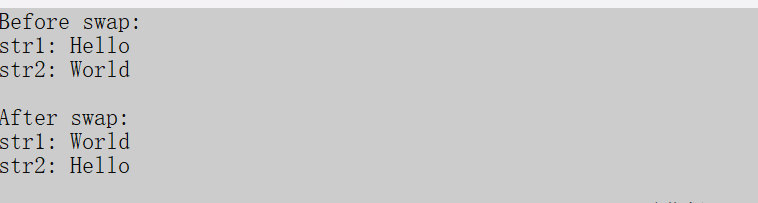
8.2 字符串交换
#include <iostream>
#include <string>

int main() {
    std::string str1 = "Hello";
    std::string str2 = "World";

    std::cout << "Before swap:" << std::endl;
    std::cout << "str1: " << str1 << std::endl;  // "Hello"
    std::cout << "str2: " << str2 << std::endl;  // "World"

    str1.swap(str2);

    std::cout << "\nAfter swap:" << std::endl;
    std::cout << "str1: " << str1 << std::endl;  // "World"
    std::cout << "str2: " << str2 << std::endl;  // "Hello"

    return 0;
}
结果:
那么本期的内容就到这里了,觉得有收获的同学们可以给个点赞、评论、关注、收藏哦,谢谢大家。





 扫一扫
扫一扫


 1426
1426

 被折叠的 条评论
为什么被折叠?
被折叠的 条评论
为什么被折叠?
 到【灌水乐园】发言





