import tensorflow as tf
import matplotlib.pyplot as plt

mnist = tf.keras.datasets.mnist

(x_train, y_train), (x_test, y_test) = mnist.load_data()

x_train = tf.expand_dims(x_train / 255.0, -1)

class Encoder(tf.keras.Model):
    def __init__(self):
        super(Encoder, self).__init__()
        self.conv = tf.keras.Sequential([
            tf.keras.layers.Conv2D(filters=32, kernel_size=(7, 7), activation='relu', strides=2),
            tf.keras.layers.BatchNormalization(),
            tf.keras.layers.Conv2D(filters=64, kernel_size=(5, 5), activation='relu', strides=1),
            tf.keras.layers.BatchNormalization(),
            tf.keras.layers.Conv2D(filters=128, kernel_size=(3, 3), activation='relu', strides=1),
            tf.keras.layers.BatchNormalization(),
        ])
        self.fc = tf.keras.Sequential([
            tf.keras.layers.Flatten(),
            tf.keras.layers.Dense(128, activation='relu'),
            tf.keras.layers.Dense(128, activation='relu'),
            tf.keras.layers.Dense(2, activation='tanh')
        ])

    def call(self, inputs):
        x = self.conv(inputs)
        y = self.fc(x)
        return y

class Decoder(tf.keras.Model):
    def __init__(self):
        super(Decoder, self).__init__()
        self.fc = tf.keras.Sequential([
            tf.keras.layers.Dense(128, activation='relu'),
            tf.keras.layers.Dense(128, activation='relu'),
            tf.keras.layers.Dense(5 * 5 * 128, activation='relu'),
        ])
        self.d_conv = tf.keras.Sequential([
            tf.keras.layers.Conv2DTranspose(filters=64, kernel_size=(3, 3), activation='relu', strides=1),
            tf.keras.layers.BatchNormalization(),
            tf.keras.layers.Conv2DTranspose(filters=32, kernel_size=(5, 5), activation='relu', strides=1),
            tf.keras.layers.BatchNormalization(),
            tf.keras.layers.Conv2DTranspose(filters=1, kernel_size=(8, 8), activation='sigmoid', strides=2),
            tf.keras.layers.BatchNormalization(),
        ])

    def call(self, inputs):
        x = self.fc(inputs)
        x = tf.reshape(x, [-1, 5, 5, 128])
        y = self.d_conv(x)
        return y

if __name__ == '__main__':

    encoder = Encoder()
    decoder = Decoder()

    out = encoder.predict(x_train)
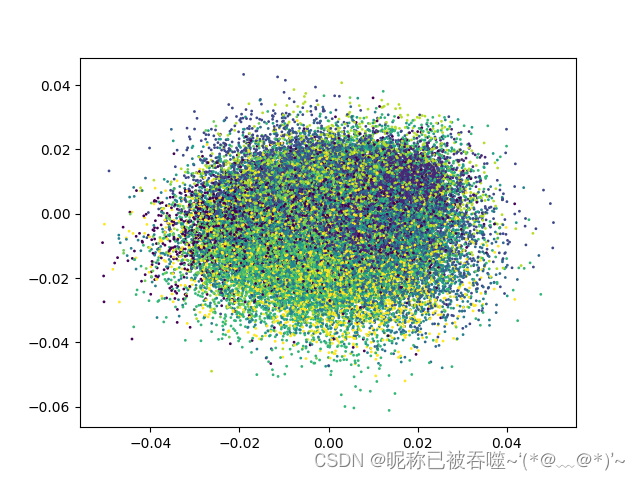
    plt.scatter(out.T[0], out.T[1], c=y_train, s=1)
    plt.show()

    model = tf.keras.Sequential([
        encoder, decoder
    ])

    model.compile(optimizer='adam', loss='MSE')

    model.fit(x_train, x_train, batch_size=1024, epochs=100)

    out = encoder.predict(x_train)
    plt.scatter(out.T[0], out.T[1], c=y_train, s=1)
    plt.show()
encode before training
encode after training
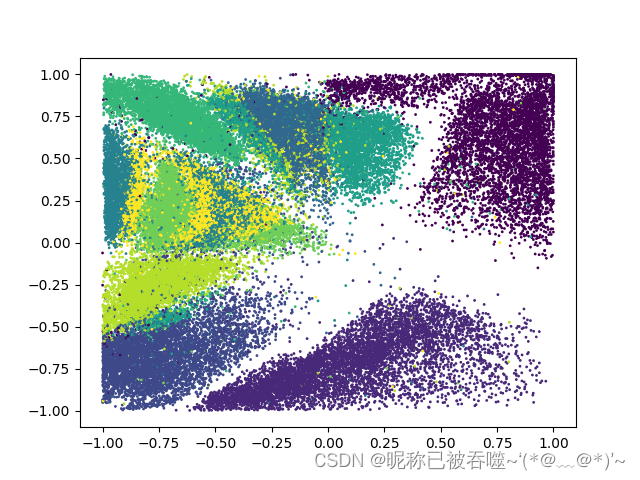






 本文介绍了使用TensorFlow构建的自动编码器模型,包括编码器和解码器的设计,以及如何对MNIST数据集进行预处理和训练。通过编码前后的特征可视化,展示了模型在数据压缩和重构上的效果。






 扫一扫
扫一扫


 4370
4370

 被折叠的 条评论
为什么被折叠?
被折叠的 条评论
为什么被折叠?
 到【灌水乐园】发言





