



注:本文为 “传感器” 相关合辑译文,机翻未校。
图片清晰度受引文原图所限。
略作重排,未整理去重。
如有内容异常,请看原文。
Difference Between Sensor and Transducer
传感器与换能器的区别
Last Updated : 12 Jul, 2025
Sensors and transducers are devices used in measurement systems, but they serve different purposes. A sensor detects and measures a physical property, providing raw data about the environment. A transducer, on the other hand, converts one form of energy into another, often transforming the signal from a sensor into a more usable form. While all transducers can be considered sensors, not all sensors are transducers. This difference is important for understanding how measurement and control systems function in various applications.
传感器和换能器是测量系统中使用的器件,但二者用途不同。传感器检测并测量物理特性,提供与环境相关的原始数据。换能器则将一种形式的能量转换为另一种形式,常将传感器输出的信号转换为更易于使用的形式。所有换能器均可被视为传感器,但并非所有传感器都是换能器。这一差异对于理解测量与控制系统在各类应用中的工作机制具有重要意义。
What is a Sensor?
什么是传感器?
A sensor is a tool that notices the things around us like how hot it is and how bright the light is or if something is moving. It takes this information and changes it into the signal we can use. This signal is usually electrical. We can then read this signal on the screen and send it to a computer or use it to make something happen. Some sensors you might know measure the temperature and check if it’s raining or turn on lights when someone walks by. Sensors help us understand what is going on in the world and often make our lives easier.
传感器是一种能够感知周围环境状态的器件,例如感知温度高低、光线亮度或物体是否运动。它获取这些信息并将其转换为可用信号,该信号通常为电信号。之后,我们可以在屏幕上读取该信号、将其传输至计算机,或利用它触发特定动作。常见的传感器包括温度传感器、雨水检测传感器以及人体感应自动开灯传感器等。传感器帮助我们了解周围世界的变化,通常能为生活提供便利。
What is Transducer?
什么是换能器?
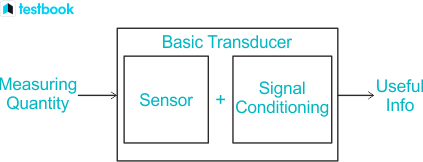
The transducer is a tool that changes one type of energy into another. It can turn something we can’t easily measure like sound into an electrical signal we can use. A transducer has three main parts something to take in information something to process it and something to give out the result. It works in two steps first it senses what is happening then it makes that signal stronger so it can be used. The transducer measures something and then changes it into a signal that matches what it measured. This signal is then cleaned up so it can be used properly.
换能器是一种将一种能量形式转换为另一种能量形式的器件。它能将声音等难以直接测量的物理量转换为可用的电信号。换能器主要由三个部分组成:信息输入部分、信息处理部分和结果输出部分。其工作过程分为两个步骤:首先感知环境变化,然后对感知到的信号进行放大以使其可用。换能器先对目标物理量进行测量,再将其转换为与测量对象对应的信号,随后对该信号进行处理以确保其能正常使用。
The Transducers change the types of energy like movement, light, sound, and heat or electromagnetic waves. Some transducers you might know are microphones which change sound into electrical signals, light bulbs which change electricity into light and speakers which change electricity into sound.
换能器可实现多种能量形式的转换,例如机械能、光能、声能、热能或电磁波的转换。常见的换能器包括:将声能转换为电信号的麦克风、将电能转换为光能的灯泡,以及将电能转换为声能的扬声器。
Difference Between Sensor and Transducer
传感器与换能器的区别
| Sensor | Transducer |
|---|---|
| A device that converts the physical parameters to an electrical output. 一种将物理参数转换为电输出的器件。 | A device that converts the energy from one form into another form is known as the Transducer. 一种将能量从一种形式转换为另一种形式的器件称为换能器。 |
| The word Sensor comes from the USA. “Sensor” 一词源自美国。 | The word Transducer comes from Europe. “Transducer” 一词源自欧洲。 |
| The use of a Sensor is for sensing the element itself. 传感器的用途是感知元件本身的状态。 | The uses of transducers are for sensing elements and also for circuitry. 换能器的用途包括感知元件状态和电路相关应用。 |
| In the Sensor its resistance changes with temperature. 传感器的电阻随温度变化。 | In Transducers its resistance changes with in voltage. 换能器的电阻随电压变化。 |
| All the sensors are not transducers. 并非所有传感器都是换能器。 | All Transducers do not contain a Sensor. They use it as a mechanism but do not always rely on it. 并非所有换能器都包含传感器,它们可将传感器作为一种机制,但并非始终依赖传感器。 |
| It is a sensor when it responds to a stimulus. 当器件对刺激产生响应时,它是传感器。 | It becomes a transducer when connected to a bridge circuit. 当器件与电桥电路连接时,它成为换能器。 |
| It detects a change in physical stimulus and turns it into a signal. 检测物理刺激的变化并将其转换为信号。 | It transfers power from one system to another in the same or in a different form. 以相同或不同形式将能量从一个系统传递至另一个系统。 |
| Examples of the Sensors are Temperature Sensors and Proximity Sensor. 传感器示例:温度传感器、接近传感器。 | Examples of the Transducers are Strain gauges and Piezoelectric Transducers. 换能器示例:应变片、压电换能器。 |
Conclusion
结论
The sensor is a tool that notices the changes in the world around us like how hot it is and how bright it is. Then it turns what it notices into an electrical signal we can use. A transducer takes one kind of energy and changes it into another kind. For example, it might change the sound into electricity and electricity into light. Both the sensors and transducers are useful but they do different work. Sensors help us measure things while transducers help us change one type of energy into another.
传感器是一种能够感知周围世界变化的器件,例如感知温度高低和光线亮度,然后将感知到的信息转换为可用的电信号。换能器则将一种能量形式转换为另一种能量形式,例如将声能转换为电能、将电能转换为光能等。传感器和换能器均具有重要用途,但功能有所不同:传感器用于测量物理量,而换能器用于实现能量形式的转换。
Sensors and Transducers
传感器与换能器
Transducers are devices that convert energy into another and can be used as both inputs to an electronic circuit or as an output from it.
换能器是一种将一种能量形式转换为另一种能量形式的器件,既可用作电子电路的输入设备,也可用作其输出设备。
Sensors and transducers are input and output devices respectively that are critical components in all electronic and control systems allowing it to either measure or change its surrounding environment depending upon the device used.
传感器和换能器分别作为输入设备和输出设备,是所有电子和控制系统中的关键组件,能根据所使用的器件实现对周围环境的测量或改变。
But for an electronic circuit or system to perform any useful task or function, it needs to be able to communicate with the “real world”. Whether task is by reading an input signal from an “ON/OFF” switch, or by activating some form of output device to illuminate a single light.
但电子电路或系统要执行任何有用的任务或功能,都需要能够与“现实世界”进行交互。这种交互既可以是读取“通/断”开关的输入信号,也可以是启动某种输出设备(如点亮一盏灯)。
In other words, an Electronic System or circuit must be able or capable of “doing” something and Sensors and Transducers are the perfect components for doing this.
换句话说,电子系统或电路必须具备“执行”功能,而传感器和换能器正是实现这一功能的理想组件。
The word “Transducer” is the collective term used for both Sensors and Actuators. Sensors can be used to sense a wide range of different energy forms such as movement, electrical signals, radiant energy, thermal or magnetic energy, etc. While actuators can be used to switch output states, voltages or currents.
“换能器(Transducer)”是传感器(Sensors) 和执行器(Actuators) 的总称。传感器可用于感知多种不同形式的能量,如机械能、电信号、辐射能、热能或磁能等;而执行器则可用于切换输出状态、电压或电流。
There are many different types of sensors and transducers, both analogue and digital, with both input and output versions available to choose from. The type of input or output transducer being used, really depends upon the type of signal or process being “Sensed” or “Controlled”. Then we can define transducers as devices that can convert one physical quantity into another.
传感器和换能器种类繁多,包括模拟式和数字式,且有输入型和输出型可供选择。所使用的输入或输出换能器类型,主要取决于被“感知”或被“控制”的信号或过程类型。因此,我们可将换能器定义为能够将一种物理量转换为另一种物理量的器件。
Devices which perform an “Input” function are commonly called Sensors because they “sense” a physical change in some characteristic which changes their response to some form of external excitation. For example, heat or a force is converted into an electrical signal. Devices which perform an “Output” function are generally called Actuators and can be used to control some external action. For example, movement or sound.
执行“输入”功能的器件通常称为传感器,因为它们能“感知”某种特性的物理变化,并据此改变自身对外部激励的响应。例如,将热量或力转换为电信号。执行“输出”功能的器件通常称为执行器,可用于控制某些外部动作,例如运动或发声。
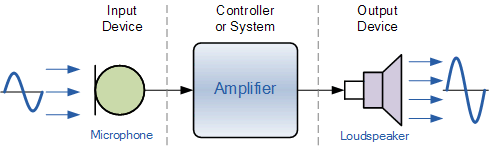
So electrical Transducers are used to convert energy of one kind into energy of another kind. For example, a microphone (input device) converts sound waves of the singer into electrical signals for the amplifier to amplify (a process), and a loudspeaker (output device) converts these electrical signals back into sound waves.
因此,电换能器用于将一种能量转换为另一种能量。例如,麦克风(输入设备)将歌手的声波转换为电信号,供放大器放大(一个处理过程);而扬声器(输出设备)则将这些电信号转换回声波。
An example of this type of simple Input/Output (I/O) system is given below.
以下是这类简单输入/输出(I/O)系统的示例。
Simple Input/Output System using Sound Transducers
基于声换能器的简单输入/输出系统
There are many different types of sensors and transducers available in the marketplace and are generally classified by the type of measurand, i.e., physical, chemical, or biological. Thus the choice of which sensor to use really depends upon the quantity being measured or controlled, with the more common types given in the table below:
市场上有多种不同类型的传感器和换能器,通常按被测量的类型(即物理量、化学量或生物量)分类。因此,传感器的选择主要取决于被测量或控制的物理量,以下表格列出了一些常见类型:
Common Sensors and Transducers
常见传感器与换能器
| Quantity being Measured | Input Device (Sensor) | Output Device (Actuator) |
|---|---|---|
| Light Level 光照强度 | Light Dependant Resistor (LDR) Photodiode Photo-transistor Solar Cell 光敏电阻(LDR)、光电二极管、光电晶体管、太阳能电池 | Lights & Lamps LED’s & Displays Fibre Optics 灯具、发光二极管(LED)及显示器、光纤 |
| Temperature 温度 | Thermocouple Thermistor Thermostat Resistive Temperature Detectors 热电偶、热敏电阻、恒温器、电阻式温度检测器 | Heater Fan 加热器、风扇 |
| Force/Pressure 力/压力 | Strain Gauge Pressure Switch Load Cells 应变片、压力开关、称重传感器 | Lifts & Jacks Electromagnet Vibration 升降机与千斤顶、电磁铁、振动装置 |
| Position 位置 | Potentiometer Encoders Reflective/Slotted Opto-switch LVDT 电位器、编码器、反射式/槽式光电开关、线性可变差动变压器(LVDT) | Motor Solenoid Panel Meters 电机、螺线管、面板仪表 |
| Speed 速度 | Tacho-generator Reflective/Slotted Opto-coupler Doppler Effect Sensors 测速发电机、反射式/槽式光耦合器、多普勒效应传感器 | AC and DC Motors Stepper Motor Brake 交流和直流电机、步进电机、制动器 |
| Sound 声音 | Carbon Microphone Piezo-electric Crystal 碳质麦克风、压电晶体 | Bell Buzzer Loudspeaker 电铃、蜂鸣器、扬声器 |
Input type transducers or sensors, produce a voltage or signal output response which is proportional to the change in the quantity that they are measuring (the stimulus). The type or amount of the output signal depends upon the type of sensor being used. But generally, all types of sensors can be classed as two kinds, either Passive Sensors or Active Sensors.
输入型换能器或传感器会产生与被测量(激励信号)变化成正比的电压或信号输出响应。输出信号的类型或大小取决于所使用的传感器类型。但总体而言,所有传感器可分为两类:无源传感器或有源传感器。
Generally, active sensors require an external power supply to operate, called an excitation signal which is used by the sensor to produce the output signal. Active sensors change their properties in response to an external effect producing and output signal. For example, an output voltage of 1 to 10V DC, or an output current such as 4 to 20mA DC. Also, due to their power supply requirements, active sensors can also produce signal amplification.
通常,有源传感器需要外部电源才能工作,该电源称为激励信号,传感器利用其产生输出信号。有源传感器会根据外部作用改变自身特性,进而产生输出信号。例如,输出 1 至 10V 直流电压,或 4 至 20mA 直流电流。此外,由于需要电源供电,有源传感器还可实现信号放大。
A good example of an active sensor is an LVDT sensor or a strain gauge. Strain gauges are pressure-sensitive resistive bridge networks that are external biased (excitation signal) in such a way as to produce an output voltage in proportion to the amount of mechanical force and/or strain being applied to the sensor.
线性可变差动变压器(LVDT)传感器或应变片是有源传感器的典型示例。应变片是压敏电阻桥网络,通过外部偏置(激励信号)实现工作,其输出电压与施加在传感器上的机械力和/或应变大小成正比。
Unlike an active sensor, a passive sensor does not need any additional power source or excitation voltage. Instead a passive sensor generates an output signal in response to some external stimulus. For example, a thermocouple which generates its own voltage output when exposed to heat. Then passive sensors are direct sensors which change their physical properties, such as resistance, capacitance or inductance etc.
与有源传感器不同,无源传感器不需要额外的电源或激励电压。相反,无源传感器会根据外部激励直接产生输出信号。例如,热电偶在受热时会自行产生电压输出。因此,无源传感器属于直接传感器,其物理特性(如电阻、电容或电感等)会随被测量变化。
But as well as analogue sensors, Digital Sensors produce a discrete output representing a binary number or digit such as a logic level “0” or a logic level “1”.
除模拟传感器外,数字传感器会产生离散输出,代表二进制数或数字,例如逻辑电平“0”或逻辑电平“1”。
Analogue and Digital Sensors and Transducers
模拟与数字传感器及换能器
Analogue Sensors
模拟传感器
Analogue Sensors produce a continuous output signal or voltage which is generally proportional to the quantity being measured. Physical quantities such as Temperature, Speed, Pressure, Displacement, Strain etc are all analogue quantities as they tend to be continuous in nature.
模拟传感器产生连续的输出信号或电压,通常与被测量成正比。温度、速度、压力、位移、应变等物理量均为模拟量,因为它们本质上是连续变化的。
For example, the temperature of a liquid can be measured using a thermometer or thermocouple which continuously responds to temperature changes as the liquid is heated up or cooled down.
例如,液体的温度可通过温度计或热电偶测量,当液体被加热或冷却时,这些器件会持续对温度变化做出响应。
Thermocouple used to produce an Analogue Signal
用于产生模拟信号的热电偶
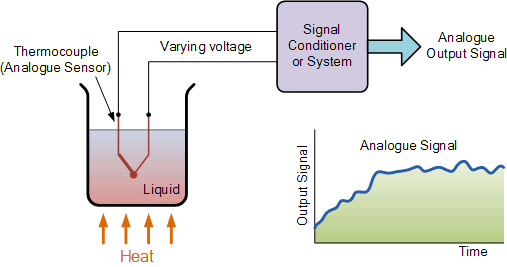
Note though that a mercury thermometer will produce a change in the volume of mercury in response to a temperature change via thermal expansion, where the output is a mechanical or visual displacement and not an electrical signal.
但需注意,水银温度计通过热膨胀原理,利用水银体积的变化响应温度变化,其输出是机械位移或视觉位移,而非电信号。
Analogue sensors tend to produce output signals that are changing smoothly and continuously over time. These signals tend to be very small in value from a few micro-volts (μV) to several milli-volts (mV), so some form of amplification is required.
模拟传感器的输出信号通常随时间平滑且连续变化。这些信号的数值通常很小,从几微伏(μV)到几毫伏(mV)不等,因此需要进行某种形式的放大。
Then circuits which measure analogue signals usually have a slow response and/or low accuracy. Also analogue signals can be easily converted into digital type signals for use in micro-controller systems by the use of analogue-to-digital converters, or ADC’s.
因此,测量模拟信号的电路通常响应较慢和/或精度较低。此外,通过模数转换器(ADC),模拟信号可轻松转换为数字信号,用于微控制器系统。
Digital Sensors
数字传感器
As its name implies, Digital Sensors produce a discrete digital output signals or voltages that are a digital representation of the quantity being measured. Digital sensors produce a Binary output signal in the form of a logic “1” or a logic “0”, (“ON” or “OFF”). This means then that a digital signal only produces discrete (non-continuous) values which may be outputted as a single “bit”, (serial transmission) or by combining the bits to produce a single “byte” output (parallel transmission).
顾名思义,数字传感器产生离散的数字输出信号或电压,是被测量的数字表示。数字传感器以逻辑“1”或逻辑“0”(“通”或“断”)的形式产生二进制输出信号。这意味着数字信号仅产生离散(非连续)值,可作为单个“位”输出(串行传输),或通过组合多个位产生单个“字节”输出(并行传输)。
Light Sensor used to Produce a Digital Signal
用于产生数字信号的光传感器
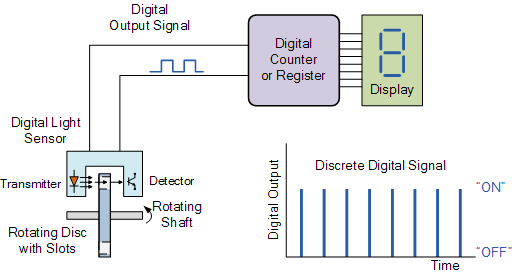
In our simple example above, the speed of the rotating shaft is measured by using a digital LED/Opto-detector sensor. The disc which is fixed to a rotating shaft (for example, from a motor or robot wheels), has a number of transparent slots within its design. As the disc rotates with the speed of the shaft, each slot passes by the sensor in turn producing an output pulse representing a logic “1” or logic “0” level.
在上述简单示例中,旋转轴的速度通过数字 LED/光电探测器传感器测量。固定在旋转轴(例如电机或机器人车轮的轴)上的圆盘设计有多个透明槽。当圆盘随轴旋转时,每个槽依次经过传感器,产生代表逻辑“1”或逻辑“0”电平的输出脉冲。
These pulses are sent to a register of counter and finally to an output display to show the speed or revolutions of the shaft. By increasing the number of slots or “windows” within the disc more output pulses can be produced for each revolution of the shaft. The advantage of this is that a greater resolution and accuracy is achieved as fractions of a revolution can be detected. Then this type of sensor arrangement could also be used for positional control with one of the discs slots representing a reference position.
这些脉冲被发送到计数器寄存器,最终传输至输出显示器,以显示轴的速度或转速。通过增加圆盘上的槽或“窗口”数量,轴每旋转一圈可产生更多输出脉冲。其优势在于能够检测到旋转的分数部分,从而实现更高的分辨率和精度。此外,这种传感器结构还可用于位置控制,将圆盘的某个槽作为参考位置。
Compared to analogue signals, digital signals or quantities have very high accuracies and can be both measured and “sampled” at a very high clock speed. The accuracy of the digital signal is proportional to the number of bits used to represent the measured quantity. For example, using a processor of 8 bits, will produce an accuracy of 0.390% (1 part in 256). While using a processor of 16 bits gives an accuracy of 0.0015%, (1 part in 65,536) or 260 times more accurate. This accuracy can be maintained as digital quantities are manipulated and processed very rapidly, millions of times faster than analogue signals.
与模拟信号相比,数字信号或数字量具有极高的精度,且能以极高的时钟速度进行测量和“采样”。数字信号的精度与用于表示被测量的位数成正比。例如,使用 8 位处理器时,精度可达 0.390%(256 分之 1);而使用 16 位处理器时,精度可达 0.0015%(65536 分之 1),即精度提升 260 倍。由于数字量的处理速度极快(比模拟信号快数百万倍),这种高精度得以保持。
In most cases, sensors and more specifically analogue sensors generally require an external power supply and some form of additional amplification or filtering of the signal in order to produce a suitable electrical signal which is capable of being measured or used. One very good way of achieving both amplification and filtering within a single circuit is to use Operational Amplifiers as seen before.
在大多数情况下,传感器(尤其是模拟传感器)通常需要外部电源,且需要对信号进行某种形式的额外放大或滤波,以产生可测量或可使用的合适电信号。如前所述,在单个电路中同时实现放大和滤波的一种极佳方式是使用运算放大器。
Signal Conditioning of Sensors and Transducers
传感器与换能器的信号调理
As we saw in the Operational Amplifier tutorial, op-amps can be used to provide amplification of signals when connected in either inverting or non-inverting configurations.
正如我们在运算放大器教程中所了解的,运算放大器在反相或同相配置下可用于信号放大。
The very small analogue signal voltages produced by a sensor such as a few milli-volts or even pico-volts can be amplified many times over by a simple op-amp circuit to produce a much larger voltage signal of say 5V or 5mA that can then be used as an input signal to a microprocessor or analogue-to-digital based system.
传感器产生的极小模拟信号电压(如几毫伏甚至几皮伏)可通过简单的运算放大器电路放大数倍,产生更大的电压信号(例如 5V 或 5mA),进而用作微处理器或模数转换系统的输入信号。
Therefore, to provide any useful signal a sensors output signal has to be amplified with an amplifier that has a voltage gain up to 10,000 and a current gain up to 1,000,000 with the amplification of the signal being linear with the output signal being an exact reproduction of the input, just changed in amplitude.
因此,要产生有用的信号,传感器的输出信号必须通过放大器放大——该放大器的电压增益可达 10,000 倍,电流增益可达 1,000,000 倍,且信号放大需呈线性,输出信号需精确复刻输入信号,仅幅值发生变化。
Then amplification is part of signal conditioning.So when using analogue sensors, generally some form of amplification (Gain), impedance matching, isolation between the input and output or perhaps filtering (frequency selection) may be required before the signal can be used and this is conveniently performed by Operational Amplifiers.
因此,放大是信号调理的一部分。在使用模拟传感器时,通常需要先对信号进行某种形式的放大(增益调节)、阻抗匹配、输入输出隔离或滤波(频率选择),才能使用该信号,而这些功能均可通过运算放大器便捷实现。
Also, when measuring very small physical changes the output signal of a sensor can become “contaminated” with unwanted signals or voltages that prevent the actual signal required from being measured correctly. These unwanted signals are called “Noise“. This Noise or Interference can be either greatly reduced or even eliminated by using signal conditioning or filtering techniques as we discussed in the Active Filter tutorial.
此外,在测量极小的物理变化时,传感器的输出信号可能会被无用信号或电压“污染”,导致所需的实际信号无法被准确测量。这些无用信号被称为“噪声”。如我们在有源滤波器教程中所讨论的,通过信号调理或滤波技术,可大幅降低甚至消除这种噪声或干扰。
By using either a Low Pass, or a High Pass or even Band Pass filter the “bandwidth” of the noise can be reduced to leave just the output signal required. For example, many types of inputs from switches, keyboards or manual controls are not capable of changing state rapidly and so low-pass filter can be used. When the interference is at a particular frequency, for example mains frequency, narrow band reject or Notch filters can be used to produce frequency selective filters.
通过使用低通滤波器、高通滤波器甚至带通滤波器,可缩小噪声的“带宽”,仅保留所需的输出信号。例如,开关、键盘或手动控制器的许多输入信号无法快速改变状态,因此可使用低通滤波器。当干扰处于特定频率(如市电频率)时,可使用窄带抑制滤波器或陷波滤波器实现频率选择性滤波。
Typical Op-amp Filters
典型运算放大器滤波器
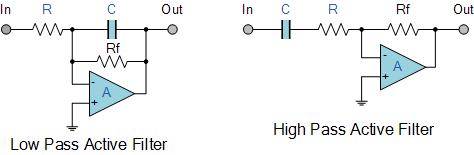
Were some random noise still remains after filtering it may be necessary to take several samples and then average them to give the final value so increasing the signal-to-noise ratio. Either way, both amplification and filtering play an important role in interfacing both sensors and transducers to microprocessor and electronics based systems in “real world” conditions.
如果滤波后仍存在部分随机噪声,可能需要采集多个样本并取平均值作为最终结果,以提高信噪比。无论如何,在“现实世界”环境中,放大和滤波在传感器、换能器与微处理器及电子系统的接口连接中均发挥着重要作用。
In the next tutorial about Sensors, we will look at Positional Sensors which measure the position and/or displacement of physical objects meaning the movement from one position to another for a specific distance or angle.
在下一篇传感器相关教程中,我们将探讨位置传感器——这类传感器用于测量物理物体的位置和/或位移,即物体从一个位置移动到另一个位置的特定距离或角度。
Transducer in Physics: Meaning, Types, and Examples
物理学中的换能器:含义、类型及示例
What is a Transducer?
什么是换能器?
A transducer is defined as any electronic device that helps energy conversion from one form to the energy of another form. The energy is generally a signal of some form, it can be both an input or an output signal.
换能器(Transducer)是指任何能够实现一种形式能量向另一种形式能量转换的电子设备。这种能量通常以某种信号形式存在,既可以是输入信号,也可以是输出信号。
How Does a Transducer Work? Explanation with Formulas and Applications
换能器的工作原理:含公式及应用说明
A transducer is a device that converts one form of energy into another. In physics, transducers are essential for measurement, allowing physical phenomena—like mechanical movement, pressure, or magnetic fields—to be transformed into electrical signals that can be measured, recorded, or displayed. Transducers also enable the reverse process, changing electrical signals into physical motion or other energy forms. This energy conversion makes them vital in scientific instruments and real-world applications.
换能器是一种将一种形式的能量转换为另一种形式的器件。在物理学中,换能器是测量工作的重要组成部分,能够将机械运动、压力或磁场等物理现象转换为可测量、记录或显示的电信号。换能器还可实现反向转换过程,将电信号转换为物理运动或其他能量形式。这种能量转换功能使其在科学仪器和实际应用中具有重要作用。
Definition and Key Principle
定义及核心原理
The defining role of a transducer is energy conversion. Most commonly, transducers convert physical, mechanical, or magnetic changes into electrical signals. In some cases, they take an electrical input and produce a different energy output, such as sound or mechanical movement. For example, a microphone changes sound waves (mechanical energy) into an electrical signal, while a loudspeaker performs the opposite conversion.
换能器的核心功能是能量转换。最常见的应用场景中,换能器将物理、机械或磁性变化转换为电信号。在部分情况下,换能器接收电信号输入并产生不同形式的能量输出,例如声音或机械运动。例如,麦克风将声波(机械能)转换为电信号,而扬声器则执行相反的转换过程。
Types of Transducers
换能器的类型
There are many types of transducers, each suited for different applications based on the kind of energy involved and the measurement required. Below is a summary to clarify their roles.
换能器的类型繁多,根据涉及的能量形式和所需测量的物理量,每种类型均适用于特定应用场景。以下为各类换能器的功能总结:
| Transducer Type | Input Energy | Output Signal | Examples |
|---|---|---|---|
| Current Transducer 电流换能器 | Electrical current 电流 | Electrical signal calibrated to measure current 经校准用于测量电流的电信号 | Clamp meter, ammeter sensor 钳形表、电流表传感器 |
| Magnetic Field Transducer 磁场换能器 | Magnetic field 磁场 | Electrical output proportional to field 与磁场成比例的电输出信号 | Hall sensor 霍尔传感器 |
| Voltage Transducer 电压换能器 | Voltage (potential difference) 电压(电势差) | Scaled electrical output 经标度的电输出信号 | Voltage dividers, reference circuits 分压器、基准电路 |
| Mechanical/Electromechanical Transducer 机械/机电式换能器 | Mechanical force, displacement 机械力、位移 | Electrical signal 电信号 | Microphone, speaker, antenna 麦克风、扬声器、天线 |
How Transducers Work: Examples and Explanation
换能器的工作机制:示例及说明
Transducers are found in various devices. Microphones transform sound energy (vibration of air particles) into corresponding electrical signals, which can then be transmitted or recorded. Speakers perform the reverse, using incoming electrical signals to move a membrane and generate sound waves. Thermocouples are transducers that sense temperature by producing a voltage corresponding to thermal changes. Antenna systems, both transmitters and receivers, also operate as transducers; they convert electrical signals into electromagnetic waves and back.
换能器广泛应用于各类设备中。麦克风将声能(空气粒子的振动)转换为相应的电信号,该信号可用于传输或记录。扬声器执行反向转换,利用输入的电信号驱动膜片振动并产生声波。热电偶是一类通过产生与热变化对应的电压来感知温度的换能器。发射机和接收机的天线系统也具备换能器功能,可将电信号转换为电磁波,反之亦然。
Functional Steps in Using a Transducer
换能器的使用流程
-
Identify the physical quantity to measure or control (such as current, field, force).
确定需测量或控制的物理量(如电流、磁场、力)。 -
Choose a transducer suited to converting this quantity into an electrical or measurable output.
选择适用于将该物理量转换为电信号或可测量输出的换能器。 -
Connect the transducer to signal conditioning circuits if needed for scaling or filtering.
如需进行信号标度或滤波处理,将换能器与信号调理电路连接。 -
Use an instrument (meter or display) to read the final signal.
使用测量仪器(仪表或显示器)读取最终信号。
Common Examples of Transducers
换能器的常见示例
- Microphones (mechanical vibrations to electrical signal)
麦克风(将机械振动转换为电信号) - Speakers (electrical signal to sound)
扬声器(将电信号转换为声音) - Thermocouples (temperature difference to voltage)
热电偶(将温度差转换为电压) - Antennas (electrical signal to electromagnetic waves, and vice versa)
天线(将电信号转换为电磁波,反之亦然)
Key Parts of a Transducer
换能器的核心组件
Most transducers have two main portions:
大多数换能器包含两个主要部分:
- Sensing Element: Part exposed to the physical phenomenon (for example, the diaphragm in a microphone or coil in a magnetic field sensor).
敏感元件:直接接触物理现象的部分(例如,麦克风中的振膜或磁场传感器中的线圈)。 - Conversion Element: Converts the sensed change into an output signal suitable for measurement or further processing.
转换元件:将感知到的变化转换为适用于测量或后续处理的输出信号的部分。
Active vs Passive Transducers
有源换能器与无源换能器
| Type | Requires External Power? | Description | Example |
|---|---|---|---|
| Active 有源 | No 否 | Generates output signal on its own from measured quantity 直接利用被测量产生输出信号 | Thermocouple 热电偶 |
| Passive 无源 | Yes 是 | Needs external power; change in the measured quantity affects output 需外部电源供电,被测量的变化会影响输出信号 | Resistive sensor 电阻式传感器 |
Physics Formulas and Application
物理公式及应用
Specific transducer types use straightforward mathematical relationships:
特定类型的换能器遵循简洁的数学关系:
| Transducer Example | Response Formula | Main Measured Quantity |
|---|---|---|
| Thermocouple 热电偶 |
V
∝
Δ
T
V \propto \Delta T
V∝ΔT (Voltage is proportional to temperature difference) V ∝ Δ T V \propto \Delta T V∝ΔT(电压与温度差成正比) | Temperature 温度 |
| Current Transducer 电流换能器 |
V
out
=
k
×
I
V_{\text{out}} = k \times I
Vout=k×I (Output voltage proportional to current) V out = k × I V_{\text{out}} = k \times I Vout=k×I(输出电压与电流成正比) | Electric current 电流 |
| Hall Effect Sensor 霍尔效应传感器 |
V
H
∝
B
×
I
V_H \propto B \times I
VH∝B×I (Hall voltage is proportional to magnetic field and current) V H ∝ B × I V_H \propto B \times I VH∝B×I(霍尔电压与磁场和电流成正比) | Magnetic field 磁场 |
Example Problem: Simple Calculation Using a Transducer
示例问题:换能器的简单计算
Suppose a Hall effect transducer produces a 5 mV output when exposed to a 0.1 T magnetic field with a current of 2 A. What would the output be for a 0.2 T field with the same current?
假设某霍尔效应换能器在 0.1 T 磁场、2 A 电流条件下输出 5 mV 信号。若磁场强度变为 0.2 T 且电流保持不变,该换能器的输出信号为多少?
-
Find the proportionality: At 0.1 T, output is 5 mV.
确定比例关系:磁场强度为 0.1 T 时,输出信号为 5 mV。 -
At 0.2 T (double the field), output will also double: 5 mV × 2 = 10 mV 5 \, \text{mV} \times 2 = 10 \, \text{mV} 5mV×2=10mV.
当磁场强度变为 0.2 T(即原磁场强度的 2 倍)时,输出信号也随之加倍: 5 mV × 2 = 10 mV 5 \, \text{mV} \times 2 = 10 \, \text{mV} 5mV×2=10mV。 -
Result: The output is 10 mV.
结果:输出信号为 10 mV。
Applications of Transducers
换能器的应用场景
- Measuring electrical currents and voltages for control and monitoring systems
为控制系统和监测系统测量电流和电压 - Detecting and converting magnetic fields (as in motor controllers or compasses)
检测并转换磁场(如电机控制器或指南针中的应用) - Allowing sound recording and playback through microphones and speakers
通过麦克风和扬声器实现声音的录制和播放 - Communication via antennas, converting signals for transmission and reception
通过天线实现通信,为信号的发射和接收进行转换
Steps for Further Study and Practice
深入学习与实践步骤
- Review key examples and try changing input parameters to see their effect on output signals.
回顾核心示例,尝试改变输入参数以观察其对输出信号的影响。 - Study signal conditioning methods, such as amplifiers and filters, often paired with transducers.
学习与换能器配套使用的信号调理方法,如放大和滤波技术。 - Practice applying response formulas for transducers in physics-based questions.
练习在物理问题中应用换能器的响应公式。 - Explore more details and practice problems on the dedicated Transducer resource page.
访问换能器专题资源页面,了解更多细节并进行习题练习。
Summary
总结
Transducers play a foundational role in linking physical, electrical, and magnetic measurement systems. They enable scientists, engineers, and students to quantify the world around us, making data measurable and actionable for experiments, devices, and modern technology.
换能器在连接物理、电气和磁测量系统方面发挥着基础性作用。它们使科学家、工程师和学生能够对周围世界进行量化分析,为实验、设备和现代技术提供可测量、可操作的数据支持。
How To Choose The Right Sensor For Your Applications
如何为你的应用选择合适的传感器
In an increasingly connected and automated world, sensors play a pivotal role across countless industries, enabling systems to perceive their environment and make informed decisions. From industrial automation and automotive safety to medical diagnostics and smart home technologies, sensors are the fundamental building blocks that translate physical phenomena into actionable data. However, choosing the right sensor for your application is not a one-size-fits-all decision. The wrong choice can lead to inaccurate data, system inefficiencies, or even catastrophic failures.
在日益互联和自动化的世界中,传感器在无数行业中发挥着关键作用,使系统能够感知周围环境并做出明智决策。从工业自动化、汽车安全到医疗诊断和智能家居技术,传感器是将物理现象转化为可用数据的基本组件。然而,为应用选择合适的传感器并非“一刀切”的决策。选择不当可能导致数据不准确、系统效率低下,甚至引发灾难性故障。
This comprehensive guide aims to demystify the sensor selection process, providing a detailed roadmap to help engineers, designers, and developers make informed decisions based on performance needs, environmental conditions, integration requirements, and more.
本综合指南旨在揭开传感器选择过程的神秘面纱,提供详细的路线图,帮助工程师、设计师和开发人员根据性能需求、环境条件、集成要求等因素做出明智决策。
Understanding Sensors
了解传感器
A sensor is a device that detects and measures a physical property and converts it into a signal that can be interpreted by a system. These devices come in numerous forms, each tailored to specific types of measurements, such as temperature, pressure, light, motion, proximity, gas concentration, and more.
传感器是一种检测并测量物理特性,并将其转换为系统可解读信号的器件。这类器件形式多样,每种都针对特定的测量类型设计,例如温度、压力、光线、运动、接近度、气体浓度等。
Sensors can be broadly categorized based on their function:
根据功能,传感器可大致分类如下:
- Temperature Sensors: Measure thermal conditions (e.g., thermocouples, RTDs).
温度传感器:测量热状态(例如热电偶、电阻式温度检测器(RTD))。 - Pressure Sensors: Detect pressure changes in gases or liquids (e.g., piezoresistive sensors).
压力传感器:检测气体或液体中的压力变化(例如压阻式传感器)。 - Proximity Sensors: Identify the presence or absence of objects (e.g., capacitive, inductive).
接近传感器:识别物体的存在或不存在(例如电容式、电感式)。 - Optical Sensors: Measure light intensity and presence (e.g., photodiodes).
光学传感器:测量光强和光的存在(例如光电二极管)。 - Motion Sensors: Detect movement or orientation (e.g., accelerometers, gyroscopes).
运动传感器:检测运动或方位(例如加速度计、陀螺仪)。 - Gas Sensors: Monitor the presence of gases in the environment (e.g., metal-oxide sensors).
气体传感器:监测环境中气体的存在(例如金属氧化物传感器)。
Key Considerations When Choosing A Sensor
选择传感器的关键考量因素
Selecting the ideal sensor involves balancing numerous factors to align with application-specific requirements.
选择理想的传感器需要平衡多个因素,以符合特定应用的需求。
1. Measurement Requirements
1. 测量要求
- Range: Ensure the sensor’s measurement range encompasses the expected values in your application.
量程:确保传感器的测量范围涵盖应用中的预期值。 - Accuracy: Determine how close the sensor’s output must be to the actual value.
精度:明确传感器输出与实际值的接近程度要求。 - Resolution: Identify the smallest detectable change in measurement.
分辨率:确定可检测到的最小测量变化量。 - Sensitivity: Understand the sensor’s ability to detect minor changes in the measured quantity.
灵敏度:了解传感器检测被测量微小变化的能力。
2. Environmental Conditions
2. 环境条件
Environmental factors can significantly impact sensor performance:
环境因素会显著影响传感器性能:
- Temperature Extremes: Some sensors may drift or fail outside certain temperature ranges.
极端温度:部分传感器在超出特定温度范围时可能出现漂移或故障。 - Humidity and Moisture: High moisture environments may require waterproof or humidity-resistant sensors.
湿度和水分:高湿度环境可能需要防水或耐湿传感器。 - Dust and Debris: IP-rated enclosures can help protect sensors in harsh environments.
灰尘和碎屑:具有 IP 防护等级的外壳有助于在恶劣环境中保护传感器。 - Electromagnetic Interference (EMI): In environments with high EMI, shielded or robust sensors may be necessary.
电磁干扰(EMI):在高电磁干扰环境中,可能需要屏蔽型或抗干扰能力强的传感器。
3. Integration And Compatibility
3. 集成与兼容性
Ensure that the sensor can be effectively integrated into your existing system:
确保传感器能有效集成到现有系统中:
- Electrical Interface: Match voltage levels and signal types (analog/digital).
电气接口:匹配电压等级和信号类型(模拟/数字)。 - Communication Protocols: Choose a sensor compatible with your system’s interface (I2C, SPI, UART, etc.).
通信协议:选择与系统接口(I2C、SPI、UART 等)兼容的传感器。 - Mechanical Compatibility: Consider the form factor and mounting requirements.
机械兼容性:考虑外形尺寸和安装要求。 - Software and Driver Support: Verify that libraries and drivers are available for your platform.
软件和驱动支持:确认平台有可用的库和驱动程序。
4. Power Requirements
4. 电源要求
For battery-powered or portable applications, power consumption is critical:
对于电池供电或便携式应用,功耗至关重要:
- Operating Voltage: Match the power supply specifications.
工作电压:匹配电源规格。 - Current Consumption: Choose low-power sensors when efficiency is a priority.
电流消耗:当效率为首要考虑因素时,选择低功耗传感器。 - Sleep Modes: Consider sensors with power-saving modes.
休眠模式:考虑具备节能模式的传感器。
5. Response Time
5. 响应时间
In time-sensitive applications, such as motion tracking or real-time monitoring, the response time of the sensor is vital. Ensure the sensor is fast enough to capture dynamic changes without lag.
在运动跟踪或实时监测等对时间敏感的应用中,传感器的响应时间至关重要。确保传感器足够快,能够无延迟地捕捉动态变化。
6. Cost And Availability
6. 成本与可用性
Balance performance requirements with budget constraints:
在性能要求和预算限制之间取得平衡:
- Unit Cost: Consider the price per unit, especially for high-volume applications.
单位成本:考虑单位价格,尤其是大批量应用。 - Availability: Choose sensors with stable supply chains and reliable vendors.
可用性:选择供应链稳定、供应商可靠的传感器。 - Lifecycle: Ensure the sensor is not nearing end-of-life or obsolescence.
生命周期:确保传感器未接近使用寿命末期或过时。
Types Of Sensors And Their Applications
传感器类型及其应用
Temperature Sensors
温度传感器
- Applications: HVAC systems, industrial equipment, medical devices, environmental monitoring.
- 应用:暖通空调(HVAC)系统、工业设备、医疗设备、环境监测。
- Types: Thermocouples, RTDs, thermistors, infrared sensors.
类型:热电偶、电阻式温度检测器(RTD)、热敏电阻、红外传感器。
Pressure Sensors
压力传感器
- Applications: Automotive, aerospace, HVAC, fluid dynamics.
应用:汽车、航空航天、暖通空调(HVAC)、流体动力学。 - Types: Piezoresistive, capacitive, electromagnetic, optical.
类型:压阻式、电容式、电磁式、光学式。
Proximity Sensors
接近传感器
- Applications: Robotics, consumer electronics, automation.
应用:机器人技术、消费电子、自动化。 - Types: Inductive, capacitive, ultrasonic, infrared.
类型:电感式、电容式、超声波式、红外式。
Light Sensors
光传感器
- Applications: Smart lighting, smartphones, solar trackers.
应用:智能照明、智能手机、太阳能跟踪器。 - Types: Photodiodes, phototransistors, LDRs.
类型:光电二极管、光电晶体管、光敏电阻(LDR)。
Motion Sensors
运动传感器
- Applications: Wearables, gaming, navigation, security.
应用:可穿戴设备、游戏、导航、安防。 - Types: Accelerometers, gyroscopes, magnetometers, PIR sensors.
类型:加速度计、陀螺仪、磁力计、被动红外传感器(PIR)。
Gas And Chemical Sensors
气体和化学传感器
- Applications: Air quality monitoring, industrial safety, automotive.
应用:空气质量监测、工业安全、汽车。 - Types: Metal-oxide sensors, electrochemical, infrared.
类型:金属氧化物传感器、电化学传感器、红外传感器。
Humidity Sensors
湿度传感器
- Applications: Agriculture, HVAC, meteorology, industrial processing.
应用:农业、暖通空调(HVAC)、气象学、工业加工。 - Types: Capacitive, resistive, thermal conductivity.
类型:电容式、电阻式、热导式。
Sensor Specifications Explained
传感器规格说明
Understanding a sensor’s datasheet is critical in making a well-informed decision. Key specifications include:
理解传感器的数据手册对于做出明智决策至关重要。关键规格包括:
- Accuracy: The deviation from the true value.
精度:与真实值的偏差。 - Resolution: The smallest increment a sensor can detect.
分辨率:传感器可检测的最小增量。 - Sensitivity: The ratio of output change to input change.
灵敏度:输出变化与输入变化的比值。 - Linearity: How the sensor’s output correlates to the actual measurement.
线性度:传感器输出与实际测量值的相关程度。 - Hysteresis: The difference in output when a measurement is approached from above or below.
滞后:从上方或下方接近某一测量值时的输出差异。 - Repeatability: The sensor’s ability to produce consistent results under the same conditions.
重复性:传感器在相同条件下产生一致结果的能力。 - Drift: Gradual deviation of sensor output over time.
漂移:传感器输出随时间的逐渐偏差。
Industry-Specific Considerations
行业特定考量
Automotive
汽车行业
-
Challenges: High vibration, wide temperature range, critical reliability.
挑战:高振动、宽温度范围、极高可靠性要求。 -
Sensors: Oxygen sensors, radar, LiDAR, pressure sensors.
传感器:氧传感器、雷达、激光雷达(LiDAR)、压力传感器。
Healthcare
医疗行业
-
Challenges: Accuracy, biocompatibility, miniaturization.
挑战:高精度、生物相容性、小型化。 -
Sensors: ECG, blood pressure, pulse oximeters, glucose monitors.
传感器:心电图(ECG)传感器、血压传感器、脉搏血氧仪、血糖监测仪。
Industrial Automation
工业自动化
-
Challenges: Harsh environments, EMI, mechanical stress.
挑战:恶劣环境、电磁干扰(EMI)、机械应力。 -
Sensors: Proximity, temperature, pressure, vibration sensors.
传感器:接近传感器、温度传感器、压力传感器、振动传感器。
Agriculture
农业
-
Challenges: Weatherproofing, wireless communication, battery life.
挑战:防风雨、无线通信、电池续航。 -
Sensors: Soil moisture, pH, light intensity, weather sensors.
传感器:土壤湿度传感器、pH 传感器、光强传感器、气象传感器。
Consumer Electronics
消费电子
-
Challenges: Size constraints, power efficiency, cost.
挑战:尺寸限制、电源效率、成本。 -
Sensors: Accelerometers, gyroscopes, ambient light, fingerprint sensors.
传感器:加速度计、陀螺仪、环境光传感器、指纹传感器。
Testing And Validation
测试与验证
Sensor validation ensures reliability and compliance with application standards. Typical steps include:
传感器验证可确保可靠性并符合应用标准。典型步骤包括:
-
Bench Testing: Initial verification using standard equipment.
台架测试:使用标准设备进行初步验证。 -
Environmental Testing: Simulation of real-world conditions.
环境测试:模拟实际应用环境。 -
Functional Testing: Integration into the actual application.
功能测试:集成到实际应用中进行测试。 -
Calibration: Adjusting the sensor output for accuracy.
校准:调整传感器输出以确保精度。 -
Long-term Testing: Ensuring consistent performance over time.
长期测试:确保长期性能稳定。
Common Pitfalls To Avoid
需避免的常见误区
-
Ignoring Environmental Factors: Not accounting for humidity, EMI, or temperature.
忽视环境因素:未考虑湿度、电磁干扰(EMI)或温度影响。 -
Overlooking Integration Needs: Misalignment with system voltage or protocol.
忽视集成需求:与系统电压或协议不匹配。 -
Underestimating Power Consumption: Especially in portable applications.
低估功耗:尤其是在便携式应用中。 -
Neglecting Calibration: Uncalibrated sensors can produce misleading data.
忽视校准:未校准的传感器可能产生误导性数据。 -
Choosing Based on Price Alone: Cost-cutting can compromise performance and reliability.
仅基于价格选择:削减成本可能会影响性能和可靠性。
Future Trends In Sensor Technology
传感器技术的未来趋势
As technology evolves, sensors are becoming smarter, smaller, and more efficient:
随着技术的发展,传感器正变得更智能、更小巧、更高效:
-
Smart Sensors: Onboard processing for faster decisions.
智能传感器:具备板载处理功能,可快速决策。 -
Wireless Connectivity: Integration with IoT and cloud platforms.
无线连接:与物联网(IoT)和云平台集成。 -
Miniaturization: Nano-sensors for biomedical and wearable tech.
小型化:用于生物医学和可穿戴技术的纳米传感器。 -
Self-powered Sensors: Energy harvesting for remote deployments.
自供电传感器:通过能量收集技术适用于远程部署。 -
Artificial Intelligence: Machine learning algorithms for data interpretation.
人工智能:采用机器学习算法进行数据解读。
Conclusion
结论
Choosing the right sensor is a multifaceted process that requires a deep understanding of the application, operating environment, integration requirements, and performance expectations. A methodical approach—considering all relevant parameters and potential constraints—will help ensure that your sensor selection supports the functionality, reliability, and efficiency of your final product or system.
选择合适的传感器是一个多方面的过程,需要深入了解应用场景、工作环境、集成要求和性能预期。采用系统的方法(考虑所有相关参数和潜在限制)将有助于确保所选传感器能够支持最终产品或系统的功能、可靠性和效率。
By understanding sensor types, evaluating key specifications, and avoiding common pitfalls, you can select the optimal sensor that meets both your technical and economic goals. As sensor technology continues to evolve, staying informed on the latest trends and advancements will provide you with a competitive edge in designing smarter, more responsive systems.
通过了解传感器类型、评估关键规格并避免常见误区,你可以选择既满足技术目标又符合经济目标的最优传感器。随着传感器技术的不断发展,及时了解最新趋势和进展将帮助你在设计更智能、响应更迅速的系统时获得竞争优势。
How to select a Transducer?
如何选择换能器?
Instrumentation
vigneshMarch 31, 2018, 8:48 am
In a measurement system the transducer is the input element with critical function of transforming some physical quantity to a proportional electrical signal. Selection of the appropriate transducer is therefore the first and perhaps most important step in obtaining accurate results in every instrumentation and control system. A number of elementary questions should be asked before a transducer can be selected, for example,
在测量系统中,换能器是输入元件,其关键功能是将某种物理量转换为与之成比例的电信号。因此,在任何仪器仪表和控制系统中,选择合适的换能器是获得准确结果的首要步骤。在选择换能器之前,应考虑以下几个基本问题:
-
What is the physical quantity to be measured?
需测量的物理量是什么? -
Which transducer principle can be used to measure this quantity?
可采用哪种换能器原理测量该物理量? -
What accuracy is required for this measurement?
该测量需要达到何种精度?
The first question can be answered by determining the type and range of the measurand. An appropriate answer to the second question requires that the input and output characteristics of the transducer be compatible with the recording or measurement system. In most cases, these two questions can be answered readily, implying that the proper transducer is selected simply by the addition of an accuracy tolerance. In practice, this is rarely possible due to the complexity of the various transducer parameters that affects the accuracy. The accuracy requirements of the total system determine the degree to which individual factors contributing to accuracy must be considered.
第一个问题可通过确定被测量的类型和量程来回答。第二个问题的合理答案要求换能器的输入和输出特性与记录或测量系统兼容。在大多数情况下,这两个问题可轻松解答,这意味着只需附加精度公差即可选择合适的换能器。但在实际应用中,由于影响精度的换能器参数较为复杂,这种简单选择方式很少可行。整个系统的精度要求决定了必须考虑各个影响精度因素的详细程度。
Some of these factors are:
其中部分因素如下:
-
Fundamental transducer parameters: type and range of measurand, sensitivity, excitation
换能器基本参数:被测量类型和量程、灵敏度、激励条件 -
Physical conditions: mechanical and electrical connections, mounting provisions, corrosion resistance.
物理条件:机械和电气连接方式、安装要求、耐腐蚀性 -
Ambient conditions: nonlinearity effects, hysteresis effects, frequency response, resolutions
环境条件:非线性效应、滞后效应、频率响应、分辨率 -
Environmental conditions: temperature effects, acceleration, shock and vibration
外界环境条件:温度影响、加速度、冲击和振动 -
Compatibility of the associated equipment: zero balance provisions, sensitivity tolerance, impedance matching, insulation resistance.
相关设备兼容性:零点平衡要求、灵敏度公差、阻抗匹配、绝缘电阻
Categories 1 and 2 are basic electrical and mechanical characteristics of the transducer. Transducer accuracy, as an independent component, is contained in categories 3 and 4. Category 5 considers the transducer’s compatibility with its associated system equipment.
第 1 类和第 2 类是换能器的基本电气和机械特性。第 3 类和第 4 类包含作为独立组件的换能器精度相关特性。第 5 类考虑换能器与相关系统设备的兼容性。
The total measurement error in a transducer-activated system may be reduced to fall within the required accuracy range by the following techniques:
通过以下技术,可将换能器驱动系统的总测量误差降低至要求的精度范围内:
-
Using in-place system calibration with corrections performed in the data reduction
采用现场系统校准,并在数据处理过程中进行修正 -
Simultaneously monitoring the environment and correcting the data accordingly.
同步监测环境,并据此修正数据 -
Artificially controlling the environment to minimize possible errors.
人工控制环境,以最大限度减少潜在误差
Some individual errors are predictable and can be calibrated out of the system. When the entire system is calibrated, these calibration date may then be used to correct the recorded data. Environmental errors can be corrected by data reduction if the environmental effects are recorded simultaneously with the actual data. Then the data are corrected by using the known environmental characteristics of the transducers. These two techniques can provide a significant increase in system accuracy.
部分单个误差是可预测的,可通过校准从系统中消除。对整个系统进行校准时,可利用这些校准数据修正记录的数据。如果在记录实际数据的同时记录环境影响,则可通过数据处理修正环境误差。随后,利用换能器已知的环境特性对数据进行修正。这两种技术可显著提高系统精度。
Another method to improve overall system accuracy is to control artificially the environment of the transducer. If the environment of the transducer can be kept unchanged, these errors are reduced to zero. This type of control may require either physically moving the transducer to a more favorable position or providing the required isolation from the environment by heater enclosure, vibration isolation, or similar means.
另一种提高系统整体精度的方法是人工控制换能器的环境。如果能保持换能器的环境不变,则这些误差可降至零。这种控制方式可能需要将换能器物理移动到更有利的位置,或通过加热罩、隔振装置或类似手段实现所需的环境隔离。
via:
- Difference Between Sensor and Transducer - GeeksforGeeks
https://www.geeksforgeeks.org/electronics-engineering/difference-between-sensor-and-transducer/ - Sensors and Transducers and Introduction
https://www.electronics-tutorials.ws/io/io_1.html - Transducer: Definition, Types & Working Principle in Physics
https://www.vedantu.com/physics/transducer - How to Choose the Right Sensor for Your 7 Applications - Auto Sensor Manufacturer | Ignition sensor | Reliable Sensor Solution Provider in China
https://ignitionsensors.com/how-to-choose-the-right-sensor-for-you/ - How to select a Transducer? - Instrumentation - INST ENG
https://insteng.com/t/how-to-select-a-transducer/3425





 扫一扫
扫一扫


 1万+
1万+

 被折叠的 条评论
为什么被折叠?
被折叠的 条评论
为什么被折叠?
 到【灌水乐园】发言





