






📝 面试求职: 「面试试题小程序」 ,内容涵盖 测试基础、Linux操作系统、MySQL数据库、Web功能测试、接口测试、APPium移动端测试、Python知识、Selenium自动化测试相关、性能测试、性能测试、计算机网络知识、Jmeter、HR面试,命中率杠杠的。(大家刷起来…)
📝 职场经验干货:
想象一下:你是一名JavaScript开发者,正盯着一个有着数千行未测试代码的遗留代码库。你的经理刚刚宣布了一个重大重构的截止日期,而你昨天就需要全面的测试覆盖……这听起来是不是很熟悉?
如果我告诉你,人工智能可以自动生成、优先排序和维护你的测试套件,将测试开销减少70%,同时提高覆盖质量,你会怎么想?欢迎来到软件测试的未来。
测试危机:传统方法为何力不从心
数据不会说谎
根据最近的行业调查,开发者将23%的时间用于编写和维护测试。然而,尽管投入巨大:
-
64%的生产环境漏洞本可以通过更好的测试覆盖来发现
-
测试维护消耗了40%的QA预算
-
手动测试优先级排序导致35%的冗余测试执行
JavaScript测试困境
JavaScript的动态特性使其难以进行全面测试:
// Traditional approach - Manual test writing
function calculateTax(income, deductions, state) {
  if (typeof income !== 'number' || income < 0) {
    throw new Error('Invalid income');
  }
  const taxableIncome = Math.max(0, income - deductions);
  const stateTaxRate = getStateTaxRate(state);
  return taxableIncome * (0.22 + stateTaxRate); // Federal + State
}
// Manual test cases - Time-consuming and potentially incomplete
describe('calculateTax', () => {
  it('should calculate tax for valid inputs', () => {
    expect(calculateTax(50000, 5000, 'CA')).toBe(/* manual calculation */);
  });
  it('should handle zero income', () => {
    expect(calculateTax(0, 0, 'TX')).toBe(0);
  });
  // What about edge cases? Boundary values? Error conditions?
});
问题在于:人工测试人员无法考虑到所有边界场景,而且随着代码的演进,维护这些测试会变成一场噩梦。
人工智能革命:智能测试生成
用于测试用例生成的机器学习
现代人工智能能够分析你的代码结构、数据流和执行路径,从而自动生成全面的测试套件。其工作原理如下:
// AI-Enhanced Test Generator
class AITestGenerator {
  constructor() {
    this.mlModel = new TestGenerationModel();
    this.codeAnalyzer = new StaticCodeAnalyzer();
    this.executionTracer = new DynamicAnalyzer();
  }
async generateTests(functionCode, functionName) {
    // Step 1: Static analysis for code structure
    const codeStructure = this.codeAnalyzer.analyze(functionCode);
    // Step 2: Generate input variations using ML
    const inputVariations = await this.mlModel.generateInputs({
      parameters: codeStructure.parameters,
      types: codeStructure.parameterTypes,
      constraints: codeStructure.constraints
    });
    // Step 3: Execute and trace to understand behavior
    const executionPaths = await this.executionTracer.trace(
      functionCode,
      inputVariations
    );
    // Step 4: Generate comprehensive test cases
    return this.createTestSuite(functionName, inputVariations, executionPaths);
  }
  createTestSuite(functionName, inputs, paths) {
    const testCases = [];
    // Generate boundary value tests
    testCases.push(...this.generateBoundaryTests(inputs));
    // Generate error condition tests
    testCases.push(...this.generateErrorTests(inputs));
    // Generate path coverage tests
    testCases.push(...this.generatePathTests(paths));
    return {
      describe: `AI-Generated Tests for ${functionName}`,
      tests: testCases,
      coverage: this.calculateCoverage(paths),
      confidence: this.calculateConfidence(testCases)
    };
  }
  generateBoundaryTests(inputs) {
    return inputs.boundaries.map(boundary => ({
      name: `should handle boundary value: ${boundary.description}`,
      input: boundary.value,
      expectedBehavior: boundary.expected,
      category: 'boundary'
    }));
  }
}
// Usage Example
const generator = new AITestGenerator();
const tests = await generator.generateTests(calculateTax.toString(), 'calculateTax');
console.log(tests);
/* Output:
{
  describe: "AI-Generated Tests for calculateTax",
  tests: [
    {
      name: "should handle boundary value: negative income",
      input: [-1, 0, 'CA'],
      expectedBehavior: "throws Error",
      category: "boundary"
    },
    {
      name: "should handle boundary value: maximum safe integer",
      input: [Number.MAX_SAFE_INTEGER, 0, 'TX'],
      expectedBehavior: "returns number",
      category: "boundary"
    },
    // ... 47 more test cases
  ],
  coverage: 94.7,
  confidence: 0.89
}
*/
智能测试优先级排序
并非所有测试的重要性都相同。人工智能可以分析历史数据、代码变更和失败模式,从而确定优先运行哪些测试:
class IntelligentTestPrioritizer {
  constructor() {
    this.riskModel = new RiskPredictionModel();
    this.historyAnalyzer = new TestHistoryAnalyzer();
    this.impactAnalyzer = new CodeImpactAnalyzer();
  }
async prioritizeTests(testSuite, codeChanges, gitHistory) {
    const tests = testSuite.tests;
    const priorities = [];
    for (const test of tests) {
      // Calculate risk score based on multiple factors
      const riskScore = await this.calculateRiskScore(test, codeChanges, gitHistory);
      priorities.push({
        test: test,
        priority: riskScore,
        reasoning: this.explainPriority(test, riskScore),
        estimatedExecutionTime: test.metadata.avgExecutionTime
      });
    }
    // Sort by priority (highest risk first)
    return priorities.sort((a, b) => b.priority - a.priority);
  }
  async calculateRiskScore(test, codeChanges, gitHistory) {
    // Factor 1: Code change impact (0-40 points)
    const changeImpact = this.impactAnalyzer.calculateImpact(
      test.targetCode,
      codeChanges
    );
    // Factor 2: Historical failure rate (0-30 points)
    const failureHistory = this.historyAnalyzer.getFailureRate(
      test.name,
      gitHistory
    );
    // Factor 3: Code complexity (0-20 points)
    const complexity = this.calculateComplexity(test.targetCode);
    // Factor 4: Business criticality (0-10 points)
    const criticality = test.metadata.businessCriticality || 5;
    const totalScore = changeImpact + failureHistory + complexity + criticality;
    return Math.min(100, totalScore); // Cap at 100
  }
  explainPriority(test, score) {
    if (score > 80) return `High risk: Recent changes affect core logic tested by ${test.name}`;
    if (score > 60) return `Medium risk: Moderate complexity with some historical failures`;
    return `Low risk: Stable code with good test history`;
  }
}
// Example usage
const prioritizer = new IntelligentTestPrioritizer();
const prioritizedTests = await prioritizer.prioritizeTests(
  generatedTestSuite,
  recentCodeChanges,
  projectGitHistory
);
console.log('Top 5 Priority Tests:');
prioritizedTests.slice(0, 5).forEach((item, index) => {
  console.log(`${index + 1}. ${item.test.name}`);
  console.log(`   Priority: ${item.priority}/100`);
  console.log(`   Reason: ${item.reasoning}`);
  console.log(`   Est. Time: ${item.estimatedExecutionTime}ms\n`);
});
自动化测试维护:自愈式测试
人工智能在测试领域最令人兴奋的应用之一是自动化维护。当你的代码发生变化时,测试能够自动适应:
class SelfHealingTestSuite {
  constructor() {
    this.codeAnalyzer = new CodeChangeAnalyzer();
    this.testUpdater = new IntelligentTestUpdater();
    this.validator = new TestValidityChecker();
  }
async maintainTests(oldCode, newCode, existingTests) {
    // Step 1: Analyze what changed
    const changes = this.codeAnalyzer.compareVersions(oldCode, newCode);
    // Step 2: Identify affected tests
    const affectedTests = this.identifyAffectedTests(changes, existingTests);
    // Step 3: Automatically update tests
    const updatedTests = [];
    for (const test of affectedTests) {
      const updateResult = await this.updateTest(test, changes);
      if (updateResult.success) {
        updatedTests.push(updateResult.updatedTest);
        console.log(`✅ Auto-updated: ${test.name}`);
      } else {
        console.log(`⚠️  Manual review needed: ${test.name}`);
        console.log(`   Reason: ${updateResult.reason}`);
      }
    }
    return {
      updatedTests,
      requiresManualReview: affectedTests.length - updatedTests.length,
      confidenceScore: this.calculateUpdateConfidence(updatedTests)
    };
  }
  async updateTest(test, changes) {
    // Handle different types of changes
    if (changes.type === 'parameter_added') {
      return this.handleParameterAddition(test, changes);
    }
    if (changes.type === 'return_type_changed') {
      return this.handleReturnTypeChange(test, changes);
    }
    if (changes.type === 'logic_modified') {
      return this.handleLogicModification(test, changes);
    }
    return { success: false, reason: 'Unsupported change type' };
  }
  handleParameterAddition(test, changes) {
    const newParameter = changes.details.newParameter;
    // Generate sensible default values for the new parameter
    const defaultValue = this.generateDefaultValue(newParameter.type);
    // Update test input
    const updatedInput = [...test.input, defaultValue];
    // Verify the test still makes sense
    if (this.validator.validateTestLogic(updatedInput, test.expectedOutput)) {
      return {
        success: true,
        updatedTest: {
          ...test,
          input: updatedInput,
          metadata: {
            ...test.metadata,
            autoUpdated: true,
            updateReason: `Added default value for new parameter: ${newParameter.name}`
          }
        }
      };
    }
    return { success: false, reason: 'Unable to generate valid default value' };
  }
  generateDefaultValue(type) {
    const defaults = {
      'string': '',
      'number': 0,
      'boolean': false,
      'array': [],
      'object': {},
      'null': null
    };
    return defaults[type] || null;
  }
}
// Real-world example
const maintainer = new SelfHealingTestSuite();
// Simulate a function change
const oldFunction = `
function calculateDiscount(price, percentage) {
  return price * (percentage / 100);
}
`;
const newFunction = `
function calculateDiscount(price, percentage, maxDiscount = 100) {
  const discount = price * (percentage / 100);
  return Math.min(discount, maxDiscount);
}
`;
const existingTests = [
  {
    name: 'should calculate 10% discount',
    input: [100, 10],
    expectedOutput: 10
  },
  {
    name: 'should calculate 25% discount',
    input: [200, 25],
    expectedOutput: 50
  }
];
const maintenanceResult = await maintainer.maintainTests(
  oldFunction,
  newFunction,
  existingTests
);
console.log('Maintenance Result:', maintenanceResult);
/* Output:
✅ Auto-updated: should calculate 10% discount
✅ Auto-updated: should calculate 25% discount
Maintenance Result: {
  updatedTests: [
    {
      name: 'should calculate 10% discount',
      input: [100, 10, 100], // Auto-added default maxDiscount
      expectedOutput: 10,
      metadata: {
        autoUpdated: true,
        updateReason: 'Added default value for new parameter: maxDiscount'
      }
    },
    // ... other updated tests
  ],
  requiresManualReview: 0,
  confidenceScore: 0.95
}
*/
故障模式识别:从错误中学习
人工智能擅长在大型数据集中识别模式。通过分析测试失败、错误报告和代码变更,它可以预测错误可能发生的位置:
class FailurePatternAnalyzer {
  constructor() {
    this.patternModel = new PatternRecognitionModel();
    this.bugDatabase = new BugHistoryDatabase();
  }
async analyzeFailurePatterns(testResults, codeMetrics, bugHistory) {
    // Collect failure data
    const failures = testResults.filter(result => !result.passed);
    // Extract features from failures
    const features = failures.map(failure => ({
      testType: failure.category,
      codeComplexity: codeMetrics[failure.targetFunction].complexity,
      linesOfCode: codeMetrics[failure.targetFunction].loc,
      cyclomatic: codeMetrics[failure.targetFunction].cyclomatic,
      changeFrequency: this.getChangeFrequency(failure.targetFunction, bugHistory),
      authorExperience: this.getAuthorExperience(failure.targetFunction),
      errorType: this.categorizeError(failure.error),
      timeOfDay: new Date(failure.timestamp).getHours(),
      dayOfWeek: new Date(failure.timestamp).getDay()
    }));
    // Train or update the pattern recognition model
    const patterns = await this.patternModel.findPatterns(features);
    return {
      criticalPatterns: patterns.filter(p => p.severity === 'high'),
      recommendations: this.generateRecommendations(patterns),
      riskAreas: this.identifyRiskAreas(patterns, codeMetrics)
    };
  }
  generateRecommendations(patterns) {
    const recommendations = [];
    for (const pattern of patterns) {
      if (pattern.type === 'complexity_correlation') {
        recommendations.push({
          type: 'refactoring',
          priority: 'high',
          message: `Functions with cyclomatic complexity > ${pattern.threshold} are ${pattern.failureRate}x more likely to fail`,
          action: 'Consider breaking down complex functions',
          affectedFunctions: pattern.affectedFunctions
        });
      }
      if (pattern.type === 'temporal_pattern') {
        recommendations.push({
          type: 'process',
          priority: 'medium',
          message: `${pattern.percentage}% of failures occur during ${pattern.timeWindow}`,
          action: 'Schedule additional testing during high-risk periods',
          schedule: pattern.suggestedSchedule
        });
      }
    }
    return recommendations;
  }
  categorizeError(error) {
    const errorPatterns = {
      'TypeError': 'type_mismatch',
      'ReferenceError': 'undefined_reference',
      'RangeError': 'boundary_violation',
      'SyntaxError': 'syntax_issue',
      'AssertionError': 'logic_error'
    };
    for (const [errorType, category] of Object.entries(errorPatterns)) {
      if (error.name.includes(errorType)) {
        return category;
      }
    }
    return 'unknown';
  }
}
// Usage example
const analyzer = new FailurePatternAnalyzer();
const analysis = await analyzer.analyzeFailurePatterns(
  lastWeekTestResults,
  codeComplexityMetrics,
  sixMonthBugHistory
);
console.log('Critical Patterns Found:');
analysis.criticalPatterns.forEach(pattern => {
  console.log(`• ${pattern.description}`);
  console.log(`  Confidence: ${pattern.confidence}%`);
  console.log(`  Impact: ${pattern.impact} functions affected\n`);
});
console.log('Recommendations:');
analysis.recommendations.forEach(rec => {
  console.log(`${rec.priority.toUpperCase()}: ${rec.message}`);
  console.log(`Action: ${rec.action}\n`);
});
预测性测试分析
人工智能驱动测试的终极目标是预测。通过分析趋势、模式和历史数据,我们可以预测测试结果并优化测试策略:
class PredictiveTestAnalytics {
  constructor() {
    this.predictionModel = new TestOutcomePredictionModel();
    this.trendAnalyzer = new TrendAnalyzer();
    this.optimizer = new TestStrategyOptimizer();
  }
async generatePredictions(codeChanges, testSuite, historicalData) {
    // Predict test outcomes before running tests
    const predictions = await this.predictTestOutcomes(codeChanges, testSuite);
    // Analyze trends in test performance
    const trends = this.trendAnalyzer.analyzeTrends(historicalData);
    // Generate optimization recommendations
    const optimizations = await this.optimizer.optimizeStrategy(
      predictions,
      trends,
      testSuite
    );
    return {
      predictions,
      trends,
      optimizations,
      dashboard: this.createDashboard(predictions, trends, optimizations)
    };
  }
  async predictTestOutcomes(codeChanges, testSuite) {
    const predictions = [];
    for (const test of testSuite.tests) {
      const features = this.extractFeatures(test, codeChanges);
      const prediction = await this.predictionModel.predict(features);
      predictions.push({
        testName: test.name,
        predictedOutcome: prediction.outcome, // 'pass', 'fail', 'flaky'
        confidence: prediction.confidence,
        estimatedRuntime: prediction.runtime,
        riskFactors: prediction.riskFactors,
        recommendation: this.getRecommendation(prediction)
      });
    }
    return predictions;
  }
  extractFeatures(test, codeChanges) {
    return {
      testComplexity: this.calculateTestComplexity(test),
      codeChangeImpact: this.calculateChangeImpact(test, codeChanges),
      historicalStability: test.metadata.historicalPassRate,
      lastFailureDate: test.metadata.lastFailure,
      testAge: Date.now() - test.metadata.created,
      dependencyCount: test.dependencies.length,
      executionTime: test.metadata.avgExecutionTime
    };
  }
  getRecommendation(prediction) {
    if (prediction.confidence < 0.7) {
      return {
        action: 'review',
        message: 'Low confidence prediction - manual review recommended'
      };
    }
    if (prediction.outcome === 'flaky') {
      return {
        action: 'stabilize',
        message: 'Test shows flaky behavior - consider refactoring'
      };
    }
    if (prediction.outcome === 'fail' && prediction.confidence > 0.9) {
      return {
        action: 'fix_first',
        message: 'High probability of failure - fix before running full suite'
      };
    }
    return {
      action: 'run_normal',
      message: 'Test appears stable - run as normal'
    };
  }
  createDashboard(predictions, trends, optimizations) {
    const dashboard = {
      summary: {
        totalTests: predictions.length,
        predictedFailures: predictions.filter(p => p.predictedOutcome === 'fail').length,
        estimatedRuntime: predictions.reduce((sum, p) => sum + p.estimatedRuntime, 0),
        confidenceAverage: predictions.reduce((sum, p) => sum + p.confidence, 0) / predictions.length
      },
      alerts: [],
      recommendations: optimizations.recommendations,
      charts: {
        outcomeDistribution: this.calculateOutcomeDistribution(predictions),
        confidenceDistribution: this.calculateConfidenceDistribution(predictions),
        runtimePrediction: this.calculateRuntimePrediction(predictions)
      }
    };
    // Generate alerts for high-risk situations
    if (dashboard.summary.predictedFailures > predictions.length * 0.3) {
      dashboard.alerts.push({
        level: 'warning',
        message: `High failure rate predicted: ${dashboard.summary.predictedFailures} out of ${predictions.length} tests`
      });
    }
    return dashboard;
  }
}
// Implementation example
const analytics = new PredictiveTestAnalytics();
const results = await analytics.generatePredictions(
  latestCodeChanges,
  currentTestSuite,
  sixMonthTestHistory
);
console.log('Predictive Analytics Dashboard');
console.log('================================');
console.log(`Total Tests: ${results.dashboard.summary.totalTests}`);
console.log(`Predicted Failures: ${results.dashboard.summary.predictedFailures}`);
console.log(`Estimated Runtime: ${results.dashboard.summary.estimatedRuntime}ms`);
console.log(`Average Confidence: ${(results.dashboard.summary.confidenceAverage * 100).toFixed(1)}%`);
console.log('\nTop Recommendations:');
results.optimizations.recommendations.slice(0, 3).forEach((rec, index) => {
  console.log(`${index + 1}. ${rec.title}`);
  console.log(`   Impact: ${rec.impact}`);
  console.log(`   Effort: ${rec.effort}\n`);
});
整合:一个完整的人工智能测试框架
以下是这些组件如何在一个统一的框架中协同工作的方式:
class AITestingFramework {
  constructor() {
    this.generator = new AITestGenerator();
    this.prioritizer = new IntelligentTestPrioritizer();
    this.maintainer = new SelfHealingTestSuite();
    this.analyzer = new FailurePatternAnalyzer();
    this.predictor = new PredictiveTestAnalytics();
  }
async runIntelligentTestCycle(codebase, options = {}) {
    console.log('🤖 Starting AI-powered test cycle...\n');
    // Phase 1: Generate tests for new/changed code
    console.log('Phase 1: Generating tests...');
    const generatedTests = await this.generator.generateTests(
      codebase.changedFunctions,
      options.generationOptions
    );
    console.log(`✅ Generated ${generatedTests.length} new tests\n`);
    // Phase 2: Maintain existing tests
    console.log('Phase 2: Maintaining existing tests...');
    const maintenanceResult = await this.maintainer.maintainTests(
      codebase.previousVersion,
      codebase.currentVersion,
      codebase.existingTests
    );
    console.log(`✅ Updated ${maintenanceResult.updatedTests.length} tests automatically\n`);
    // Phase 3: Prioritize all tests
    console.log('Phase 3: Prioritizing test execution...');
    const allTests = [...generatedTests, ...maintenanceResult.updatedTests];
    const prioritizedTests = await this.prioritizer.prioritizeTests(
      { tests: allTests },
      codebase.changes,
      codebase.history
    );
    console.log(`✅ Prioritized ${prioritizedTests.length} tests\n`);
    // Phase 4: Predict outcomes
    console.log('Phase 4: Generating predictions...');
    const predictions = await this.predictor.generatePredictions(
      codebase.changes,
      { tests: allTests },
      codebase.testHistory
    );
    console.log(`✅ Generated predictions with ${(predictions.dashboard.summary.confidenceAverage * 100).toFixed(1)}% avg confidence\n`);
    // Phase 5: Execute tests intelligently
    console.log('Phase 5: Executing tests...');
    const executionResults = await this.executeTestsIntelligently(
      prioritizedTests,
      predictions,
      options.executionOptions
    );
    // Phase 6: Analyze results and learn
    console.log('Phase 6: Analyzing results...');
    const analysis = await this.analyzer.analyzeFailurePatterns(
      executionResults,
      codebase.metrics,
      codebase.bugHistory
    );
    return {
      testResults: executionResults,
      predictions: predictions,
      analysis: analysis,
      recommendations: this.generateFinalRecommendations(
        executionResults,
        predictions,
        analysis
      ),
      metrics: this.calculateMetrics(executionResults, predictions)
    };
  }
  async executeTestsIntelligently(prioritizedTests, predictions, options) {
    const results = [];
    let totalTime = 0;
    const maxTime = options.maxExecutionTime || 300000; // 5 minutes default
    for (const testItem of prioritizedTests) {
      if (totalTime >= maxTime) {
        console.log(`⏰ Time limit reached. Skipping remaining ${prioritizedTests.length - results.length} tests`);
        break;
      }
      const prediction = predictions.predictions.find(p => p.testName === testItem.test.name);
      // Skip tests predicted to pass with high confidence if we're running out of time
      if (prediction && prediction.predictedOutcome === 'pass' &&
          prediction.confidence > 0.95 && totalTime > maxTime * 0.8) {
        console.log(`⏭️  Skipping high-confidence pass: ${testItem.test.name}`);
        continue;
      }
      const startTime = Date.now();
      const result = await this.executeTest(testItem.test);
      const executionTime = Date.now() - startTime;
      results.push({
        ...result,
        executionTime,
        prediction: prediction,
        priority: testItem.priority
      });
      totalTime += executionTime;
      // Early termination if we find critical failures
      if (!result.passed && testItem.priority > 90) {
        console.log(`🚨 Critical test failure detected: ${testItem.test.name}`);
        console.log('Consider fixing this before continuing...');
      }
    }
    return results;
  }
  generateFinalRecommendations(results, predictions, analysis) {
    const recommendations = [];
    // Accuracy assessment
    const predictionAccuracy = this.calculatePredictionAccuracy(results, predictions);
    if (predictionAccuracy < 0.8) {
      recommendations.push({
        type: 'model_improvement',
        priority: 'high',
        message: `Prediction accuracy is ${(predictionAccuracy * 100).toFixed(1)}% - consider retraining models`
      });
    }
    // Test suite optimization
    const redundantTests = this.identifyRedundantTests(results);
    if (redundantTests.length > 0) {
      recommendations.push({
        type: 'optimization',
        priority: 'medium',
        message: `${redundantTests.length} potentially redundant tests identified`,
        details: redundantTests.map(t => t.name)
      });
    }
    // Combine with pattern analysis recommendations
    recommendations.push(...analysis.recommendations);
    return recommendations.sort((a, b) => {
      const priorityOrder = { 'high': 3, 'medium': 2, 'low': 1 };
      return priorityOrder[b.priority] - priorityOrder[a.priority];
    });
  }
}
// Usage example
const aiFramework = new AITestingFramework();
const result = await aiFramework.runIntelligentTestCycle({
  changedFunctions: [calculateTax, processPayment, validateUser],
  previousVersion: previousCodebase,
  currentVersion: currentCodebase,
  existingTests: existingTestSuite,
  changes: gitDiff,
  history: projectHistory,
  testHistory: testExecutionHistory,
  metrics: codeMetrics,
  bugHistory: bugTrackingData
}, {
  generationOptions: {
    coverage: 'comprehensive',
    includeEdgeCases: true
  },
  executionOptions: {
    maxExecutionTime: 180000, // 3 minutes
    parallelExecution: true
  }
});
console.log('\n🎯 AI Testing Framework Results');
console.log('================================');
console.log(`Tests Executed: ${result.testResults.length}`);
console.log(`Pass Rate: ${(result.metrics.passRate * 100).toFixed(1)}%`);
console.log(`Prediction Accuracy: ${(result.metrics.predictionAccuracy * 100).toFixed(1)}%`);
console.log(`Time Saved: ${result.metrics.timeSaved}ms`);
console.log('\n📋 Top Recommendations:');
result.recommendations.slice(0, 5).forEach((rec, index) => {
  console.log(`${index + 1}. [${rec.priority.toUpperCase()}] ${rec.message}`);
});
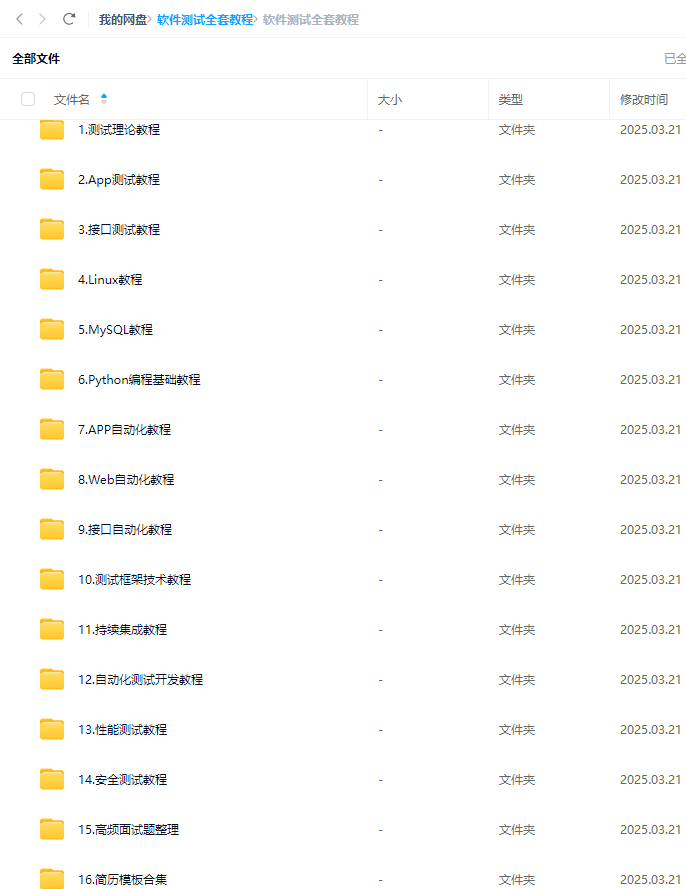
最后: 下方这份完整的软件测试视频教程已经整理上传完成,需要的朋友们可以自行领取【保证100%免费】






 扫一扫
扫一扫


 被折叠的 条评论
为什么被折叠?
被折叠的 条评论
为什么被折叠?
 到【灌水乐园】发言





