
NextPilot基础知识(1):浅谈飞行中的空速IAS、CAS、EAS和TAS

本文引用自:浅谈飞行中的空速:IAS、CAS、EAS和TAS - 哔哩哔哩,为了更好的理解对部分内容进行调整!

在飞行原理、飞行性能、飞行计划、空中领航学、航图、仪表飞行程序等飞行专业课程中,我们经常会遇到飞机的相关飞行速度概念,其中最常见的有指示空速(IAS)、校正空速(CAS)、当量空速(EAS)、真空速(TAS)。特别是IAS、CAS和EAS这三个空速,在飞行性能手册以及相关资料中,有时会同时出现,很多同学顿时就懵逼了。下面我就简单地做一个梳理,希望能帮助同学能够彻底明白这几个空速的概念和区别。

一般各种空速计算过程如下:

  1. 首先由空速管测量出冲撞压力(总压-静压,注意这不是动压,近似等于动压,冲击压力包含了仪表误差和空气压缩滞止压力等),根据冲撞压力计算指示空速IAS(海平面密度)
  2. 对冲撞压力进行校准,主要是仪表误差(包括空速管类型、安装位置、空气摩擦力等等),得到校准后的冲撞压力,计算出校准空速CAS(海平面密度)
  3. 将校准冲撞压力减去由于空气压缩引起的空速管内滞止压力,得到动压,根据动压计算当量空速EAS(海平面密度),表征了飞行空气动力,也就是EAS越大飞机承受的空气动力越大
  4. 采用当前海拔的大气密度,根据动压计算真空速TAS,表征了飞行相对大气的速度,一般用于计算MACH数

指示空速IAS(Indicated Airspeed)

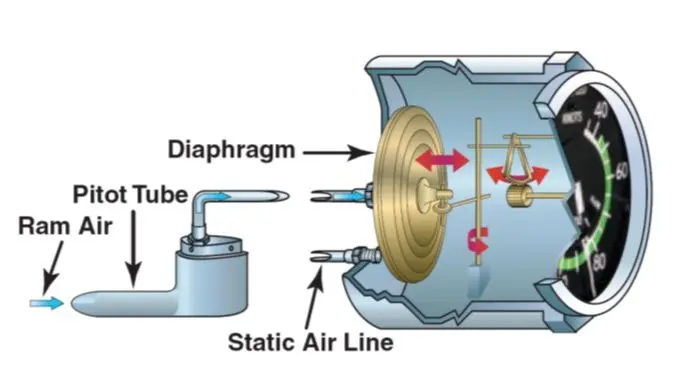
说到IAS,需要先复习一下空速表的基本工作原理:

<think>Hmm, the user is asking for the formula to convert Calibrated Airspeed (CAS) to Equivalent Airspeed (EAS). This seems like an aeronautical engineering or aviation-related query. The user specifically wants the conversion formula, so they're probably working on flight calculations or aircraft performance analysis. Considering the technical nature, the user might be a pilot, aerospace engineer, or aviation student. They need precise mathematical formulas with proper aviation terminology. The request mentions "calibration" and "equivalent" airspeed, which are critical concepts in correcting airspeed measurements for instrument and compressibility errors. Since the task requires web search integration, reputable aviation resources and NASA's technical documents should be prioritized. The formula involves compressibility corrections and the speed of sound, so it's important to explain each variable clearly. The Mach number relationship is also relevant since CAS to EAS conversion depends on it. The answer should strictly follow the requested format: mathematical notation using $ $ delimiters, no first-person language, and methodical presentation without step words. The complexity suggests the user understands aerodynamics, so the explanation can be technical but should define all terms. For the mandatory related questions section, potential expansions could include practical applications, conversion tools, or related aerodynamic concepts - making sure each question stems naturally from this conversion process. Safety note: must emphasize that real flight operations require certified tools rather than manual calculations. </think> 从校准空速CAS)转换为等效空速EAS)是航空中的重要计算,涉及空气动力学大气物理。核心公式考虑了压缩性效应,具体转换过程如下: **转换公式与步骤:** 1. **计算校准空速对应的压力比:** 基于校准空速的定义,求解压力比 $\delta$: $$ \frac{q_c}{p_0} = \left[\left(1 + \frac{0.2}{k} M_{cas}^2\right)^{\frac{k}{k-1}} - 1\right] $$ 其中: - $q_c$ 为冲击压力 - $p_0$ 为标准海平面静压力(101325 Pa) - $M_{cas}$ 是校准空速对应的马赫数 - $k$ 是比热比(空气约为 1.4) 2. **计算真实马赫数(M):** 利用压力比 $\delta$ 当前高度静压 $p$ 求真实马赫数: $$ \frac{q_c}{p} = \frac{\delta}{\left[(1 + \frac{0.2}{k} M^2)^{\frac{k}{k-1}} - 1\right]} $$ 通过数值方法(如牛顿迭代法)求解此方程得到 $M$。 3. **计算等效空速EAS):** 使用真实马赫数当前高度的声速 $a$ 计算 EAS: $$ EAS = M \cdot a \cdot \sqrt{\frac{p}{p_0}} $$ 声速 $a$ 计算公式为 $a = \sqrt{k \cdot R \cdot T}$,其中 $R$ 是气体常数(287 J/kg·K),$T$ 是当前静温(开尔文)。 **关键说明:** - **压缩性修正:** 该过程本质是修正高亚音速飞行时空气压缩性对 CAS 的影响。EAS 代表了在海平面标准大气条件下产生相同动压的速度。 - **数值求解:** 步骤 2 通常需要迭代计算,无法直接解析求解 $M$。 - **实践工具:** 飞行员使用飞行管理计算机或空速表直接读取,工程师使用标准大气表或专用软件(如 NASA 的在线计算器)进行精确转换。 **示例代码(Python):** ```python import math def cas_to_eas(CAS, p, T, p0=101325.0, k=1.4, R=287.0): a0 = math.sqrt(k * R * 288.15) # 海平面声速 (15°C) Mcas = CAS / a0 # 假设CAS单位与a0一致 (m/s) qc_p0 = ((1 + 0.2/k * Mcas**2)**(k/(k-1)) - 1) # 步骤1 qc = qc_p0 * p0 # 步骤2: 牛顿迭代求真实M (简化示例) M = Mcas # 初始猜测值 for _ in range(10): # 迭代10次 f = (1 + 0.2/k * M**2)**(k/(k-1)) - 1 - qc/p df_dM = ( (1 + 0.2/k * M**2)**(1/(k-1)) ) * (0.4/k * M) M = M - f / df_dM a = math.sqrt(k * R * T) # 当前声速 EAS = M * a * math.sqrt(p / p0) # 步骤3 return EAS # 示例用法 (需输入CAS, 当前静压p, 当前静温T) ```
评论
添加红包

请填写红包祝福语或标题

红包个数最小为10个

红包金额最低5元

当前余额3.43前往充值 >
需支付:10.00
成就一亿技术人!
领取后你会自动成为博主和红包主的粉丝 规则
hope_wisdom
发出的红包
实付
使用余额支付
点击重新获取
扫码支付
钱包余额 0

抵扣说明:

1.余额是钱包充值的虚拟货币,按照1:1的比例进行支付金额的抵扣。
2.余额无法直接购买下载,可以购买VIP、付费专栏及课程。

余额充值



