



 本文详细探讨了哈夫曼树的构建方法,通过代码解析思路,深入理解哈夫曼树的生成过程,帮助读者掌握数据结构中的这一重要概念。
讲述哈夫曼树的构建过程(按照代码的思路):
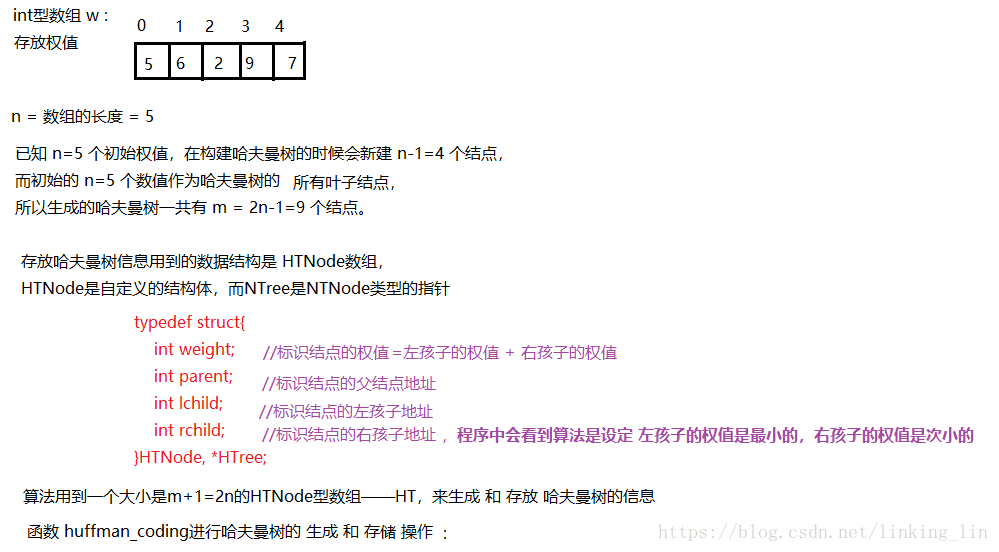
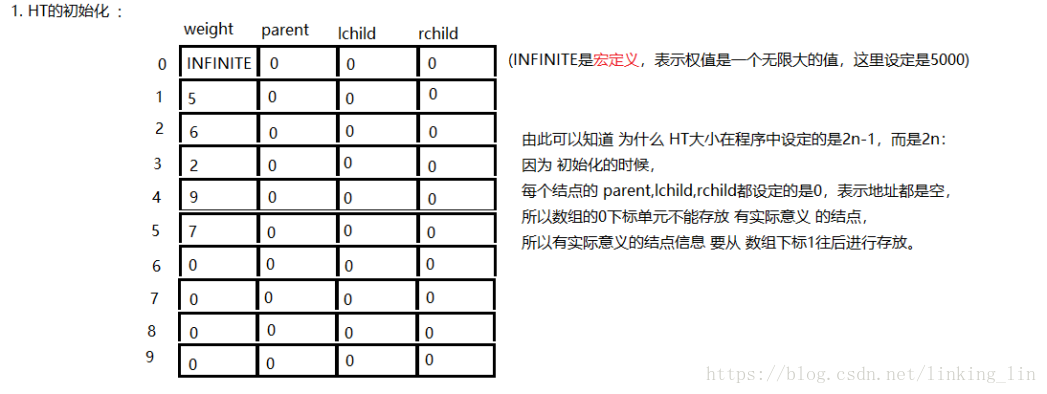
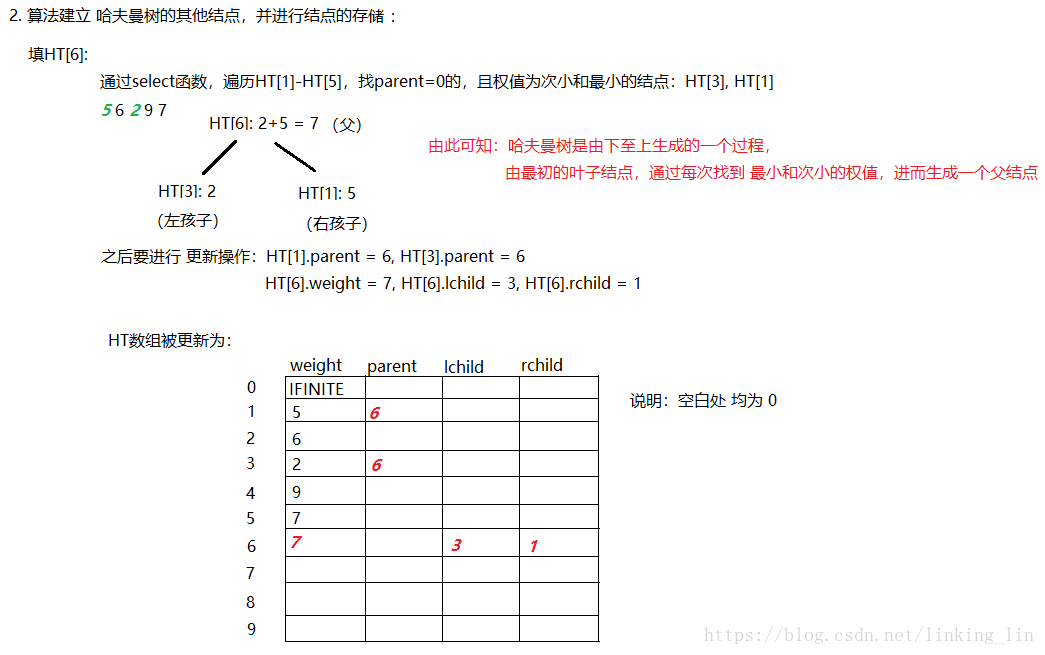
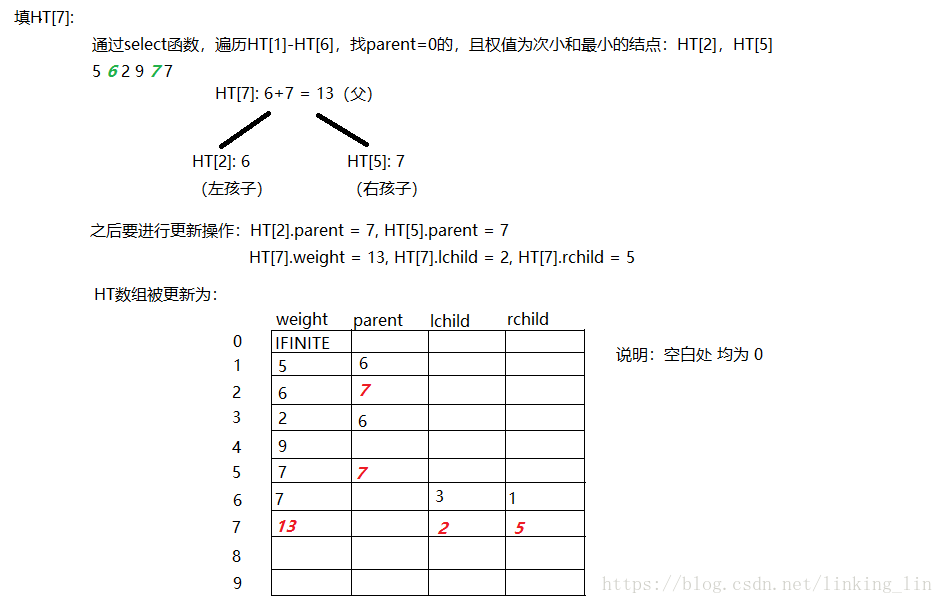
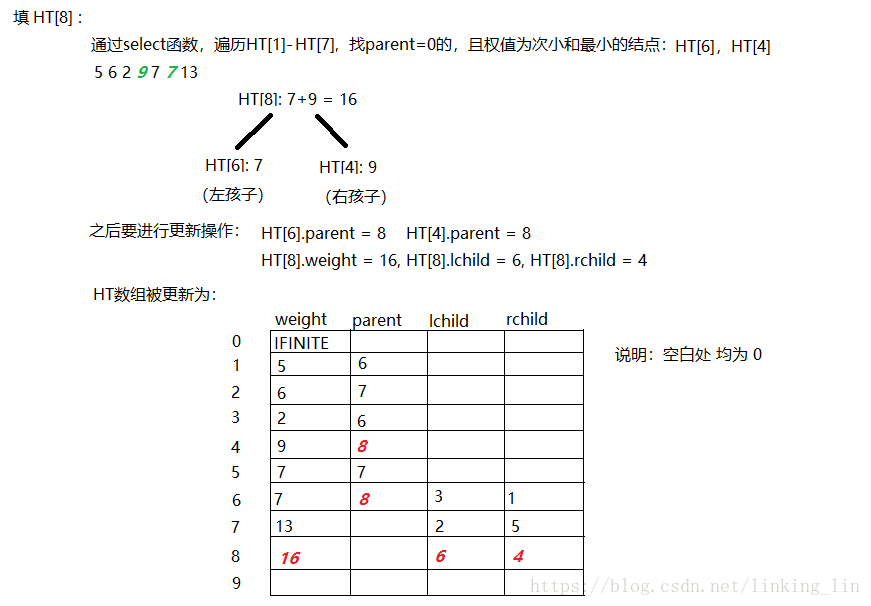
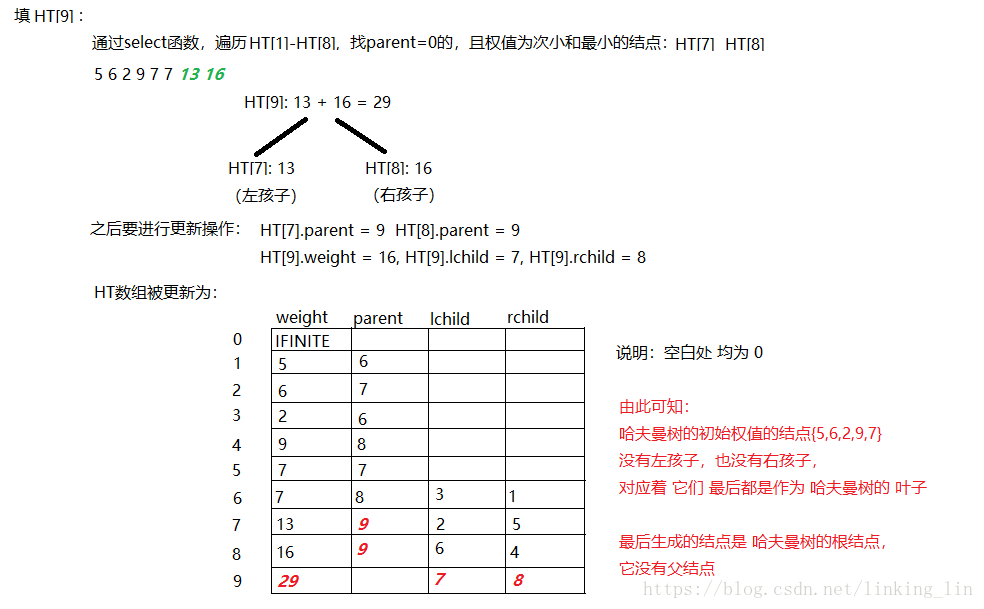
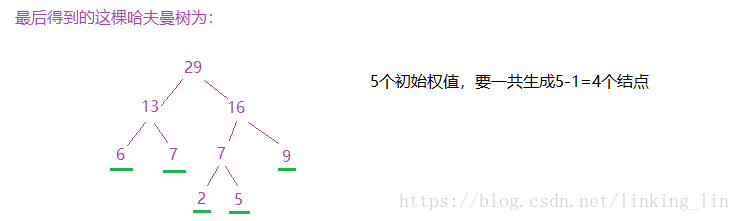
代码:
#include <stdio.h>
#include <malloc.h>

typedef struct{
    int weight;
    int parent;
    int lchild;
    int rchild;
}HTNode, *HTree;

#define INFINITE 5000

void select(HTree HT, int n, int *smallest_index, int *second_smallest_index)
{
//    int tmp = *smallest_index;
    int i;
    HTree p = HT;
    for(i=1;i<=n;++i){
        if(p[i].parent == 0){
            if(p[i].weight < p[*smallest_index].weight){
                *second_smallest_index = *smallest_index;
                *smallest_index = i;
            }else if(p[i].weight < p[*second_smallest_index].weight){
                *second_smallest_index = i;
            }
        }
    }

}

// n: the number of leaves in a Huffman Tree
// w: an array which stores weights
void huffman_coding(int n,int m,int *w, HTree HT)
{
    if(n < 1 || HT == NULL){
        return;
    }
    *HT = (HTNode){INFINITE,0,0,0};
    HTree p = HT+1;
    int i;
    for(i = 1; i <= n; ++i,++p,++w){
        *p=(HTNode){*w,0,0,0};

//        HTNode tmp ={*w,0,0,0};
//        *p=tmp;

//        p->weight = *w;
//        p->parent = 0;
//        p->lchild = 0;
//        p->rchild = 0;
    }// i在这个for循环中只是计数作用

    for(;i<=m;++i,++p){
        *p=(HTNode){0,0,0,0};
    }// i在这个for循环中只是计数作用

    int *s1 = 0;
    int *s2 = 0;
    for(i=n;i<=m-1;++i){
        select(HT,i,s1,s2);
        HT[*s1].parent = i+1;
        HT[*s2].parent = i+1;
        HT[i+1].lchild = *s1;
        HT[i+1].rchild = *s2;
        HT[i+1].weight = HT[*s1].weight+HT[*s2].weight;
    }
}

int main()
{
    int w[5] = {5,6,2,9,7};
    int n = 5;
    int m = 2*n-1;
    HTree HT = (HTree)malloc((m+1)*sizeof(HTNode));
    huffman_coding(n,m,w,HT);
}





 扫一扫
扫一扫


 921
921

 被折叠的 条评论
为什么被折叠?
被折叠的 条评论
为什么被折叠?
 到【灌水乐园】发言





