


 现有电动汽车驾驶辅助系统中,前向雷达多用于安全控制,少用于节能。本文提出基于前向雷达检测前车运动的节能策略,采用分层控制架构,设计节能模式与电机扭矩优化策略。经仿真和实验验证,该策略能显著降低城市道路下电动汽车能耗。
Intelligent energy-saving control strategy for electric vehicle based on preceding vehicle movement
基于前车运动的电动汽车智能节能控制策略


abstract
In the existing driver assistance systems of electric vehicle, the vehicular forward radar is mainly used for active safety control and seldom for energy-saving control. In order to improve the energy efficiency of electric vehicle, this paper proposes a novel energysaving control strategy for electric vehicle based on movement of the preceding vehicle detected by forward radar. A hierarchical control architecture, which consists of three layers, is adopted in the proposed strategy. In the upper layer, the vehicles’ relative motion state is classified into four different scenarios based on the assessment of driving safety. In the middle layer, the energy-saving mode decision and transition control strategy are designed according to the scenario classification. In the bottom layer, the motor’s torque optimization and coordination control strategy are proposed to improve energy efficiency, while ensuring both driving safety and ride comfort. An optimized control algorithm based on Model Predictive Control (MPC) theory, is designed to optimize the motor’s torque for each mode in real-time. Finally, our proposed energy-saving control strategy is applied to an electric bus. Simulation and experiment tests are carried out to verify the effectiveness of the designed energy-saving control strategy. The results show that the proposed strategy can significantly reduce the energy consumption of electric vehicle under urban road conditions.
现有的电动汽车驾驶辅助系统中,车载前向雷达主要用于主动安全控制,很少用于节能控制。 为了提高电动汽车的能源效率,提出一种基于前向雷达检测前车运动的电动汽车节能控制策略。 该策略采用了由三层组成的分层控制架构。 在上层,根据行车安全评估,将车辆的相对运动状态分为四种不同的场景。 中间层根据场景分类设计节能模式决策和过渡控制策略。 在底层,提出了电机的扭矩优化和协调控制策略,以提高能源效率,同时保证行驶安全性和乘坐舒适性。 基于模型预测控制(MPC)理论的优化控制算法旨在实时优化每种模式下的电机扭矩。 最后,我们提出的节能控制策略应用于电动公交车。 通过仿真和实验测试验证了所设计的节能控制策略的有效性。 结果表明,所提出的策略能够显着降低城市道路条件下电动汽车的能耗。
1. Introduction
In recent years, new energy vehicles have received wide attention from both automobile manufacturers and researchers. Electric vehicles represent a promising solution to the depletion of fossil energy and vehicle emissions [1]. However, considering that the battery storage capacity of current electric vehicles is insufficient, the phenomenon where drivers are concerned about running out of power, or the so-called ‘range anxiety’, is a major obstacle for the widespread application and future advances of electric vehicles. Prolonging the driving range of electric vehicles has become a major challenge. Therefore, an effective energy-saving strategy is vital for improving the energy efficiency and driving range of electric vehicles.
近年来,新能源汽车受到汽车制造商和研究人员的广泛关注。 电动汽车是解决化石能源枯竭和车辆排放问题的一种有前途的解决方案[1]。 然而,考虑到目前电动汽车的电池存储容量不足,驾驶者担心没电的现象,即所谓的“里程焦虑”,是电动汽车广泛应用和未来发展的一大障碍。 汽车。 延长电动汽车的续驶里程已成为一项重大挑战。 因此,有效的节能策略对于提高电动汽车的能源效率和续驶里程至关重要。
Previous studies have shown that radical or aggressive driving operations such as rapid acceleration or rapid deceleration are high energy-consuming behaviors [2]. Therefore, vehicle speed optimization and optimal speed control are key research areas for energy-saving control. Barth et al. proposed a dynamic driving strategy, which used the location of the vehicle and the real time traffic information, including the average speed and service level of the section, to determine the speed of a specified vehicle, thus reducing the frequent acceleration or deceleration. Their results show that this strategy can reduce energy consumption by 10%–20% [3]. Grossard et al. designed an auxiliary driving system for electric vehicles with a similar method, which was to determine and provide the corresponding driving speed for the vehicle, also achieved an ideal energysaving effect [4]. Kuriyama and Miyatake introduced the optimal control model into the energy-saving driving assistant control. Under certain road and traffic conditions, the optimal control model was established with the total energy consumption as the planning goal. With this method, the optimal speed of vehicle at each moment is solved, thus the optimal speed curve is drawn to provide guidance for the vehicle running under certain conditions [5,6]. Mensing et al. took vehicle velocity and acceleration as control variables, and attained the energy-saving driving curve [7]. Laine et al. used control allocation to distribute the torque among different motors for maintaining vehicle motion and achieving energy-efficiency improvement [8]. Nandi proposed a comfortable and optimal driving strategy using a multi-objective optimization method [9]. A similar method was applied to hybrid electric vehicles or distributed electric vehicles and achieved multi-objective optimization [10–13]. As can be seen, energy-saving control strategy is one of the research hotspots in the field of electric vehicle. Despite the previous efforts, the dynamic time-varying information of traffic environment, such as the motion of the preceding vehicle, are not fully considered in these energy-saving control strategies. In addition, vehicular sensors in intelligent electric vehicle, such as forward radar, were not utilized in braking energy recovery of electric vehicle, so there is still potential for greater energy-savings.
以往的研究表明,快速加速或快速减速等激进或激进的驾驶操作是高耗能行为[2]。 因此,车辆速度优化和最优速度控制是节能控制的重点研究领域。 巴特等人。 提出了一种动态驾驶策略,利用车辆的位置和实时交通信息,包括路段的平均速度和服务水平,来确定指定车辆的速度,从而减少频繁的加速或减速。 他们的结果表明,这种策略可以减少 10%–20% 的能源消耗 [3]。 格罗萨德等人。 采用类似的方法设计了电动汽车辅助驱动系统,确定并为车辆提供相应的行驶速度,也取得了理想的节能效果[4]。 Kuriyama和Miyatake将最优控制模型引入到节能驾驶辅助控制中。 在一定的道路和交通条件下,以能源消耗总量为规划目标,建立最优控制模型。 该方法求解出车辆在每一时刻的最优速度,从而绘制出最优速度曲线,为车辆在一定条件下的运行提供指导[5,6]。 门辛等人。 以车辆速度和加速度为控制变量,得到节能行驶曲线[7]。 莱恩等人。 利用控制分配在不同电机之间分配扭矩,以维持车辆运动并实现能源效率的提高[8]。 Nandi 使用多目标优化方法提出了一种舒适且最优的驾驶策略[9]。 类似的方法应用于混合动力电动汽车或分布式电动汽车并实现了多目标优化[10-13]。 可见,节能控制策略是电动汽车领域的研究热点之一。 尽管之前的努力,这些节能控制策略并未充分考虑交通环境的动态时变信息,例如前车的运动。 此外,智能电动汽车中的车载传感器,如前向雷达等,并未用于电动汽车的制动能量回收,因此仍有较大的节能潜力。
With the development of Intelligent Transportation System (ITS) and communication technologies over the past few years, much attention has been paid to the energy-saving control of vehicles based on the traffic information, including the V2V and V2I communication, GIS and GPS, preceding vehicle movement, and road terrain profile. Information obtained from the ITS can be used to optimize vehicle control in terms of fuel efficiency [14], vehicle dynamic performance [15], and driving stability/safety [16].Chen et al. introduced an energy-efficient control strategy based on the preview of forward terrain profile to optimally distribute the torque between the front and rear motors as a method to save energy [17,18]. Zheng et al. presented a predictive driving control strategy for pure electric vehicles for energy saving [19]. Based on V2I technology, the optimal speed strategy for continuous intersections can help reduce energy consumption. Luo et al. proposes an optimal speed advisory method based on genetic algorithm, and the simulation results show that the proposed strategy has a significant advantage in reducing energy consumption and intersection passing time [20]. Based on V2V technology, the movement information of preceding vehicles was used to improve energy efficiency [21,22]. The Bayesian network was used to predict the future motion of the preceding vehicles and to optimize the speed and power output of electric vehicles [23–26]. However, the energy-saving effects of these technologies depend on external communication facility or device. The main drawback of existing energy-saving technologies is summarized as follows: The dynamic time-varying information of traffic environment, such as the motion of the preceding vehicle, is not fully considered. Although many recent studies have taken the preceding vehicle into account, they are too costly for their over-reliance on the external communication facility, and are difficult to be applied within a short period of time.
近年来,随着智能交通系统(ITS)和通信技术的发展,基于交通信息的车辆节能控制受到广泛关注,包括V2V和V2I通信、GIS和GPS等。 车辆运动和道路地形轮廓。 从 ITS 获得的信息可用于在燃油效率 [14]、车辆动态性能 [15] 和行驶稳定性/安全性 [16] 方面优化车辆控制。 引入了一种基于前方地形轮廓预览的节能控制策略,以优化前后电机之间的扭矩分配,作为节能的方法[17,18]。 郑等人。 提出了一种用于纯电动汽车节能的预测驾驶控制策略[19]。 基于V2I技术,连续交叉路口的最优速度策略有助于降低能耗。 罗等人。 提出一种基于遗传算法的最优车速咨询方法,仿真结果表明,该策略在降低能耗和路口通过时间方面具有显着优势[20]。 基于V2V技术,利用前车的运动信息来提高能源效率[21,22]。 贝叶斯网络用于预测前方车辆的未来运动并优化电动汽车的速度和功率输出[23-26]。 然而,这些技术的节能效果取决于外部通信设施或设备。 现有节能技术的主要缺点概括如下:没有充分考虑交通环境的动态时变信息,例如前车的运动。 尽管最近的许多研究都考虑了前车,但由于过度依赖外部通信设施,成本过高,且难以在短时间内得到应用。
In order to further explore the energy-saving potential of intelligent electric vehicles and seek a cost-effective method of improving energy efficiency based on existing vehicular sensor, we proposed an intelligent energy-saving controller (IEC) for electric vehicles in this paper. The main contribution of this paper is summarized as follows: We proposed an intelligent energy-saving control strategy for electric vehicle based on preceding vehicle movement detected by on-board radar originally used for active safety in vehicle. In order to achieve the objective of energy-saving for electric vehicle while considering both driving safety and driving intention, the IEC mode decision and transition control strategy are designed according to the classification of driving scenarios. In order to optimize the motor’s torque in each mode real-timely, an optimized control algorithm based on model predictive control (MPC) theory is designed. The proposed method fully considers the objectives of energy efficiency, driving safety and driving intention, and ensures the real-time performance of IEC.
为了进一步挖掘智能电动汽车的节能潜力,寻求一种基于现有车辆传感器的、经济有效的提高能源效率的方法,本文提出了一种电动汽车智能节能控制器(IEC)。 本文的主要贡献总结如下:我们提出了一种基于车载雷达检测前车运动的电动汽车智能节能控制策略,该策略最初用于车辆的主动安全。 为了在兼顾驾驶安全和驾驶意图的同时实现电动汽车节能的目标,根据驾驶场景分类设计了IEC模式决策和过渡控制策略。 为了实时优化电机各模式下的扭矩,设计了基于模型预测控制(MPC)理论的优化控制算法。 该方法充分考虑了能源效率、驾驶安全和驾驶意图等目标,并保证了IEC的实时性。
The remaining parts of this paper are organized as follows: The second section introduces the architecture of IEC system ased on preceding vehicle movement. The third section describes the energy-saving control strategy in detail. The fourth ection shows the results of simulation in Matlab/Simulink environment. The fifth section gives the results of the experiments to validate the effectiveness of our proposed IEC system. Finally, conclusions are drawn in the sixth section.
本文的其余部分组织如下:第二部分介绍了针对前行车辆运动的IEC系统的体系结构。 第三部分详细介绍了节能控制策略。 第四部分展示了Matlab/Simulink环境下的仿真结果。 第五部分给出了验证我们提出的 IEC 系统有效性的实验结果。 最后,第六部分得出结论。
2. Architecture of IEC system
The hierarchical control architecture in [27] is adopted in IEC system, which consists of three layers, as shown in Fig. 1.
IEC系统采用[27]中的分层控制架构,由三层组成,如图1所示。
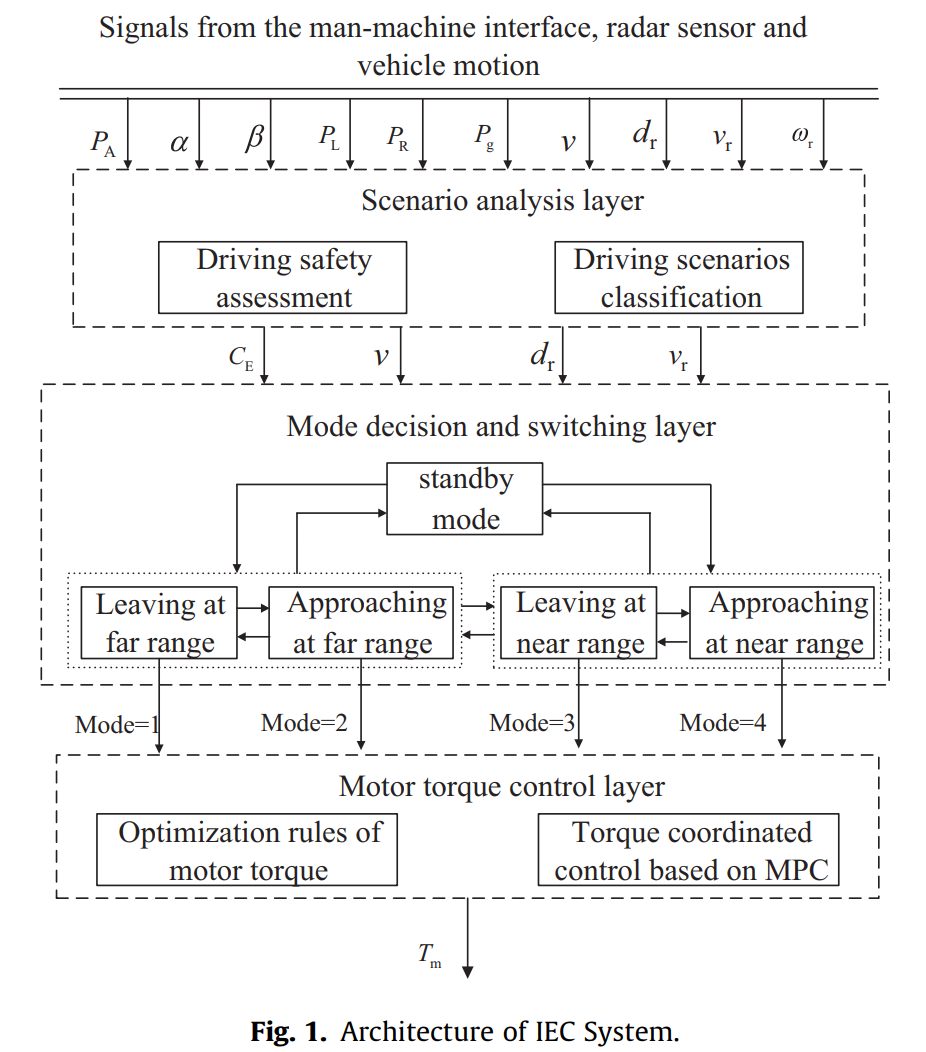
The upper layer is the scenario analysis layer, in which the driving safety is assessed based on the relative movement of ego-vehicle and preceding vehicle. The safe distance and working range of IEC are defined as the bases for scenario classification. In addition, the driver’s intention is recognized according to factors including the IEC switch, current gear position, acceleration pedal stroke, brake pedal stroke, cornering lamp, and yaw rate of the vehicle. The driving intention is used to determine whether the IEC should be open or exited.
上层为场景分析层,根据本车与前车的相对运动来评估行车安全。 IEC定义的安全距离和工作范围作为场景分类的基础。 此外,还根据IEC开关、当前档位、加速踏板行程、制动踏板行程、转向灯和车辆横摆率等因素来识别驾驶员的意图。 驾驶意图用于确定是否应该打开或退出IEC。
In the middle layer, we develop the mode decision and transition control strategy. According to the relative distance and velocity of ego-vehicle and preceding vehicle obtained from the radar, the driving scenario is classified into four states: leaving at far range, approaching at far range, leaving at near range and approaching at near range, where the demarcation of far range and near range is the safe distance. These four states correspond to four energy-saving modes respectively. The mode transition is carried out according to the motion state of ego-vehicle and preceding vehicle.
在中间层,我们开发模式决策和转换控制策略。 根据雷达获取的本车与前车的相对距离和速度,将驾驶场景分为远距离开、远距接近、近距离开和近距接近四种状态,其中 远距离和近距离的分界线就是安全距离。 这四种状态分别对应四种节能模式。 根据本车和前车的运动状态进行模式转换。
The bottom layer is the torque control layer, in which the optimization rule and coordinated control algorithm are designed to optimize the motor torque in each mode. The optimized control algorithm based on MPC method is designed to achieve the objective of energy efficiency, driving safety and ride comfort. The optimization rule of motor torque is designed to optimize the torque and increase braking energy recovery in different modes. The proposed method is supposed to guarantee the real-time performance of IEC.
最底层是扭矩控制层,设计优化规则和协调控制算法来优化各模式下的电机扭矩。 设计基于MPC方法的优化控制算法,以实现能源效率、行驶安全性和乘坐舒适性的目标。 设计电机扭矩优化规则,优化不同模式下的扭矩,增加制动能量回收。 该方法旨在保证IEC的实时性。
3. Energy-saving control strategy
3.1. Mode decision and transition control strategy based on scenario analysis
3.1.1. The classification of driving scenarios based on assessment of driving safety
The assessment of driving safety is an important basis for scenario classification and also a prerequisite for mode decision. Time Headway (THW) is adopted to assess the levels of driving safety in this paper. THW is defined as the time spacing between the two vehicles passing through the same place, and represents the maximum reaction time of the ego-vehicle driver when the preceding vehicle has an emergency brake. The model of minimum safe spacing based on THW is presented as
驾驶安全评估是场景分类的重要依据,也是模式决策的前提。 本文采用车头时距(THW)来评估行车安全水平。 THW定义为两辆车经过同一地点的时间间隔,代表本车驾驶员在前车紧急制动时的最大反应时间。 基于THW的最小安全间距模型为

Considering the driver’s pre-warning time and braking deceleration, the model of minimum safe spacing is established as
考虑驾驶员预警时间和制动减速度,建立最小安全间距模型为

Considering the emergency braking of the preceding vehicle, the model of safe spacing between the two vehicles is established as
考虑前车紧急制动,建立两车安全间距模型为

In order to ensure the driving safety, the safe distance ds should be the largest value amongst (1)–(3) and is expressed as
为了保证行车安全,安全距离 dsd_sds 应取式(1)~(3)中的最大值,表达式为

Similarly, the working range model of IEC is established as
类似地,建立IEC的工作范围模型为

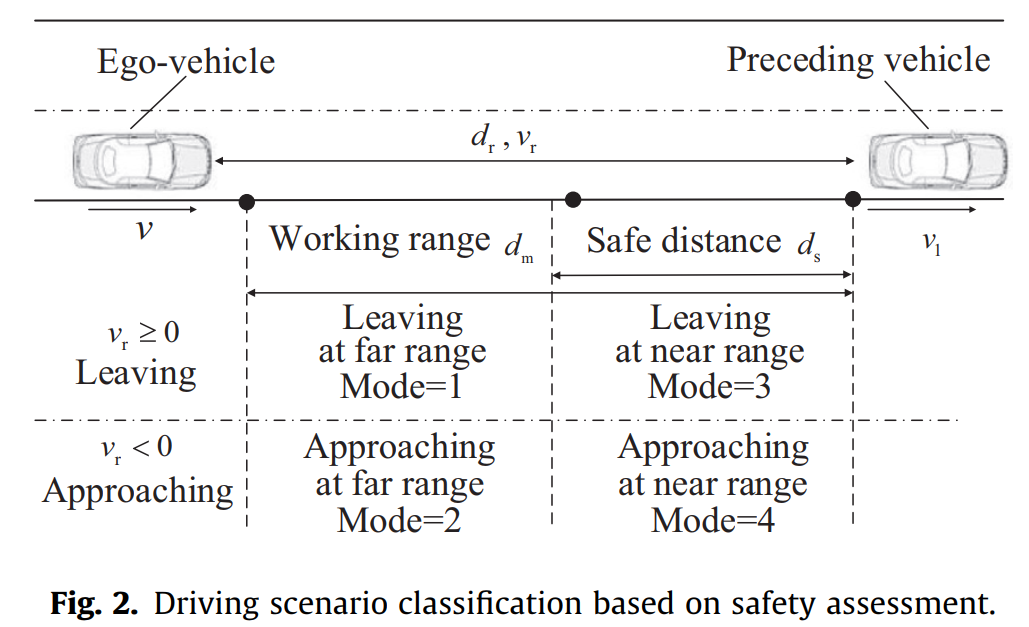
According to the safe distance and the working range obtained from Eq. (4) and Eq. (5), the driving scenario is classified into four states: leaving at far range, approaching at far range, leaving at near range and approaching at near range. These four scenarios correspond to four modes respectively, as shown in Fig. 2.
根据公式 (4) 和公式 (5)得出安全距离和工作范围,将驾驶场景分为四种状态:远距离离开、远距离接近、近距离离开和近距离接近。 这四种场景分别对应四种模式,如图2所示。
3.1.2. Mode transition control based on scenarios classification
As shown in Fig. 3, the logical relationship of mode transition is established based on the scenarios classification. The condition that distinguishes a far-range scenario from a near-range scenario is dr > ds. However, to prevent frequent transition, a buffer zone is introduced to the actual transition condition. When dr > ds þ d1, the far-range modes, including mode 1 and mode 2, are switched to the near-range modes, including mode 3 and mode 4. When dr < ds d2, the far-range modes are switched to the near-range modes. Similarly, when vr > v1, the approaching modes, including mode 2 and mode 4, are switched to the leaving modes, including mode 1 and mode 3. When vr < v2, the leaving modes are switched to the approaching modes.
如图3所示,根据场景分类建立模式转换的逻辑关系。 区分远距离场景和近距离场景的条件是 dr>dsd_r > d_sdr>ds。 然而,为了防止频繁转换,在实际转换条件中引入了缓冲区。 当 dr>ds+d1d_r > d_s + d_1d
 最低0.47元/天 解锁文章






 扫一扫
扫一扫


 1374
1374

 被折叠的 条评论
为什么被折叠?
被折叠的 条评论
为什么被折叠?
 到【灌水乐园】发言





