 DPO微调效果验证方法


大模型DPO强化学习微调验证过程
💪 为什么必须进行强化学习验证
1. 证明微调有效性
科学验证必要
- 证明投入值得:DPO训练消耗了时间和算力资源,必须证明确实有提升
- 避免自欺欺人:仅看loss曲线下降不足以说明实际应用效果
- 数据支撑决策:为后续优化方向提供明确的数据依据
2. 发现具体改进点
细致效果分析
- 语言风格变化:原始模型偏技术性,DPO后更加亲和温暖
- 专业性提升:能够给出更具体、更实用的专业建议
- 服务意识增强:主动提供额外的贴心提示和后续引导
3. 质量控制保证
防止负面效应
- 确保基础能力未退化:验证微调没有损害模型的基本推理能力
- 检查过拟合风险:确保模型没有只记住训练数据而失去泛化能力
- 发现潜在问题:及时发现可能的偏见或错误倾向
4. 业务价值验证
商业效果评估
- 转化率预期:更专业贴心的回答预期能提升客户转化率
- 客户满意度:温暖专业的服务体验有助于提升客户满意度
- 运营成本优化:AI处理更多专业咨询,减少人工客服压力
📊 验证结果的应用价值
通过系统性的验证,我们能够:
- 量化微调效果:用具体案例证明DPO训练的价值
- 识别优化方向:发现哪些方面还需要进一步改进
- 建立评估标准:为后续类似项目提供评估方法论
- 支撑业务决策:为模型上线和推广提供数据支撑
顶级技术资源聚合
- 免费获取市面稀缺内容:部分免费课程资源对标万元级付费培训(二次源码开发,公开课价值含量都非常高
- 大厂技术总监级导师研发:提供一线工程经验与架构设计思维
😰 DPO强化学习验证的难度
1. 技术实现难度
内存管理挑战
def clear_memory(self):
    """需要频繁清理GPU内存避免OOM"""
    if self.current_model:
        del self.current_model
        del self.current_tokenizer
    gc.collect()
    torch.cuda.empty_cache()
模型兼容性问题
- Flash Attention兼容性问题需要降级到eager模式
- 不同模型的tokenizer和生成配置差异
- 设备映射和精度配置的复杂性
2. 评估标准主观性
缺乏客观指标
- 专业性、温暖度、实用性等很难量化
- 需要人工判断"哪个回答更好"
- 不同评估者可能有不同偏好
评估工作量大
- 每个问题需要逐一对比两个回答
- 需要具备相关专业知识才能准确评估
- 大量样本评估耗时耗力
3. 资源消耗高
计算资源需求
- 需要重复加载两个大模型进行推理
- 每个问题都要运行两次生成过程
- GPU内存需求较大,处理速度相对较慢
🔍 DPO强化学习验证方法
1. A/B对比测试法
文档中采用了ModelComparator序列化模型对比器的方法:
# 核心对比逻辑
对比方案:
- 模型A:原始微调模型 (/root/autodl-tmp/FT-Qwen3-4B)
- 模型B:DPO强化微调模型 (/root/autodl-tmp/FT-Qwen3-4B_DPO)
- 测试数据:随机抽取10个专业儿童服装咨询问题
- 输出格式:JSONL格式,包含问题和两个模型的回答
2. 实际场景验证法
验证数据来源:使用真实的儿童服装专业咨询场景
- 专业尺码建议问题
- 儿童安全专业知识问题
- 儿童行为习惯匹配问题
- 季节性专业搭配问题
- 儿童心理与偏好问题
基础数据准备
import json
import random
import time
from openai import OpenAI
from concurrent.futures import ThreadPoolExecutor

# 配置
API_KEY = "个人deepseek apikey"
client = OpenAI(api_key=API_KEY, base_url="https://api.deepseek.com")

# 儿童服装专业场景(容易出微调效果的)
question_templates = {
    "专业尺码建议": [
        "我家宝宝{age}个月,{height}cm,{weight}斤,现在是{season},这件{item}选什么码合适?会不会买大了?",
        "孩子{age}岁,比同龄人{size_diff}一些,平时{brand}牌子穿{size}码,你们家这件{item}建议选什么码?",
        "双胞胎宝宝,一个{weight1}斤一个{weight2}斤,都{age}岁,这款{item}怎么选码?",
    ],

    "儿童安全专业知识": [
        "这件{item}的拉链是什么材质?会不会划伤宝宝皮肤?有没有防夹设计?",
        "宝宝{age}个月,正在长牙期,这件衣服的纽扣会不会被咬掉?安全吗?",
        "孩子有异位性皮炎,这个面料的pH值是多少?会刺激皮肤吗?",
        "这件{item}符合GB31701-2015标准吗?甲醛含量多少?",
    ],

    "儿童行为习惯匹配": [
        "我家宝宝{age}岁,特别爱在地上爬,这件{item}耐脏吗?膝盖部分会不会很快磨破?",
        "孩子{age}岁,还不会自己上厕所,这件{item}方便脱吗?松紧带会不会勒肚子?",
        "宝宝{age}个月,正在学走路,经常摔倒,这件{item}的面料厚度够保护吗?",
        "孩子特别好动,上蹿下跳的,这件{item}的接缝结实吗?会不会开线?",
    ],

    "季节性专业搭配": [
        "现在{season},温度{temp}度,孩子{age}岁,这件{item}里面需要穿什么?怎么搭配不会热?",
        "马上要{next_season}了,这件{item}能穿到什么时候?需要买大一码为明年准备吗?",
        "孩子{age}岁,{season}去{place}旅游,这套{item}搭配合适吗?需要带什么备用衣服?",
    ],

    "儿童心理与偏好": [
        "我家{gender}宝{age}岁,特别喜欢{character},不喜欢{dislike},这件{item}的设计孩子会喜欢吗?",
        "孩子{age}岁,刚上幼儿园,比较内向,这件{item}的颜色会不会太{color_type}?",
        "宝宝{age}个月,对声音很敏感,这件{item}的装饰会不会有声音?会影响睡觉吗?",
    ]
}

# 专业变量池(更具体、更专业)
variables = {
    "age": ["6个月", "10个月", "1岁", "1岁半", "2岁", "3岁", "4岁", "5岁"],
    "height": ["70", "75", "80", "85", "90", "95", "100", "105", "110"],
    "weight": ["16", "18", "20", "22", "24", "26", "28", "30", "32"],
    "season": ["春天", "夏天", "秋天", "冬天", "换季"],
    "next_season": ["夏天", "秋天", "冬天", "春天"],
    "item": ["连体衣", "分体睡衣", "外出服", "家居服", "防踢被", "爬服"],
    "size_diff": ["偏瘦", "偏胖", "偏高", "偏矮"],
    "brand": ["优衣库", "Gap", "Zara", "HM", "Carter's"],
    "size": ["80", "90", "100", "110", "120"],
    "weight1": ["20", "22", "24"],
    "weight2": ["18", "21", "23"],
    "temp": ["15-20", "20-25", "25-30", "10-15"],
    "place": ["海边", "山区", "北方", "南方", "国外"],
    "gender": ["男", "女"],
    "character": ["小猪佩奇", "汪汪队", "冰雪奇缘", "超级飞侠"],
    "dislike": ["太花哨的图案", "硬质装饰", "紧身设计"],
    "color_type": ["鲜艳", "暗淡", "成熟"]
}

def generate_question():
    category = random.choice(list(question_templates.keys()))
    template = random.choice(question_templates[category])

    question = template
    for var, values in variables.items():
        if f"{{{var}}}" in question:
            question = question.replace(f"{{{var}}}", random.choice(values))

    return question, category

def batch_generate_response(questions_batch):
    # 针对不同类别使用专业的system prompt
    system_prompts = {
        "专业尺码建议": "你是资深的儿童服装尺码专家,有10年经验。要考虑儿童生长发育特点、季节因素、品牌差异,给出精准的尺码建议和理由。",
        "儿童安全专业知识": "你是儿童用品安全专家,熟悉国标GB31701-2015,了解各种材质和工艺的安全性,要给出专业的安全评估。",
        "儿童行为习惯匹配": "你是儿童发展心理学专家,了解各年龄段儿童的行为特点和生理需求,能根据孩子习惯推荐合适的服装功能。",
        "季节性专业搭配": "你是儿童服装搭配师,精通不同季节、地区、温度下的儿童穿搭,能给出实用的搭配方案。",
        "儿童心理与偏好": "你是儿童心理专家,了解不同年龄段孩子的心理特点和审美偏好,能推荐符合儿童心理需求的服装。"
    }

    combined_prompt = "请为以下专业的儿童服装咨询问题分别给出详细专业的回答,体现你的专业知识和经验,每个回答用\"---\"分隔:\n\n"

    categories = []
    for i, (question, category) in enumerate(questions_batch, 1):
        combined_prompt += f"{i}. {question}\n"
        categories.append(category)

    # 使用第一个问题的类别作为主要专业方向
    main_category = categories[0]

    try:
        response = client.chat.completions.create(
            model="deepseek-chat",
            messages=[
                {"role": "system", "content": system_prompts[main_category]},
                {"role": "user", "content": combined_prompt}
            ],
            temperature=0.7,
            max_tokens=2000
        )

        full_response = response.choices[0].message.content.strip()
        answers = full_response.split("---")

        cleaned_answers = []
        for answer in answers:
            cleaned = answer.strip()
            if cleaned.startswith(("1.", "2.", "3.", "4.", "5.")):
                cleaned = cleaned[2:].strip()
            cleaned_answers.append(cleaned)

        return cleaned_answers[:len(questions_batch)]

    except Exception as e:
        print(f"批量API调用失败: {e}")
        return [f"抱歉,这个问题比较专业,建议您联系我们的儿童服装专家客服获得详细解答。" for _ in questions_batch]

# 其余代码保持不变...
def process_batch(batch_questions):
    answers = batch_generate_response(batch_questions)

    results = []
    for (question, category), answer in zip(batch_questions, answers):
        sample = {
            "instruction": "作为专业的儿童服装顾问,请根据儿童发育特点、安全标准、行为习惯等专业知识回答问题。",
            "input": question,
            "output": answer
        }
        results.append(sample)

    return results

# 生成数据的代码保持不变...
print("生成专业儿童服装问题中...")
all_questions = []
used_questions = set()

while len(all_questions) < 150:
    question, category = generate_question()
    if question not in used_questions:
        used_questions.add(question)
        all_questions.append((question, category))

print(f"生成了{len(all_questions)}个专业问题")

# 批量处理
print("开始批量生成专业回答...")
batch_size = 5  # 专业问题复杂,减少批次大小
all_data = []

with ThreadPoolExecutor(max_workers=2) as executor:
    futures = []
    for i in range(0, len(all_questions), batch_size):
        batch = all_questions[i:i+batch_size]
        future = executor.submit(process_batch, batch)
        futures.append(future)

    for i, future in enumerate(futures):
        try:
            batch_results = future.result(timeout=45)
            all_data.extend(batch_results)
            print(f"完成批次 {i+1}/{len(futures)}, 已生成 {len(all_data)} 条专业数据")
        except Exception as e:
            print(f"批次 {i+1} 处理失败: {e}")

        time.sleep(0.5)

print("专业数据生成完成!")

# 保存文件
random.shuffle(all_data)
train_data = all_data[:130]
test_data = all_data[130:150]

with open('train.jsonl', 'w', encoding='utf-8') as f:
    for item in train_data:
        f.write(json.dumps(item, ensure_ascii=False) + '\n')

with open('test.jsonl', 'w', encoding='utf-8') as f:
    for item in test_data:
        f.write(json.dumps(item, ensure_ascii=False) + '\n')

print(f"训练集: train.jsonl ({len(train_data)}条)")
print(f"测试集: test.jsonl ({len(test_data)}条)")
点击加入 -> 赋范空间社区 :
带你攻克LLM工业级全栈技术开发!10+工业级方案,还有更多持续更新Agent、模型微调、RAG、MCP、多模态等课程
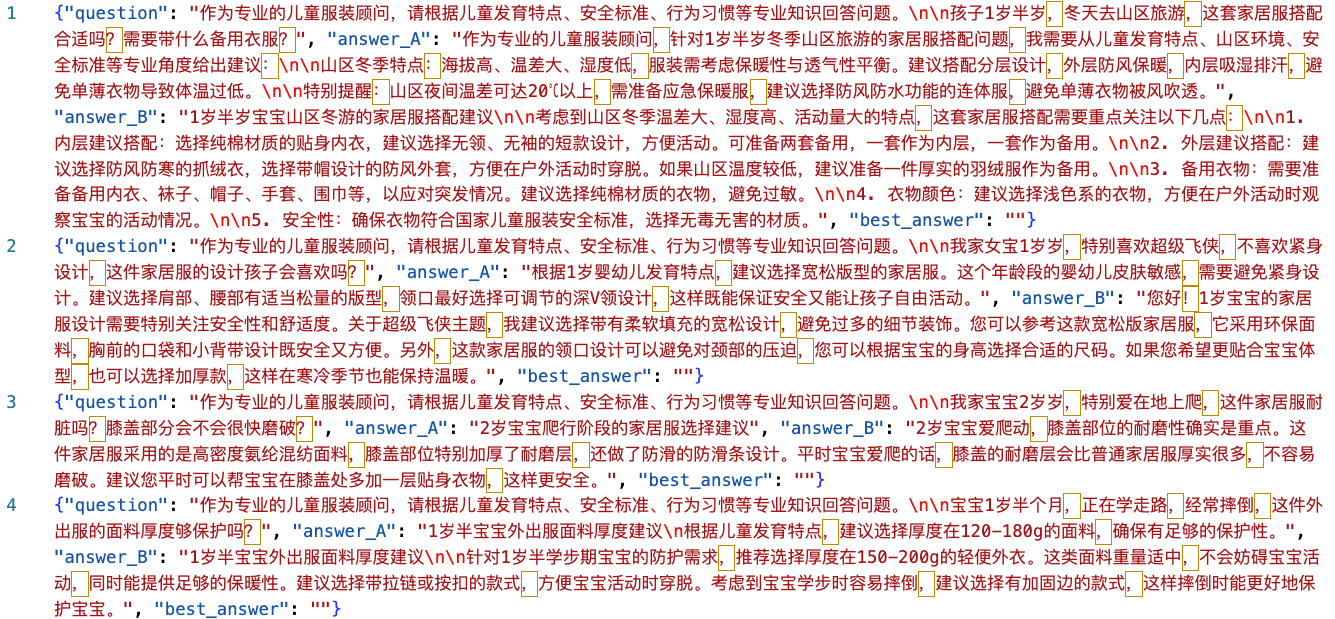
微调结果对比
对比方案设计
import json
import random
import torch
import gc
from datetime import datetime
from typing import List, Dict
from tqdm import tqdm

class ModelComparator:
    """序列化模型对比生成器"""

    def __init__(self, data_path: str, model_a: str, model_b: str,
                 sample_size: int = 10, output_file: str = "comparison.jsonl"):
        self.data_path = data_path
        self.model_a_path = model_a
        self.model_b_path = model_b
        self.sample_size = sample_size
        self.output_file = output_file
        self.current_model = None
        self.current_tokenizer = None

    def load_questions(self) -> List[Dict]:
        """加载并随机抽样问题"""
        print(f"加载数据: {self.data_path}")

        samples = []
        with open(self.data_path, 'r', encoding='utf-8') as f:
            for line in f:
                try:
                    samples.append(json.loads(line.strip()))
                except json.JSONDecodeError:
                    continue

        selected = random.sample(samples, min(self.sample_size, len(samples)))
        print(f"抽取 {len(selected)} 个样本")
        return selected

    def format_question(self, sample: Dict) -> str:
        """格式化问题文本"""
        instruction = sample.get("instruction", "")
        input_text = sample.get("input", "")

        if input_text:
            return f"{instruction}\n\n{input_text}"
        return instruction

    def clear_memory(self):
        """清理GPU内存和垃圾回收"""
        if self.current_model:
            del self.current_model
            del self.current_tokenizer
            self.current_model = None
            self.current_tokenizer = None

        gc.collect()
        if torch.cuda.is_available():
            torch.cuda.empty_cache()

    def load_model(self, model_path: str):
        """加载模型 - 简化版本,避免Flash Attention错误"""
        from transformers import AutoTokenizer, AutoModelForCausalLM
        import warnings

        # 屏蔽警告
        warnings.filterwarnings("ignore", category=UserWarning)

        self.clear_memory()
        print(f"加载模型: {model_path}")

        # 加载tokenizer
        self.current_tokenizer = AutoTokenizer.from_pretrained(
            model_path,
            trust_remote_code=True,
            use_fast=False
        )

        # 加载模型 - 直接使用eager attention,避免Flash Attention
        self.current_model = AutoModelForCausalLM.from_pretrained(
            model_path,
            torch_dtype=torch.bfloat16,
            device_map="auto",
            trust_remote_code=True,
            low_cpu_mem_usage=True,
            attn_implementation="eager"  # 直接使用eager,不尝试flash_attention_2
        )

        self.current_model.eval()
        print("模型加载完成")

    def generate_answer(self, question: str) -> str:
        """生成回答 - 修复生成配置警告"""
        try:
            # 构建对话格式
            messages = [{"role": "user", "content": question}]
            text = self.current_tokenizer.apply_chat_template(
                messages, tokenize=False, add_generation_prompt=True
            )

            # 编码
            inputs = self.current_tokenizer(
                text,
                return_tensors="pt",
                truncation=True,
                max_length=2048
            ).to(self.current_model.device)

            # 生成 - 修复配置
            with torch.no_grad():
                outputs = self.current_model.generate(
                    **inputs,
                    max_new_tokens=512,
                    do_sample=True,      # 改为True
                    temperature=0.7,     # 配合do_sample=True
                    top_p=0.9,
                    pad_token_id=self.current_tokenizer.eos_token_id,
                    eos_token_id=self.current_tokenizer.eos_token_id
                )

            # 解码
            response = self.current_tokenizer.decode(
                outputs[0][inputs['input_ids'].shape[-1]:],
                skip_special_tokens=True
            ).strip()

            return response

        except Exception as e:
            return f"生成失败: {str(e)}"

    def run_comparison(self):
        """执行模型对比流程"""
        print("开始模型对比")

        questions = self.load_questions()
        results = []

        for i, sample in enumerate(tqdm(questions, desc="处理中")):
            question = self.format_question(sample)
            print(f"\n问题 {i+1}: {question[:50]}...")

            # 模型A生成
            self.load_model(self.model_a_path)
            answer_a = self.generate_answer(question)
            print("模型A完成")

            # 模型B生成
            self.load_model(self.model_b_path)
            answer_b = self.generate_answer(question)
            print("模型B完成")

            # 保存结果
            result = {
                "question": question,
                "answer_A": answer_a,
                "answer_B": answer_b,
                "best_answer": ""
            }

            results.append(result)
            self.save_results(results)

        self.clear_memory()
        print(f"\n完成! 生成 {len(results)} 个对比")
        return results

    def save_results(self, results: List[Dict]):
        """保存到JSONL文件"""
        with open(self.output_file, 'w', encoding='utf-8') as f:
            for result in results:
                f.write(json.dumps(result, ensure_ascii=False) + '\n')

def main():
    """主函数"""
    # 全局屏蔽警告
    import warnings
    warnings.filterwarnings("ignore")

    config = {
        "data_path": "/root/train.jsonl",
        "model_a": "/root/autodl-tmp/FT-Qwen3-4B",
        "model_b": "/root/autodl-tmp/FT-Qwen3-4B_DPO",
        "sample_size": 10,
        "output_file": "comparison3.jsonl"
    }

    comparator = ModelComparator(**config)
    results = comparator.run_comparison()

    # 预览
    if results:
        print(f"\n预览:")
        sample = results[0]
        print(f"问题: {sample['question'][:80]}...")
        print(f"回答A: {sample['answer_A'][:80]}...")
        print(f"回答B: {sample['answer_B'][:80]}...")

if __name__ == "__main__":
    main()
预览:
问题: 作为专业的儿童服装顾问,请根据儿童发育特点、安全标准、行为习惯等专业知识回答问题。

孩子1岁半岁,冬天去山区旅游,这套家居服搭配合适吗?需要带什么备用衣服?...
回答A: 作为专业的儿童服装顾问,针对1岁半岁冬季山区旅游的家居服搭配问题,我需要从儿童发育特点、山区环境、安全标准等专业角度给出建议:

山区冬季特点:海拔高、温差大、...
回答B: 1岁半岁宝宝山区冬游的家居服搭配建议

考虑到山区冬季温差大、湿度高、活动量大的特点,这套家居服搭配需要重点关注以下几点:

1. 内层建议搭配:选择纯棉材质的...
点击加入 -> 赋范空间社区 :
带你攻克LLM工业级全栈技术开发!10+工业级方案,还有更多持续更新Agent、模型微调、RAG、MCP、多模态等课程





 扫一扫
扫一扫


 129
129

 被折叠的 条评论
为什么被折叠?
被折叠的 条评论
为什么被折叠?
 到【灌水乐园】发言





