





 本文介绍了一道经典的计算几何题目,通过线段树和离散化的方法解决多个矩形粘贴在墙上的问题,目标是计算这些矩形并集的周长。
Picture
Time Limit: 6000/2000 MS (Java/Others) Memory Limit: 32768/32768 K (Java/Others)Total Submission(s): 1095 Accepted Submission(s): 608
Problem Description
A number of rectangular posters, photographs and other pictures of the same shape are pasted on a wall. Their sides are all vertical or horizontal. Each rectangle can be partially or totally covered by the others. The length of the boundary of the union of all rectangles is called the perimeter.
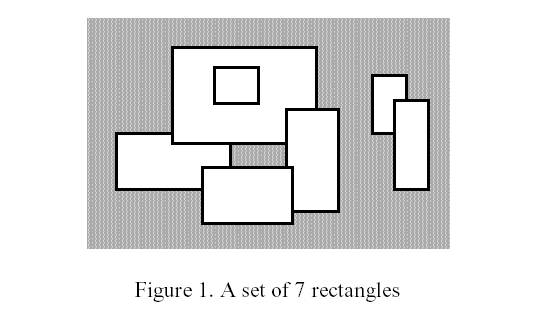
Write a program to calculate the perimeter. An example with 7 rectangles is shown in Figure 1.
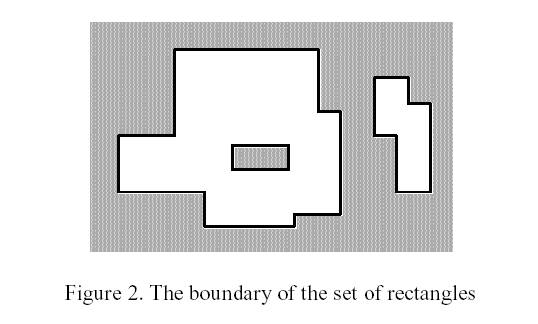
The corresponding boundary is the whole set of line segments drawn in Figure 2.
The vertices of all rectangles have integer coordinates.
Write a program to calculate the perimeter. An example with 7 rectangles is shown in Figure 1.
The corresponding boundary is the whole set of line segments drawn in Figure 2.
The vertices of all rectangles have integer coordinates.
Input
Your program is to read from standard input. The first line contains the number of rectangles pasted on the wall. In each of the subsequent lines, one can find the integer coordinates of the lower left vertex and the upper right vertex of each rectangle. The values of those coordinates are given as ordered pairs consisting of an x-coordinate followed by a y-coordinate.
0 <= number of rectangles < 5000
All coordinates are in the range [-10000,10000] and any existing rectangle has a positive area.
Please process to the end of file.
0 <= number of rectangles < 5000
All coordinates are in the range [-10000,10000] and any existing rectangle has a positive area.
Please process to the end of file.
Output
Your program is to write to standard output. The output must contain a single line with a non-negative integer which corresponds to the perimeter for the input rectangles.
Sample Input
   7
-15 0 5 10
-5 8 20 25
15 -4 24 14
0 -6 16 4
2 15 10 22
30 10 36 20
34 0 40 16
Sample Output
228
Source
Recommend
linle
分析:这道题算是经典题吧,线段树+离散化。。。什么是离散化,囧,原来是那种东东,没什么好说的,开始时读入弄错了好像,
居然没检查出来,还有,为什么坐标想同的每次都要分开计算,甚是不解~~~还有这样竟然没有0ms。。。跟暴力差不多
注意:题目数据貌似有错。。。
大家试一下这组
3
0 0 1 2
0 2 1 4
1 1 2 3
答案:12
ac的程序输出16.。。。
原来那个觉得是对的(就是加上这句 if(x[i].d!=x[i+1].d) )输出12.。。。
如果有错请指正。
这题实在是揪心,第三次更新啦。。。囧,发现陈宏的解题方法有漏洞,不能简单地用前后两测度想减来求值(+abs(lt[1].m-gk))。。。
附上一组数据:
13
0 0 1 1
0 1 1 4
0 4 1 6
1 0 2 1
1 1 2 4
1 4 2 6
2 0 3 2
2 2 3 3
2 5 3 6
3 1 4 4
3 5 5 6
4 0 5 2
4 2 5 5
答案:32
如果你是按y轴排序来做的,自己转换一下坐标试试
好吧最后发现陈牛的思想是对的,但是论文里貌似没讲清楚坐标相同的处理要按先插入后删除,这样才能保持正确性,正确代码在最后~~~
贴下代码(有漏洞):
无数次修改。。。汗:
n久之后又回来做这题:
#include<cstdio>
#include<cmath>
#include<iostream>
#include<algorithm>
#define ls rt<<1
#define rs rt<<1|1
#define lson l,m,ls
#define rson m,r,rs
using namespace std;
const int mm=11111;
const int mn=mm<<2;
struct seg
{
    int x,y1,y2,v;
}g[mm];
int y[mm],t[mn],s[mn],a[mn],b[mn],sum[mn];
int val,L,R;
void build()
{
    for(int i=0;i<mn;++i)s[i]=a[i]=b[i]=sum[i]=t[i]=0;
}
void updata(int l,int r,int rt)
{
    if(L<=y[l]&&R>=y[r])t[rt]+=val;
    else
    {
        int m=(l+r)>>1;
        if(L<y[m])updata(lson);
        if(R>y[m])updata(rson);
    }
    if(t[rt])s[rt]=a[rt]=b[rt]=1,sum[rt]=y[r]-y[l];
    else if(l==r)s[rt]=a[rt]=b[rt]=sum[rt]=0;
    else
    {
        a[rt]=a[ls],b[rt]=b[rs];
        s[rt]=s[ls]+s[rs]-(b[ls]&a[rs]);
        sum[rt]=sum[ls]+sum[rs];
    }
}
bool cmp(seg a,seg b)
{
    return a.x<b.x||(a.x==b.x&&a.v>b.v);
}
int main()
{
    int i,j,n,m,tmp,ans;
    while(~scanf("%d",&n))
    {
        for(j=i=0;i<n;++i,j+=2)
        {
            scanf("%d%d%d%d",&g[j].x,&y[j],&g[j+1].x,&y[j+1]);
            g[j].y1=g[j+1].y1=y[j];
            g[j].y2=g[j+1].y2=y[j+1];
            g[j].v=1,g[j+1].v=-1;
        }
        sort(y,y+j);
        sort(g,g+j,cmp);
        for(m=i=0;i<j;++i)
            if(y[m]<y[i])y[++m]=y[i];
        build();
        for(ans=tmp=i=0;i<j;++i)
        {
            L=g[i].y1,R=g[i].y2,val=g[i].v;
            updata(0,m,1);
            ans+=(g[i+1].x-g[i].x)*s[1]*2+abs(sum[1]-tmp),tmp=sum[1];
        }
        printf("%d\n",ans);
    }
    return 0;
}





 扫一扫
扫一扫


 1162
1162

 被折叠的 条评论
为什么被折叠?
被折叠的 条评论
为什么被折叠?
 到【灌水乐园】发言





