



 本文介绍了一种图像处理技术,即面积开运算,用于从二值图像中去除小对象。通过设定像素阈值,该操作能有效清除不重要的细节,保持图像的主要特征。文章提供了使用MathWorks MATLAB实现的具体示例。
From: https://ww2.mathworks.cn/help/images/ref/bwareaopen.html
bwareaopen
Remove small objects from binary image
Syntax
BW2 = bwareaopen(BW,P)
BW2 = bwareaopen(BW,P,conn)
Description
BW2 = bwareaopen(BW,P)P pixels from the binary image BW, producing another binary image, BW2. This operation is known as an area opening.
BW2 = bwareaopen( removes all connected components, where BW,P,conn)conn specifies the desired connectivity.
Examples
collapse all
Remove Objects in Image Containing Fewer Than 50 Pixels
Try This Example
Read binary image.
BW = imread('text.png');Remove objects containing fewer than 50 pixels using bwareaopen function.
BW2 = bwareaopen(BW, 50);Display original image next to morphologically opened image.
imshowpair(BW,BW2,'montage')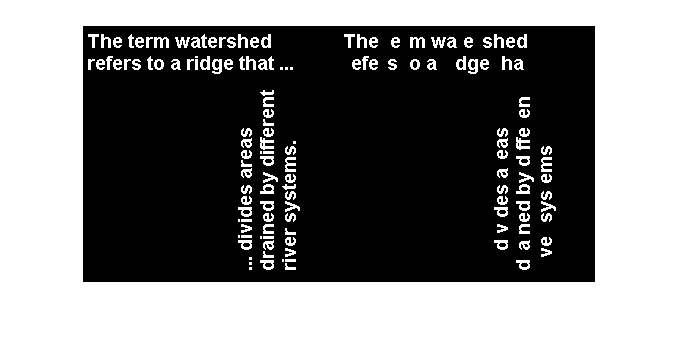
Input Arguments
collapse all
BW — Binary image
real, nonsparse, logical or numeric array of any dimension
Binary image, specified as a nonsparse, logical or numeric array of any dimension.
Example: BW2 = bwareaopen(BW, 50);
Data Types: single | double | int8 | int16 | int32 | int64 | uint8 | uint16 | uint32 | uint64 | logical
P — Maximum number of pixels in objects
nonnegative, integer-valued, numeric scalar
Maximum number of pixels in objects, specified as a nonnegative, integer-valued, numeric scalar.
Example: BW2 = bwareaopen(BW, 50);
Data Types: double
conn — Pixel connectivity
4 | 8 | 6 | 18 | 26 | 3-by-3-by- ... -by-3 matrix of 0s and 1s
Pixel connectivity, specified as one of the values in this table. The default connectivity is 8 for 2-D images, and 26 for 3-D images.
| Value | Meaning | |
|---|---|---|
| Two-Dimensional Connectivities | ||
| 4-connected | Pixels are connected if their edges touch. Two adjoining pixels are part of the same object if they are both on and are connected along the horizontal or vertical direction. |
|
| 8-connected | Pixels are connected if their edges or corners touch. Two adjoining pixels are part of the same object if they are both on and are connected along the horizontal, vertical, or diagonal direction. |
|
| Three-Dimensional Connectivities | ||
| 6-connected | Pixels are connected if their faces touch. Two adjoining pixels are part of the same object if they are both on and are connected in:
|
|
| 18-connected | Pixels are connected if their faces or edges touch. Two adjoining pixels are part of the same object if they are both on and are connected in
|
|
| 26-connected | Pixels are connected if their faces, edges, or corners touch. Two adjoining pixels are part of the same object if they are both on and are connected in
|
|


For higher dimensions, bwareaopen uses the default value conndef(ndims(BW),'maximal')
Connectivity can also be defined in a more general way for any dimension by specifying a 3-by-3-by- ... -by-3 matrix of 0s and 1s. The 1-valued elements define neighborhood locations relative to the center element of conn. Note that conn must be symmetric about its center element. See Specifying Custom Connectivities for more information.
Data Types: double | logical
Output Arguments
collapse all
BW2 — Image that has been morphologically opened
nonsparse, logical array of any dimension
Image that has been morphologically opened, specified as a nonsparse, logical array the same size as BW.
Algorithms
The basic steps are
-
Determine the connected components:
CC = bwconncomp(BW, conn); -
Compute the area of each component:
S = regionprops(CC, 'Area'); -
Remove small objects:
L = labelmatrix(CC);
BW2 = ismember(L, find([S.Area] >= P));





 扫一扫
扫一扫


 3276
3276

 被折叠的 条评论
为什么被折叠?
被折叠的 条评论
为什么被折叠?
 到【灌水乐园】发言





