 利用斐波那契数列的隐式公式探究其性质


 本文展示了如何使用斐波那契数列的隐式公式来验证其性质,并通过数学软件Maxima实现了这一过程。包括使用黄金比例、简化表达式、证明恒等式和发现新恒等式等。文章最后讨论了如何通过求和运算符简化斐波那契数列的表达式。
Fibonacci numbers are numbers in the Fibonacci sequence  . We define the Fibonacci sequence recursively as
  and
and  .
.
In Maxima we can compute the n-th Fibonacci number with the fib function. The beginning of the sequence is
(%i1) makelist(fib(i), i, 1, 10);
(%o1) [1,1,2,3,5,8,13,21,34,55]
We can compute the well-known explicit formula for
(%i2) load(solve_rec)$
(%i3) solve_rec(f[n]=f[n-1]+f[n-2], f[n], f[1]=1, f[2]=2);
(%o3) f[n]=((sqrt(5)+1)^n*(sqrt(5)+5)*2^(-n-1))/5-
  ((sqrt(5)-5)*(sqrt(5)-1)^n*2^(-n-1)*(-1)^n)/5
or nicer

In this post I want to show how to use the explicit formula to investigate some interesting properties of the Fibonacci numbers. Usually we prove identities with Fibonacci numbers using induction, but here I also show how to find them.
Proving identities
First we need to express using the golden ratio  . We will use the
 fibtophi function.
(%i4) fib(n)$
(%i5) fibtophi(%);
(%o5) (%phi^n-(1-%phi)^n)/(2*%phi-1)
which gives 
 to simplify expressions which contain
  .
.
A simple example is to “prove” the definition of Fibonacci numbers.
(%i6) fib(n) - fib(n-1) - fib(n-2);
(%o6) fib(n)-fib(n-1)-fib(n-2)
(%i7) ratsimp(fibtophi(%));
(%o7) 0
A little more interesting is the identity 
simplify_sum package from cvs.
(%i8) load(simplify_sum)$
(%i9) sum(k*fib(k), k, 1, n) - n*fib(n+2) + fib(n+3) - 2$
(%i10) fibtophi(simplify_sum(%))$
(%i11) ratsimp(%);
(%o11) 0
The last example is from Wikipedia. It is the “divisibility by 11″ property:
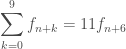
(%i12) sum(fib(n+k), k, 0, 9)/fib(n+6)$
(%i13) fibtophi(%)$
(%i14) ratsimp(%);
(%o14) 11
Finding identities
Division identities
We can find more identities like the divisibility property given above.
(%i15) fib_ratio(a,b) :=
         ratsimp(
           fibtophi(sum(fib(n+i), i, 0, a)/fib(n+b)))$
(%i16) sublist(
         create_list([a,b,fib_ratio(a,b)], a, 1, 20, b, 1, a),
         lambda([l], is(integerp(last(l)))));
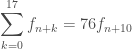
(%o16) [[2,2,2],[5,4,4],[9,6,11],[13,8,29],[17,10,76]]
The last triple gives the identity
As a comparison, here is some similar code in Mathematica
In[1]:= fibRatio[a_, b_] := FullSimplify[
  Sum[Fibonacci[n + i], {i, 0, a}]/Fibonacci[n + b]]

In[2]:= Select[
 Flatten[Table[{a, b, fibRatio[a, b]}, {a, 1, 10}, {b, 1, a}], 1],
 IntegerQ[#[[3]]] &
 ]

Out[2]= {{2, 2, 2}, {9, 6, 11}}
Note that the Mathematica code (in Mathematica 7.0.0) runs much longer than the Maxima code, even though I searched in a smaller sample of ratios. It also misses the case [5,4,4].
Sums of Fibonacci numbers
Let’s find a simple expression for  . We search for an identity of the form
where  ,
,  ,
,  and
and  are unknowns.

First we setup the expression for the identity.
(%i17) sm: sum(k^2*fib(k), k, 1, n) =
             sum(a[k-n]*n^2*fib(k), k, n+1, n+3) +
             sum(b[k-n]*n*fib(k), k, n+1, n+3) +
             sum(c[k-n]*fib(k), k, n+1, n+3) + d$
(%i18) sm1: simplify_sum(sm)$
(%i19) eq: fibtophi(sm1)$
Now we evaluate eq so that we get 10 equations with 10 unknowns.
(%i20) makelist(''eq, n, 10, 19)$
Now solve the system. We get many solutions and pick one by setting all parameters in the solution to 0.
(%i21) sol: solve(%);
solve: dependent equations eliminated: (8 10 9)
(%o21) [[d=-8,c[3]=3-%r3,b[3]=-%r2-2,a[3]=-%r1,c[2]=%r3+2,b[2]=%r2,
    a[2]=%r1+1,c[1]=%r3,b[1]=%r2,a[1]=%r1]]
(%i22) sol1: subst(
          map(lambda([x], x=0), %rnum_list),
          sol);
(%o22) [[d=-8,c[3]=3,b[3]=-2,a[3]=0,c[2]=2,b[2]=0,a[2]=1,c[1]=0,b[1]=0,a[1]=0]]
Let’s look at the identity.
(%i23) subst(sol1[1], sm);
(%o23) sum(k^2*fib(k),k,1,n)=-2*n*fib(n+3)+3*fib(n+3)+n^2*fib(n+2)+2*fib(n+2)-8
(%i24) map(factorsum, %);
(%o24) sum(k^2*fib(k),k,1,n)=-(2*n-3)*fib(n+3)+(n^2+2)*fib(n+2)-8
which is

Of course this is not a proof yet. But the proof is easy:
(%i25) ratsimp(fibtophi(simplify_sum(rhs(%) - lhs(%))));
(%o25) 0






 扫一扫
扫一扫


 661
661

 被折叠的 条评论
为什么被折叠?
被折叠的 条评论
为什么被折叠?
 到【灌水乐园】发言





