


 Flink的checkpoint机制包括启动、执行和确认完成三个阶段,由JobManager的checkpointCoordinator组件控制。该过程涉及ExecutionGraph的构建、状态后端创建、容错管理、协调器的协调以及定时调度。当作业状态变为RUNNING时,启动checkpoint调度程序,通过ExecutionVertex触发和执行checkpoint操作。
checkpoint的执行过程分为三个阶段:启动,执行以及确认完成,其中checkpoint的启动过程由JobManager管理节点中的checkpointCoordinator组件控制。该组件会周期性的向source节点发送执行checkpoint的请求。执行频率取决于配置的checkpointInterval参数。下面我们一起来看一下checkpoint的执行过程。
checkpoint的执行流程如下图所示:
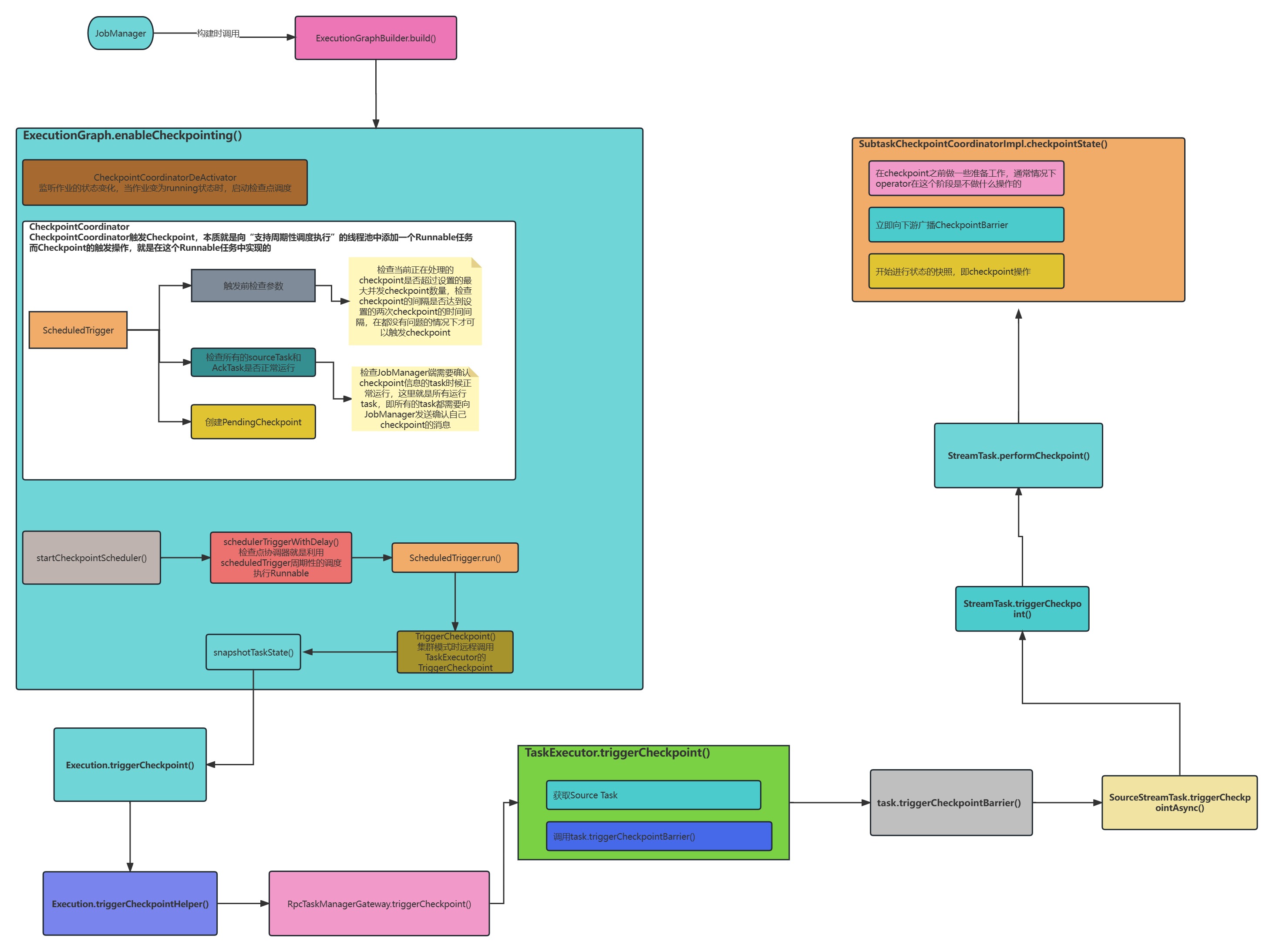
1.ExecutionGraphBuilder.build
当用户在代码中开启checkpoint的时候此时checkpoint的配置会存在StreamGraph中,然后将streamGraph的checkpoint配置转换为JobCheckpointingSetting数据结构存储在JobGraph中,并伴随着JobGraph提交到集群运行,启动JobMaster服务会调度和执行checkpoint操作。
// configure the state checkpointing
		JobCheckpointingSettings snapshotSettings = jobGraph.getCheckpointingSettings();
		if (snapshotSettings != null) {
			List<ExecutionJobVertex> triggerVertices =
					idToVertex(snapshotSettings.getVerticesToTrigger(), executionGraph);

			List<ExecutionJobVertex> ackVertices =
					idToVertex(snapshotSettings.getVerticesToAcknowledge(), executionGraph);

			List<ExecutionJobVertex> confirmVertices =
					idToVertex(snapshotSettings.getVerticesToConfirm(), executionGraph);

			CompletedCheckpointStore completedCheckpoints;
			CheckpointIDCounter checkpointIdCounter;
			try {
				int maxNumberOfCheckpointsToRetain = jobManagerConfig.getInteger(
						CheckpointingOptions.MAX_RETAINED_CHECKPOINTS);

				if (maxNumberOfCheckpointsToRetain <= 0) {
					// warning and use 1 as the default value if the setting in
					// state.checkpoints.max-retained-checkpoints is not greater than 0.
					log.warn("The setting for '{} : {}' is invalid. Using default value of {}",
							CheckpointingOptions.MAX_RETAINED_CHECKPOINTS.key(),
							maxNumberOfCheckpointsToRetain,
							CheckpointingOptions.MAX_RETAINED_CHECKPOINTS.defaultValue());

					maxNumberOfCheckpointsToRetain = CheckpointingOptions.MAX_RETAINED_CHECKPOINTS.defaultValue();
				}

				completedCheckpoints = recoveryFactory.createCheckpointStore(jobId, maxNumberOfCheckpointsToRetain, classLoader);
				checkpointIdCounter = recoveryFactory.createCheckpointIDCounter(jobId);
			}
			catch (Exception e) {
				throw new JobExecutionException(jobId, "Failed to initialize high-availability checkpoint handler", e);
			}

			// Maximum number of remembered checkpoints
			int historySize = jobManagerConfig.getInteger(WebOptions.CHECKPOINTS_HISTORY_SIZE);

			CheckpointStatsTracker checkpointStatsTracker = new CheckpointStatsTracker(
					historySize,
					ackVertices,
					snapshotSettings.getCheckpointCoordinatorConfiguration(),
					metrics);

			// load the state backend from the application settings
			final StateBackend applicationConfiguredBackend;
			final SerializedValue<StateBackend> serializedAppConfigured = snapshotSettings.getDefaultStateBackend();

			if (serializedAppConfigured == null) {
				applicationConfiguredBackend = null;
			}
			else {
				try {
					applicationConfiguredBackend = serializedAppConfigured.deserializeValue(classLoader);
				} catch (IOException | ClassNotFoundException e) {
					throw new JobExecutionException(jobId,
							"Could not deserialize application-defined state backend.", e);
				}
			}

			final StateBackend rootBackend;
			try {
				rootBackend = StateBackendLoader.fromApplicationOrConfigOrDefault(
						applicationConfiguredBackend, jobManagerConfig, classLoader, log);
			}
			catch (IllegalConfigurationException | IOException | DynamicCodeLoadingException e) {
				throw new JobExecutionException(jobId, "Could not instantiate configured state backend", e);
			}

			// instantiate the user-defined checkpoint hooks

			final SerializedValue<MasterTriggerRestoreHook.Factory[]> serializedHooks = snapshotSettings.getMasterHooks();
			final List<MasterTriggerRestoreHook<?>> hooks;

			if (serializedHooks == null) {
				hooks = Collections.emptyList();
			}
			else {
				final MasterTriggerRestoreHook.Factory[] hookFactories;
				try {
					hookFactories = serializedHooks.deserializeValue(classLoader);
				}
				catch (IOException | ClassNotFoundException e) {
					throw new JobExecutionException(jobId, "Could not instantiate user-defined checkpoint hooks", e);
				}

				final Thread thread = Thread.currentThread();
				final ClassLoader originalClassLoader = thread.getContextClassLoader();
				thread.setContextClassLoader(classLoader);

				try {
 最低0.47元/天 解锁文章






 扫一扫
扫一扫


 1361
1361


 被折叠的 条评论
为什么被折叠?
被折叠的 条评论
为什么被折叠?
 到【灌水乐园】发言




