




 本文介绍一种算法,用于计算多个矩形粘贴在墙上的总周长,通过跟踪矩形边界并处理重叠部分,确保计算准确无误。
Picture
Time Limit: 6000/2000 MS (Java/Others) Memory Limit: 32768/32768 K (Java/Others)Total Submission(s): 5768 Accepted Submission(s): 2740
Problem Description
A number of rectangular posters, photographs and other pictures of the same shape are pasted on a wall. Their sides are all vertical or horizontal. Each rectangle can be partially or totally covered by the others. The length of the boundary of the union of all rectangles is called the perimeter.
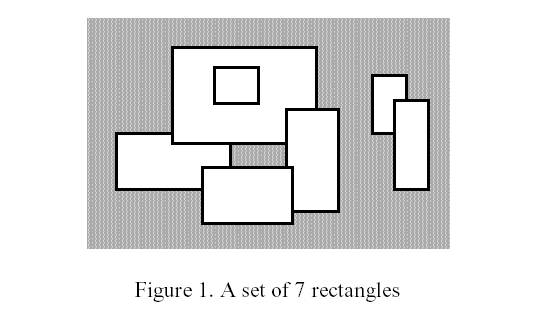
Write a program to calculate the perimeter. An example with 7 rectangles is shown in Figure 1.
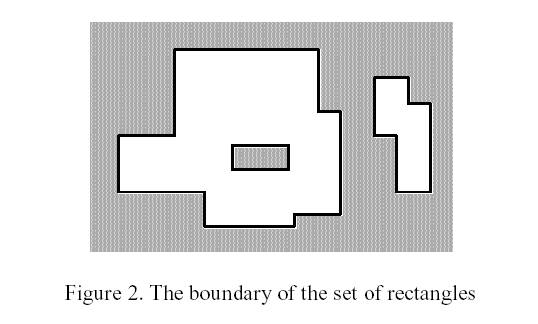
The corresponding boundary is the whole set of line segments drawn in Figure 2.
The vertices of all rectangles have integer coordinates.
Write a program to calculate the perimeter. An example with 7 rectangles is shown in Figure 1.
The corresponding boundary is the whole set of line segments drawn in Figure 2.
The vertices of all rectangles have integer coordinates.
Input
Your program is to read from standard input. The first line contains the number of rectangles pasted on the wall. In each of the subsequent lines, one can find the integer coordinates of the lower left vertex and the upper right vertex of each rectangle. The values of those coordinates are given as ordered pairs consisting of an x-coordinate followed by a y-coordinate.
0 <= number of rectangles < 5000
All coordinates are in the range [-10000,10000] and any existing rectangle has a positive area.
Please process to the end of file.
0 <= number of rectangles < 5000
All coordinates are in the range [-10000,10000] and any existing rectangle has a positive area.
Please process to the end of file.
Output
Your program is to write to standard output. The output must contain a single line with a non-negative integer which corresponds to the perimeter for the input rectangles.
Sample Input
7
-15 0 5 10
-5 8 20 25
15 -4 24 14
0 -6 16 4
2 15 10 22
30 10 36 20
34 0 40 16
Sample Output
228
题解:
和求面积类似,不过这里横边竖边都要求。这里要注意,
边有重合的地方的情况,在求面积时是不影响的,但是
求周长不能重复相加,因此可以在排序的时候若x值相同
则先排入边后排出边(之前一直不知道怎么去重,看了一位
大神的博客是这样搞的,实在太巧妙啦)。

代码:

#include<bits/stdc++.h>
using namespace std;
const int maxn=5007;
int x1[maxn],y11[maxn],x2[maxn],y2[maxn];
int x[maxn*2],y[maxn*2];
struct LINE
{
    int x,y_down,y_up;
    int flag;
} line[maxn*2];
bool cmp(const LINE& a,const LINE& b)
{
    if(a.x!=b.x)return a.x<b.x;
    return a.flag>b.flag;
}
struct TREE
{
    int x,y_down,y_up;
    int cover;
    bool flag;
} tree[maxn<<4];
int abs1(int x)
{
    if(x<0)return -x;
    return x;
}
void build(int l,int r,int rt)
{
    tree[rt].x=-1;
    tree[rt].y_down=y[l];
    tree[rt].y_up=y[r];
    tree[rt].flag=0;
    tree[rt].cover=0;
    if(l+1==r)
    {
        tree[rt].flag=1;
        return;
    }
    build(l,(l+r)>>1,rt<<1);
    build((l+r)>>1,r,rt<<1|1);
}
int query(int x,int l,int r,int rt,int flag)
{
    if(r<=tree[rt].y_down||l>=tree[rt].y_up)
        return 0;
    if(tree[rt].flag)
    {
        if(tree[rt].cover<=0)
        {
            tree[rt].cover+=flag;
            int ans=abs1(tree[rt].y_up-tree[rt].y_down);
            tree[rt].x=x;
            return ans;
        }
        else
        {
            tree[rt].cover+=flag;
            tree[rt].x=x;
            return 0;
        }
    }
    return query(x,l,r,rt<<1,flag)+query(x,l,r,rt<<1|1,flag);
}
int main()
{
    int n;
    while(~scanf("%d",&n))
    {
        int i,j;
        if(n==0)
        {
            printf("0\n");
            continue;
        }
        for(i=1; i<=n; i++)
            scanf("%d%d%d%d",&x1[i],&y11[i],&x2[i],&y2[i]);
        int t=0;
        for(i=1; i<=n; i++)
        {
            t++;
            y[t]=y11[i];
            line[t].x=x1[i];
            line[t].y_down=y11[i];
            line[t].y_up=y2[i];
            line[t].flag=1;
            t++;
            y[t]=y2[i];
            line[t].x=x2[i];
            line[t].y_down=y11[i];
            line[t].y_up=y2[i];
            line[t].flag=-1;
        }
        sort(y+1,y+t+1);
        sort(line+1,line+t+1,cmp);
        build(1,t,1);
        int ans=0;
        for(i=1; i<=t; i++)
            ans+=query(line[i].x,line[i].y_down,line[i].y_up,1,line[i].flag);
        t=0;
        for(i=1; i<=n; i++)
        {
            t++;
            y[t]=x1[i];
            line[t].x=y11[i];
            line[t].y_down=x1[i];
            line[t].y_up=x2[i];
            line[t].flag=1;
            t++;
            y[t]=x2[i];
            line[t].x=y2[i];
            line[t].y_down=x1[i];
            line[t].y_up=x2[i];
            line[t].flag=-1;
        }
        sort(y+1,y+t+1);
        sort(line+1,line+t+1,cmp);
        build(1,t,1);
        for(i=1; i<=t; i++)
            ans+=query(line[i].x,line[i].y_down,line[i].y_up,1,line[i].flag);
        printf("%d\n",2*ans);
        //边是对称的,求的时候只求了一条。
    }
    return 0;
}





 扫一扫
扫一扫


 2160
2160

 被折叠的 条评论
为什么被折叠?
被折叠的 条评论
为什么被折叠?
 到【灌水乐园】发言





