


学习内容
1 Ridge/LASSO 多项式回归的实现
Ridge/LASSO 多项式回归理论
多项式回归是一种强大的工具,用于捕捉数据中的非线性关系。其核心思想是通过在原始特征中引入高次项(如 x2x^2x2、x3x^ 3x3等),扩展特征空间,使模型能够拟合更复杂的模式。然而,当特征数量增加或多项式阶数较高时,模型容易变得过于复杂,导致在训练数据上表现良好但在测试数据上泛化能力差,即过拟合。为了解决这一问题,Ridge回归和LASSO回归被引入到多项式回归中,通过正则化来控制模型的复杂度。
Ridge回归(也称为L2正则化)在损失函数中添加一个L2范数惩罚项。其目标函数可以表示为:
minβ(∑i=1n(yi−∑j=0pβjxij)2+λ∑j=1pβj2) \min_{\beta} \left( \sum_{i=1}^{n} (y_i - \sum_{j=0}^{p} \beta_j x_{ij})^2 + \lambda \sum_{j=1}^{p} \beta_j^2 \right) βmin(i=1∑n(yi−j=0∑pβjxij)2+λj=1∑pβj2)
其中,yiy_iyi 是目标值,xijx_ijxij 是特征值,βjβ_jβj 是模型系数,λλλ 是正则化参数,用于控制惩罚强度。L2正则化通过缩小系数的大小来防止过拟合,但不会将系数完全置为零。这使得Ridge回归在处理多重共线性问题时特别有效,因为它通过收缩系数来稳定模型。
LASSO回归(也称为L1正则化)则在损失函数中添加一个L1范数惩罚项。其目标函数为:
minβ(∑i=1n(yi−∑j=0pβjxij)2+λ∑j=1p∣βj∣) \min_{\beta} \left( \sum_{i=1}^{n} (y_i - \sum_{j=0}^{p} \beta_j x_{ij})^2 + \lambda \sum_{j=1}^{p} |\beta_j| \right) βmin(i=1∑n(yi−j=0∑pβjxij)2+λj=1∑p∣βj∣)
L1正则化的独特之处在于它能够将一些系数压缩为零,从而实现特征选择。这对于高维数据集尤其有用,因为它可以帮助我们识别最重要的特征,并简化模型。
在多项式回归中结合Ridge或LASSO正则化,可以有效地平衡模型的偏差和方差。通过调整正则化参数 λλλ,我们可以控制模型的复杂度,找到一个在训练数据和测试数据上表现都较好的模型。这种结合方式在处理具有复杂非线性关系的数据时特别有效,为数据分析提供了强大的工具。
1.1 导入库
导入NumPy(数值计算)、Pandas(数据处理)和Matplotlib(绘图)三个Python科学计算核心库
%pip install scikit-learn==1.1.3
import numpy as np
import pandas as pd
import matplotlib.pyplot as plt
from sklearn.preprocessing import PolynomialFeatures
from sklearn.pipeline import make_pipeline
from sklearn.linear_model import LassoCV
from sklearn.metrics import mean_squared_error
from sklearn.linear_model import LinearRegression
from sklearn.linear_model import LassoCV
from sklearn.linear_model import RidgeCV
from sklearn.ensemble import AdaBoostRegressor
from sklearn.model_selection import train_test_split
from sklearn.pipeline import make_pipeline
%matplotlib inline
1.2 定义程序的全局变量
定义了多项式回归实验的参数:生成41个x值(范围1-10),添加均值为0、标准差为2的高斯噪声;设置岭回归的正则化强度(10到100的等比数列)、Lasso回归的参数(精度0.001,alpha数20,迭代1000次),以及多项式阶数范围(2-8阶)。
N_points = 41 # 构建函数所需的点
x_min = 1 # x(特征)范围的最小值
x_max = 10 # x(特征)范围的最大值
noise_mean = 0 # 高斯噪声添加器的均值
noise_sd = 2 # 高斯噪声添加器的标准差
ridge_alpha = tuple([10**(x) for x in range(-3,0,1) ]) # 岭回归中的正则化强度
lasso_eps = 0.001
lasso_nalpha=20
lasso_iter=1000
degree_min = 2
degree_max = 8
1.3 遵循非线性函数生成特征和输出向量 
The ground truth or originating function is as follows: The\ ground\ truth\ or\ originating\ function\ is\ as\ follows:\ The ground truth or originating function is as follows:
y=f(x)=x2.sin(x).e−0.1x+ψ(x) y=f(x)= x^2.sin(x).e^{-0.1x}+\psi(x) y=f(x)=x2.sin(x).e−0.1x+ψ(x)
ψ(x)=f(x ∣ μ,σ2)=12πσ2 e−(x−μ)22σ2 \psi(x) = {\displaystyle f(x\;|\;\mu ,\sigma ^{2})={\frac {1}{\sqrt {2\pi \sigma ^{2}}}}\;e^{-{\frac {(x-\mu )^{2}}{2\sigma ^{2}}}}} ψ(x)=f(x∣μ,σ2)=2πσ21e−2σ2(x−μ)2
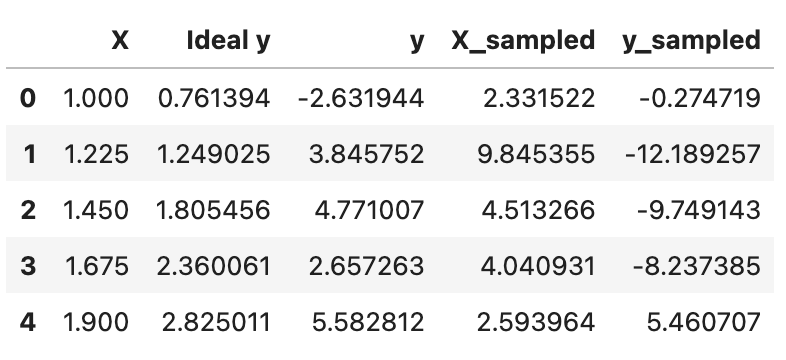
首先生成1001个均匀分布的x值用于平滑曲线绘制,然后创建两组不同的x采样点:41个均匀间隔点和41个均匀随机分布点。定义了一个非线性目标函数f(x)=x2⋅sin(x)⋅e−1x10f(x)=x²·sin(x)·e^{\frac {-1x}{10}}f(x)=x2⋅sin(x)⋅e10−1x,并添加高斯噪声生成对应的y值。最后将数据整理为DataFrame,包含均匀x值、理想y值(无噪声)、带噪声的均匀采样y值、随机采样x值及其对应的带噪声y值,并展示前5行数据。
x_smooth = np.array(np.linspace(x_min,x_max,1001))

# 线性间隔采样点
X=np.array(np.linspace(x_min,x_max,N_points))

# 从均匀随机分布中提取的样本
X_sample = x_min+np.random.rand(N_points)*(x_max-x_min)

def func(x):
    result = x**2*np.sin(x)*np.exp(-(1/x_max)*x)
    return (result)

noise_x = np.random.normal(loc=noise_mean,scale=noise_sd,size=N_points)

y = func(X)+noise_x
y_sampled = func(X_sample)+noise_x

df = pd.DataFrame(data=X,columns=['X'])
df['Ideal y']=df['X'].apply(func)
df['y']=y
df['X_sampled']=X_sample
df['y_sampled']=y_sampled
df.head()
1.4 绘制函数,包括理想特征和观察到的输出 (带有过程和观察噪声) 
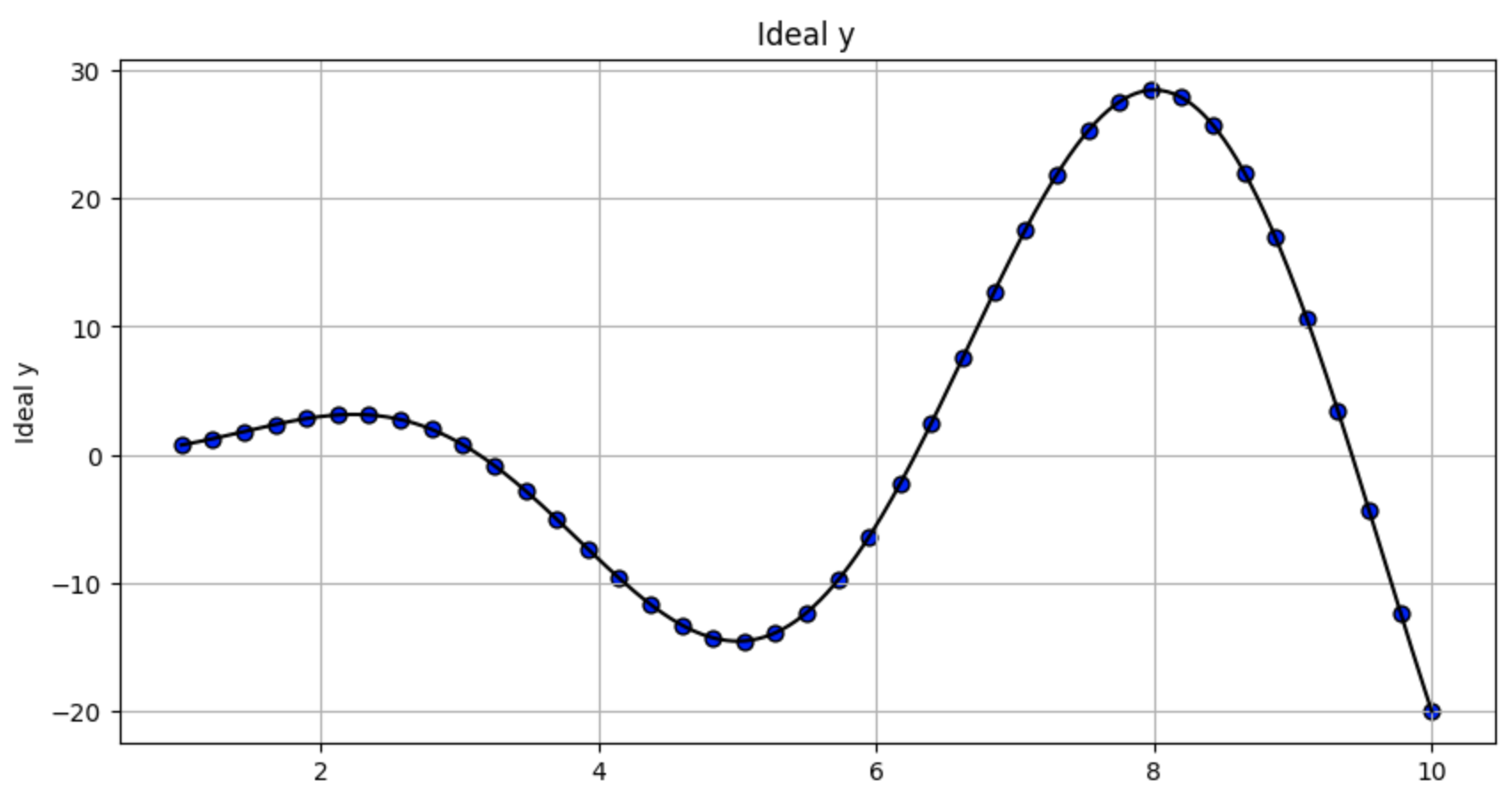
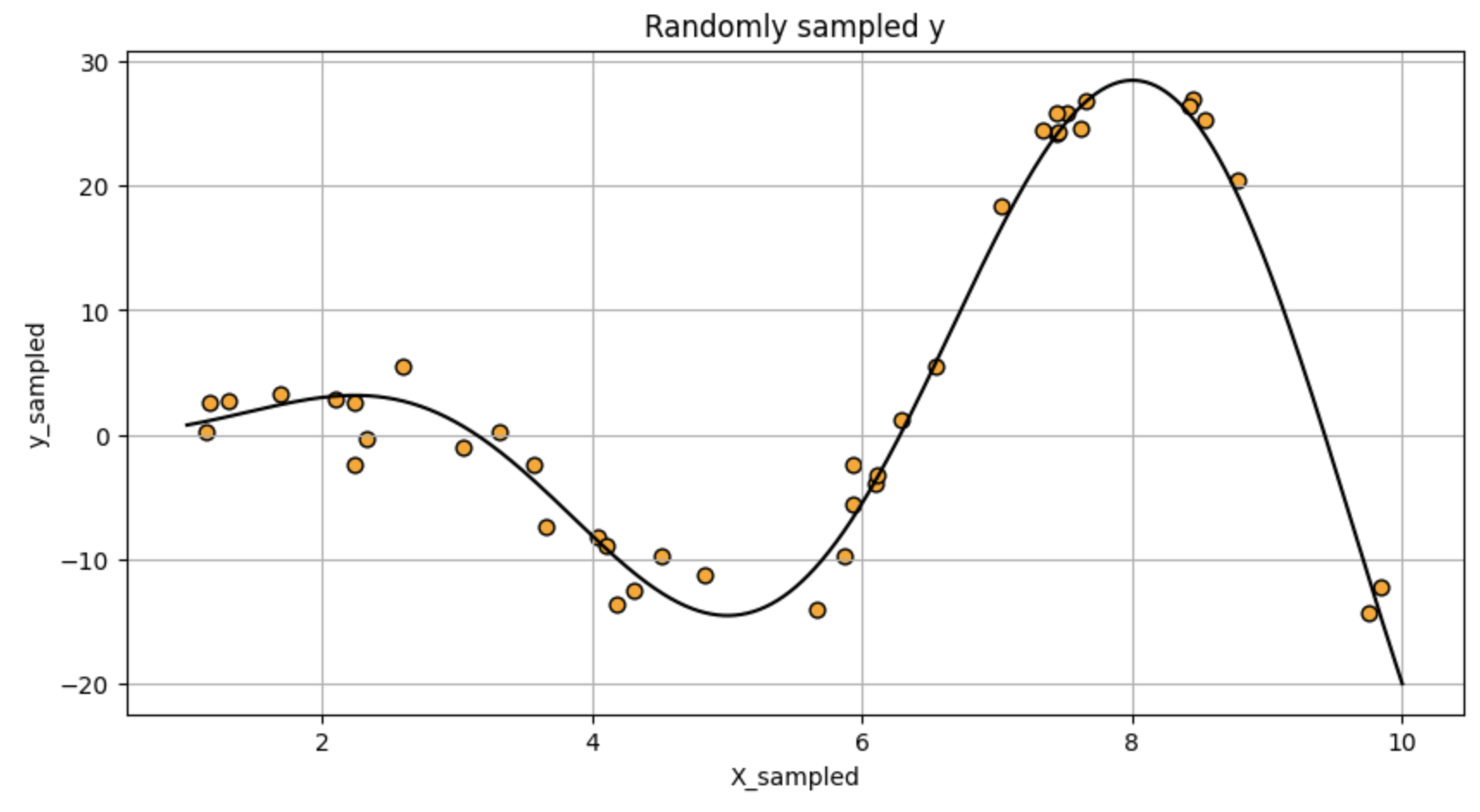
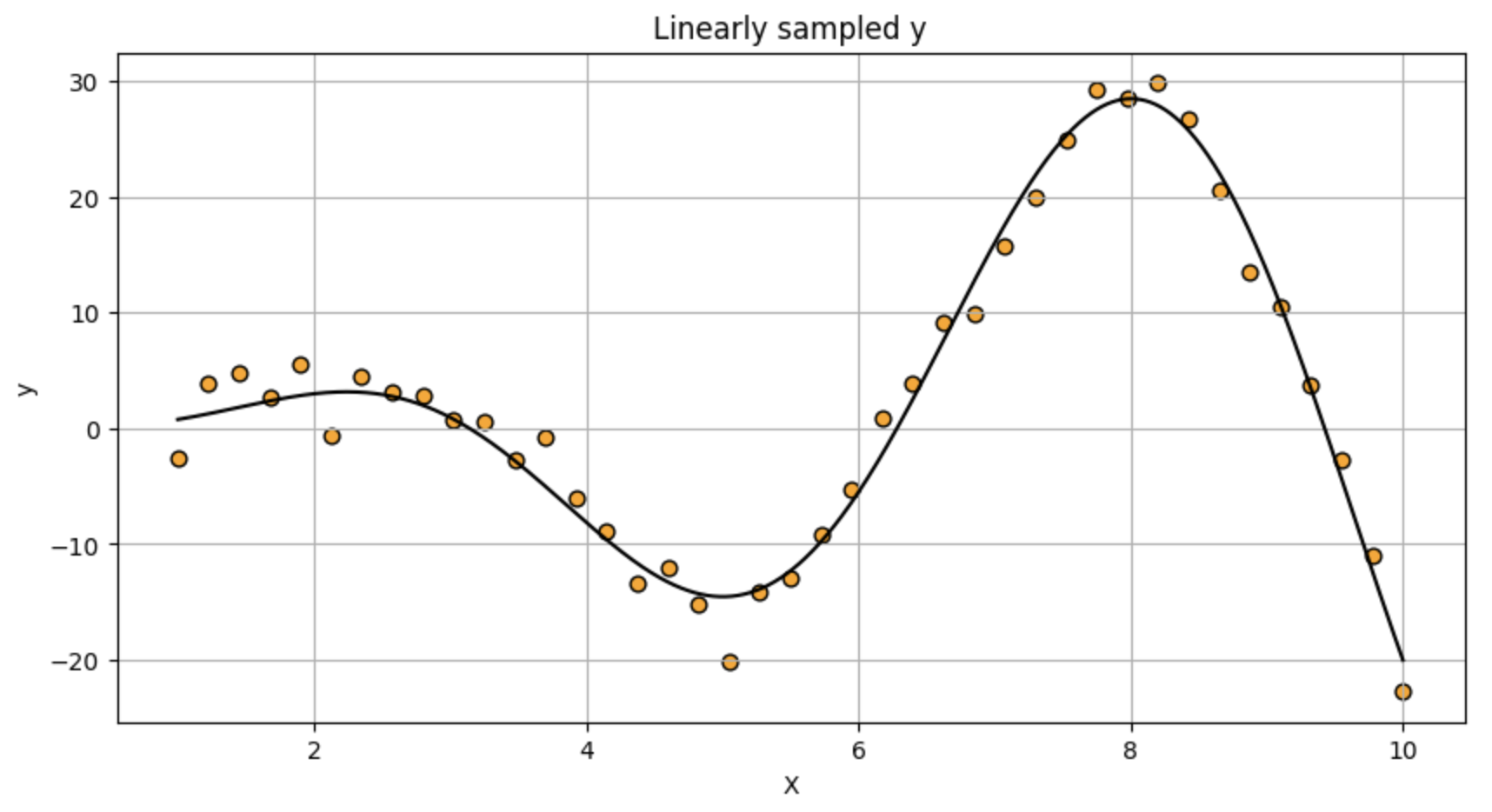
通过三个散点图可视化不同采样方式下的数据分布:
第一个图展示均匀采样点(X)与理想无噪声y值的关系,黑色曲线表示真实函数f(x)=x²·sin(x)·e^(-x/10)。
第二个图显示随机采样点(X_sampled)与带噪声y值的分布,同样叠加真实函数曲线。
第三个图呈现均匀采样点与带噪声y值的关系,也包含真实函数曲线作为参考。
所有图表使用相同可视化参数:网格线、黑色边框、橙色/蓝色散点(随机采样用橙色,均匀采样用蓝色),点大小为40,图像尺寸10x5英寸。这种对比有助于观察采样方式对数据分布和噪声影响的表现。
df.plot.scatter('X','Ideal y',title='Ideal y',grid=True,edgecolors=(0,0,0),c='blue',s=40,figsize=(10,5))
plt.plot(x_smooth,func(x_smooth),'k')
df.plot.scatter('X_sampled',y='y_sampled',title='Randomly sampled y',
                grid=True,edgecolors=(0,0,0),c='orange',s=40,figsize=(10,5))
plt.plot(x_smooth,func(x_smooth),'k')
df.plot.scatter('X',y='y',title='Linearly sampled y',grid=True,edgecolors=(0,0,0),c='orange',s=40,figsize=(10,5))
plt.plot(x_smooth,func(x_smooth),'k')
1.5 导入 scikit-learn 库并准备训练/测试拆分 
导入scikit-learn库中的回归建模工具,将数据集划分为67%训练集和33%测试集,并将一维特征数组重塑为二维格式以满足scikit-learn的输入要求。
X_train, X_test, y_train, y_test = train_test_split(df['X'], df['y'], test_size=0.33)
X_train=X_train.values.reshape(-1,1)
X_test=X_test.values.reshape(-1,1)
1.6 多项式模型使用岭正则化通过(pipelined)完成样本的等距分布
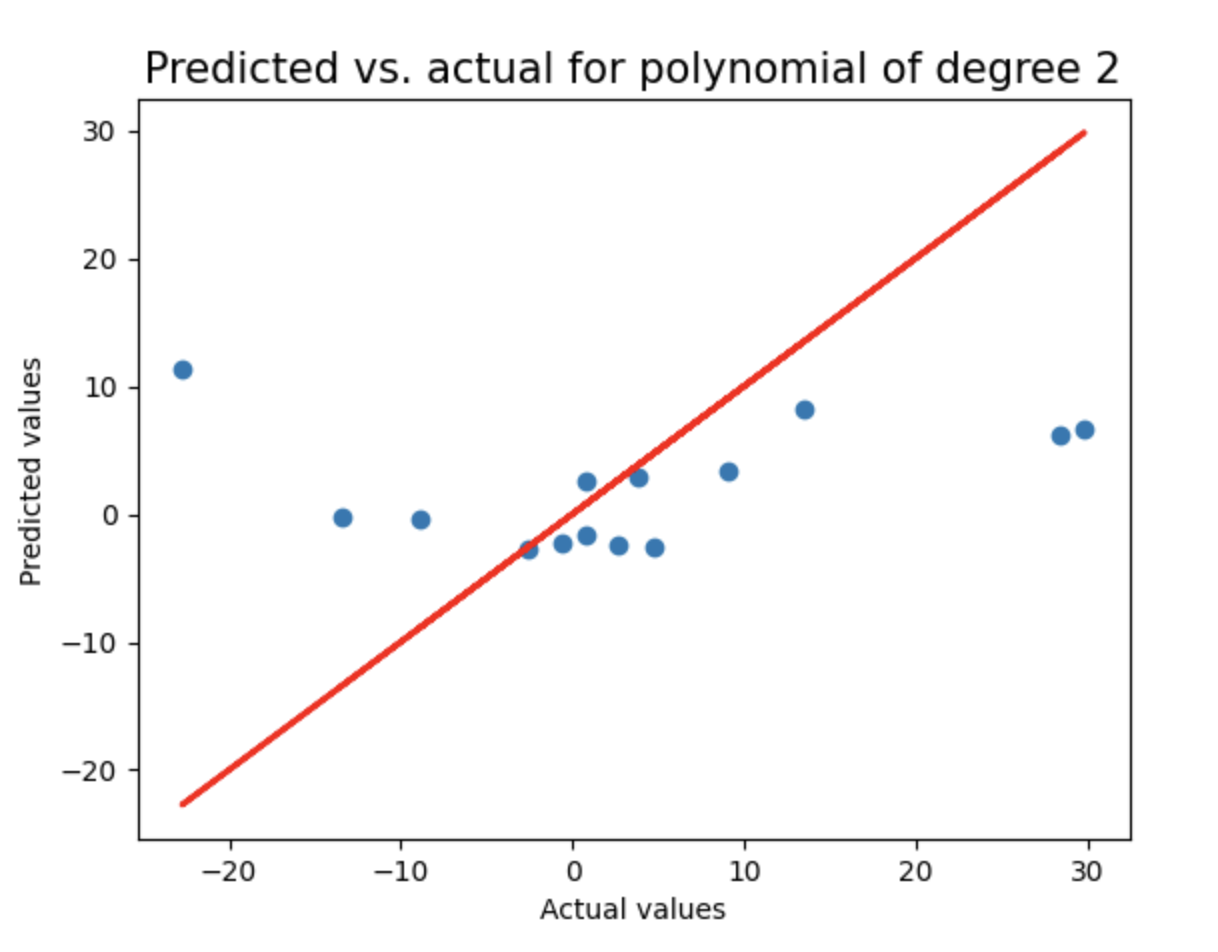
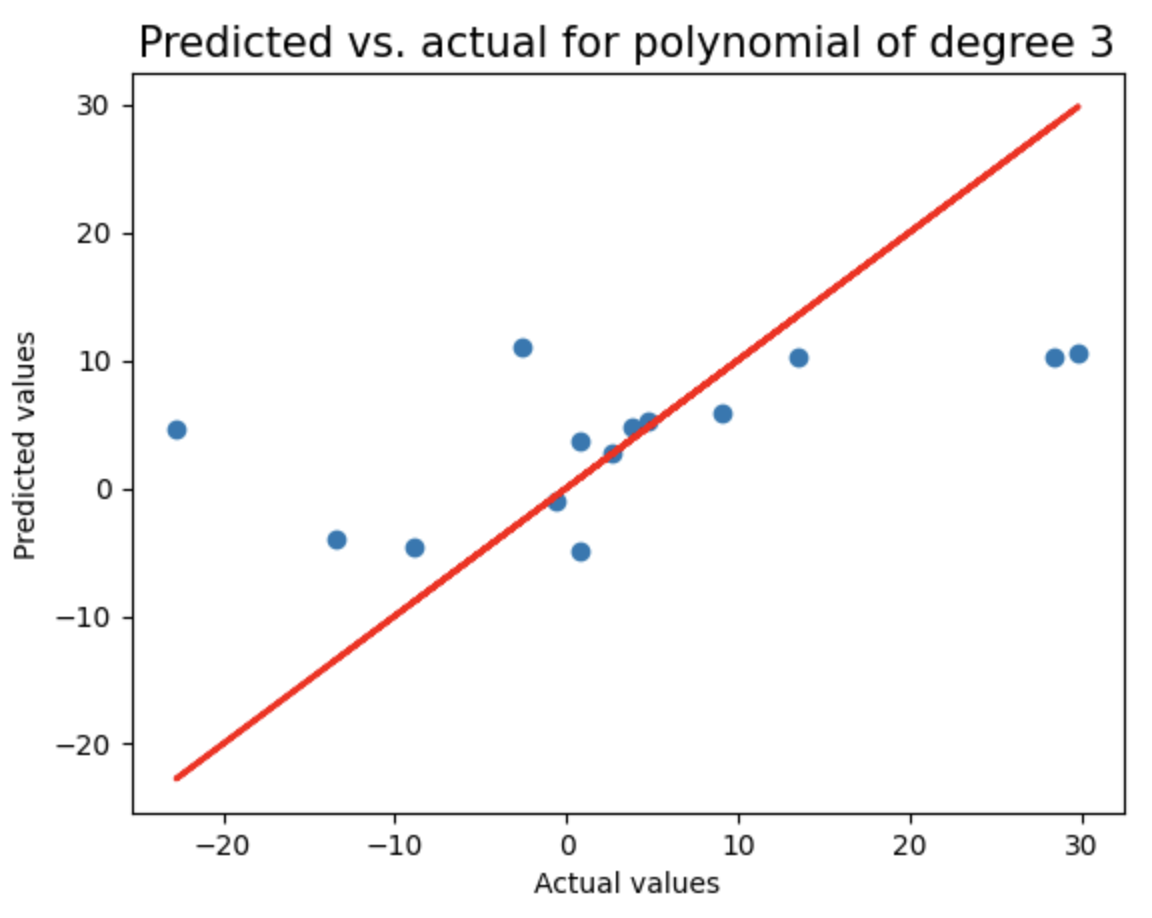
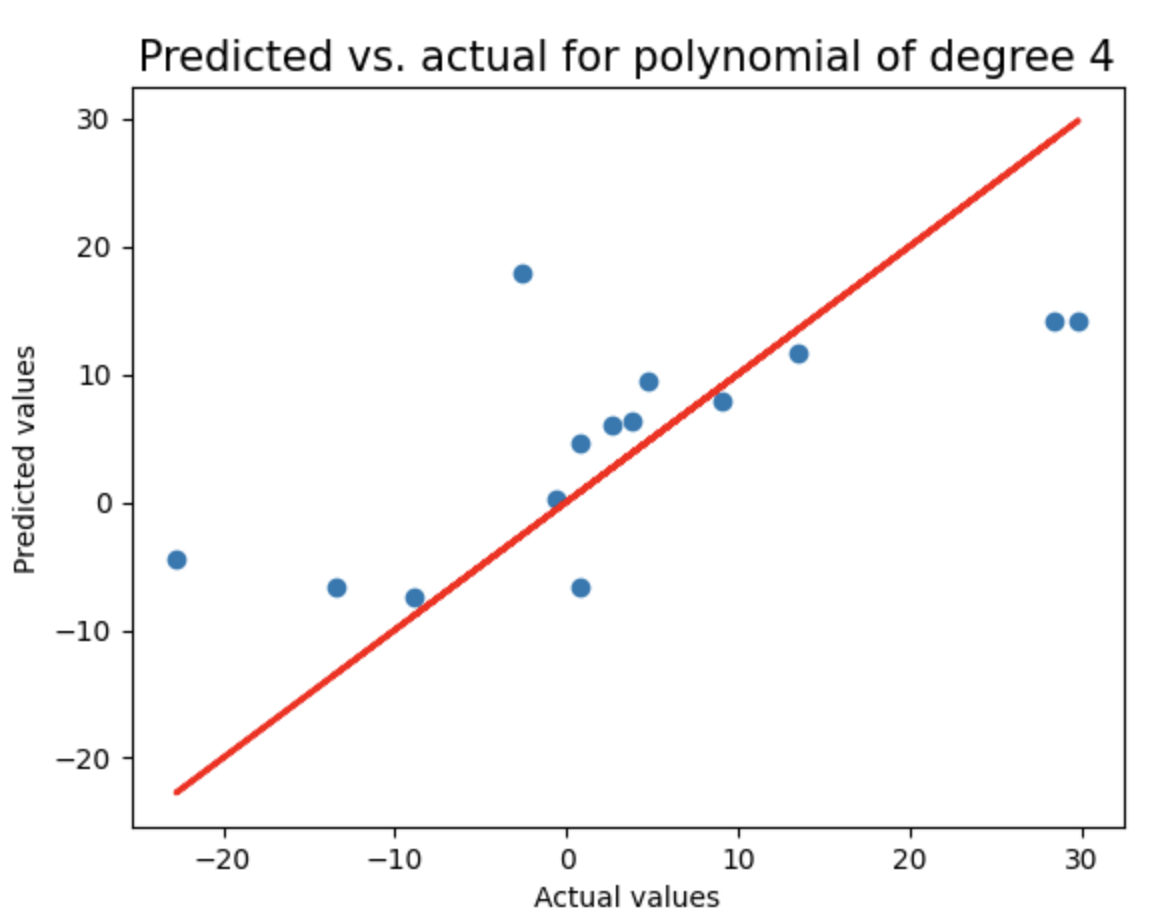
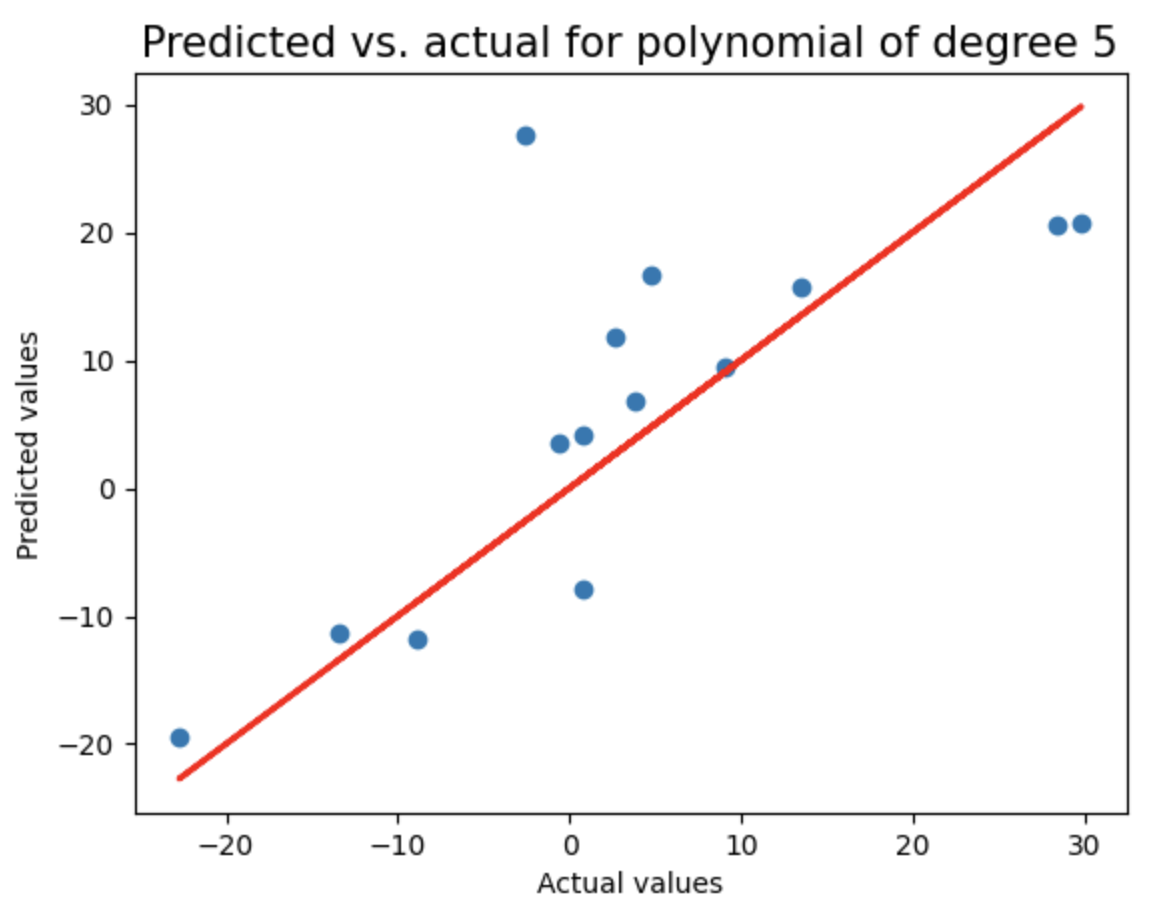
这是一种先进的机器学习方法,通过惩罚高值系数(即保持它们有界)来防止过度拟合。通过循环测试2到8阶多项式回归模型,使用LassoCV进行正则化,记录每个模型的测试集R²分数和多项式阶数,并绘制预测值与实际值的对比图(含理想预测线),用于评估不同复杂度模型的泛化性能。
linear_sample_score = []
poly_degree = []
for degree in range(degree_min,degree_max+1):

    model = make_pipeline(PolynomialFeatures(degree), LassoCV(eps=lasso_eps,n_alphas=lasso_nalpha,
                                                                  max_iter=lasso_iter,normalize=True,cv=5))

    model.fit(X_train, y_train)
    y_pred = np.array(model.predict(X_train))
    test_pred = np.array(model.predict(X_test))
    RMSE=np.sqrt(np.sum(np.square(y_pred-y_train)))
    test_score = model.score(X_test,y_test)
    linear_sample_score.append(test_score)
    poly_degree.append(degree)
    print("Test score of model with degree {}: {}\n".format(degree,test_score))

    plt.figure()
    plt.title("Predicted vs. actual for polynomial of degree {}".format(degree),fontsize=15)
    plt.xlabel("Actual values")
    plt.ylabel("Predicted values")
    plt.scatter(y_test,test_pred)
    plt.plot(y_test,y_test,'r',lw=2)
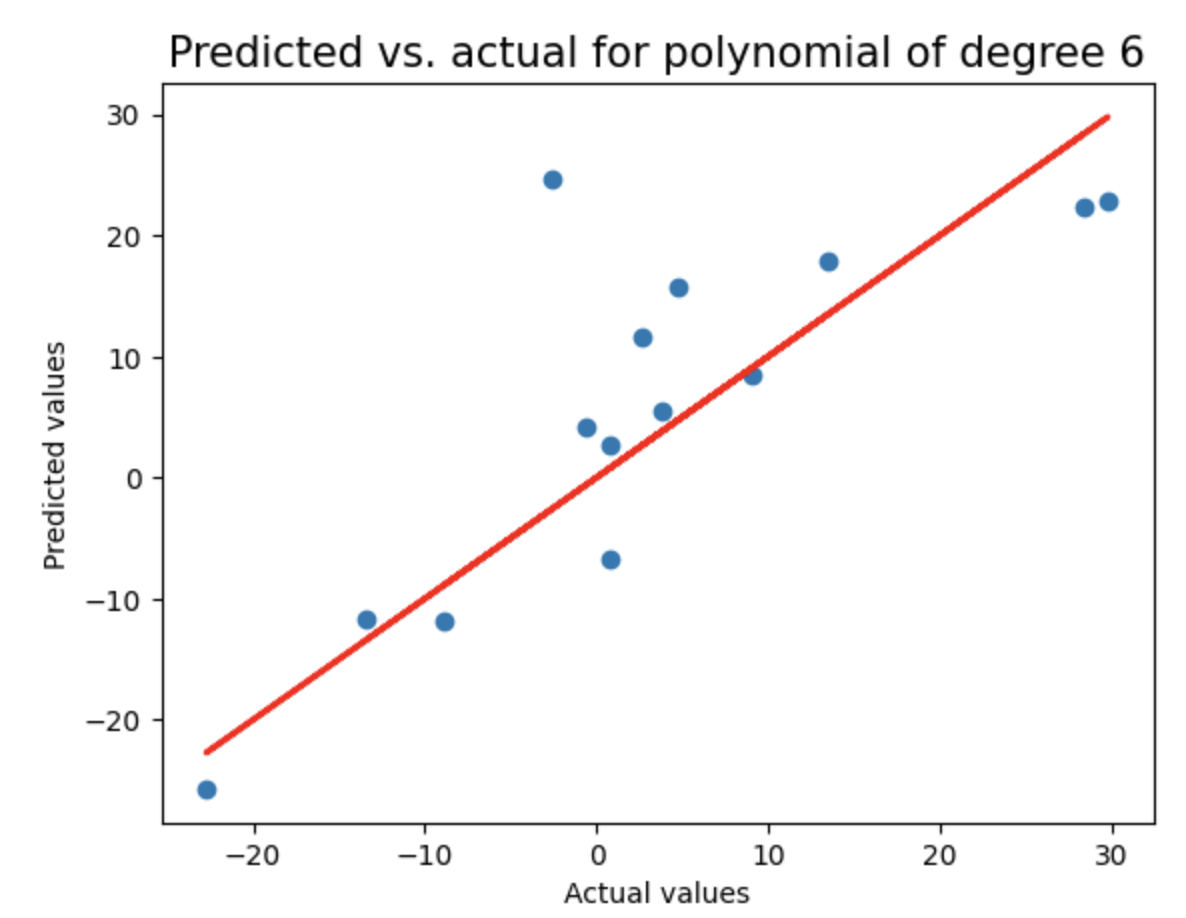
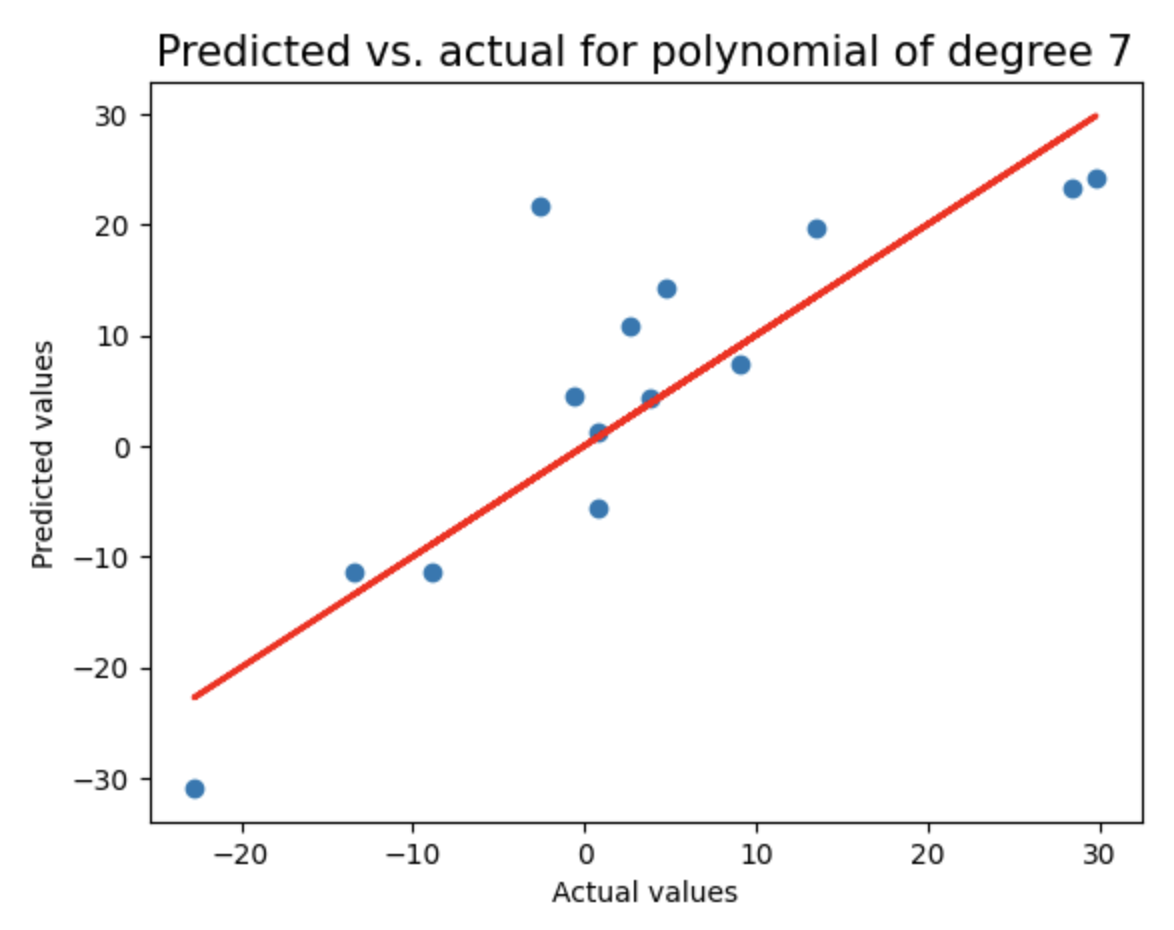
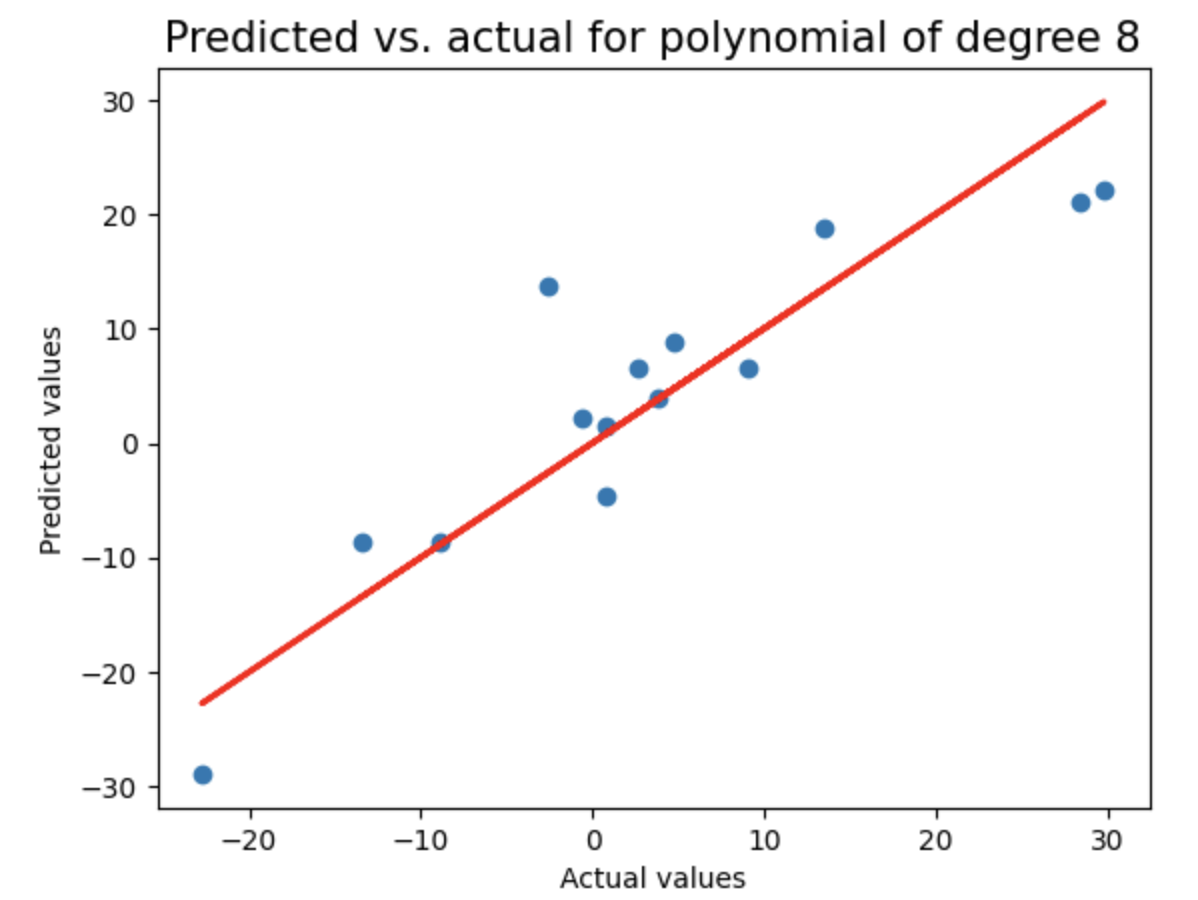
linear_sample_score
Result:
[0.01972262259273616,
 0.31696961499861065,
 0.48354017207617983,
 0.4619441805300364,
 0.5614210750057387,
 0.6263648368163351,
 0.7935722818093062]
1.7 使用随机采样对数据集建模 
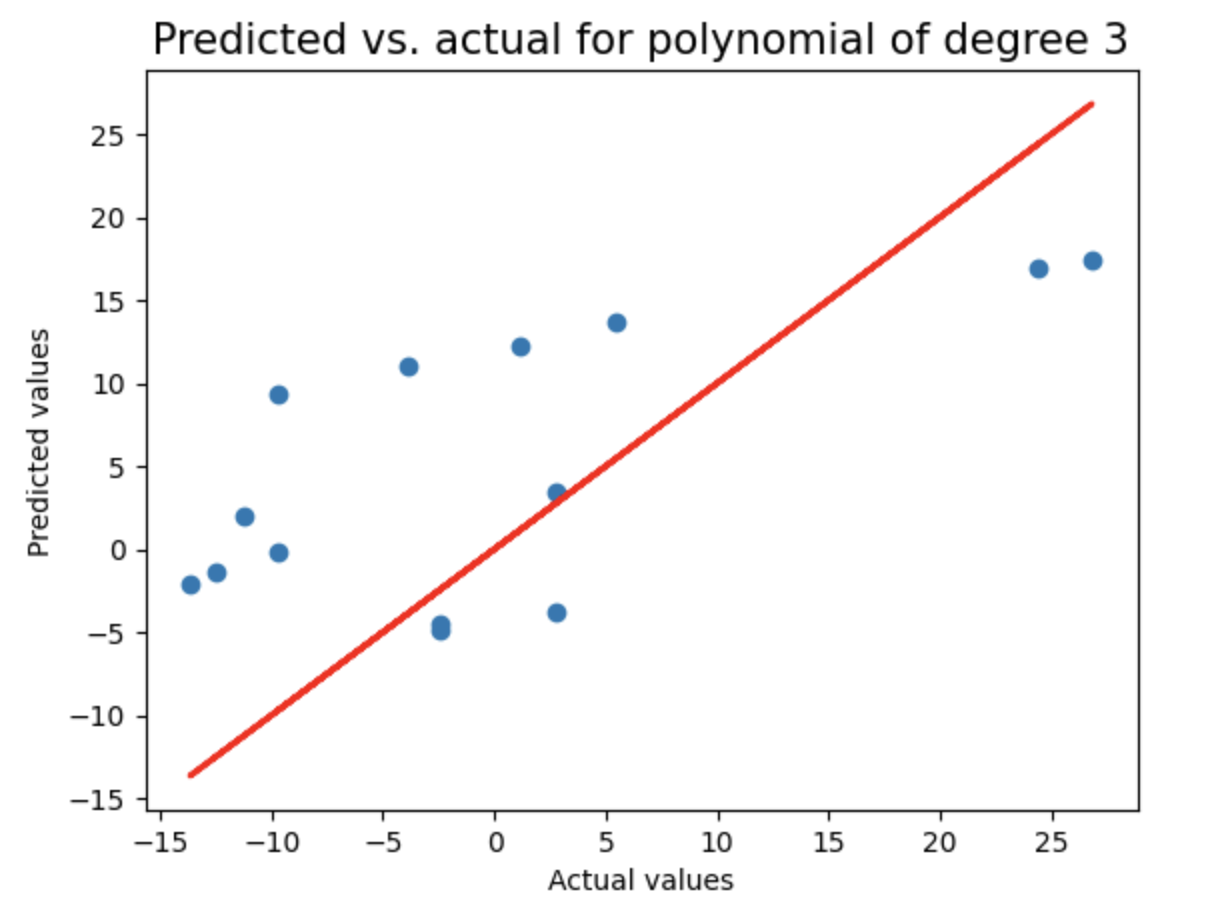
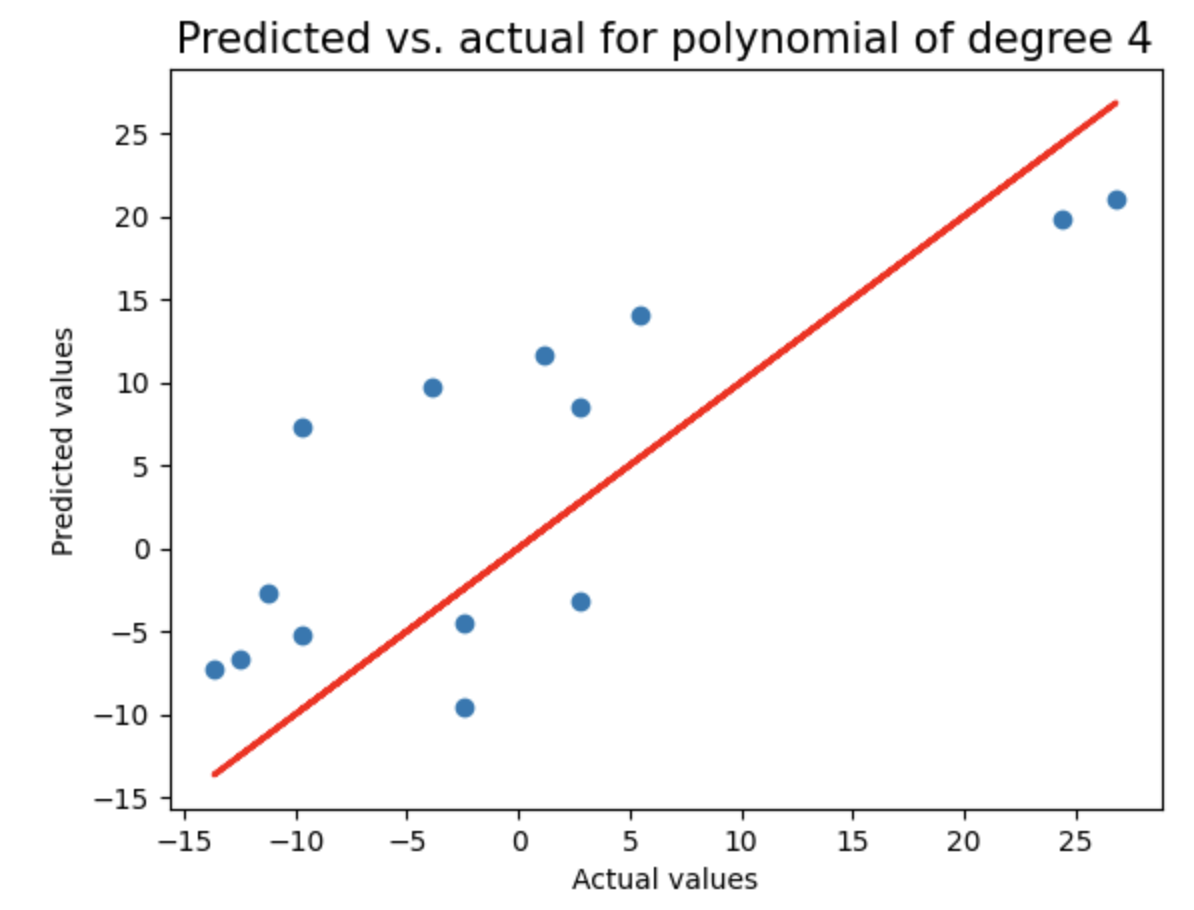
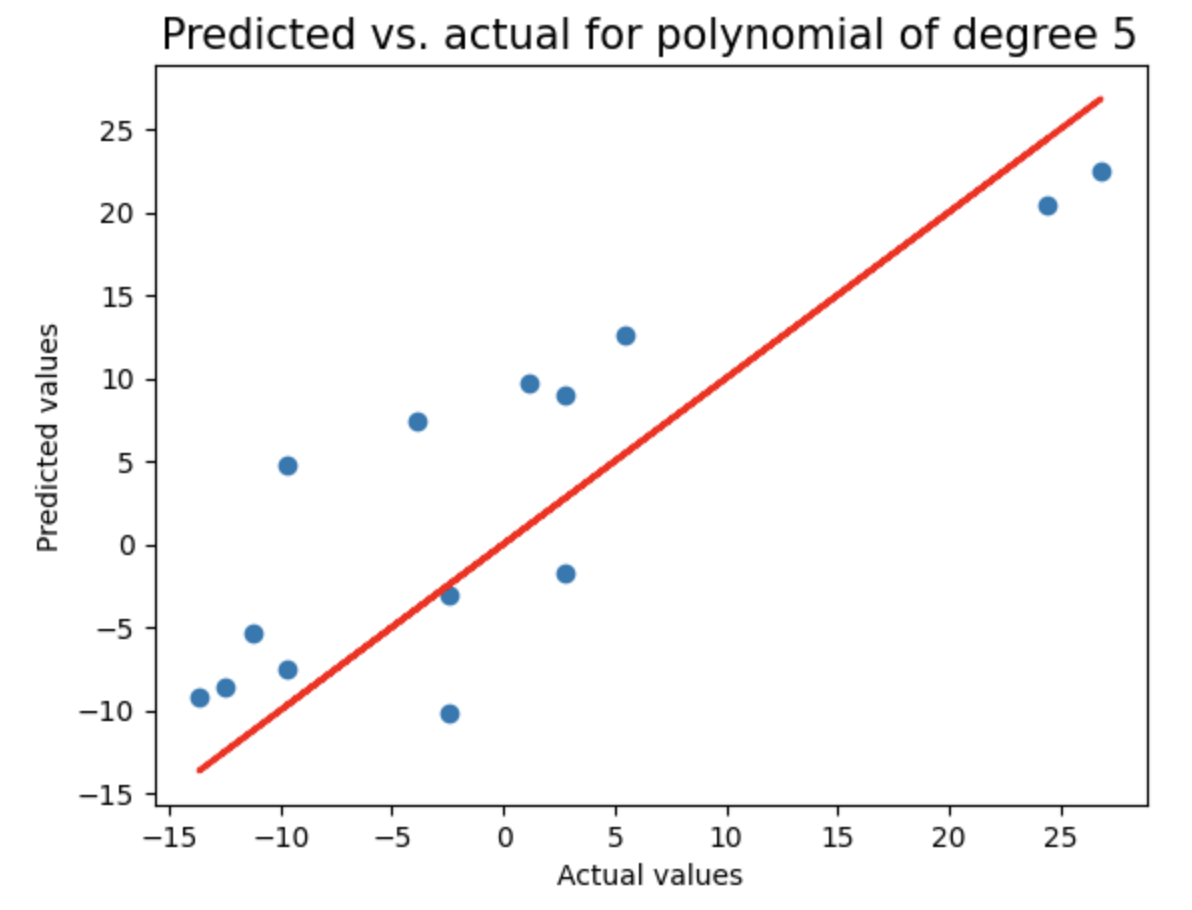
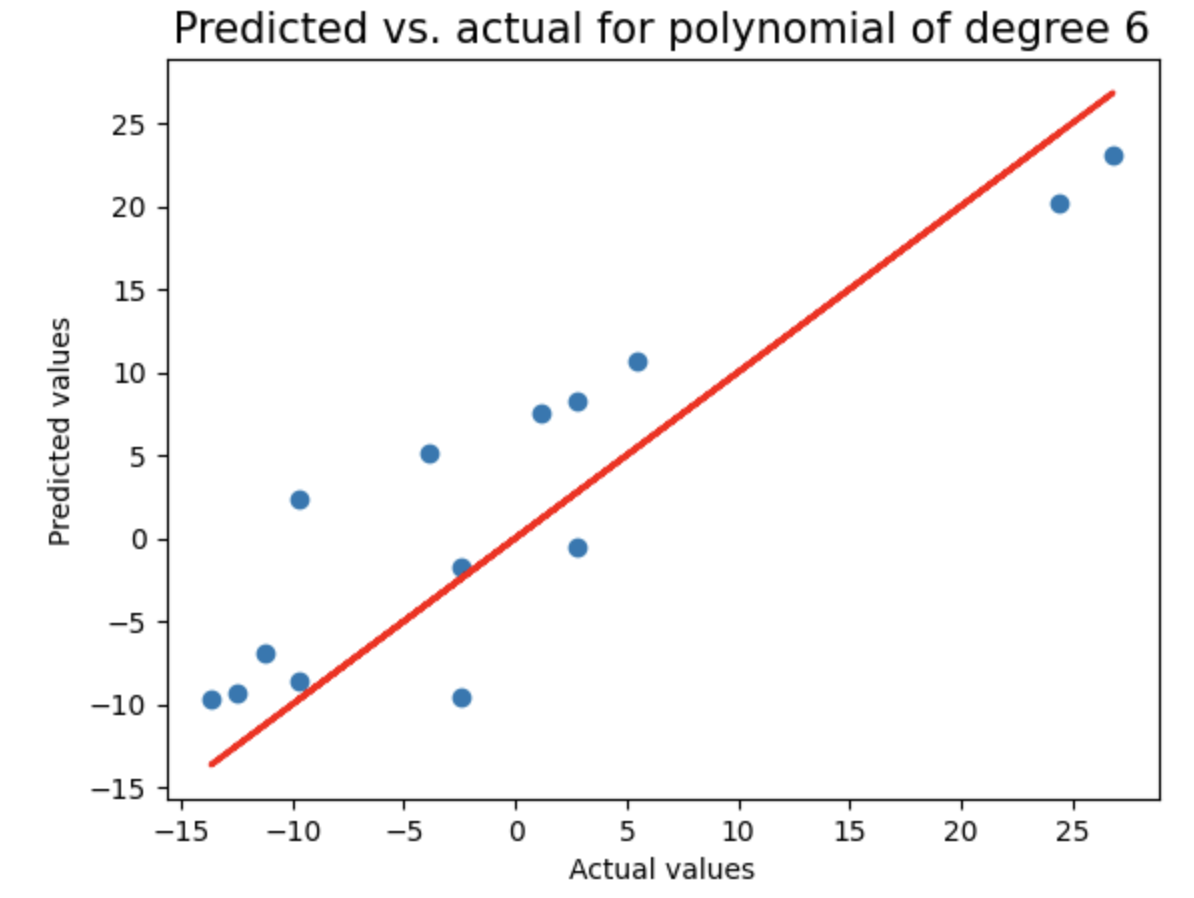
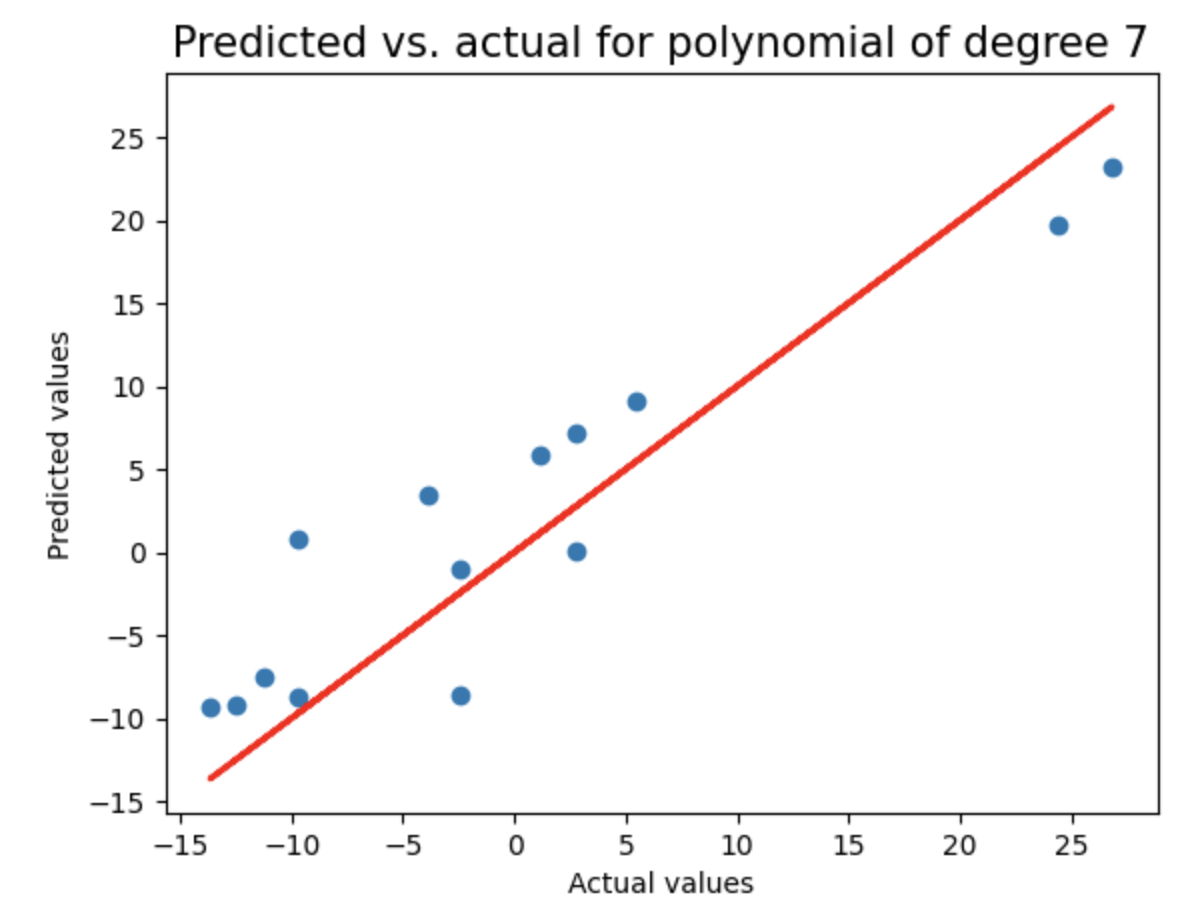
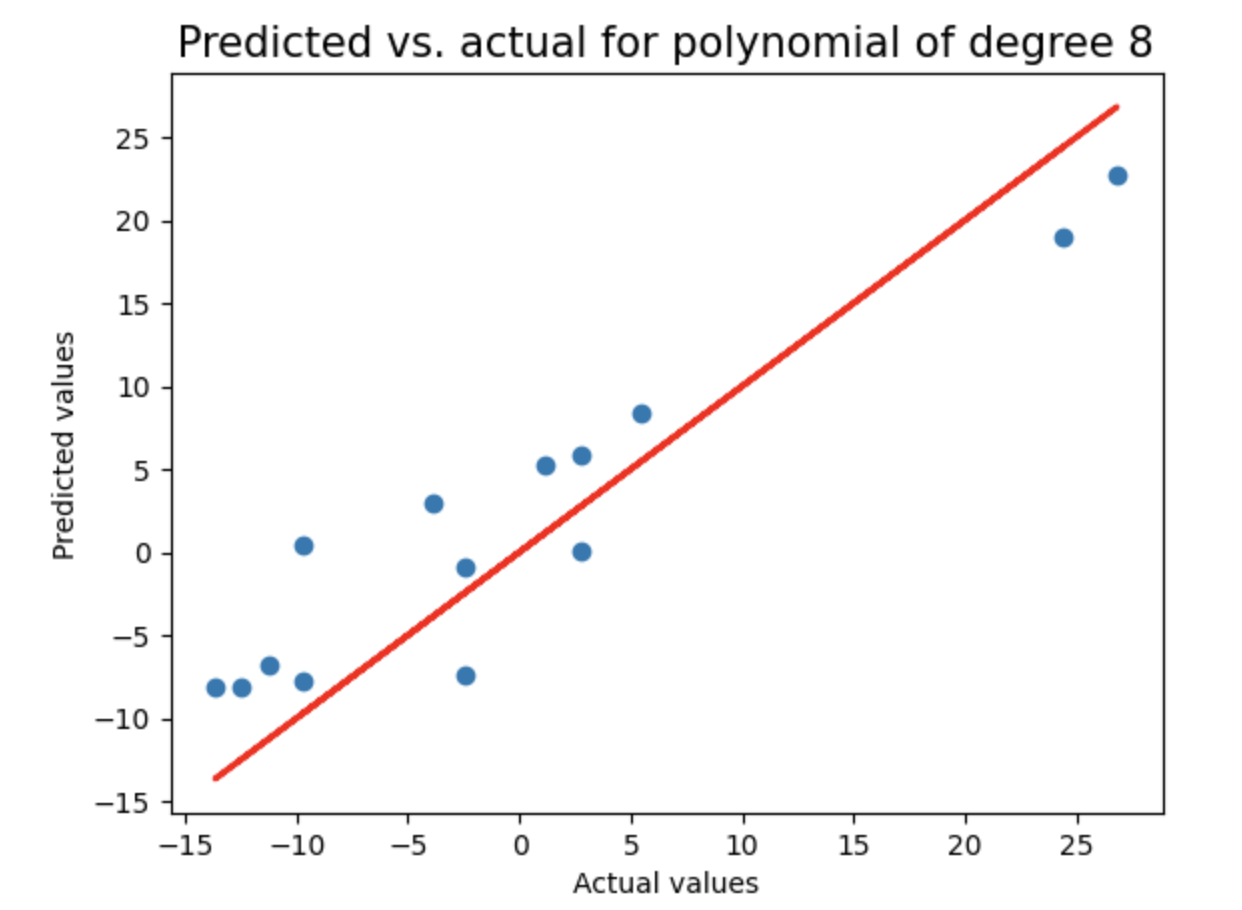
对随机采样数据执行与之前相同的分析:将数据划分为训练集和测试集,测试2到8阶多项式回归模型,使用LassoCV进行正则化,记录每个模型的测试集R²分数和多项式阶数,并绘制预测值与实际值的对比图,用于评估不同复杂度模型在随机采样数据上的泛化性能。
X_train, X_test, y_train, y_test = train_test_split(df['X_sampled'], df['y_sampled'], test_size=0.33)
X_train=X_train.values.reshape(-1,1)
X_test=X_test.values.reshape(-1,1)


random_sample_score = []
poly_degree = []
for degree in range(degree_min,degree_max+1):

    model = make_pipeline(PolynomialFeatures(degree), LassoCV(eps=lasso_eps,n_alphas=lasso_nalpha,
                                                                  max_iter=lasso_iter,normalize=True,cv=5))

    model.fit(X_train, y_train)
    y_pred = np.array(model.predict(X_train))
    test_pred = np.array(model.predict(X_test))
    RMSE=np.sqrt(np.sum(np.square(y_pred-y_train)))
    test_score = model.score(X_test,y_test)
    random_sample_score.append(test_score)
    poly_degree.append(degree)

    print("Test score of model with degree {}: {}\n".format(degree,test_score))


    plt.figure()
    plt.title("Predicted vs. actual for polynomial of degree {}".format(degree),fontsize=15)
    plt.xlabel("Actual values")
    plt.ylabel("Predicted values")
    plt.scatter(y_test,test_pred)
    plt.plot(y_test,y_test,'r',lw=2)
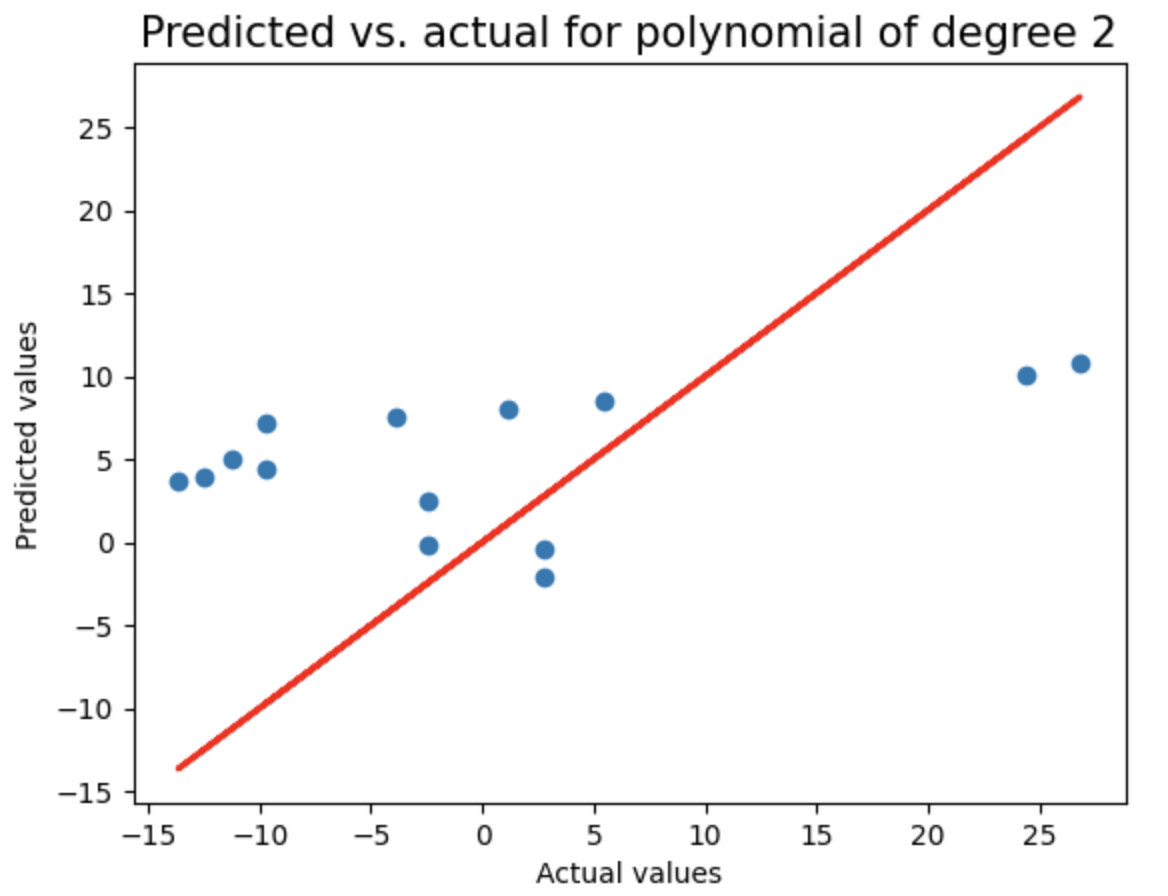
random_sample_score
Result:
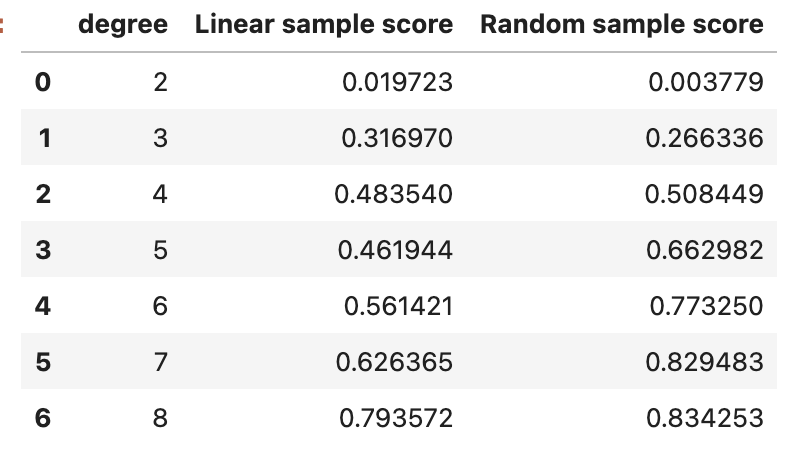
[0.0037787102872796074,
 0.26633554841881124,
 0.5084485116234183,
 0.6629824255648642,
 0.7732499623544961,
 0.8294830115060845,
 0.8342525581964225]
df_score = pd.DataFrame(data={'degree':[d for d in range(degree_min,degree_max+1)],
                              'Linear sample score':linear_sample_score,
                              'Random sample score':random_sample_score})
df_score
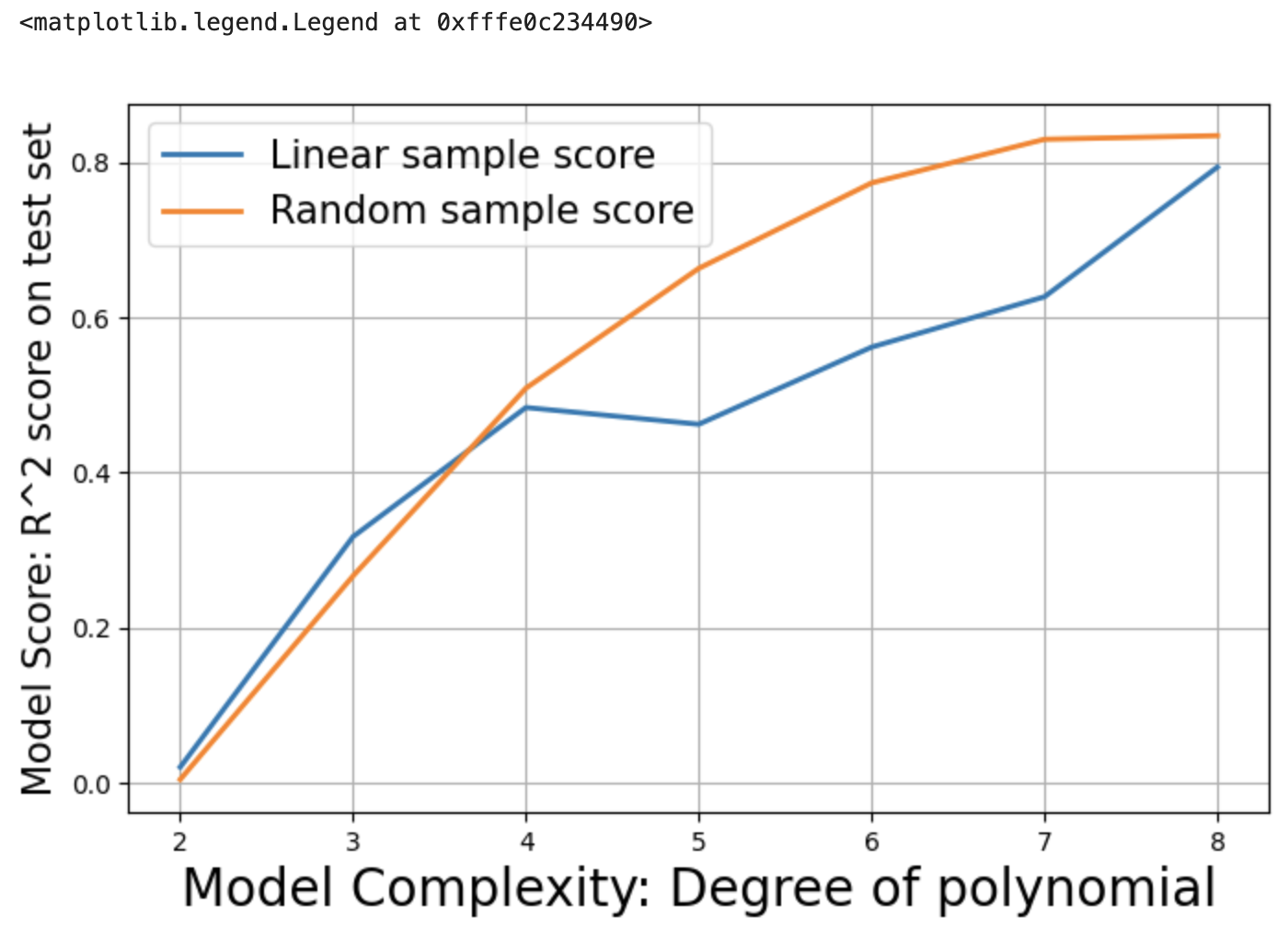
plt.figure(figsize=(8,5))
plt.grid(True)
plt.plot(df_score['degree'],df_score['Linear sample score'],lw=2)
plt.plot(df_score['degree'],df_score['Random sample score'],lw=2)
plt.xlabel("Model Complexity: Degree of polynomial",fontsize=20)
plt.ylabel("Model Score: R^2 score on test set",fontsize=15)
plt.legend(['Linear sample score','Random sample score'],fontsize=15)
1.8 从交叉验证的模型管道中引入正则化强度 
从已训练的scikit-learn管道模型中提取Lasso回归器(model.steps[1][1]),并访问其alpha_属性,该属性表示通过交叉验证选择的最佳正则化强度参数。
m=model.steps[1][1]
m.alpha_
Output:
0.004868836133537874





 扫一扫
扫一扫


 被折叠的 条评论
为什么被折叠?
被折叠的 条评论
为什么被折叠?
 到【灌水乐园】发言





