



哈希表封装实现 unordered_map 和 unordered_set哈希表封装实现 unordered_map 和 unordered_set
哈希表封装实现 unordered_map 和 unordered_set
1. 源码及框架分析
SGI-STL30版本源代码中没有 unordered_map 和 unordered_set ,SGI-STL30版本是C++11之前的STL版本,这两个容器是C++11之后才更新的。但是SGI-STL30实现了哈希表,只是容器的名字是 hash_map 和 hash_set ,它们作为非标准的容器实现的,非标准是指C++标准规定必须实现的,源代码在hash_map/hash_set/stl_hash_map/stl_hash_set/stl_hashtable.h 中。
hash_map 和 hash_set 的实现结构框架核心部分摘取出来如下:
// stl_hashtable.h
template <class Value>
struct __hashtable_node
{
	__hashtable_node* next;
	Value val;
};

template <class Value, class Key, class HashFcn,class ExtractKey, class EqualKey,class Alloc>
class hashtable
{
public:
	typedef Key key_type;
	typedef Value value_type;
	typedef HashFcn hasher;
	typedef EqualKey key_equal;

private:
	hasher hash;
	key_equal equals;
	ExtractKey get_key;
	typedef __hashtable_node<Value> node;

	vector<node*, Alloc> buckets;
	size_type num_elements;

public:
	typedef __hashtable_iterator<Value, Key, HashFcn, ExtractKey, EqualKey,Alloc> iterator;
	pair<iterator, bool> insert_unique(const value_type& obj);
	const_iterator find(const key_type& key) const;
};

// stl_hash_set
template <class Value, class HashFcn = hash<Value>,class EqualKey = equal_to<Value>,class Alloc = alloc>
class hash_set
{
private:
	typedef hashtable<Value, Value, HashFcn, identity<Value>,
		EqualKey, Alloc> ht;
	ht rep;

public:
	typedef typename ht::key_type key_type;
	typedef typename ht::value_type value_type;
	typedef typename ht::hasher hasher;
	typedef typename ht::key_equal key_equal;

	typedef typename ht::const_iterator iterator;
	typedef typename ht::const_iterator const_iterator;
	hasher hash_funct() const { return rep.hash_funct(); }
	key_equal key_eq() const { return rep.key_eq(); }
};

// stl_hash_map
template <class Key, class T, class HashFcn = hash<Key>,class EqualKey = equal_to<Key>,class Alloc = alloc>
class hash_map
{
private:
	typedef hashtable<pair<const Key, T>, Key, HashFcn,
		select1st<pair<const Key, T> >, EqualKey, Alloc> ht;
	ht rep;

public:
	typedef typename ht::key_type key_type;
	typedef T data_type;
	typedef T mapped_type;
	typedef typename ht::value_type value_type;
	typedef typename ht::hasher hasher;
	typedef typename ht::key_equal key_equal;
	typedef typename ht::iterator iterator;
	typedef typename ht::const_iterator const_iterator;
};
补充:
-
通过源代码可以看到,结构上 hash_map 和 hash_se t跟 map 和 set 的基本类似,复用同一个 hashtable 实现 key 和 key/value 结构,hash_set 传给 hash_table 的是两个key,hash_map 传给 hash_table 的是 pair<const key, value>。
-
需要注意的是源代码里跟 map/set 源码类似,命名风格比较乱,这里比map和set还乱,hash_set模板参数居然用的Value命名,hash_map用的是Key和T命名。下面模仿一份自己的出来,就按自己的风格进行编写。
2. 模拟实现unorder_set和unorder_map
2.1 实现复用的底层哈希表框架,并支持insert
-
参考源代码框架,unordered_map 和 unordered_set 复用上篇文章实现的哈希表。
-
这里相比源代码调整一下,key 参数就用 K,value 参数就用 V,哈希表中的数据类型,使用 T。
-
其次跟 map 和 set 相比而言 unordered_map 和 unordered_set 的模拟类结构更复杂一点,但是大框架和思路是完全类似的。为了使哈希表能够同时封装 KV模型的 unordered_map 和 K模型的 unordered_set,哈希表不能将节点的数据类型直接定义为 pair<K, V>,而是需要通过参数 T 来确定;
同时,由于 insert 函数在求余数时需要取出 T 中的 key 转化为整形,所以上层的 unordered_map 和 unordered_set 需要定义一个仿函数 MapKeyOfT 和 SetKeyOfT 来获取 key (主要是为了 unordered_map 而设计)。
2.1.1 实现基本框架:
// HashTable.h
template<class K>
struct HashFunc
{
	size_t operator()(const K& key)
	{
		return (size_t)key;
	}
};

namespace hash_bucket
{
	template<class T>
	struct HashNode
	{
		T _data;
		HashNode<T>* _next;

		HashNode(const T& data)
			:_data(data)
			, _next(nullptr)
		{}
	};

	template<class K, class T, class KeyOfT, class Hash>
	class HashTable
	{
		typedef HashNode<T> Node;
	public:
		// ...
	private:
		vector<Node*> _tables; // 指针数组
		size_t _n = 0; // 表中存储数据个数
	};
}
// MyUnorderedSet.h
template<class K>
class unordered_set
{
	// 仿函数
	struct SetKeyOfT
	{
		const K& operator()(const K& key) // 返回键值key
		{
			return key;
		}
	};

public:
	//...
private:
	HashTable<K, K, SetKeyOfT> _ht;
};
// MyUnorderedMap.h
template<class K, class V>
class unordered_map
{
	// 仿函数
	struct MapKeyOfT
	{
		const K& operator()(const pair<K, V>& kv) // 返回键值对当中的键值key
		{
			return kv.first;
		}
	};

public:
	//...
private:
	HashTable<K, pair<K, V>, MapKeyOfT> _ht;
};
补充:
-
哈希表模版参数的控制
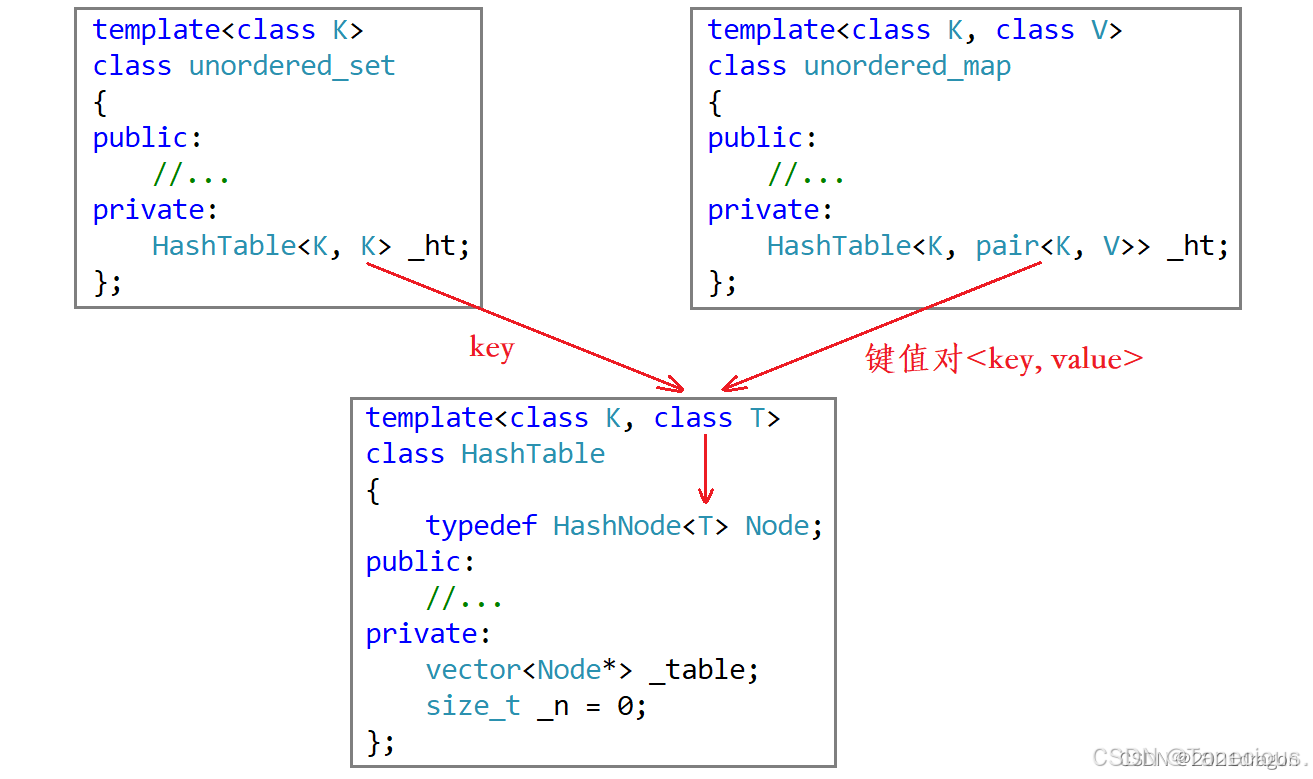
使用同一个哈希表结构由上层传入不同参数来控制其封装出不同容器。
而哈希结点的模板参数也应该由原来的K、V变为T:
- 上层容器是unordered_set时,传入的T是键值,哈希结点中存储的就是键值。
- 上层容器是unordered_map时,传入的T是键值对,哈希结点中存储的就是键值对。
-
string类型无法取模问题
在上篇文章介绍哈希表底层的时候就介绍了,由于哈希表需要对键值 key 进行进行取模映射所以需要保证键值 key 的类型是整型。所以需要在哈希表的模板参数中再增加一个仿函数,用于将键值key转换成对应的整型。
这里实现的仿函数就是 HashTable.h 文件中的 HashFunc ,同时因为 string 类型是最经常需要被处理的类型,为了提高效率还可以对此类型进行特化。
// 哈希表的仿函数 template<class K> struct HashFunc { size_t operator()(const K& key) { return (size_t)key; } }; // string类模板特化 template<> struct HashFunc<string> { // 字符串转换成整形,可以把字符ascii码相加即可 // 但是直接相加的话,类似"abcd"和"bcad"这样的字符串计算出是相同的 // 这里使用BKDR哈希的思路,用上次的计算结果去乘以⼀个质数,这个质数⼀般取31, 131等效果会比较好 size_t operator()(const string& key) { size_t hash = 0; for (auto e : key) { hash *= 131; hash += e; } return hash; } }; -
键值 key 的引出
同时为了后续 insert 等接口对键值 key 的需要,这里需要在上层 MyUnorderedMap.h 和 MyUnorderedSet.h 中分别传入一个仿函数用于返回键值 key。
2.1.2 支持 insert
insert 的具体实现仍在上一篇哈希表的底层实现有具体介绍,这里因为作为底层需要提高兼容性,针对许多参数类型需要使用模版参数代替,其余逻辑基本没有改变,具体代码如下:
// HashTable.h
template<class K>
struct HashFunc
{
	size_t operator()(const K& key)
	{
		return (size_t)key;
	}
};

namespace hash_bucket
{
	template<class T>
	struct HashNode
	{
		T _data;
		HashNode<T>* _next;

		HashNode(const T& data)
			:_data(data)
			, _next(nullptr)
		{}
	};

	template<class K, class T, class KeyOfT, class Hash>
	class HashTable
	{
		typedef HashNode<T> Node;

		inline unsigned long __stl_next_prime(unsigned long n)
		{
			static const int __stl_num_primes = 28;
			static const unsigned long __stl_prime_list[__stl_num_primes] =
			{
			53, 97, 193, 389, 769,
			1543, 3079, 6151, 12289, 24593,
			49157, 98317, 196613, 393241, 786433,
			1572869, 3145739, 6291469, 12582917, 25165843,
			50331653, 100663319, 201326611, 402653189, 805306457,
			1610612741, 3221225473, 4294967291

			};
			const unsigned long* first = __stl_prime_list;
			const unsigned long* last = __stl_prime_list + __stl_num_primes;
			const unsigned long* pos = lower_bound(first, last, n);
			return pos == last ? *(last - 1) : *pos;
		}

	public:
		HashTable()
		{
			_tables.resize(__stl_next_prime(_tables.size()), nullptr);
		}

		~HashTable()
		{
			// 依次把每个桶释放
			for (size_t i = 0; i < _tables.size(); i++)
			{
				Node* cur = _tables[i];
				while (cur)
				{
					Node* next = cur->_next;
					delete cur;
					cur = next;
				}
				_tables[i] = nullptr;
			}
		}

		bool Insert(const T& data)
		{
			KeyOfT kot;
			if (Find(kot(data)))
				return false;
			Hash hs;
			size_t hashi = hs(kot(data)) % _tables.size();
			// 负载因⼦==1扩容
			if (_n == _tables.size())
			{
				vector<Node*> newtables(__stl_next_prime(_tables.size()),

					nullptr);
				for (size_t i = 0; i < _tables.size(); i++)
				{
					Node* cur = _tables[i];
					while (cur)
					{
						Node* next = cur->_next;
						// 旧表中结点,挪动新表重新映射的位置
						size_t hashi = hs(kot(cur->_data)) % newtables.size();
						// 头插到新表
						cur->_next = newtables[hashi];
						newtables[hashi] = cur;

						cur = next;
					}
					_tables[i] = nullptr;
				}
				_tables.swap(newtables);
			}
			// 头插
			Node* newnode = new Node(data);
			newnode->_next = _tables[hashi];
			_tables[hashi] = newnode;
			++_n;
			return true;
		}

	private:
		vector<Node*> _tables; // 指针数组
		size_t _n = 0; // 表中存储数据个数
	};
}
2.2 支持 iterator 的实现
2.2.1 iterator 的核心源码
template <class Value, class Key, class HashFcn,class ExtractKey, class EqualKey, class Alloc>
struct __hashtable_iterator {
	typedef hashtable<Value, Key, HashFcn, ExtractKey, EqualKey, Alloc>
		hashtable;
	typedef __hashtable_iterator<Value, Key, HashFcn,
		ExtractKey, EqualKey, Alloc>
		iterator;
	typedef __hashtable_const_iterator<Value, Key, HashFcn,
		ExtractKey, EqualKey, Alloc>
		const_iterator;
	typedef __hashtable_node<Value> node;
	typedef forward_iterator_tag iterator_category;
	typedef Value value_type;
	node* cur;
	hashtable* ht;
	__hashtable_iterator(node* n, hashtable* tab) : cur(n), ht(tab) {}
	__hashtable_iterator() {}
	reference operator*() const { return cur->val; }

#ifndef __SGI_STL_NO_ARROW_OPERATOR

	pointer operator->() const { return &(operator*()); }

#endif /* __SGI_STL_NO_ARROW_OPERATOR */
	iterator& operator++();
	iterator operator++(int);
	bool operator==(const iterator& it) const { return cur == it.cur; }
	bool operator!=(const iterator& it) const { return cur != it.cur; }
};

template <class V, class K, class HF, class ExK, class EqK, class A>
__hashtable_iterator<V, K, HF, ExK, EqK, A>&
__hashtable_iterator<V, K, HF, ExK, EqK, A>::operator++()
{
	const node* old = cur;
	cur = cur->next;
	if (!cur) {
		size_type bucket = ht->bkt_num(old->val);
		while (!cur && ++bucket < ht->buckets.size())
			cur = ht->buckets[bucket];
	}
	return *this;
}
2.2.2 具体实现思路
-
iterator 实现的大框架跟 list 的 iterator 思路是一致的,用一个类型封装结点的指针,再通过重载运算符实现,发送器指针一样访问的行为,要注意的是哈希表的是单向迭代器。
-
begin() 返回一个桶中第一个节点指针构造的迭代器,这里 end() 返回迭代器可以用空表示。
-
这里的难点是 operator++ 的实现。
iterator 中有一个指向结点的指针,如果当前桶下面还有结点,则结点的指针指向下一个结点即可。如果当前桶走完了,则需要想办法计算找到下一个桶。这里的难点是反而是结构设计的问题,参考上面的源码,可以看到 iterator 中除了有结点的指针,还包含哈希表对象的指针,这样当桶走完了,要计算下一个桶就容易多了,用 key 值计算当前桶位置,依次往后找下一个不为空的桶即可。
代码示例:
// HashTable.h
namespace hash_bucket
{
	// 前置声明,提前声明一下HashTable类,解决相互引用问题
	template<class K, class T, class KeyOfT, class Hash>
		class HashTable;

	template<class K, class T, class Ptr, class Ref, class KeyOfT, class Hash>
	struct HTIterator
	{
		typedef HashNode<T> Node;
		typedef HTIterator<K, T, Ptr, Ref, KeyOfT, Hash> Self;

		Node* _node;
		const HashTable<K, T, KeyOfT, Hash>* _pht;

		HTIterator(Node* node, const HashTable<K, T, KeyOfT, Hash>* pht)
			:_node(node)
			, _pht(pht)
		{}

		Ref operator*()
		{
			return _node->_data;
		}

		Ptr operator->()
		{
			return &_node->_data;
		}

		bool operator!=(const Self& s)
		{
			return _node != s._node;
		}

		Self& operator++()
		{
			if (_node->_next)
			{
				// 当前桶还有节点
				_node = _node->_next;
			}
			else
			{
				// 当前桶⾛完了,找下⼀个不为空的桶
				KeyOfT kot;
				Hash hs;
				size_t hashi = hs(kot(_node->_data)) % _pht -> _tables.size();
				++hashi;
				while (hashi < _pht->_tables.size())
				{
					if (_pht->_tables[hashi])
					{
						break;
					}
					++hashi;
				}

				if (hashi == _pht->_tables.size())
				{
					_node = nullptr; // end()
				}
				else
				{
					_node = _pht->_tables[hashi];
				}
			}
			return *this;
		}
	};

	template<class K, class T, class KeyOfT, class Hash>
	class HashTable
	{
		// 友元声明
		template<class K, class T, class Ptr, class Ref, class KeyOfT, class Hash>
		friend struct HTIterator;

		typedef HashNode<T> Node;
	public:
		typedef HTIterator<K, T, T*, T&, KeyOfT, Hash> Iterator;
		typedef HTIterator<K, T, const T*, const T&, KeyOfT, Hash> ConstIterator;

		Iterator Begin()
		{
			if (_n == 0)
				return End();
			for (size_t i = 0; i < _tables.size(); i++)
			{
				Node* cur = _tables[i];
				if (cur)
				{
					return Iterator(cur, this);
				}
			}
			return End();
		}

		Iterator End()
		{
			return Iterator(nullptr, this);
		}

		ConstIterator Begin() const

		{
			if (_n == 0)
				return End();
			for (size_t i = 0; i < _tables.size(); i++)
			{
				Node* cur = _tables[i];
				if (cur)
				{
					return ConstIterator(cur, this);
				}
			}
			return End();
		}

		ConstIterator End() const
		{
			return ConstIterator(nullptr, this);
		}namespace hash_bucket
{
	template<class T>
	struct HashNode

	{
		T _data;
		HashNode<T>* _next;
		HashNode(const T& data)
			:_data(data)
			, _next(nullptr)
		{}
	};

	// 前置声明
	template<class K, class T, class KeyOfT, class Hash>
		class HashTable;

	template<class K, class T, class Ptr, class Ref, class KeyOfT, class Hash>
	struct HTIterator
	{
		typedef HashNode<T> Node;
		typedef HTIterator<K, T, Ptr, Ref, KeyOfT, Hash> Self;

		Node* _node;
		const HashTable<K, T, KeyOfT, Hash>* _pht;

		HTIterator(Node* node, const HashTable<K, T, KeyOfT, Hash>* pht)
			:_node(node)
			, _pht(pht)
		{}

		Ref operator*()
		{
			return _node->_data;
		}

		Ptr operator->()
		{
			return &_node->_data;
		}

		bool operator!=(const Self& s)
		{
			return _node != s._node;
		}

		Self& operator++()
		{
			if (_node->_next)
			{
				// 当前桶还有节点
				_node = _node->_next;
			}
			else

			{
				// 当前桶⾛完了,找下⼀个不为空的桶
				KeyOfT kot;
				Hash hs;
				size_t hashi = hs(kot(_node->_data)) % _pht -> _tables.size();
				++hashi;
				while (hashi < _pht->_tables.size())
				{
					if (_pht->_tables[hashi])
					{
						break;
					}
					++hashi;
				}

				if (hashi == _pht->_tables.size())
				{
					_node = nullptr; // end()
				}
				else
				{
					_node = _pht->_tables[hashi];
				}
			}
			return *this;
		}
	};

	template<class K, class T, class KeyOfT, class Hash>
	class HashTable
	{
		// 友元声明
		template<class K, class T, class Ptr, class Ref, class KeyOfT, class Hash>
		friend struct HTIterator;

		typedef HashNode<T> Node;
	public:
		typedef HTIterator<K, T, T*, T&, KeyOfT, Hash> Iterator;
		typedef HTIterator<K, T, const T*, const T&, KeyOfT, Hash> ConstIterator;

		Iterator Begin()
		{
			if (_n == 0)
				return End();
			for (size_t i = 0; i < _tables.size(); i++)
			{
				Node* cur = _tables[i];
				if (cur)
				{
					return Iterator(cur, this);
				}
			}
			return End();
		}

		Iterator End()
		{
			return Iterator(nullptr, this);
		}

		ConstIterator Begin() const
		{
			if (_n == 0)
				return End();
			for (size_t i = 0; i < _tables.size(); i++)
			{
				Node* cur = _tables[i];
				if (cur)
				{
					return ConstIterator(cur, this);
				}
			}
			return End();
		}

		ConstIterator End() const
		{
			return ConstIterator(nullptr, this);
		}

    private:
	 	vector<Node*> _tables; // 指针数组
	 	size_t _n = 0; // 表中存储数据个数
 	};
}
2.3 模拟实现完整代码
2.3.1 HashTable.h
// HashTable.h
template<class K>
struct HashFunc

{
	size_t operator()(const K& key)
	{
		return (size_t)key;
	}
};

// 特化
template<>
struct HashFunc<string>
{
	size_t operator()(const string& key)
	{
		size_t hash = 0;
		for (auto e : key)
		{
			hash *= 131;
			hash += e;
		}
		return hash;
	}
};

namespace hash_bucket
{
	template<class T>
	struct HashNode

	{
		T _data;
		HashNode<T>* _next;
		HashNode(const T& data)
			:_data(data)
			, _next(nullptr)
		{}
	};

	// 前置声明
	template<class K, class T, class KeyOfT, class Hash>
		class HashTable;

	template<class K, class T, class Ptr, class Ref, class KeyOfT, class Hash>
	struct HTIterator
	{
		typedef HashNode<T> Node;
		typedef HTIterator<K, T, Ptr, Ref, KeyOfT, Hash> Self;

		Node* _node;
		const HashTable<K, T, KeyOfT, Hash>* _pht;

		HTIterator(Node* node, const HashTable<K, T, KeyOfT, Hash>* pht)
			:_node(node)
			, _pht(pht)
		{}

		Ref operator*()
		{
			return _node->_data;
		}

		Ptr operator->()
		{
			return &_node->_data;
		}

		bool operator!=(const Self& s)
		{
			return _node != s._node;
		}

		Self& operator++()
		{
			if (_node->_next)
			{
				// 当前桶还有节点
				_node = _node->_next;
			}
			else

			{
				// 当前桶⾛完了,找下⼀个不为空的桶
				KeyOfT kot;
				Hash hs;
				size_t hashi = hs(kot(_node->_data)) % _pht -> _tables.size();
				++hashi;
				while (hashi < _pht->_tables.size())
				{
					if (_pht->_tables[hashi])
					{
						break;
					}
					++hashi;
				}

				if (hashi == _pht->_tables.size())
				{
					_node = nullptr; // end()
				}
				else
				{
					_node = _pht->_tables[hashi];
				}
			}
			return *this;
		}
	};

	template<class K, class T, class KeyOfT, class Hash>
	class HashTable
	{
		// 友元声明
		template<class K, class T, class Ptr, class Ref, class KeyOfT, class Hash>
		friend struct HTIterator;

		typedef HashNode<T> Node;
	public:
		typedef HTIterator<K, T, T*, T&, KeyOfT, Hash> Iterator;
		typedef HTIterator<K, T, const T*, const T&, KeyOfT, Hash> ConstIterator;

		Iterator Begin()
		{
			if (_n == 0)
				return End();
			for (size_t i = 0; i < _tables.size(); i++)
			{
				Node* cur = _tables[i];
				if (cur)
				{
					return Iterator(cur, this);
				}
			}
			return End();
		}

		Iterator End()
		{
			return Iterator(nullptr, this);
		}

		ConstIterator Begin() const

		{
			if (_n == 0)
				return End();
			for (size_t i = 0; i < _tables.size(); i++)
			{
				Node* cur = _tables[i];
				if (cur)
				{
					return ConstIterator(cur, this);
				}
			}
			return End();
		}

		ConstIterator End() const
		{
			return ConstIterator(nullptr, this);
		}

		inline unsigned long __stl_next_prime(unsigned long n)
		{
			static const int __stl_num_primes = 28;
			static const unsigned long __stl_prime_list[__stl_num_primes] =
			{
				53, 97, 193, 389, 769,
				1543, 3079, 6151, 12289, 24593,
				49157, 98317, 196613, 393241, 786433,
				1572869, 3145739, 6291469, 12582917, 25165843,
				50331653, 100663319, 201326611, 402653189, 805306457,
				1610612741, 3221225473, 4294967291
			};
			const unsigned long* first = __stl_prime_list;
			const unsigned long* last = __stl_prime_list +
				__stl_num_primes;
			const unsigned long* pos = lower_bound(first, last, n);
			return pos == last ? *(last - 1) : *pos;
		}

		HashTable()
		{
			_tables.resize(__stl_next_prime(_tables.size()), nullptr);
		}

		~HashTable()
		{
			// 依次把每个桶释放
			for (size_t i = 0; i < _tables.size(); i++)
			{
				Node* cur = _tables[i];
				while (cur)
				{
					Node* next = cur->_next;
					delete cur;
					cur = next;
				}
				_tables[i] = nullptr;
			}
		}

		pair<Iterator, bool> Insert(const T& data)
		{
			KeyOfT kot;
			Iterator it = Find(kot(data));
			if (it != End())
				return make_pair(it, false);
			Hash hs;
			size_t hashi = hs(kot(data)) % _tables.size();
			// 负载因⼦==1扩容
			if (_n == _tables.size())
			{
				vector<Node*>

					newtables(__stl_next_prime(_tables.size() + 1), nullptr);
				for (size_t i = 0; i < _tables.size(); i++)
				{
					Node* cur = _tables[i];
					while (cur)
					{
						Node* next = cur->_next;
						// 旧表中节点,挪动新表重新映射的位置
						size_t hashi = hs(kot(cur->_data)) % newtables.size();
						// 头插到新表
						cur->_next = newtables[hashi];
						newtables[hashi] = cur;

						cur = next;
					}
					_tables[i] = nullptr;
				}
				_tables.swap(newtables);
			}
			// 头插
			Node* newnode = new Node(data);
			newnode->_next = _tables[hashi];
			_tables[hashi] = newnode;
			++_n;
			return make_pair(Iterator(newnode, this), true);
		}

		Iterator Find(const K& key)
		{
			KeyOfT kot;
			Hash hs;
			size_t hashi = hs(key) % _tables.size();
			Node* cur = _tables[hashi];
			while (cur)
			{
				if (kot(cur->_data) == key)
				{
					return Iterator(cur, this);
				}
				cur = cur->_next;
			}
			return End();
		}

		bool Erase(const K& key)
		{
			KeyOfT kot;
			Hash hs;
			size_t hashi = hs(key) % _tables.size();
			Node* prev = nullptr;
			Node* cur = _tables[hashi];
			while (cur)
			{
				if (kot(cur->_data) == key)
				{
					if (prev == nullptr)
					{
						_tables[hashi] = cur->_next;
					}
					else

					{
						prev->_next = cur->_next;
					}
					delete cur;
					--_n;
					return true;
				}
				prev = cur;
				cur = cur->_next;
			}
			return false;
		}

	private:
		vector<Node*> _tables; // 指针数组
		size_t _n = 0; // 表中存储数据个数
	};
}
2.3.2 MyUnorderedSet.h
// MyUnorderedSet.h
namespace tcq
{
	template<class K, class Hash = HashFunc<K>>
	class unordered_set
	{
		struct SetKeyOfT
		{
			const K& operator()(const K& key)
			{
				return key;
			}
		};
	public:
		typedef typename hash_bucket::HashTable<K, const K, SetKeyOfT,
			Hash>::Iterator iterator;
		typedef typename hash_bucket::HashTable<K, const K, SetKeyOfT,
			Hash>::ConstIterator const_iterator;

		iterator begin()
		{
			return _ht.Begin();
		}

		iterator end()
		{
			return _ht.End();
		}

		const_iterator begin() const

		{
			return _ht.Begin();
		}

		const_iterator end() const

		{
			return _ht.End();
		}

		pair<iterator, bool> insert(const K & key)
		{
			return _ht.Insert(key);
		}

		iterator Find(const K & key)
		{
			return _ht.Find(key);
		}

		bool Erase(const K & key)
		{
			return _ht.Erase(key);
		}

	private:
		hash_bucket::HashTable<K, const K, SetKeyOfT, Hash> _ht;
	};
}
2.3.3MyUnorderedMap.h
// MyUnorderedMap.h
namespace tcq
{
	template<class K, class V, class Hash = HashFunc<K>>
	class unordered_map
	{
		struct MapKeyOfT
		{
			const K& operator()(const pair<K, V>& kv)
			{
				return kv.first;
			}
		};
	public:
		typedef typename hash_bucket::HashTable<K, pair<const K, V>,
			MapKeyOfT, Hash>::Iterator iterator;
		typedef typename hash_bucket::HashTable<K, pair<const K, V>,
			MapKeyOfT, Hash>::ConstIterator const_iterator;
		iterator begin()
		{
			return _ht.Begin();
		}
		iterator end()
		{
			return _ht.End();
		}
		const_iterator begin() const

		{
			return _ht.Begin();
		}
		const_iterator end() const

		{
			return _ht.End();
		}
		pair<iterator, bool> insert(const pair<K, V>& kv)
		{
			return _ht.Insert(kv);
		}
		V& operator[](const K& key)
		{
			pair<iterator, bool> ret = _ht.Insert(make_pair(key, V()));
			return ret.first->second;
		}
		iterator Find(const K& key)
		{
			return _ht.Find(key);
		}
		bool Erase(const K& key)
		{
			return _ht.Erase(key);
		}
	private:
		hash_bucket::HashTable<K, pair<const K, V>, MapKeyOfT, Hash> _ht;
	}
}





 扫一扫
扫一扫


 1248
1248

 被折叠的 条评论
为什么被折叠?
被折叠的 条评论
为什么被折叠?
 到【灌水乐园】发言





