[论文精读]DynBrainGNN: Towards Spatio-Temporal Interpretable Graph Neural Network Based on Dynamic Brain

论文提出了一种名为DynBrainGNN的模型,利用动态脑连接组和变分自编码器,解决了精神疾病诊断中动态模型缺乏解释性的挑战。模型结合了空间注意力和时间注意力机制,提供了疾病特异性大脑动态网络连接和时间属性的解释。实验在多个数据集上展示了其在分类性能上的优势。
部署运行你感兴趣的模型镜像

论文全名:DynBrainGNN: Towards Spatio-Temporal Interpretable Graph Neural Network Based on Dynamic Brain Connectome for Psychiatric Diagnosis

论文网址:DynBrainGNN: Towards Spatio-Temporal Interpretable Graph Neural Network Based on Dynamic Brain Connectome for Psychiatric Diagnosis | SpringerLink

英文是纯手打的!论文原文的summarizing and paraphrasing。可能会出现难以避免的拼写错误和语法错误,若有发现欢迎评论指正!文章偏向于笔记,谨慎食用

目录

1. 省流版

1.1. 心得

1.2. 论文总结图

2. 论文逐段精读

2.1. Abstract

2.2. Introduction

2.3. Proposed Model

2.3.1. Problem Definition

2.3.2. Overall Framework of DynBrainGNN

2.3.3. Construction of Dynamic Functional Graph

2.3.4. Graph Encoder

2.3.5. Spatio-Temporal Attention-Based READOUT Module

2.3.6. Dynamic Variational Autoencoders (DVAE)

2.4. Experiments

2.4.1. Dataset

2.4.2. Baselines

2.4.3. Experimental Settings

2.4.4. Evaluation on Classification Performance

2.5. Interpretation Analysis

2.5.1. Disease-Specific Brain Dynamic Network Connections

2.5.2. Temporal Properties

2.5.3. Conclusion

3. 知识补充

3.1. Dwell time

4. Reference List


1. 省流版

1.1. 心得

(1)完了写完了才发现没有心得,那我咋总结啊?

1.2. 论文总结图
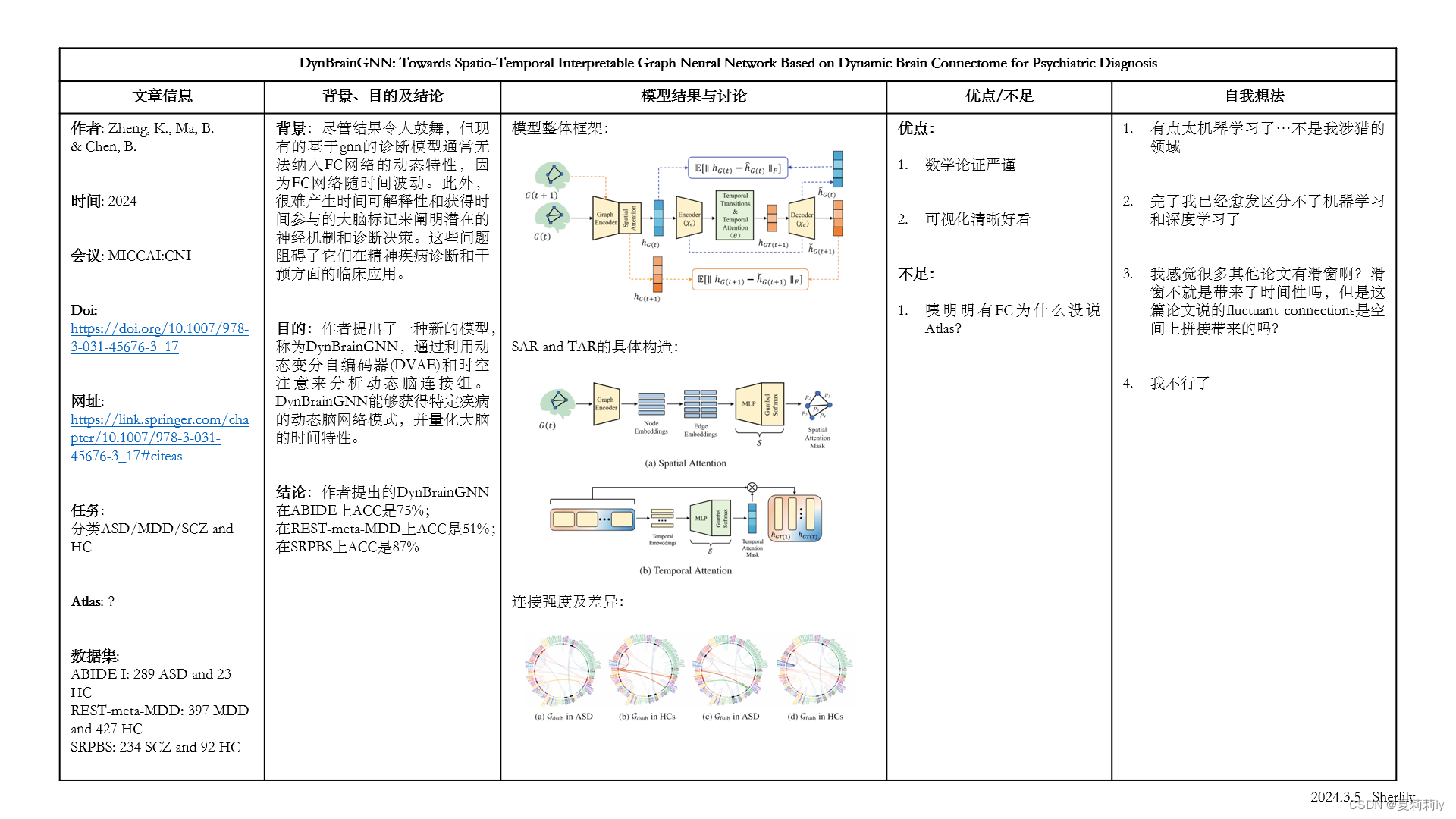
2. 论文逐段精读

2.1. Abstract

        ①Again, FC can not present the dynamic character of fMRI

elucidate  v.阐明;说明;解释

2.2. Introduction

        ①⭐They challenge that the exist dynamic models lack interpretability in dwell time, fractional windows and number of transitions(意思你能解决?)

        ②They propose a Dynamic Brain Graph Neural Networks (DynBrainGNN), which based on dynamic brain connectom via dynamic variational autoencoders (DVAE) and spatio-temporal attention

        ③It is the first time that someone put forward such a "build in" dynamic FC?(啥玩意?真真第一次?)

2.3. Proposed Model

2.3.1. Problem Definition

        ①Graph set: \left\{\mathcal{G}_{dyn}^{1},\mathcal{G}_{dyn}^{2},...,\mathcal{G}_{dyn}^{N}\right\}, where \mathcal{G}_{dyn}^{i}=\left\{\mathcal{G}^{i}\left(1\right),...,\mathcal{G}^{i}\left(T\right)\right\} is the time series with T length of the i-th subject and N is the number of subjects

        ②Through graphs, they extract and learn features \left\{h_{\mathcal{G}_{dyn}}^1,h_{\mathcal{G}_{dyn}}^2,...,h_{\mathcal{G}_{dyn}}^N\right\}

        ③The real label set: \{Y_{1},Y_{2},...,Y_{N}\}

2.3.2. Overall Framework of DynBrainGNN

        ①The schematic of DynBrainGNN:
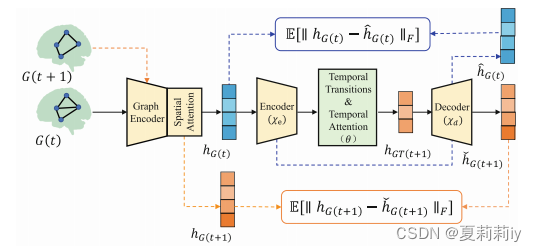
which covers graph encoder, spatial attention module, temporal attention module and DVAE four modules;

where decoder recovers \hat{h}_{G(t)}=\mathcal{X}_{d}\circ\mathcal{X}_{e}\left(h_{G(t)}\right) and \check{h}_{G(t+1)}={\mathcal X}_{d}\circ\theta\circ{\mathcal X}_{e}\left(h_{G(t)}\right);

然后,作者只是说橙色蓝色那俩框框是“为了保证解码器的可靠”,然后也没多说了

2.3.3. Construction of Dynamic Functional Graph

        ①Length of time series: T

        ②Length of slicing window: L

        ③Stride: S

        ④By dynamic cutting, they obtain W=[T-L/S] windowed dFC matrices(为啥?如果T=10,L=8,S=1,W不就等于2了吗,但是看上去是不是有1-8,2-9,3-10三个啊,不会要加一吗?

        ⑤Each dFC calculated by Pearson correlation

        ⑥⭐They get the graph \mathcal{G}\left(t\right)=\left(A\left(t\right),X\left(t\right)\right) where A\left ( t \right ) is a adjacency matrix that all 1 transformed by the top 20% absolute correlation and X_{i}\left(t\right)=\left[\rho_{i1},\ldots,\rho_{in}\right]^{\mathrm{T}} denotes the node features which constructed by the row or column of FC matrix

2.3.4. Graph Encoder

        ①Graph encoder: GCN

        ②Propagation rule of GCN:

H^l=\sigma\left(D^{-\frac{1}{2}}\hat{A}D^{-\frac{1}{2}}\Theta^{l-1}\right)

where \hat{A}=A+I,D=\sum_{j}\hat{A}_{ij}\Theta^{l-1} denotes learnable parameters and \sigma \left ( \cdot \right ) denotes Sigmoid

2.3.5. Spatio-Temporal Attention-Based READOUT Module

        ①They designed two attention based READOUT methods, Spatial Attention READOUT (SAR) and Temporal Attention READOUT (TAR)

        ②Based on prior H, they define {\mathcal Z}={\mathcal S}(H), {\mathcal Z}\in\left[0,1\right]^{N},H\in \mathbb{R}^{D\times N}

        ③In SAR, H_{\mathrm{space}}=[x_{i};x_{j}], where [\cdot ;\cdot ] denotes concatenation

        ④In TAR, H_{\mathrm{temporal}} is constructed by the concatenation of several graph presentations at different times

        ⑤The specific operation of {\mathcal S}:

{\mathcal Z}=\mathrm{Gumbel}\_\mathrm{Softmax}\left(\mathrm{Sigmoid}\left(\mathrm{MLP}\left(H\right)\right)\right)

after Sigmoid, {\mathcal Z}\in[0,1]. "Then, attention masks are sampled from Bernoulli distributions, and the gumbelsoftmax reparameterization trick is applied to update {\mathcal S}"

        ⑥In SAR, h_{G}=\mathrm{GCN}\left(\mathcal{Z}_{\mathrm{space}}\odot G\right)

        ⑦In TAR, h_{GT}=\mathcal{Z}_{\mathrm{time}}\otimes G where \otimes denotes Kronecker product

        ⑧Schematic of SAR and TAR:
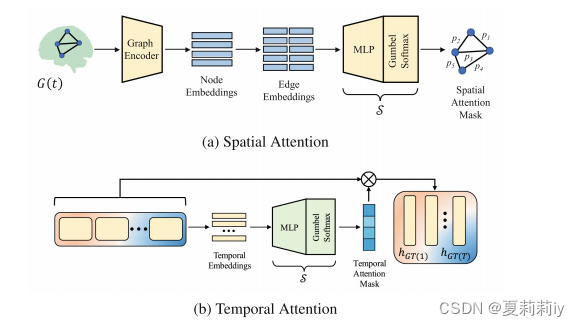
2.3.6. Dynamic Variational Autoencoders (DVAE)

        ①Temporal transition: h_{G(t+1)}=\mathrm{LSTM}\left(h_{G(t)}\right)

        ②The function of DVAE:

\begin{aligned} \mathcal{L}_{\mathrm{DVAE}}& =\alpha\left(\sum_{t=1}^{T}\mathbb{E}\left[\left\|h_{G(t)}-\hat{h}_{G(t)}\right\|_{F}\right]+\sum_{t=1}^{T-1}\mathbb{E}\left[\left\|h_{G(t+1)}-\check{h}_{G(t+1)}\right\|_{F}\right]\right) \\ &-\beta\left(\sum_{t=1}^{T}\mathbb{E}\left[D_{\mathrm{KL}}\left[q\left(Z|h_{G(t)}\right)\parallel p\left(Z\right)\right]\right]\right), \end{aligned}

where \hat{h}_{G(t)}={\mathcal X}_{d}\circ{\mathcal X}_{e}\left(h_{G(t)}\right),\check{h}_{G(t+1)}={\mathcal X}_{d}\circ\theta\circ{\mathcal X}_{e}\left(h_{G(t)}\right)q\left(Z|h_{G}\right) represents the encoder model(什么东西啊?就是GCN吗?), \left\|\cdot\right\|_{F} indicates the Frobenius norm, p\left(Z\right) denotes the prior distribution with isotropic Gaussian (assumed), \alpha and \beta are both  scaling coefficients of the regularization term

        ③One more regularization term for compacting:

\mathcal{L}_{\mathbf{MI}}=\gamma\left(\sum_{t=1}^{T-1}I\left(h_{G(t+1)},h_{GT(t+1)}\right)\right)

where I\left ( \cdot \right ) denotes the matrix-based Renyi’s \alpha-order mutual information and \gamma denotes the scaling coefficient

        ④Accordingly, combining them all \mathcal{L}=\mathcal{L}_{\mathrm{CE}}+\mathcal{L}_{\mathrm{DVAE}}+\mathcal{L}_{\mathrm{MI}} to get a final loss function, where \mathcal{L}_{\mathrm{CE}} is cross entropy loss

2.4. Experiments

2.4.1. Dataset

        ①ABIDE I: 289 ASD and 23 HC for no reason

        ②REST-meta-MDD: 397 MDD and 427 HC

        ③SRPBS: " This is a multi-disorder MRI dataset"(吓我一跳,总感觉是同时身患玉玉症多动症焦虑症自闭症老年痴呆的被试呢), selecting 234 SCZ and 92 HC

2.4.2. Baselines

        ①Settings:
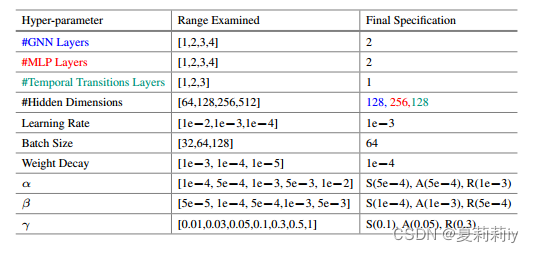
2.4.3. Experimental Settings

        ①Cross validation: 5 fold

        ②Decision of hyper-parameter: grid search

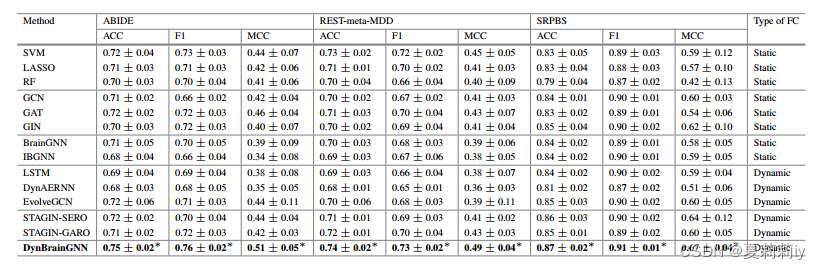
2.4.4. Evaluation on Classification Performance

        ①Comparison table:
2.5. Interpretation Analysis

2.5.1. Disease-Specific Brain Dynamic Network Connections

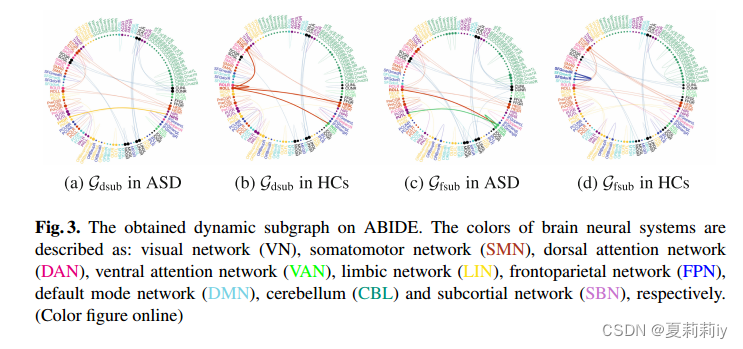
        ①The interpretations of dynamically dominant and fluctuant connections()are brought by \mathcal{Z}_{\mathrm{time}} and \mathcal{Z}_{\mathrm{space}}

        ②They define dominant subgraph \mathcal{G}_{\mathrm{dsub}} and fluctuant subgraph \mathcal{G}_{\mathrm{fsub}}:

\mathcal{G}_{\mathrm{dsub}}=\frac{1}{T}\sum\limits_{t=1}^{T}\left(\mathcal{Z}\left(t\right)\right),\mathcal{G}_{\mathrm{fsub}}=\sqrt{\frac{1}{T}\sum\limits_{t=1}^{T}\left(\mathcal{Z}\left(t\right)-\bar{\mathcal{Z}}\right)^{2}}

where \mathcal{Z}\left(t\right)=\mathcal{Z}_{\mathrm{space}}\left(t\right)\odot\mathcal{Z}_{\mathrm{time}}\left(t\right) and \overline{\mathcal{Z}} is the mean value of \mathcal{Z}\left(t\right)

        ③The top 50 influential edges:

sensorimotor  adj. 感觉运动的(等于 sensomotor)

2.5.2. Temporal Properties

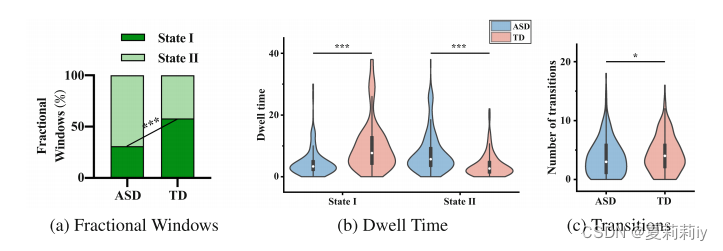
        ①“我们提供的时间属性的解释,以了解大脑的灵活性和适应性在精神疾病。具体而言,我们首先应用k-means聚类算法对有窗时空参与的图表示hGT进行聚类,以评估动态大脑模式(状态)。使用基于轮廓分数的聚类有效性分析来确定最佳聚类数量。然后,我们量化这些状态的时间属性的组差异,包括停留时间(即属于一个状态的连续窗口的持续时间),分数窗口(即属于一个状态的总窗口的比例)和转换数量(即状态之间的转换数量)。使用带有错误发现率(FDR)校正的双样本t检验(图4)。我们的分析显示,ASD患者在II状态下有更高的分数窗口和平均停留时间,这与最近的一项神经影像学研究一致”(我失去了paraphrase能力)

        ②Temporal properties:
2.5.3. Conclusion

        They want to further try their model in other datasets

3. 知识补充

3.1. Dwell time

搜了一圈没搜到关于医学设备的,提供以下猜测

(1)最可能的,length of time series signals

(2)两个相邻点之间的时间?比如task fMRI两次task之间的时间间隔

(3)嘻嘻,事实证明上面俩都是错的,在2.5.2.作者说它是"the duration of consecutive windows belonging to one state"

4. Reference List

Zheng, K., Ma, B. & Chen, B. (2024) 'DynBrainGNN: Towards Spatio-Temporal Interpretable Graph Neural Network Based on Dynamic Brain Connectome for Psychiatric Diagnosis', Machine Learning in Medical Imaging, 14349.doi: DynBrainGNN: Towards Spatio-Temporal Interpretable Graph Neural Network Based on Dynamic Brain Connectome for Psychiatric Diagnosis | SpringerLink

您可能感兴趣的与本文相关的镜像

ACE-Step

ACE-Step

音乐合成
ACE-Step

ACE-Step是由中国团队阶跃星辰(StepFun)与ACE Studio联手打造的开源音乐生成模型。 它拥有3.5B参数量,支持快速高质量生成、强可控性和易于拓展的特点。 最厉害的是,它可以生成多种语言的歌曲,包括但不限于中文、英文、日文等19种语言

### 论文《Unlearnable Clusters: Towards Label-agnostic Unlearnable Examples》解读 论文《Unlearnable Clusters: Towards Label-agnostic Unlearnable Examples》探讨了一种新的方法,旨在生成无法被机器学习模型学习的样本(unlearnable examples),并且这些样本不依赖于特定标签。这种方法通过聚类技术将数据分组,并利用无监督学习的方式生成难以学习的样本[^1]。 #### 核心概念 1. **Unlearnable Examples** Unlearnable Examples 是指那些对模型训练几乎没有贡献的数据点。它们的存在可以干扰模型的学习过程,从而降低模型性能。这种技术在隐私保护和对抗攻击中具有重要意义[^2]。 2. **Label-agnostic** 与传统的对抗样本生成方法不同,该论文提出的方法不需要依赖特定标签信息。这意味着它可以应用于任何数据集,而无需了解数据的真实分类标签[^3]。 3. **Cluster-based Generation** 论文提出了一种基于聚类的方法来生成 unlearnable examples。具体来说,通过将数据划分为不同的簇(clusters),然后从每个簇中提取特征以生成难以学习的样本。这种方法确保了生成的样本能够覆盖数据分布的多个方面,而不是局限于某一类或某些特征[^4]。 #### 方法论 论文的核心方法包括以下几个部分: - **数据预处理**:对原始数据进行标准化处理,以便后续的聚类分析。 - **聚类分析**:使用无监督学习算法(如 K-Means 或 DBSCAN)将数据划分为若干簇。每个簇代表数据空间中的一个子区域[^5]。 - **特征提取**:从每个簇中提取代表性特征,用于生成 unlearnable examples。 - **样本生成**:基于提取的特征,通过优化算法生成难以学习的样本。这些样本可能位于数据分布的边界区域,从而使模型难以捕捉其模式[^6]。 #### 实验结果 论文展示了该方法在多个数据集上的有效性。实验表明,生成的 unlearnable examples 能够显著降低模型的性能,尤其是在深度学习模型中。此外,由于该方法不依赖于标签信息,因此可以应用于各种场景,包括但不限于图像分类、文本分类和时间序列预测[^7]。 #### 技术意义 1. **隐私保护**:通过生成 unlearnable examples,可以防止敏感数据被模型过度学习,从而保护用户隐私。 2. **对抗攻击**:这种方法可以作为一种防御机制,用于检测和抵御对抗性攻击。 3. **模型评估**:unlearnable examples 可以用作一种工具,帮助研究者更好地理解模型的局限性和鲁棒性[^8]。 ```python # 示例代码:基于 K-Means 的聚类分析 from sklearn.cluster import KMeans import numpy as np # 假设 X 是输入数据 X = np.random.rand(100, 10) # 100 个样本,每个样本有 10 个特征 # 使用 K-Means 进行聚类 kmeans = KMeans(n_clusters=5, random_state=0).fit(X) labels = kmeans.labels_ # 提取每个簇的中心点 centroids = kmeans.cluster_centers_ ``` #### 局限性 尽管该方法具有诸多优点,但仍存在一些局限性: - 对于高维数据,聚类分析可能会变得复杂且计算成本较高。 - 生成的 unlearnable examples 在某些情况下可能仍然可以被特定模型学习到,这取决于模型架构和训练策略[^9]。 ---
评论 2
添加红包

请填写红包祝福语或标题

红包个数最小为10个

红包金额最低5元

当前余额3.43前往充值 >
需支付:10.00
成就一亿技术人!
领取后你会自动成为博主和红包主的粉丝 规则
hope_wisdom
发出的红包
实付
使用余额支付
点击重新获取
扫码支付
钱包余额 0

抵扣说明:

1.余额是钱包充值的虚拟货币,按照1:1的比例进行支付金额的抵扣。
2.余额无法直接购买下载,可以购买VIP、付费专栏及课程。

余额充值