



目录
本文是对LPIPS技术的代码解读,原文解读请看LPIPS,本文参考的代码是PYIQA。
原文概要
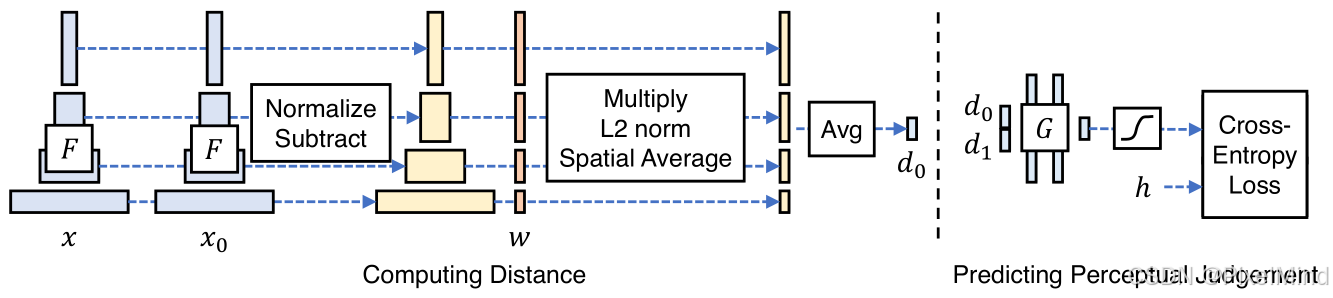
LPIPS通过计算深度网络中不同图像的特征距离来评估感知相似性指标,过程如下图所示。
下面将根据PYIQA的实现来对LPIPS进行代码讲解。
1. 代码讲解
总的来说,LPIPS的计算可以被分为以下5步:
- 图像进行预处理,标准化。
- 通过选定的网络的多个特征层的激活输出作为LPIPS指标的计算输入。
- 逐个特征进行对比,特征首先进行normalize,然后进行MSE计算,normalize是L2范数的归一化,通道上所有值相加为L2范数大小。
- 然后是在空间上做平均,(这里可以选择是否使用LPIPS训练的几个FC层参数,在论文中也有提到)
- 最终的结果由所有层的结果求和得来,多个层的结果权重一样。
代码路径位于pyiqa/archs/lpips_arch.py中,实现如下所示。
@ARCH_REGISTRY.register()
class LPIPS(nn.Module):
    """LPIPS model.
    Args:
        lpips (Boolean) : Whether to use linear layers on top of base/trunk network.
        pretrained (Boolean): Whether means linear layers are calibrated with human
            perceptual judgments.
        pnet_rand (Boolean): Whether to randomly initialized trunk.
        net (String): ['alex','vgg','squeeze'] are the base/trunk networks available.
        version (String): choose the version ['v0.1'] is the default and latest;
            ['v0.0'] contained a normalization bug.
        pretrained_model_path (String): Petrained model path.

        The following parameters should only be changed if training the network:

        eval_mode (Boolean): choose the mode; True is for test mode (default).
        pnet_tune (Boolean): Whether to tune the base/trunk network.
        use_dropout (Boolean): Whether to use dropout when training linear layers.


    """

    def __init__(
        self,
        pretrained=True,
        net='alex',
        version='0.1',
        lpips=True,
        spatial=False,
        pnet_rand=False,
        pnet_tune=False,
        use_dropout=True,
        pretrained_model_path=None,
        eval_mode=True,
        semantic_weight_layer=-1,
        **kwargs,
    ):
        super(LPIPS, self).__init__()

        self.pnet_type = net
        self.pnet_tune = pnet_tune
        self.pnet_rand = pnet_rand
        self.spatial = spatial
        self.lpips = lpips  # false means baseline of just averaging all layers
        self.version = version
        self.scaling_layer = ScalingLayer()

        self.semantic_weight_layer = semantic_weight_layer

        if self.pnet_type in ['vgg', 'vgg16']:
            net_type = vgg16
            self.chns = [64, 128, 256, 512, 512]
        elif self.pnet_type == 'alex':
            net_type = alexnet
            self.chns = [64, 192, 384, 256, 256]
        elif self.pnet_type == 'squeeze':
            net_type = squeezenet
            self.chns = [64, 128, 256, 384, 384, 512, 512]
        self.L = len(self.chns)

        self.net = net_type(pretrained=not self.pnet_rand, requires_grad=self.pnet_tune)

        if lpips:
            self.lin0 = NetLinLayer(self.chns[0], use_dropout=use_dropout)
            self.lin1 = NetLinLayer(self.chns[1], use_dropout=use_dropout)
            self.lin2 = NetLinLayer(self.chns[2], use_dropout=use_dropout)
            self.lin3 = NetLinLayer(self.chns[3], use_dropout=use_dropout)
            self.lin4 = NetLinLayer(self.chns[4], use_dropout=use_dropout)
            self.lins = [self.lin0, self.lin1, self.lin2, self.lin3, self.lin4]
            if self.pnet_type == 'squeeze':  # 7 layers for squeezenet
                self.lin5 = NetLinLayer(self.chns[5], use_dropout=use_dropout)
                self.lin6 = NetLinLayer(self.chns[6], use_dropout=use_dropout)
                self.lins += [self.lin5, self.lin6]
            self.lins = nn.ModuleList(self.lins)

            if pretrained_model_path is not None:
                load_pretrained_network(self, pretrained_model_path, False)
            elif pretrained:
                load_pretrained_network(
                    self, default_model_urls[f'{version}_{net}'], False
                )

        if eval_mode:
            self.eval()

    def forward(self, in1, in0, retPerLayer=False, normalize=True):
        r"""Computation IQA using LPIPS.
        Args:
            in1: An input tensor. Shape :math:`(N, C, H, W)`.
            in0: A reference tensor. Shape :math:`(N, C, H, W)`.
            retPerLayer (Boolean): return result contains result of
                each layer or not. Default: False.
            normalize (Boolean): Whether to normalize image data range
                in [0,1] to [-1,1]. Default: True.

        Returns:
            Quality score.

        """
        if (
            normalize
        ):  # turn on this flag if input is [0,1] so it can be adjusted to [-1, +1]
            in0 = 2 * in0 - 1
            in1 = 2 * in1 - 1

        # v0.0 - original release had a bug, where input was not scaled
        in0_input, in1_input = (
            (self.scaling_layer(in0), self.scaling_layer(in1))
            if self.version == '0.1'
            else (in0, in1)
        )
        outs0, outs1 = self.net.forward(in0_input), self.net.forward(in1_input)
        feats0, feats1, diffs = {}, {}, {}

        for kk in range(self.L):
            feats0[kk], feats1[kk] = (
                normalize_tensor(outs0[kk]),
                normalize_tensor(outs1[kk]),
            )
            diffs[kk] = (feats0[kk] - feats1[kk]) ** 2

        if self.lpips:
            if self.spatial:
                res = [
                    upsample(self.lins[kk](diffs[kk]), out_HW=in0.shape[2:])
                    for kk in range(self.L)
                ]
            elif self.semantic_weight_layer >= 0:
                res = []
                semantic_feat = outs0[self.semantic_weight_layer]
                for kk in range(self.L):
                    diff_score = self.lins[kk](diffs[kk])
                    semantic_weight = torch.nn.functional.interpolate(
                        semantic_feat,
                        size=diff_score.shape[2:],
                        mode='bilinear',
                        align_corners=False,
                    )
                    avg_score = torch.sum(
                        diff_score * semantic_weight, dim=[1, 2, 3], keepdim=True
                    ) / torch.sum(semantic_weight, dim=[1, 2, 3], keepdim=True)
                    res.append(avg_score)
            else:
                res = [
                    spatial_average(self.lins[kk](diffs[kk]), keepdim=True)
                    for kk in range(self.L)
                ]
        else:
            if self.spatial:
                res = [
                    upsample(diffs[kk].sum(dim=1, keepdim=True), out_HW=in0.shape[2:])
                    for kk in range(self.L)
                ]
            else:
                res = [
                    spatial_average(diffs[kk].sum(dim=1, keepdim=True), keepdim=True)
                    for kk in range(self.L)
                ]

        val = 0
        for i in range(self.L):
            val += res[i]

        if retPerLayer:
            return (val, res)
        else:
            return val.squeeze(-1).squeeze(-1)
可以看到,输入的两幅图像会首先进行预处理,标准化,即self.scaling_layer的前向过程,如下所示。
class ScalingLayer(nn.Module):
    def __init__(self):
        super(ScalingLayer, self).__init__()
        self.register_buffer(
            'shift', torch.Tensor([-0.030, -0.088, -0.188])[None, :, None, None]
        )
        self.register_buffer(
            'scale', torch.Tensor([0.458, 0.448, 0.450])[None, :, None, None]
        )

    def forward(self, inp):
        return (inp - self.shift) / self.scale
接下来是计算选定网络的多个特征层的激活输出,代码这里默认是alexnet,计算了5个不同位置的特征输出,则现在我们拥有了2幅图像的5对特征输出,总共10个特征,net按照选定的网络类型进行初始化。
self.net = net_type(pretrained=not self.pnet_rand, requires_grad=self.pnet_tune)前向中,利用这个net进行推理。
outs0, outs1 = self.net.forward(in0_input), self.net.forward(in1_input)然后来到前面讲的第三步,逐个特征进行对比,特征首先进行normalize,然后进行MSE计算,normalize是L2范数的归一化,通道上所有值相加为L2范数大小,代码如下所示:
for kk in range(self.L):
    feats0[kk], feats1[kk] = (
        normalize_tensor(outs0[kk]),
        normalize_tensor(outs1[kk]),
    )
    diffs[kk] = (feats0[kk] - feats1[kk]) ** 2
这里的L是层的数目,在本例子中是5,normalize_tensor实现如下:
def normalize_tensor(in_feat, eps=1e-10):
    norm_factor = torch.sqrt(torch.sum(in_feat**2, dim=1, keepdim=True))
    return in_feat / (norm_factor + eps)
可以看到feat在dim维度上做了L2范数的归一化。
后续来到第四步,即计算空间上的平均,(这里可以选择是否使用LPIPS训练的几个FC层参数),如下所示:
if self.lpips:
    if self.spatial:
        res = [
            upsample(self.lins[kk](diffs[kk]), out_HW=in0.shape[2:])
            for kk in range(self.L)
        ]
    elif self.semantic_weight_layer >= 0:
        res = []
        semantic_feat = outs0[self.semantic_weight_layer]
        for kk in range(self.L):
            diff_score = self.lins[kk](diffs[kk])
            semantic_weight = torch.nn.functional.interpolate(
                semantic_feat,
                size=diff_score.shape[2:],
                mode='bilinear',
                align_corners=False,
            )
            avg_score = torch.sum(
                diff_score * semantic_weight, dim=[1, 2, 3], keepdim=True
            ) / torch.sum(semantic_weight, dim=[1, 2, 3], keepdim=True)
            res.append(avg_score)
    else:
        res = [
            spatial_average(self.lins[kk](diffs[kk]), keepdim=True)
            for kk in range(self.L)
        ]
else:
    if self.spatial:
        res = [
            upsample(diffs[kk].sum(dim=1, keepdim=True), out_HW=in0.shape[2:])
            for kk in range(self.L)
        ]
    else:
        res = [
            spatial_average(diffs[kk].sum(dim=1, keepdim=True), keepdim=True)
            for kk in range(self.L)
        ]
可以看到如果self.LPIPS生效的话,会用到self.lins这几个FC层用于计算LPIPS指标,如果我们只使用特征来进行计算的话是不需要这几个参数的,可以直接到spatial_average函数对本次求取的特征距离进行空间的平均值计算,前面计算的特征只是做了L2范数的归一化,这里是求取最后的res,即LPIPS结果,看最后一个分支,首先特征距离会进行通道的sum,然后再求空间的均值。得到L个res结果,spatial_average的实现如下:
def spatial_average(in_tens, keepdim=True):
    return in_tens.mean([2, 3], keepdim=keepdim)
最后我们将所有层的结果求和得到最终的值即可。
val = 0
for i in range(self.L):
    val += res[i]
以上就得到了最终我们使用到的LPIPS指标。
以上针对于LPIPS的代码实现的部分讲解完毕,如果有不清楚的问题欢迎大家提出。






 扫一扫
扫一扫


 939
939

 被折叠的 条评论
为什么被折叠?
被折叠的 条评论
为什么被折叠?
 到【灌水乐园】发言





