


一、简介
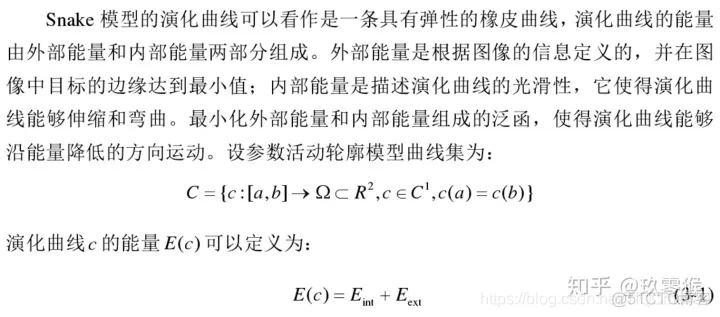
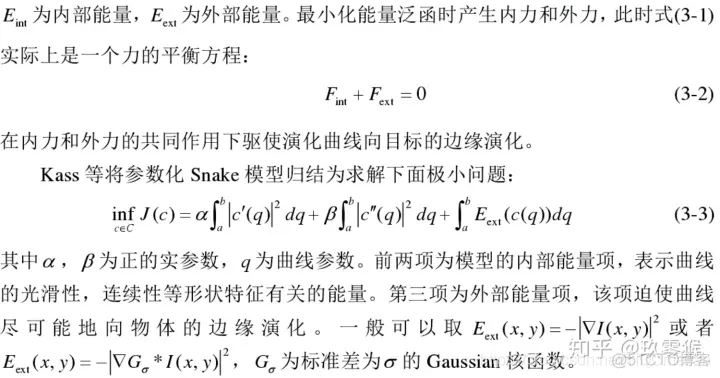
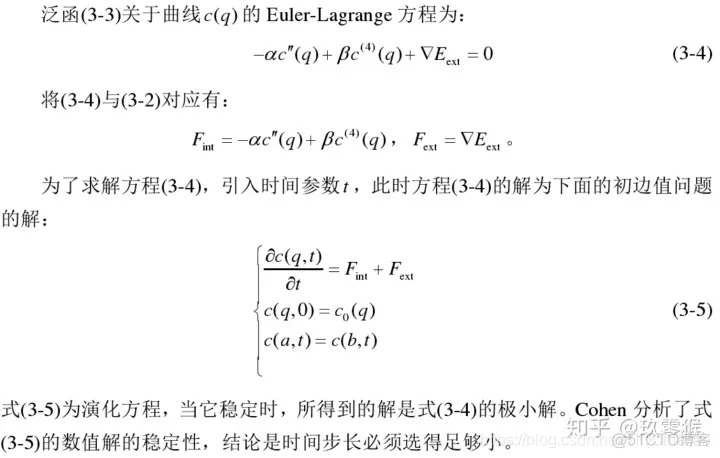
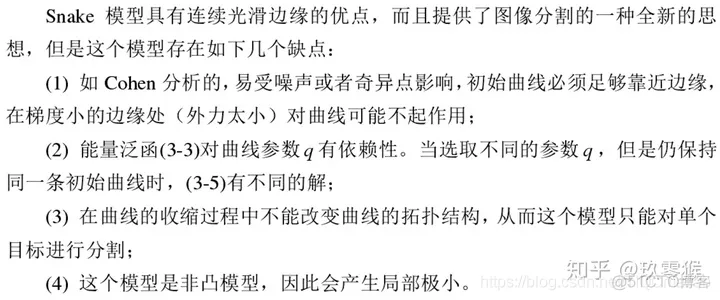
2 原理解释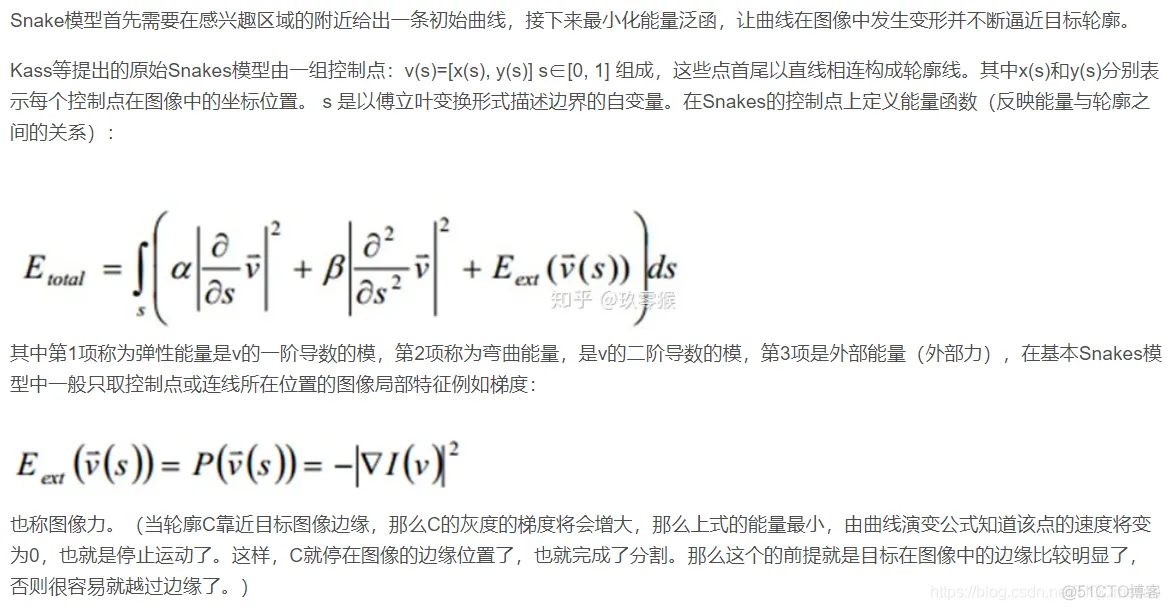
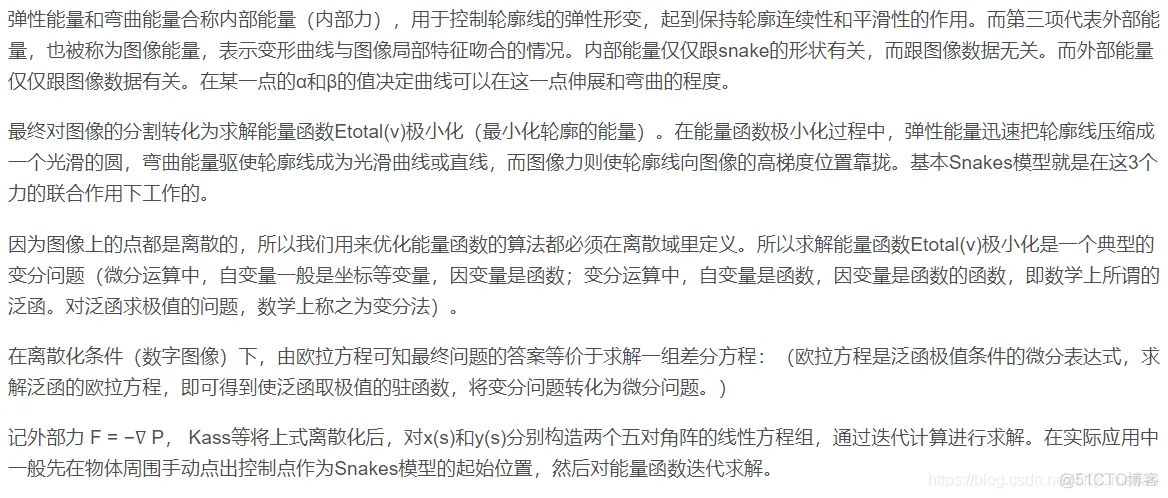
二、源代码
clear all;
close all;
Img = imread('twocells.bmp');  % The same cell image in the paper is used here
Img=double(Img(:,:,1));
sigma=1.5;    % scale parameter in Gaussian kernel for smoothing.
G=fspecial('gaussian',15,sigma);
Img_smooth=conv2(Img,G,'same');  % smooth image by Gaussiin convolution
[Ix,Iy]=gradient(Img_smooth);
f=Ix.^2+Iy.^2;
g=1./(1+f);  % edge indicator function.

epsilon=1.5; % the papramater in the definition of smoothed Dirac function

timestep=5;  % time step
mu=0.2/timestep;  % coefficient of the internal (penalizing) energy term P(\phi)
          % Note: the product timestep*mu must be less than 0.25 for stability!
lambda=5; % coefficient of the weighted length term L(\phi)
alf=1.5;  % coefficient of the weighted area term A(\phi);
          % Note: Choose smaller value for weak object bounday, such as the cell image in this demo.


% define initial level set function (LSF) as -c, 0, c at points outside, on
% the boundary, and inside of a region R, respectively.
[nrow, ncol]=size(Img);
c0=4;
initialLSF=c0*ones(nrow,ncol);
w=8;
initialLSF(w+1:end-w, w+1:end-w)=0;  % zero level set is on the boundary of R.
                                     % Note: this can be commented out. The intial LSF does NOT necessarily need a zero level set.

initialLSF(w+2:end-w-1, w+2: end-w-1)=-c0; % negative constant -c inside of R, postive constant c outside of R.
u=initialLSF;
figure;imagesc(Img);colormap(gray);hold on;
[c,h] = contour(u,[0 0],'r');
title('Initial contour');

% start level set evolution
for n=1:300
    u=EVOLUTION(u, g ,lambda, mu, alf, epsilon, timestep, 1);
    pause(0.001);
    if mod(n,20)==0
        imagesc(Img);colormap(gray);hold on;
        [c,h] = contour(u,[0 0],'r');
        iterNum=[num2str(n), ' iterations'];
        title(iterNum);
        hold off;
    end
end
% define initial level set function (LSF) as -c, 0, c at points outside, on
% the boundary, and inside of a region R, respectively.
[nrow, ncol]=size(Img);
c=4;
initialLSF=c*ones(nrow,ncol);
w=10;
initialLSF(w+1:end-w, w+1:end-w)=0;  % zero level set is on the boundary of R.
                                     % Note: this can be commented out. The intial LSF does NOT necessarily need a zero level set.

initialLSF(w+2:end-w-1, w+2: end-w-1)=-c; % negative constant -c inside of R, postive constant c outside of R.
u=initialLSF;
figure;imagesc(Img, [0, 255]);colormap(gray);hold on;
[c,h] = contour(u,[0 0],'r');
title('Initial contour');


% start level set evolution
for n=1:500
    u=EVOLUTION(u, g ,lambda, mu, alf, epsilon, timestep, 1);
    pause(0.001);
    if mod(n,20)==0
        imagesc(Img, [0, 255]);colormap(gray);hold on;
        [c,h] = contour(u,[0 0],'r');
        iterNum=[num2str(n), ' iterations'];
        title(iterNum);
        hold off;
    end
end- 1.
- 2.
- 3.
- 4.
- 5.
- 6.
- 7.
- 8.
- 9.
- 10.
- 11.
- 12.
- 13.
- 14.
- 15.
- 16.
- 17.
- 18.
- 19.
- 20.
- 21.
- 22.
- 23.
- 24.
- 25.
- 26.
- 27.
- 28.
- 29.
- 30.
- 31.
- 32.
- 33.
- 34.
- 35.
- 36.
- 37.
- 38.
- 39.
- 40.
- 41.
- 42.
- 43.
- 44.
- 45.
- 46.
- 47.
- 48.
- 49.
- 50.
- 51.
- 52.
- 53.
- 54.
- 55.
- 56.
- 57.
- 58.
- 59.
- 60.
- 61.
- 62.
- 63.
- 64.
- 65.
- 66.
- 67.
- 68.
- 69.
- 70.
- 71.
- 72.
- 73.
- 74.
- 75.
- 76.
- 77.
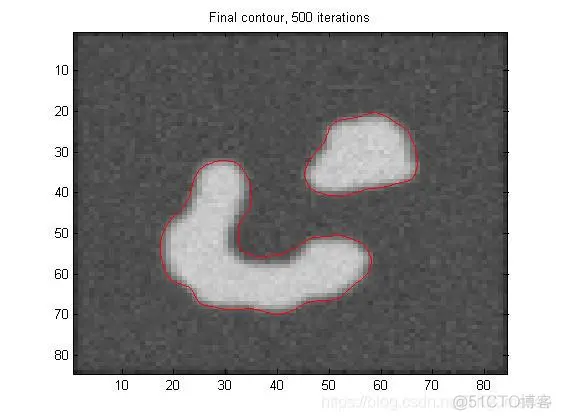
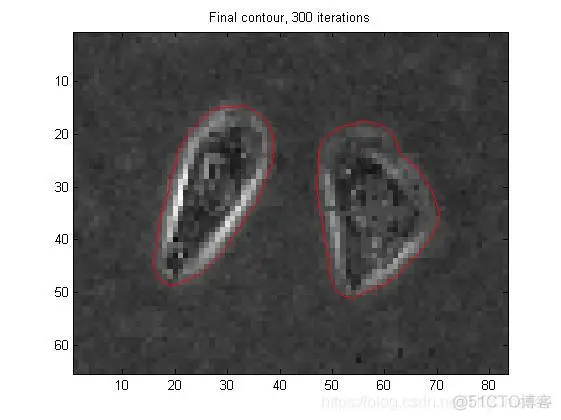
三、运行结果





 扫一扫
扫一扫


 177
177

 被折叠的 条评论
为什么被折叠?
被折叠的 条评论
为什么被折叠?
 到【灌水乐园】发言





