


 该论文系列关注于手写数学表达式识别(HMER)的任务,提出了将DenseNet与多尺度注意力模型结合的方法,以改善细小符号如小数点的识别。核心模型包括多尺度注意力编码器,它利用GRU和覆盖注意力机制来处理特征。实验表明,增加DenseBlock的深度可以提高识别性能,并与其他模型相比表现出优势。
HMER论文系列
1、论文阅读和分析:When Counting Meets HMER Counting-Aware Network for HMER_KPer_Yang的博客-优快云博客
2、论文阅读和分析:Syntax-Aware Network for Handwritten Mathematical Expression Recognition_KPer_Yang的博客-优快云博客
3、论文阅读和分析:A Tree-Structured Decoder for Image-to-Markup Generation_KPer_Yang的博客-优快云博客
4、 论文阅读和分析:Watch, attend and parse An end-to-end neural network based approach to HMER_KPer_Yang的博客-优快云博客
5、 论文阅读和分析:Multi-Scale Attention with Dense Encoder for Handwritten Mathematical Expression Recognition_KPer_Yang的博客-优快云博客
6、 论文阅读和分析:Mathematical formula recognition using graph grammar_KPer_Yang的博客-优快云博客
7、 论文阅读和分析:Hybrid Mathematical Symbol Recognition using Support Vector Machines_KPer_Yang的博客-优快云博客
8、论文阅读和分析:HMM-BASED HANDWRITTEN SYMBOL RECOGNITION USING ON-LINE AND OFF-LINE FEATURES_KPer_Yang的博客-优快云博客
主要工作:
1、将当时比较火的DenseNet用到HMER任务中;
2、使用多尺度注意力模型,通过将高分辨率、低语义的特征和低分辨率、高语义特征相融合,识别出细小符号,例如小数点;
核心模型实现:
1、多尺度注意力编码器:
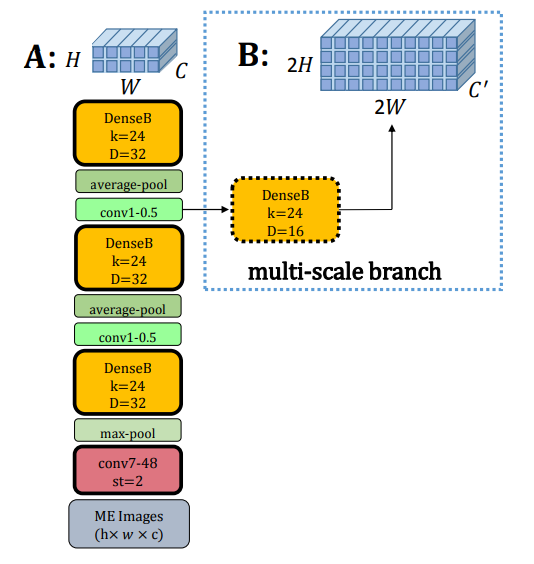
k:growth rate
D:(number of convolution layers) of each block:
for example:D = 32 which means each block has 16 1 × 1 convolution layers and 16 3 × 3 convolution layers.(A batch normalization layer [24] and a ReLU activation layer [25] are performed after each convolution layer consecutively)
流程:
(1)先从正常的DenseNet中,第一个池化层分出,进行DenseB的处理得到B: B ∈ R 2 H × 2 W × C ′ \mathbf{B}\in \mathbb{R} ^{2H \times 2W \times C^{'}} B∈R2H×2W×C′.
(2)GRU计算t步的s hat;
s ^ t = G R U ( y t − 1 , s t − 1 ) \mathbf{\hat{s}}_t=GRU\left(\mathbf{y}_{t-1},\mathbf{s}_{t-1}\right) s^t=GRU(yt−1,st−1)
(3)计算A和B的a single-scale coverage based attention model.
c A t = f c a t t ( A , s ^ t ) c B t = f c a t t ( B , s ^ t ) \mathbf{c}\mathbf{A}_{t}=f_{\mathrm{catt}}\left(\mathbf{A},\mathbf{\hat{s}}_{t}\right)\\ \mathbf{cB}_{t}=f_{
{\mathrm{catt}}}\left(\mathbf{B},\mathbf{\hat{\mathbf{s}}}_{t}\right) cAt=fcatt(A,s^t)cBt=fcatt(B,
 最低0.47元/天 解锁文章






 扫一扫
扫一扫


 1203
1203

 被折叠的 条评论
为什么被折叠?
被折叠的 条评论
为什么被折叠?
 到【灌水乐园】发言





