 AVL树构建与旋转详解



PAT甲级1066
题目:
An AVL tree is a self-balancing binary search tree. In an AVL tree, the heights of the two child subtrees of any node differ by at most one; if at any time they differ by more than one, rebalancing is done to restore this property. Figures 1-4 illustrate the rotation rules.
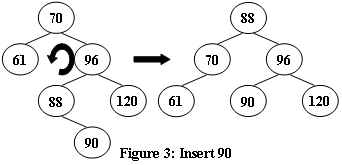
Now given a sequence of insertions, you are supposed to tell the root of the resulting AVL tree.
Input Specification:
Each input file contains one test case. For each case, the first line contains a positive integer N (≤20) which is the total number of keys to be inserted. Then N distinct integer keys are given in the next line. All the numbers in a line are separated by a space.
Output Specification:
For each test case, print the root of the resulting AVL tree in one line.
Sample Input 1:
5
88 70 61 96 120
Sample Output 1:
70
Sample Input 2:
7
88 70 61 96 120 90 65
Sample Output 2:
88
题目大意:给出一组数据,建立AVL,打印最终的根节点
简单的建AVL过程,注意左旋右旋以及插入功能里要传入引用
#include <iostream>
#include <vector>
using namespace std;

struct node{
	int data,height;
	node *left,*right;
};
typedef node* Node;
int getHeight(Node root){	//获得当前节点高度
	if(root==NULL) return 0;
	return root->height;
}
int getBalanceFactor(Node root){	//获取平衡因子
	return getHeight(root->left)-getHeight(root->right);
}
void updateHeight(Node root){	//更新树高
	root->height=max(getHeight(root->left),getHeight(root->right))+1;
}
void leftRotation(Node &root){	//左旋
	Node tmp=root->right;
	root->right=tmp->left;
	tmp->left=root;
	updateHeight(root);
	updateHeight(tmp);
	root=tmp;
}
void rightRotation(Node &root){	//右旋
	Node tmp=root->left;
	root->left=tmp->right;
	tmp->right=root;
	updateHeight(root);
	updateHeight(tmp);
	root=tmp;
}
Node newNode(int data){
	Node root=new node;
	root->data=data,root->height=1;
	root->left=root->right=NULL;
	return root;
}
void insert(Node &root,int data){
	if(root==NULL){
		root=newNode(data);
		return ;
	}
	if(data<root->data){
		insert(root->left,data);
		updateHeight(root);
		if(getBalanceFactor(root)==2){	//若在左子树中插入节点使得整棵树不平衡
			if(getBalanceFactor(root->left)==1){	//在左子树的左子树中插入节点不平衡,LL型
				rightRotation(root);
			}else if(getBalanceFactor(root->left)==-1){	//在左子树的右子树中插入节点不平衡,LR型
				leftRotation(root->left);
				rightRotation(root);
			}
		}
	}else{
		insert(root->right,data);
		updateHeight(root);
		if(getBalanceFactor(root)==-2){	//若在右子树中插入节点使得整棵树不平衡
			if(getBalanceFactor(root->right)==-1){	//在右子树的右子树中插入节点不平衡,RR型
				leftRotation(root);
			}else if(getBalanceFactor(root->right)==1){	//在右子树的左子树中插入节点不平衡,RL型
				rightRotation(root->right);
				leftRotation(root);
			}
		}
	}
}
int main(){
	int n,tmp;
	scanf("%d",&n);
	Node root=NULL;
	for(int i=0;i<n;i++){
		scanf("%d",&tmp);
		insert(root,tmp);
	}
	printf("%d",root->data);
	system("pause");
	return 0;
}





 扫一扫
扫一扫


 1339
1339

 被折叠的 条评论
为什么被折叠?
被折叠的 条评论
为什么被折叠?
 到【灌水乐园】发言





