



这里写自定义目录标题
今天复习的是运算符的重载,运算符的重载可以使我们自定义的类型更像是一个内置类型,可以便捷的使用 +,-,*,/,++,–,<<,>>等符号直接进行操作。
我实现的是一个复数类型的重载
Complex.h 里边是复数类的函数声明
#pragma once
#include<iostream>
class Complex
{
public:
	Complex(): _real(0.0),_virtual(0.0) {  };   //构造函数


	Complex(double r, double i) : _real(r), _virtual(i) //构造函数
	{
		std::cout << "构造函数被调用" << std::endl;

	}
	Complex(const Complex& other):_real(other._real),_virtual(other._virtual) //拷贝构造函数
	{
	  std::cout << "拷贝构造函数被调用"<<std::endl;
	}
	Complex(Complex&& other)noexcept :_real(other._real), _virtual(other._virtual) //移动拷贝构造函数
	{
		std::cout << "移动拷贝构造函数被调用" << std::endl;
	}

	virtual ~Complex() {
		std::cout << "析构函数被调用" << std::endl;
	}


	double get_real()const;  //访问实部
	void set_real(double x);//设置实部
	double get_virtual()const; //访问虚部
	void set_virtual(double y); //设置虚部
	void print_complex()const;  //打印函数

	//运算符重载
	//返回类型 operator 运算符符号 (参数列表)
	// {
	//	// 运算符实现
	//  }
	//注意 函数声明后边带 const 表示不改变函数的成员变量
	Complex operator + (const Complex& x)const;  //重载+
	Complex operator - (const Complex& x)const;  //重载-
	Complex operator * (const Complex& x)const;  //重载*
	Complex operator / (const Complex& x)const;  //重载/
	Complex& operator = (const Complex& x); //重载=
	Complex& operator ++ ();  //前置
	Complex operator ++(int);//后置++
	Complex& operator -- ();//前置--
	Complex operator --(int);//后置--


	friend std::ostream & operator << (std::ostream & os, const Complex& x);  //友元函数  使用ostream 重载 <<
	friend std::istream& operator >> (std::istream& is, Complex& x);    //友元函数  使用istream 重载 <<
private:
	double _real;
	double _virtual;

};
Complex.cpp
#include "Complex.h"
#include<iostream>


double Complex::get_real()const { return _real; }
void Complex::set_real(double x) { _real = x; }
double Complex::get_virtual()const { return _virtual; }
void Complex::set_virtual(double y) { _virtual = y; }

void Complex::print_complex() const{ std::cout << _real << "+" << _virtual<<"i"<<std::endl; }


Complex Complex:: operator + (const Complex& x) const { return Complex(_real+x.get_real() , _virtual+x.get_virtual() ); }
Complex Complex:: operator - (const Complex& x)const{ return Complex(_real - x.get_real(), _virtual - x.get_virtual()); }
//复数*运算公式   (a + bi)(c + di) = (ac - bd) + (ad + bc)i
Complex Complex:: operator * (const Complex& x)const{

	return Complex(_real * x._real- _virtual * x._virtual,_real*x. _virtual +_virtual* x._real);
}

//复数的除法公式 (a + bi) / (c + di) = [(ac + bd) + (bc - ad)i] / (c² + d²),确保分母不为零。
Complex Complex:: operator / (const Complex& x)const {
	double denominator = x._real * x._real + x._virtual * x._virtual;
	if (denominator == 0) {
		std::cerr << "Error: Division by zero!" << std::endl;
		return Complex(_real,_virtual);
	}
	return Complex((_real * x._real + _virtual * x._virtual)/denominator, (_virtual * x._real - _real * x._virtual)/denominator);
}

//  每一个对象都有一个this指针,通过*this可以返回当前对象,这样可以不用出现临时对象
Complex& Complex::operator = (const Complex& x) {
	if(this != &x)
	{
	_real = x._real;
	_virtual = x._virtual;}
	return *this;
}


Complex& Complex::operator ++ ()//前置++ ++a
{
	_real++;
	_virtual++;
	return *this;
}
//Complex Complex::operator ++(int)//后置++  a++
//{
//	Complex tmp(*this);
//	_real++;
//	_virtual++;
//	return tmp;
//}

Complex Complex::operator ++(int)//后置++  a++
{
	return Complex(_real++,_virtual++);
}

Complex& Complex::operator -- ()//前置++ ++a
{
	_real--;
	_virtual--;
	return *this;
}

Complex Complex::operator --(int)//后置++  a++
{
	return Complex(_real--, _virtual--);
}

std::ostream& operator<<(std::ostream& os, const Complex& x)
{
	os << x._real;

	if (x._virtual >= 0) {
		os << " + " << x._virtual << "i";
	}
	else {
		os << " - " << -x._virtual << "i";
	}
	return os;
}
std::istream& operator >> (std::istream& is, Complex& x)
{
	is >> x._real >> x._virtual;
	return is;
}
test.cpp
#include"Complex.h"
#include<iostream>
using namespace std;

int main()
{
	 Complex a(1.0, 2.0);
	 a.print_complex() ;
	Complex c = a + a;
	c.print_complex();
	Complex d = c - a;
	d.print_complex();
	Complex e = a * a;
	e.print_complex();
	Complex f = a / a;
	f.print_complex();
	Complex g(a);
	g.print_complex();

	d = a++;
	d.print_complex();
	a.print_complex();
	e = ++a;
	e.print_complex();
	a.print_complex();
	cout << a << endl;
	cin >>e;
	cout << e << endl;
	return 0;
}
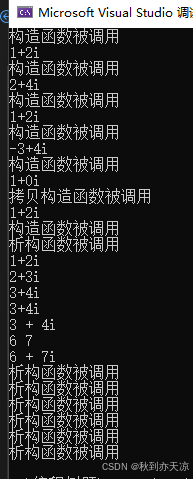 如果我的后置++定义为
Complex Complex::operator ++(int)//后置++  a++
{
	Complex tmp(*this);
	_real++;
	_virtual++;
	return tmp;
}

这个涉及到 拷贝构造函数和移动拷贝构造函数,可以去我前边的文章看–》》拷贝构造和移动拷贝构造





 扫一扫
扫一扫


 453
453

 被折叠的 条评论
为什么被折叠?
被折叠的 条评论
为什么被折叠?
 到【灌水乐园】发言





