



下载源代码:https://github.com/facebookresearch/dino
onnxruntime部署
pytorch推理和onnx模型导出:
from PIL import Image
import torch
from torchvision.transforms import v2


def make_transform(resize_size: int | list[int] = 768):
    resize = v2.Resize(256, interpolation=3)
    centercrop=v2.CenterCrop(224)
    to_tensor = v2.ToTensor()
    normalize = v2.Normalize(
        mean=(0.485, 0.456, 0.406),
        std=(0.229, 0.224, 0.225),
    )
    return v2.Compose([resize, centercrop, to_tensor , normalize])

class LinearClassifier(torch.nn.Module):
    """Linear layer to train on top of frozen features"""
    def __init__(self, dim, num_labels=1000):
        super(LinearClassifier, self).__init__()
        self.num_labels = num_labels
        self.linear = torch.nn.Linear(dim, num_labels)
        self.linear.weight.data.normal_(mean=0.0, std=0.01)
        self.linear.bias.data.zero_()

    def forward(self, x):
        # flatten
        x = x.view(x.size(0), -1)

        # linear layer
        return self.linear(x)

class DinoClassifier(torch.nn.Module):
    def __init__(self, dino_model, linear_classifier):
        super().__init__()
        self.dino = dino_model
        self.classifier = linear_classifier

    def forward(self, x):
        intermediate_output = self.dino.get_intermediate_layers(x, 4)
        features = torch.cat([out[:, 0] for out in intermediate_output], dim=-1)
        return self.classifier(features)

model = torch.hub.load('./dino-main', 'dino_vits16', source="local")
transform = make_transform()
img = Image.open('bus.jpg')
batch_img = transform(img)[None]
intermediate_output = model.get_intermediate_layers(batch_img, 4)
output = torch.cat([x[:, 0] for x in intermediate_output], dim=-1)
linear_classifier = LinearClassifier(dim=1536, num_labels=1000)
state_dict = torch.load("dino_deitsmall16_linearweights.pth")["state_dict"]
new_state_dict = {}
for k, v in state_dict.items():
    new_key = k.replace("module.", "")
    new_state_dict[new_key] = v
linear_classifier.load_state_dict(new_state_dict, strict=False)
output = linear_classifier(output)
print(torch.argmax(output.squeeze(0)))

combined_model = DinoClassifier(model, linear_classifier)
torch.onnx.export(combined_model, batch_img, "dino.onnx", opset_version=15)
bus.jpg如下

输出结果是636。
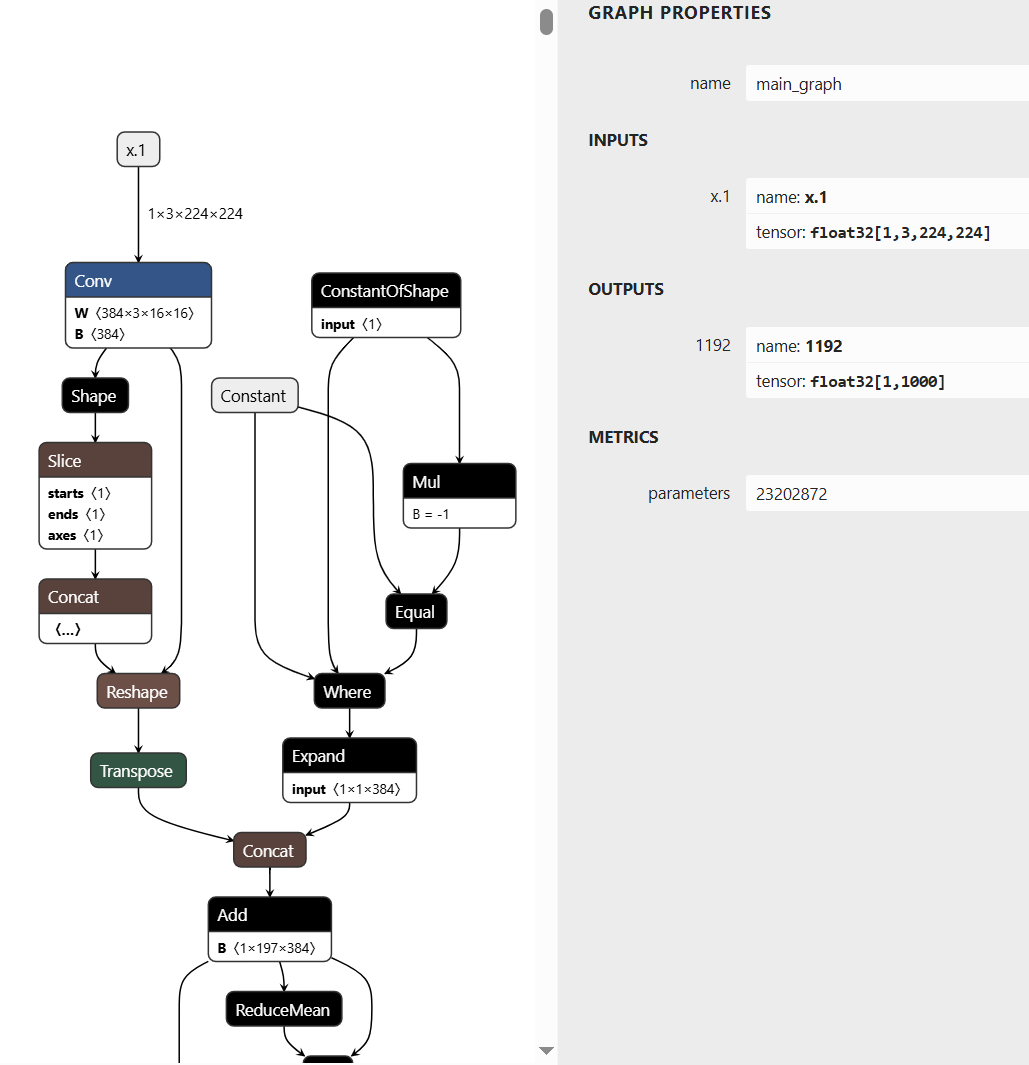
导出onnx模型结构如下:
onnxruntime推理脚本:
import cv2
import numpy as np
import onnxruntime


img = cv2.imread('bus.jpg', cv2.COLOR_BGR2RGB)
resized = cv2.resize(img, (256, 256), interpolation=cv2.INTER_CUBIC)

h, w = resized.shape[:2]
crop_size = 224
start_h = (h - crop_size) // 2
start_w = (w - crop_size) // 2
cropped = resized[start_h:start_h+crop_size, start_w:start_w+crop_size]

normalized = cropped.astype(np.float32) / 255.0
mean = np.array([0.485, 0.456, 0.406]).astype(np.float32)
std = np.array([0.229, 0.224, 0.225]).astype(np.float32)
normalized = (normalized - mean) / std

onnx_session = onnxruntime.InferenceSession("dino.onnx", providers=['CPUExecutionProvider'])
inputs = {}
inputs['x.1'] = normalized.transpose(2, 0, 1)[np.newaxis, :]
outputs = onnx_session.run(None, inputs)
print(np.argmax(outputs[0].squeeze(0)))
tensorrt部署
import cv2
import numpy as np
import tensorrt as trt
import common


img = cv2.imread('bus.jpg', cv2.COLOR_BGR2RGB)
resized = cv2.resize(img, (256, 256), interpolation=cv2.INTER_CUBIC)

h, w = resized.shape[:2]
crop_size = 224
start_h = (h - crop_size) // 2
start_w = (w - crop_size) // 2
cropped = resized[start_h:start_h+crop_size, start_w:start_w+crop_size]

normalized = cropped.astype(np.float32) / 255.0
mean = np.array([0.485, 0.456, 0.406]).astype(np.float32)
std = np.array([0.229, 0.224, 0.225]).astype(np.float32)
normalized = (normalized - mean) / std

logger = trt.Logger(trt.Logger.WARNING)
trt.init_libnvinfer_plugins(logger, "")
with open("dino.engine", "rb") as f, trt.Runtime(logger) as runtime:
    engine = runtime.deserialize_cuda_engine(f.read())
context = engine.create_execution_context()
inputs, outputs, bindings, stream = common.allocate_buffers(engine)

np.copyto(inputs[0].host, normalized.transpose(2, 0, 1).ravel())
output = common.do_inference(context,engine=engine, bindings=bindings, inputs=inputs, outputs=outputs, stream=stream)
print(np.argmax(output[0]))
common.py
#
# SPDX-FileCopyrightText: Copyright (c) 1993-2023 NVIDIA CORPORATION & AFFILIATES. All rights reserved.
# SPDX-License-Identifier: Apache-2.0
#
# Licensed under the Apache License, Version 2.0 (the "License");
# you may not use this file except in compliance with the License.
# You may obtain a copy of the License at
#
# http://www.apache.org/licenses/LICENSE-2.0
#
# Unless required by applicable law or agreed to in writing, software
# distributed under the License is distributed on an "AS IS" BASIS,
# WITHOUT WARRANTIES OR CONDITIONS OF ANY KIND, either express or implied.
# See the License for the specific language governing permissions and
# limitations under the License.
#

import argparse
import os
import ctypes
from typing import Optional, List

import numpy as np
import tensorrt as trt
from cuda import cuda, cudart

try:
    # Sometimes python does not understand FileNotFoundError
    FileNotFoundError
except NameError:
    FileNotFoundError = IOError

EXPLICIT_BATCH = 1 << (int)(trt.NetworkDefinitionCreationFlag.EXPLICIT_BATCH)

def check_cuda_err(err):
    if isinstance(err, cuda.CUresult):
        if err != cuda.CUresult.CUDA_SUCCESS:
            raise RuntimeError("Cuda Error: {}".format(err))
    if isinstance(err, cudart.cudaError_t):
        if err != cudart.cudaError_t.cudaSuccess:
            raise RuntimeError("Cuda Runtime Error: {}".format(err))
    else:
        raise RuntimeError("Unknown error type: {}".format(err))

def cuda_call(call):
    err, res = call[0], call[1:]
    check_cuda_err(err)
    if len(res) == 1:
        res = res[0]
    return res

def GiB(val):
    return val * 1 << 30


def add_help(description):
    parser = argparse.ArgumentParser(description=description, formatter_class=argparse.ArgumentDefaultsHelpFormatter)
    args, _ = parser.parse_known_args()


def find_sample_data(description="Runs a TensorRT Python sample", subfolder="", find_files=[], err_msg=""):
    """
    Parses sample arguments.

    Args:
        description (str): Description of the sample.
        subfolder (str): The subfolder containing data relevant to this sample
        find_files (str): A list of filenames to find. Each filename will be replaced with an absolute path.

    Returns:
        str: Path of data directory.
    """

    # Standard command-line arguments for all samples.
    kDEFAULT_DATA_ROOT = os.path.join(os.sep, "usr", "src", "tensorrt", "data")
    parser = argparse.ArgumentParser(description=description, formatter_class=argparse.ArgumentDefaultsHelpFormatter)
    parser.add_argument(
        "-d",
        "--datadir",
        help="Location of the TensorRT sample data directory, and any additional data directories.",
        action="append",
        default=[kDEFAULT_DATA_ROOT],
    )
    args, _ = parser.parse_known_args()

    def get_data_path(data_dir):
        # If the subfolder exists, append it to the path, otherwise use the provided path as-is.
        data_path = os.path.join(data_dir, subfolder)
        if not os.path.exists(data_path):
            if data_dir != kDEFAULT_DATA_ROOT:
                print("WARNING: " + data_path + " does not exist. Trying " + data_dir + " instead.")
            data_path = data_dir
        # Make sure data directory exists.
        if not (os.path.exists(data_path)) and data_dir != kDEFAULT_DATA_ROOT:
            print(
                "WARNING: {:} does not exist. Please provide the correct data path with the -d option.".format(
                    data_path
                )
            )
        return data_path

    data_paths = [get_data_path(data_dir) for data_dir in args.datadir]
    return data_paths, locate_files(data_paths, find_files, err_msg)


def locate_files(data_paths, filenames, err_msg=""):
    """
    Locates the specified files in the specified data directories.
    If a file exists in multiple data directories, the first directory is used.

    Args:
        data_paths (List[str]): The data directories.
        filename (List[str]): The names of the files to find.

    Returns:
        List[str]: The absolute paths of the files.

    Raises:
        FileNotFoundError if a file could not be located.
    """
    found_files = [None] * len(filenames)
    for data_path in data_paths:
        # Find all requested files.
        for index, (found, filename) in enumerate(zip(found_files, filenames)):
            if not found:
                file_path = os.path.abspath(os.path.join(data_path, filename))
                if os.path.exists(file_path):
                    found_files[index] = file_path

    # Check that all files were found
    for f, filename in zip(found_files, filenames):
        if not f or not os.path.exists(f):
            raise FileNotFoundError(
                "Could not find {:}. Searched in data paths: {:}\n{:}".format(filename, data_paths, err_msg)
            )
    return found_files


class HostDeviceMem:
    """Pair of host and device memory, where the host memory is wrapped in a numpy array"""
    def __init__(self, size: int, dtype: np.dtype):
        nbytes = size * dtype.itemsize
        host_mem = cuda_call(cudart.cudaMallocHost(nbytes))
        pointer_type = ctypes.POINTER(np.ctypeslib.as_ctypes_type(dtype))

        self._host = np.ctypeslib.as_array(ctypes.cast(host_mem, pointer_type), (size,))
        self._device = cuda_call(cudart.cudaMalloc(nbytes))
        self._nbytes = nbytes

    @property
    def host(self) -> np.ndarray:
        return self._host

    @host.setter
    def host(self, arr: np.ndarray):
        if arr.size > self.host.size:
            raise ValueError(
                f"Tried to fit an array of size {arr.size} into host memory of size {self.host.size}"
            )
        np.copyto(self.host[:arr.size], arr.flat, casting='safe')

    @property
    def device(self) -> int:
        return self._device

    @property
    def nbytes(self) -> int:
        return self._nbytes

    def __str__(self):
        return f"Host:\n{self.host}\nDevice:\n{self.device}\nSize:\n{self.nbytes}\n"

    def __repr__(self):
        return self.__str__()

    def free(self):
        cuda_call(cudart.cudaFree(self.device))
        cuda_call(cudart.cudaFreeHost(self.host.ctypes.data))


# Allocates all buffers required for an engine, i.e. host/device inputs/outputs.
# If engine uses dynamic shapes, specify a profile to find the maximum input & output size.
def allocate_buffers(engine: trt.ICudaEngine, profile_idx: Optional[int] = None):
    inputs = []
    outputs = []
    bindings = []
    stream = cuda_call(cudart.cudaStreamCreate())
    tensor_names = [engine.get_tensor_name(i) for i in range(engine.num_io_tensors)]
    for binding in tensor_names:
        # get_tensor_profile_shape returns (min_shape, optimal_shape, max_shape)
        # Pick out the max shape to allocate enough memory for the binding.
        shape = engine.get_tensor_shape(binding) if profile_idx is None else engine.get_tensor_profile_shape(binding, profile_idx)[-1]
        shape_valid = np.all([s >= 0 for s in shape])
        if not shape_valid and profile_idx is None:
            raise ValueError(f"Binding {binding} has dynamic shape, " +\
                "but no profile was specified.")
        size = trt.volume(shape)
        if engine.has_implicit_batch_dimension:
            size *= engine.max_batch_size
        dtype = np.dtype(trt.nptype(engine.get_tensor_dtype(binding)))

        # Allocate host and device buffers
        bindingMemory = HostDeviceMem(size, dtype)

        # Append the device buffer to device bindings.
        bindings.append(int(bindingMemory.device))

        # Append to the appropriate list.
        if engine.get_tensor_mode(binding) == trt.TensorIOMode.INPUT:
            inputs.append(bindingMemory)
        else:
            outputs.append(bindingMemory)
    return inputs, outputs, bindings, stream


# Frees the resources allocated in allocate_buffers
def free_buffers(inputs: List[HostDeviceMem], outputs: List[HostDeviceMem], stream: cudart.cudaStream_t):
    for mem in inputs + outputs:
        mem.free()
    cuda_call(cudart.cudaStreamDestroy(stream))


# Wrapper for cudaMemcpy which infers copy size and does error checking
def memcpy_host_to_device(device_ptr: int, host_arr: np.ndarray):
    nbytes = host_arr.size * host_arr.itemsize
    cuda_call(cudart.cudaMemcpy(device_ptr, host_arr, nbytes, cudart.cudaMemcpyKind.cudaMemcpyHostToDevice))


# Wrapper for cudaMemcpy which infers copy size and does error checking
def memcpy_device_to_host(host_arr: np.ndarray, device_ptr: int):
    nbytes = host_arr.size * host_arr.itemsize
    cuda_call(cudart.cudaMemcpy(host_arr, device_ptr, nbytes, cudart.cudaMemcpyKind.cudaMemcpyDeviceToHost))


def _do_inference_base(inputs, outputs, stream, execute_async):
    # Transfer input data to the GPU.
    kind = cudart.cudaMemcpyKind.cudaMemcpyHostToDevice
    [cuda_call(cudart.cudaMemcpyAsync(inp.device, inp.host, inp.nbytes, kind, stream)) for inp in inputs]
    # Run inference.
    execute_async()
    # Transfer predictions back from the GPU.
    kind = cudart.cudaMemcpyKind.cudaMemcpyDeviceToHost
    [cuda_call(cudart.cudaMemcpyAsync(out.host, out.device, out.nbytes, kind, stream)) for out in outputs]
    # Synchronize the stream
    cuda_call(cudart.cudaStreamSynchronize(stream))
    # Return only the host outputs.
    return [out.host for out in outputs]


def do_inference(context, engine, bindings, inputs, outputs, stream):
    def execute_async_func():
        context.execute_async_v3(stream_handle=stream)
    # Setup context tensor address.
    num_io = engine.num_io_tensors
    for i in range(num_io):
        context.set_tensor_address(engine.get_tensor_name(i), bindings[i])
    return _do_inference_base(inputs, outputs, stream, execute_async_func)






 扫一扫
扫一扫


 937
937

 被折叠的 条评论
为什么被折叠?
被折叠的 条评论
为什么被折叠?
 到【灌水乐园】发言





