


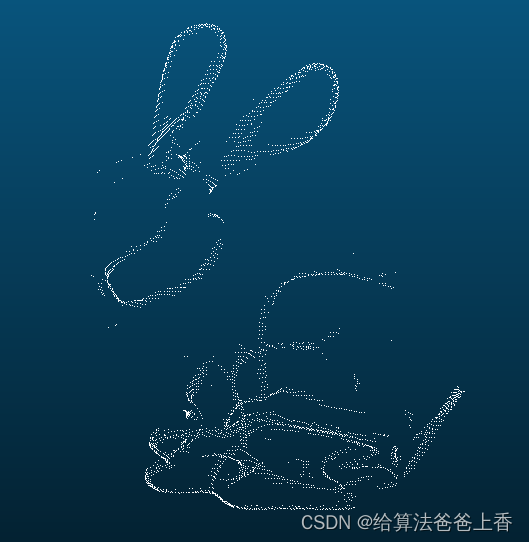
 该代码示例展示了如何使用PCL库进行点云处理,包括法线估计、基于曲率的点云采样和滤波。首先,通过KdTree进行最近邻搜索,然后计算每个点的法线。接着,结合点云和法线信息,按曲率排序并按比例采样得到新的点云。最后,保存采样后的点云数据。
#include <iostream>
#include <pcl/io/pcd_io.h>
#include <pcl/point_types.h>
#include <pcl/features/normal_3d.h>


/**
 * @description:			法线采样
 * @param cloud				输入点云
 * @param cloud_filtered	滤波点云
 * @param sample_ratio		采样比例
 */
void normalspacesample(pcl::PointCloud<pcl::PointXYZ>::Ptr& cloud, pcl::PointCloud<pcl::PointXYZ>::Ptr& cloud_filtered, int k, float sample_ratio)
{
	pcl::search::KdTree<pcl::PointXYZ>::Ptr tree(new pcl::search::KdTree<pcl::PointXYZ>);   //创建用于最近邻搜索的KD-Tree
	pcl::PointCloud<pcl::Normal>::Ptr cloud_normals(new pcl::PointCloud<pcl::Normal>);		//存储输出数据
	pcl::NormalEstimation<pcl::PointXYZ, pcl::Normal> normalEstimation;						//创建法线估计向量
	normalEstimation.setInputCloud(cloud);													//输入点云
	normalEstimation.setKSearch(k);															//使用当前点周围最近的个数
	normalEstimation.compute(*cloud_normals);												//计算法线

	//通过concatenateFields函数将point和normal组合起来形成PointNormal点云数据
	pcl::PointCloud<pcl::PointNormal>::Ptr cloud_with_normal(new pcl::PointCloud<pcl::PointNormal>);
	pcl::concatenateFields(*cloud, *cloud_normals, *cloud_with_normal);

	std::sort(cloud_with_normal->begin(), cloud_with_normal->end(), [](pcl::PointNormal pt1, pcl::PointNormal pt2) {return pt1.curvature>pt2.curvature; });
	for (size_t i = 0; i < sample_ratio*cloud->size(); i++)
	{
		cloud_filtered->push_back(pcl::PointXYZ(cloud_with_normal->points[i].x, cloud_with_normal->points[i].y, cloud_with_normal->points[i].z));
	}
}


int main(int argc, char* argv[])
{
	pcl::PointCloud<pcl::PointXYZ>::Ptr cloud(new pcl::PointCloud<pcl::PointXYZ>);
	pcl::PointCloud<pcl::PointXYZ>::Ptr cloud_filtered(new pcl::PointCloud<pcl::PointXYZ>);
	pcl::io::loadPCDFile("rabbit.pcd", *cloud);

	normalspacesample(cloud, cloud_filtered, 10, 0.1f);
	pcl::io::savePCDFile("mynormalspacesample.pcd", *cloud_filtered);

	return EXIT_SUCCESS;
}
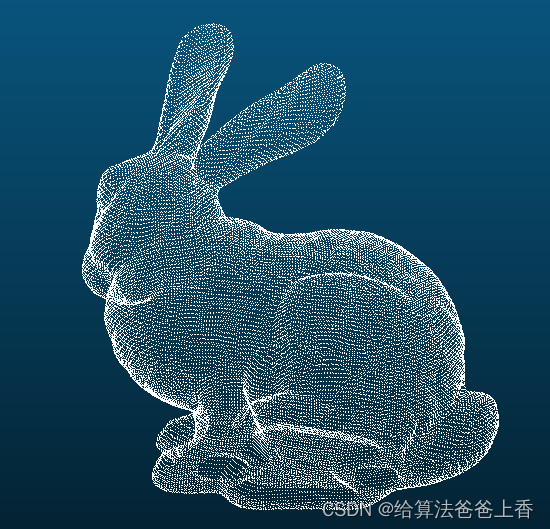
原始点云:
法线空间采样得到的点云:





 扫一扫
扫一扫


 765
765


 到【灌水乐园】发言



