


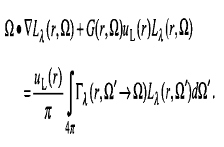
Green Function
1.Green function for ODE
Consider a linear ODE:
an(x)dnydxn+⋯+a1(x)dydx+a0(x)y=f(x)
a_n(x)\frac{d^ny}{dx^n}+\cdots+a_1(x)\frac{dy}{dx}+a_0(x)y = f(x)
an(x)dxndny+⋯+a1(x)dxdy+a0(x)y=f(x)
The LHS is denoted as Ly(x)Ly(x)Ly(x), then we got
Ly(x)=f(x)
Ly(x)=f(x)
Ly(x)=f(x)
Suppose the Green function G(x,z)G(x,z)G(x,z) is the solution of such ODE obey a boundary conditions in the range a≤x≤ba \le x \le ba≤x≤b, which the solution would be given by
y(x)=∫abG(x,z)f(z)dz
y(x)=\int_a^{b}G(x,z)f(z)dz
y(x)=∫abG(x,z)f(z)dz
So G(x,z)G(x,z)G(x,z) could be viewed as the response of a system to a unit impulse at x=zx =zx=z. Then we apply the linear operator on it:
Ly(x)=∫abLG(x,z)f(z)dz=f(x)
Ly(x)=\int_a^bLG(x,z)f(z)dz=f(x)
Ly(x)=∫abLG(x,z)f(z)dz=f(x)
Compared to the property of the Dirac Delta function:
∫f(t)δ(t−a)dt=f(a)
\int f(t)\delta(t-a)dt = f(a)
∫f(t)δ(t−a)dt=f(a)
Then, it could be find that:
LG(x,z)=δ(z−x)
LG(x,z)=\delta(z-x)
LG(x,z)=δ(z−x)
This means that the Green function satifies the ODE with RHS become the delta function.
An important fact is that
limϵ→0∑m=0n∫z−ϵz+ϵam(x)dmG(x,z)dxmdx=limϵ→0∫z−ϵz+ϵδ(x−z)dx=1
\lim_{\epsilon\rightarrow0}\sum_{m=0}^n\int_{z-\epsilon}^{z+\epsilon}a_m(x)\frac{d^mG(x,z)}{dx^m}dx=\lim_{\epsilon\rightarrow0}\int_{z-\epsilon}^{z+\epsilon}\delta(x-z)dx=1
ϵ→0limm=0∑n∫z−ϵz+ϵam(x)dxmdmG(x,z)dx=ϵ→0lim∫z−ϵz+ϵδ(x−z)dx=1
So dmG(x,z)dxm\frac{d^mG(x,z)}{dx^m}dxmdmG(x,z) must has derivative at x=zx=zx=z with infinite value (since RHS is a delta function), which means that dm−1G(x,z)dx(m−1)\frac{d^{m-1}G(x,z)}{dx^(m-1)}dx(m−1)dm−1G(x,z) must have a finite discontinuity, and then lower order derivative must be continous. Then, they are 0 in the intergral. By intetration by parts, we get that:
limϵ→0∑m=0n∫z−ϵz+ϵam(x)dmG(x,z)dxmdx=limϵ→0∫z−ϵz+ϵan(x)dnG(x,z)dxndx=limϵ→0[an(x)dn−1G(x,z)dxn−1]z−ϵz+ϵ−∫z−ϵz+ϵan(x)′dnG(x,z)dxndx=limϵ→0[an(x)dn−1G(x,z)dxn−1]z−ϵz+ϵ=1→an(z)[dn−1G(x,z)dxn−1]∣x=z=1→[dn−1G(x,z)dxn−1]∣x=z=1an(z)
\begin{aligned}
&\lim_{\epsilon\rightarrow0}\sum_{m=0}^n\int_{z-\epsilon}^{z+\epsilon}a_m(x)\frac{d^mG(x,z)}{dx^m}dx \\&=\lim_{\epsilon\rightarrow0}\int_{z-\epsilon}^{z+\epsilon}a_n(x)\frac{d^nG(x,z)}{dx^n}dx\\
&=\lim_{\epsilon\rightarrow0}[a_n(x)\frac{d^{n-1}G(x,z)}{dx^{n-1}}]_{z-\epsilon}^{z+\epsilon}-\int_{z-\epsilon}^{z+\epsilon}a_n(x)'\frac{d^{n}G(x,z)}{dx^{n}}dx\\
&=\lim_{\epsilon\rightarrow0}[a_n(x)\frac{d^{n-1}G(x,z)}{dx^{n-1}}]_{z-\epsilon}^{z+\epsilon}=1 \\
& \rightarrow a_n(z)[\frac{d^{n-1}G(x,z)}{dx^{n-1}}]|_{x=z}=1\\
& \rightarrow [\frac{d^{n-1}G(x,z)}{dx^{n-1}}]|_{x=z}=\frac{1}{a_n(z)}
\end{aligned}
ϵ→0limm=0∑n∫z−ϵz+ϵam(x)dxmdmG(x,z)dx=ϵ→0lim∫z−ϵz+ϵan(x)dxndnG(x,z)dx=ϵ→0lim[an(x)dxn−1dn−1G(x,z)]z−ϵz+ϵ−∫z−ϵz+ϵan(x)′dxndnG(x,z)dx=ϵ→0lim[an(x)dxn−1dn−1G(x,z)]z−ϵz+ϵ=1→an(z)[dxn−1dn−1G(x,z)]∣x=z=1→[dxn−1dn−1G(x,z)]∣x=z=an(z)1
The properties of Green’s function G(x,z)G(x,z)G(x,z) is summarised as following:
- G(x,z)G(x,z)G(x,z) obey the original ODE with f(x) set to δ(x−z)\delta(x-z)δ(x−z)
- Consider G(x,z)G(x,z)G(x,z) a function of x alone obeys the homogeneous boundarty conditions on y(x)y(x)y(x)
- The diravatives of G(x,z)G(x,z)G(x,z) w.r.t x up to order n-2 are continous at x=zx=zx=z, and n-1 order derivative has dicontinous of 1an(z)\frac{1}{a_n(z)}an(z)1 at this point.
2.Green function for in homogeneous PDE
A linear PDE is given by
Lu(r)=ρ(r)
\mathcal{L}u(r)=\rho(r)
Lu(r)=ρ(r)
Here, L\mathcal{L}L is linear paritial defferential operator. The solution to (1) satisfies some homogeneous boundary conditions on u(r)u(r)u(r) then the Green’s function G(r,r0)G(r,r_0)G(r,r0) for this problem is a solution of
LG(r,r0)=δ(r−r0)
\mathcal{L}G(r,r_0)=\delta(r-r_0)
LG(r,r0)=δ(r−r0)
where r0r_0r0 lies in V. Then the solution to (1) is that
u(r)=∫G(r,r0)ρ(r0)dV(r0)
u(r)=\int G(r,r_0)\rho(r_0)dV(r_0)
u(r)=∫G(r,r0)ρ(r0)dV(r0)
3.Green function for in RTM
The stationary RTM is given by
Ω⋅∇I(r,Ω)+σλ(r,Ω)I(r,Ω)=∫4πσs(r,Ω′,Ω)I(r,Ω′)dΩ′+q(r,Ω)
\begin{aligned}
&\Omega\cdot\nabla I(r,\Omega)+\sigma_{\lambda}(r,\Omega)I(r,\Omega) \\&= \int_{4\pi}\sigma_{s}(r,\Omega',\Omega)I(r,\Omega')d\Omega'+q(r,\Omega)
\end{aligned}
Ω⋅∇I(r,Ω)+σλ(r,Ω)I(r,Ω)=∫4πσs(r,Ω′,Ω)I(r,Ω′)dΩ′+q(r,Ω)
with boundary condition
I(rB,Ω)=B(rB,Ω), rB∈δV, n(rB)⋅Ω<0
I(r_B,\Omega)=B(r_B,\Omega), \ r_B\in\delta V,\ n(r_B)\cdot\Omega <0
I(rB,Ω)=B(rB,Ω), rB∈δV, n(rB)⋅Ω<0
We could find that the left side and the first term of (4) is linear operator on I(r,Ω)I(r,\Omega)I(r,Ω), that means if I1I_1I1 and I2I_2I2 is the solutions then I1+I2I_1 + I_2I1+I2 is also the solution.
Then the Volumn Green function satisfies the equation:
Ω⋅∇GV(r,Ω;r′,Ω′)+σλ(r,Ω)GV(r,Ω;r′,Ω′)=∫4πσs(r,Ω′′,Ω)GV(r,Ω′′;r′,Ω′)dΩ′′+δ(Ω−Ω′)δV(r−r′)
\begin{aligned}
&\Omega\cdot\nabla G_V(r,\Omega;r',\Omega')+\sigma_{\lambda}(r,\Omega)G_V(r,\Omega;r',\Omega') \\&= \int_{4\pi}\sigma_{s}(r,\Omega'',\Omega)G_V(r,\Omega'';r',\Omega')d\Omega''+\delta(\Omega-\Omega')\delta_V(r-r')
\end{aligned}
Ω⋅∇GV(r,Ω;r′,Ω′)+σλ(r,Ω)GV(r,Ω;r′,Ω′)=∫4πσs(r,Ω′′,Ω)GV(r,Ω′′;r′,Ω′)dΩ′′+δ(Ω−Ω′)δV(r−r′)
with boundary condition
GV(rB,Ω;r′,Ω′=0) rB∈δV,Ω⋅n(rB)<0
G_V(r_B,\Omega;r',\Omega'=0) \ \ r_B\in \delta V, \Omega \cdot n(r_B)<0
GV(rB,Ω;r′,Ω′=0) rB∈δV,Ω⋅n(rB)<0

And the surface Green’s function is the solution to RT with source q(r,Ω)=0q(r,\Omega)=0q(r,Ω)=0 with boundary condition
Gs(r,Ω;rB′,Ω)=δ(Ω−Ω′)δS(rB,rB′) rB′∈δV,n(rB′)⋅Ω′<0
G_s(r,\Omega;r_B',\Omega)=\delta(\Omega-\Omega')\delta_S(r_B,r'_B)\ \ r_B'\in\delta V, n(r'_B)\cdot\Omega'<0
Gs(r,Ω;rB′,Ω)=δ(Ω−Ω′)δS(rB,rB′) rB′∈δV,n(rB′)⋅Ω′<0
Using these two Green’s function, we could rewrite the solution to the RTE with arbitrary source q(r,Ω)q(r,\Omega)q(r,Ω) and boundart counditions with sources qBq_BqB on the non-reflecting boundary δV\delta VδV as
I(r,Ω)=∫Vdr′∫4πGV(r,Ω;r′,Ω′)q(r′,Ω′)dΩ′+∫δVdS∫n(rB′)⋅Ω′<0dΩ′GS(r,Ω;rB′,Ω′)qB(rB′,Ω′).
\begin{aligned}
I(r,\Omega)&=\int_Vdr'\int_{4\pi}G_V(r,\Omega;r',\Omega')q(r',\Omega')d\Omega'\\& + \int_{\delta V}dS\int_{n(r'_B)\cdot \Omega' <0}d\Omega'G_S(r,\Omega;r'_B,\Omega')q_B(r'_B,\Omega').
\end{aligned}
I(r,Ω)=∫Vdr′∫4πGV(r,Ω;r′,Ω′)q(r′,Ω′)dΩ′+∫δVdS∫n(rB′)⋅Ω′<0dΩ′GS(r,Ω;rB′,Ω′)qB(rB′,Ω′).





 扫一扫
扫一扫


 3190
3190

 被折叠的 条评论
为什么被折叠?
被折叠的 条评论
为什么被折叠?
 到【灌水乐园】发言





