
论文阅读:Learning Human-Object Interactions by Graph Parsing Neural Networks

GPNN(ECCV2018)

文章
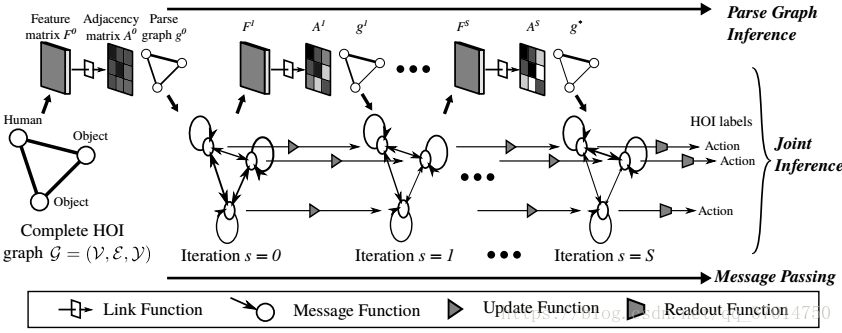
  用来检测human-object interaction。Paper说提出GPNN的目的是为了在HOI任务中显式地对空间、时间(视频)以及human-object关系进行利用。
这里写图片描述
  complete HOI指的是所有的node之间都有link,node包括human和object,假设node特征为d_V维,edge的特征为d_E维(从两个box的union box提取得到的),且complete HOI一共有N个node,那么特征矩阵F则为NxNx(2d_V+d_E),也就是每两个node及其之间的边都要按顺序组合一次。然后用1x1的卷积计算出一个邻接矩阵。邻接矩阵可以用来表示两个node的某种相关性
这里写图片描述

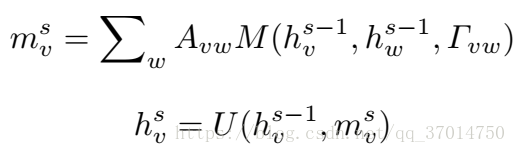
  上面的公式为每个node的状态h的更新过程,A是邻接矩阵,M是计算message的函数,U是利用当前状态h和新的信息m计算更新状态h的函数。然后这样不断地迭代:

计算特征矩阵F –> 计算邻接矩阵A –> 计算message –> 更新node隐藏状态 –> 计算特征矩阵F…

  迭代一定次数后,graph收敛?得到每个node的一个综合了context的隐藏状态,然后使用一个readout函数,得到每个node的输出:

### Human-AI Interaction Design Principles and Best Practices Designing effective interactions between humans and AI systems involves a set of principles and best practices aimed at enhancing usability, trust, and efficiency. These principles ensure that AI systems are not only functional but also intuitive and accessible to a wide range of users. One of the key aspects of human-AI interaction design is ensuring that the system is accessible to all users, including those with disabilities. This aligns with the concepts of universal design, inclusive design, and accessible design, which emphasize increasing the accessibility of interactive systems such as websites, browsers, tools, and various digital products. These design philosophies share a common goal of making technology usable by everyone, regardless of their abilities or disabilities [^1]. When designing for human-AI interaction, it is essential to consider the following principles: - **Transparency**: Users should understand how the AI system works and why it makes certain decisions. This helps build trust and allows users to predict the system's behavior. - **Control and Flexibility**: Users should have control over the AI system and be able to customize it according to their needs. This includes providing options for adjusting settings and preferences. - **Feedback and Error Handling**: The system should provide clear feedback and handle errors gracefully. Users should be informed when something goes wrong and given guidance on how to correct it. - **Consistency**: Consistent design elements and behaviors help users learn and use the system more effectively. Consistency should be maintained across different parts of the system and over time. - **Simplicity and Intuitiveness**: The interface should be simple and easy to use. Complex features should be hidden until needed, and the system should be designed to be as intuitive as possible. Implementing these principles requires a deep understanding of both the technical capabilities of AI systems and the needs of the users. For instance, when developing complex LabVIEW applications using the Actor Framework, it is crucial to evaluate the advantages and challenges associated with building large, concurrent, and scalable systems. This involves researching the principles, design patterns, and implementation details of the Actor Framework to ensure that the resulting applications meet high standards of performance and reliability [^2]. Furthermore, considering the competitive landscape in the test and measurement and automation fields, it is important to stay ahead by incorporating innovative design practices and leveraging the latest technologies to enhance user experience and system performance [^3]. ### Code Example Here is a simple example of how to implement a basic feedback mechanism in a Python application: ```python def get_user_feedback(): feedback = input("Please provide your feedback: ") print(f"Thank you for your feedback: {feedback}") get_user_feedback() ``` This code snippet demonstrates a function that collects user feedback and acknowledges it, which is a fundamental aspect of error handling and user engagement in human-AI interaction design. ###
评论
添加红包

请填写红包祝福语或标题

红包个数最小为10个

红包金额最低5元

当前余额3.43前往充值 >
需支付:10.00
成就一亿技术人!
领取后你会自动成为博主和红包主的粉丝 规则
hope_wisdom
发出的红包
实付
使用余额支付
点击重新获取
扫码支付
钱包余额 0

抵扣说明:

1.余额是钱包充值的虚拟货币,按照1:1的比例进行支付金额的抵扣。
2.余额无法直接购买下载,可以购买VIP、付费专栏及课程。

余额充值



