


 本文围绕 Spring AOP 原理解析的切面实现过程展开。先介绍 <aop> 配置标签解析,包括 <aop:config> 和 <aop:aspectj-autoproxy>。接着阐述注解切面代理创建类 AnnotationAwareAspectJAutoProxyCreator,分析其核心方法,最后总结了 AOP 从配置解析到代理创建的整体流程。
目录
3.1. AnnotationAwareAspectJAutoProxyCreator 类
3.2. postProcessBeforeInstantiation() 方法
3.3. postProcessAfterInitialization() 方法
一. 前言
在《(二)Spring 核心之控制反转(IoC)—— 体系结构设计及原理详解》中,我们分析了 Spring IoC 的初始化过程和 Bean 的生命周期等,而 Spring AOP 也是基于 IoC 的 Bean 加载来实现的。本文主要介绍 Spring AOP 原理解析的切面实现过程(将切面类的所有切面方法根据使用的注解生成对应 Advice,并将 Advice 连同切入点匹配器和切面类等信息一并封装到 Advisor,为后续交给代理增强实现做准备的过程)。
在《(一)Spring 核心之面向切面编程(AOP)—— 配置及使用》中我们写了 AOP 的 Demo,根据其 XML 配置我们不难发现 AOP 是基于 IoC 的 Bean 加载来实现的。这便是我们的主要入口:
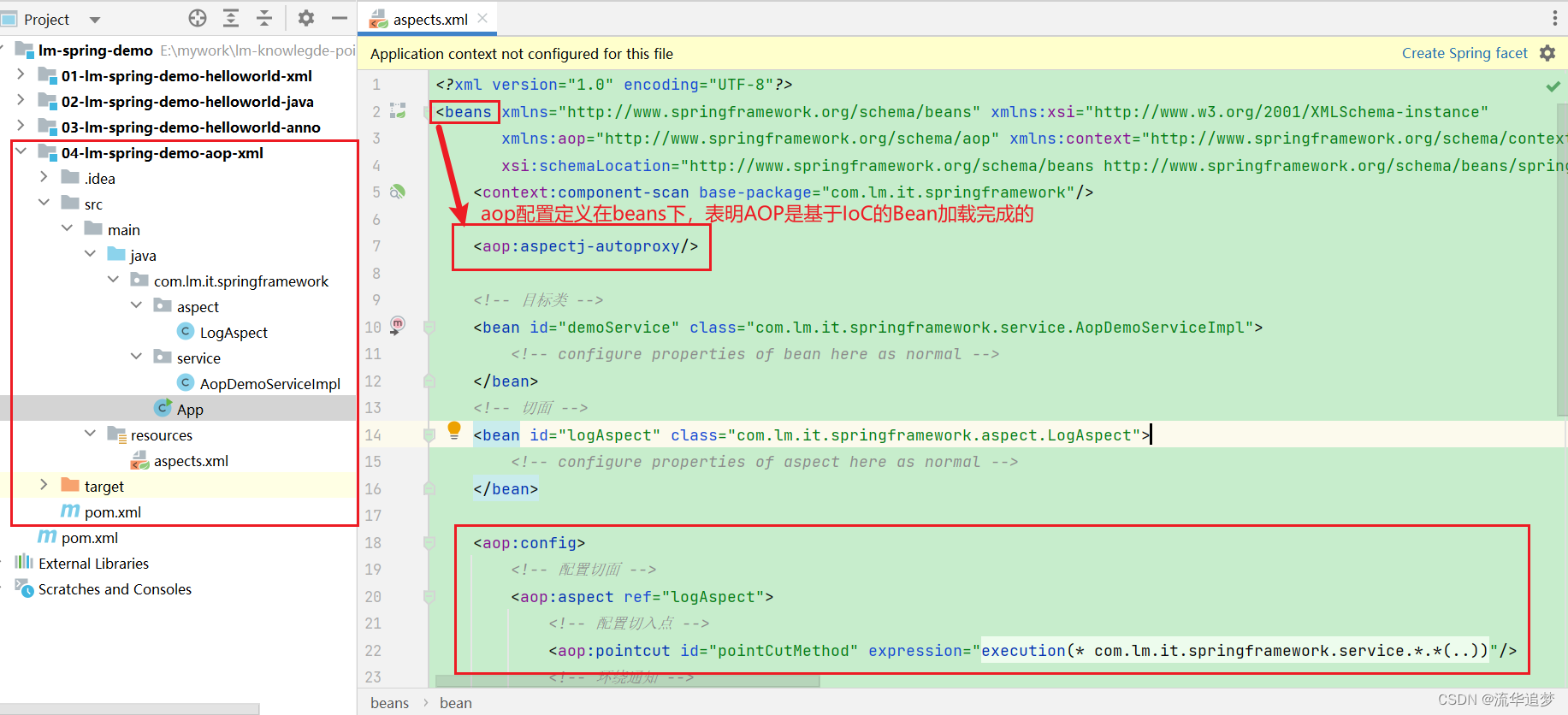
所以,理解 Spring AOP 的初始化必须要先理解 Spring IoC 的初始化。然后我们就能找到如下初始化的流程和 AOP 对应的 handler 类(即 parseCustomElement 方法找到 parse aop:aspectj-autoproxy 的 handler(org.springframework.aop.config.AopNamespaceHandler)):
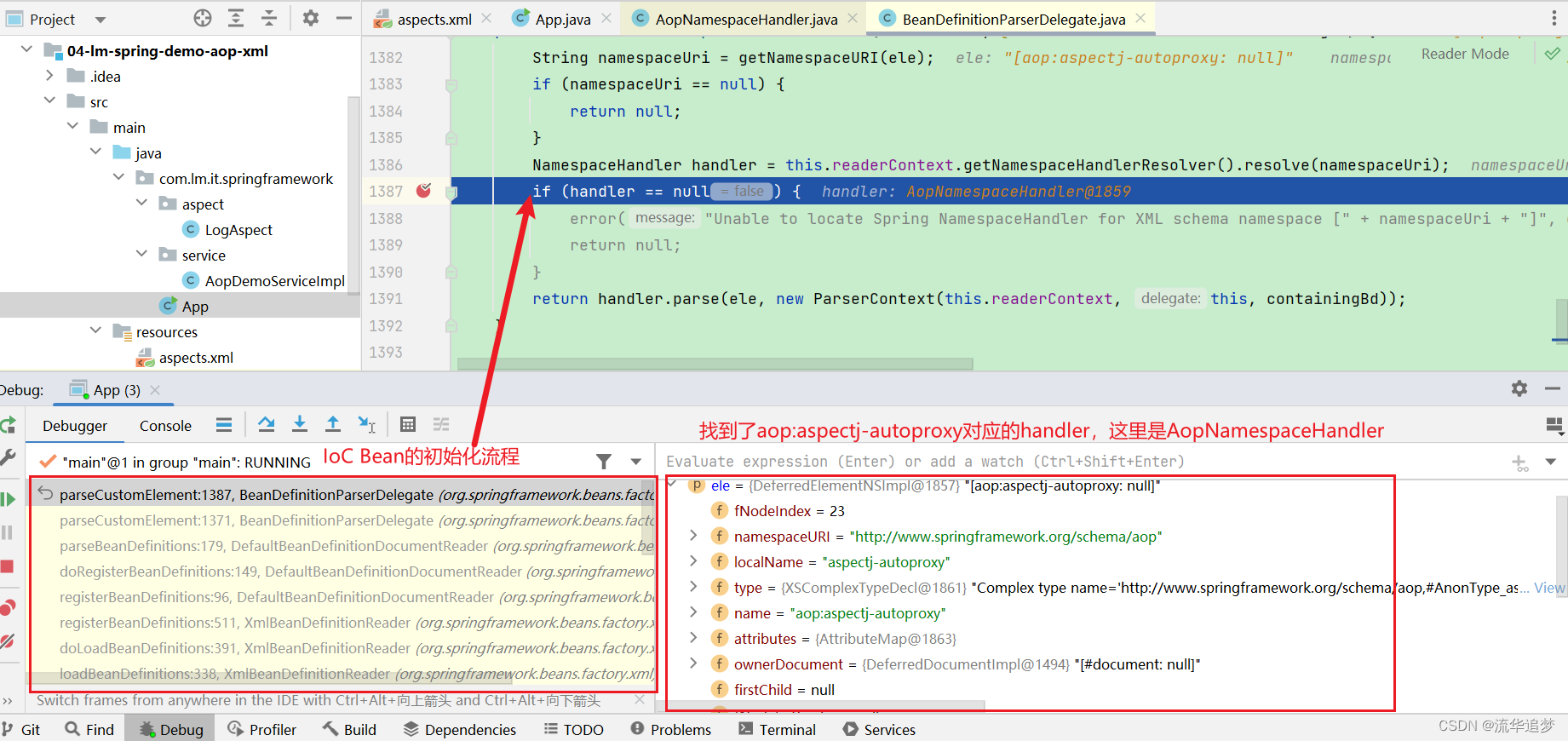
注:其实你会发现,最重要的是知识点的关联关系,而不是知识点本身。后续代码就是打个断点慢慢看了。
二. <aop> 配置标签的解析
上一节中,我们找到了 AopNamespaceHandler,其实就是注册 BeanDefinition 的解析器BeanDefinitionParser,将 aop:xxxxxx 配置标签交给指定的 parser 来处理。
public class AopNamespaceHandler extends NamespaceHandlerSupport {

	/**
	 * Register the {@link BeanDefinitionParser BeanDefinitionParsers} for the
	 * '{@code config}', '{@code spring-configured}', '{@code aspectj-autoproxy}'
	 * and '{@code scoped-proxy}' tags.
	 */
	@Override
	public void init() {
		// In 2.0 XSD as well as in 2.5+ XSDs
        // 注册解析<aop:config> 配置
		registerBeanDefinitionParser("config", new ConfigBeanDefinitionParser());
        // 注册解析<aop:aspectj-autoproxy> 配置
		registerBeanDefinitionParser("aspectj-autoproxy", new AspectJAutoProxyBeanDefinitionParser());
		registerBeanDefinitionDecorator("scoped-proxy", new ScopedProxyBeanDefinitionDecorator());

		// Only in 2.0 XSD: moved to context namespace in 2.5+
		registerBeanDefinitionParser("spring-configured", new SpringConfiguredBeanDefinitionParser());
	}

}
2.1. <aop:config> 配置标签的解析
<aop:config /> 由 ConfigBeanDefinitionParser 这个类处理,作为 parser 类最重要的就是 parse方法:
@Override
@Nullable
public BeanDefinition parse(Element element, ParserContext parserContext) {
    CompositeComponentDefinition compositeDef =
            new CompositeComponentDefinition(element.getTagName(), parserContext.extractSource(element));
    parserContext.pushContainingComponent(compositeDef);

    configureAutoProxyCreator(parserContext, element);

    List<Element> childElts = DomUtils.getChildElements(element);
    for (Element elt: childElts) {
        String localName = parserContext.getDelegate().getLocalName(elt);
        if (POINTCUT.equals(localName)) {
            parsePointcut(elt, parserContext);
        }
        else if (ADVISOR.equals(localName)) {
            parseAdvisor(elt, parserContext);
        }
        else if (ASPECT.equals(localName)) {
            parseAspect(elt, parserContext);
        }
    }

    parserContext.popAndRegisterContainingComponent();
    return null;
}
打个断点看下:
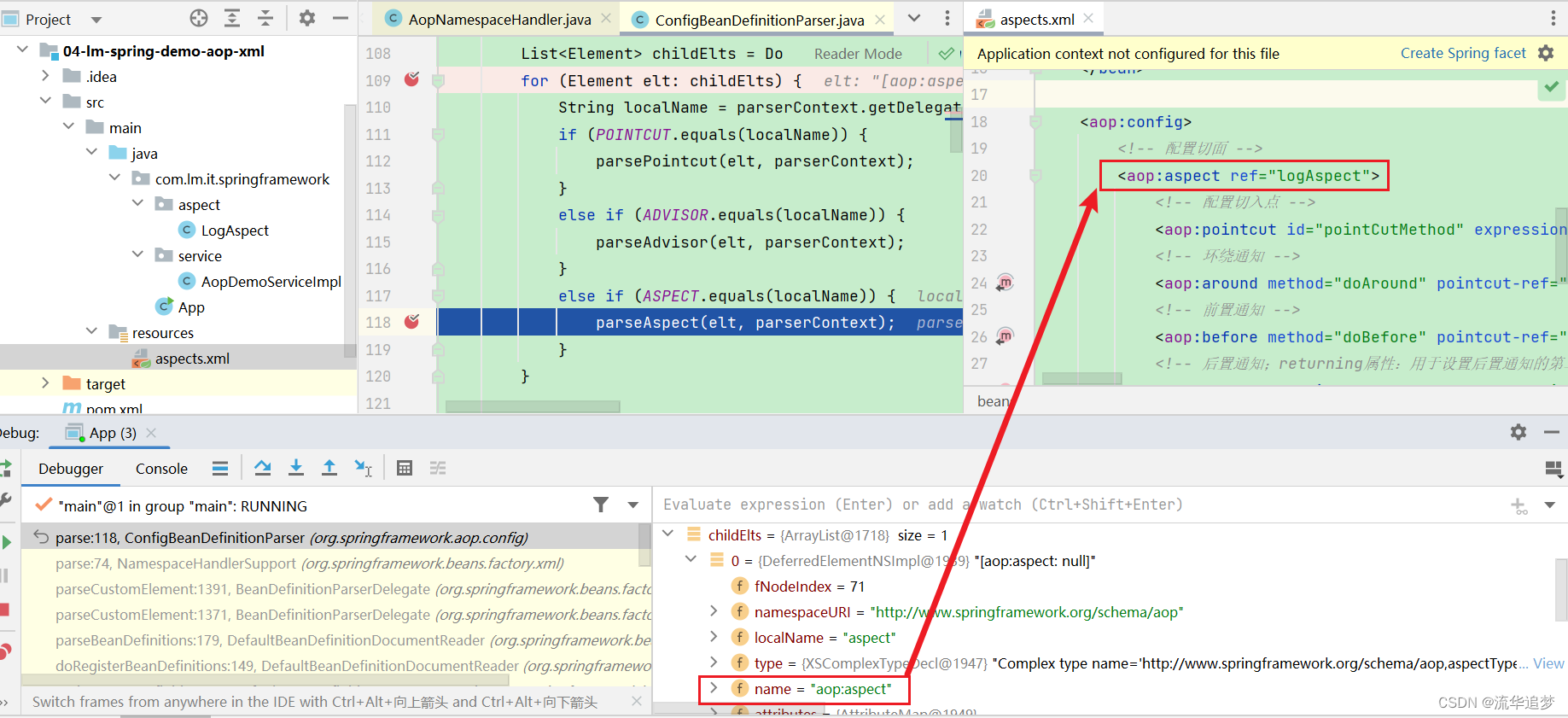
parseAspect 的方法如下,处理逻辑不难,这里就不展开了:
private void parseAspect(Element aspectElement, ParserContext parserContext) {
    String aspectId = aspectElement.getAttribute(ID);
    String aspectName = aspectElement.getAttribute(REF);

    try {
        this.parseState.push(new AspectEntry(aspectId, aspectName));
        List<BeanDefinition> beanDefinitions = new ArrayList<>();
        List<BeanReference> beanReferences = new ArrayList<>();

        List<Element> declareParents = DomUtils.getChildElementsByTagName(aspectElement, DECLARE_PARENTS);
        for (int i = METHOD_INDEX; i < declareParents.size(); i++) {
            Element declareParentsElement = declareParents.get(i);
            beanDefinitions.add(parseDeclareParents(declareParentsElement, parserContext));
        }

        // We have to parse "advice" and all the advice kinds in one loop, to get the
        // ordering semantics right.
        NodeList nodeList = aspectElement.getChildNodes();
        boolean adviceFoundAlready = false;
        for (int i = 0; i < nodeList.getLength(); i++) {
            Node node = nodeList.item(i);
            if (isAdviceNode(node, parserContext)) {
                if (!adviceFoundAlready) {
                    adviceFoundAlready = true;
                    if (!StringUtils.hasText(aspectName)) {
                        parserContext.getReaderContext().error(
                                "<aspect> tag needs aspect bean reference via 'ref' attribute when declaring advices.",
                                aspectElement, this.parseState.snapshot());
                        return;
                    }
                    beanReferences.add(new RuntimeBeanReference(aspectName));
                }
                AbstractBeanDefinition advisorDefinition = parseAdvice(
                        aspectName, i, aspectElement, (Element) node, parserContext, beanDefinitions, beanReferences);
                beanDefinitions.add(advisorDefinition);
            }
        }

        AspectComponentDefinition aspectComponentDefinition = createAspectComponentDefinition(
                aspectElement, aspectId, beanDefinitions, beanReferences, parserContext);
        parserContext.pushContainingComponent(aspectComponentDefinition);

        List<Element> pointcuts = DomUtils.getChildElementsByTagName(aspectElement, POINTCUT);
        for (Element pointcutElement : pointcuts) {
            parsePointcut(pointcutElement, parserContext);
        }

        parserContext.popAndRegisterContainingComponent();
    }
    finally {
        this.parseState.pop();
    }
}
2.2. <aop:aspectj-autoproxy> 配置标签的解析
<aop:aspectj-autoproxy /> 则由 AspectJAutoProxyBeanDefinitionParser 这个类处理的,我们看下 parse 方法:
@Override
@Nullable
public BeanDefinition parse(Element element, ParserContext parserContext) {
    // 注册AspectJAnnotationAutoProxyCreator
    AopNamespaceUtils.registerAspectJAnnotationAutoProxyCreatorIfNecessary(parserContext, element);
    // 拓展BeanDefinition
    extendBeanDefinition(element, parserContext);
    return null;
}
AopNamespaceUtils.registerAspectJAnnotationAutoProxyCreatorIfNecessary 方法对应如下:
public static void registerAspectJAnnotationAutoProxyCreatorIfNecessary(
        ParserContext parserContext, Element sourceElement) {

    BeanDefinition beanDefinition = AopConfigUtils.registerAspectJAnnotationAutoProxyCreatorIfNecessary(
            parserContext.getRegistry(), parserContext.extractSource(sourceElement));
    useClassProxyingIfNecessary(parserContext.getRegistry(), sourceElement);
    registerComponentIfNecessary(beanDefinition, parserContext);
}
AopConfigUtils.registerAspectJAnnotationAutoProxyCreatorIfNecessary 对应如下:
@Nullable
public static BeanDefinition registerAspectJAnnotationAutoProxyCreatorIfNecessary(
        BeanDefinitionRegistry registry, @Nullable Object source) {

    return registerOrEscalateApcAsRequired(AnnotationAwareAspectJAutoProxyCreator.class, registry, source);
}
到这里,我们发现 AOP 的创建工作是交给 AnnotationAwareAspectJAutoProxyCreator 来完成的。
三. 注解切面代理创建类
3.1. AnnotationAwareAspectJAutoProxyCreator 类
注解切面代理创建类 AnnotationAwareAspectJAutoProxyCreator 类结构关系如下:
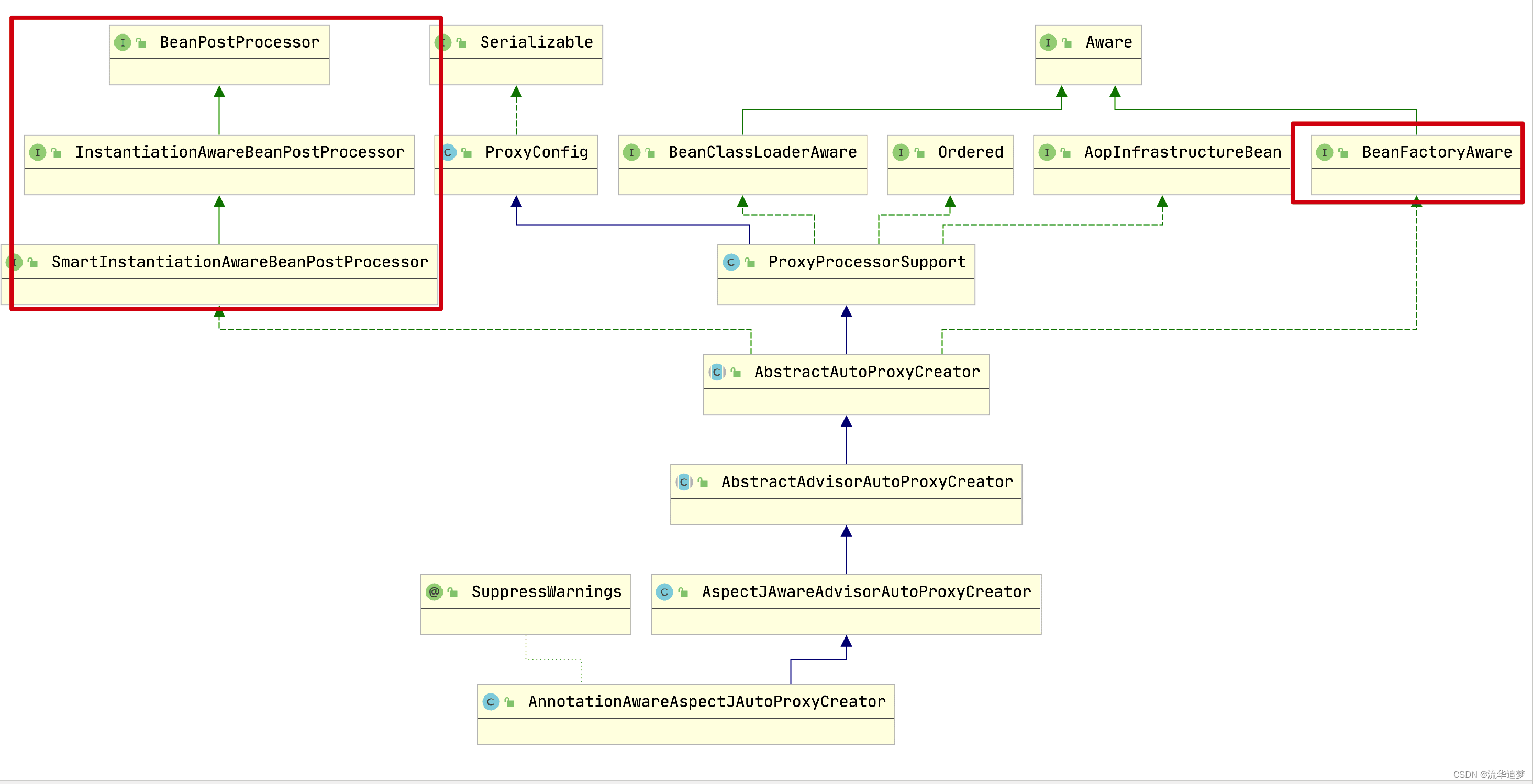
它实现了两类接口:
- BeanFactoryAware 属于 Bean 级生命周期接口方法;
- InstantiationAwareBeanPostProcessor 和 BeanPostProcessor 这两个接口实现,一般称它们的实现类为“后处理器”,是容器级生命周期接口方法。
结合 Spring Bean 生命周期的流程:《Spring 面试必考:Spring Bean 的生命周期和作用域》
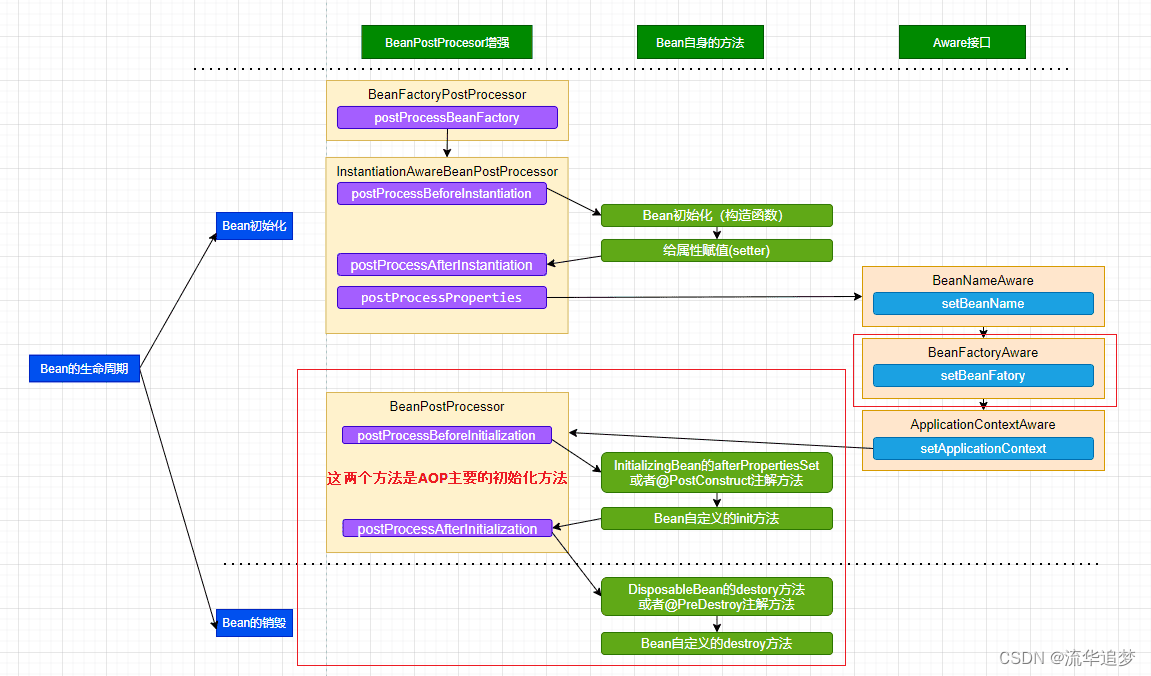
我们就可以定位到核心的初始化方法肯定在 postProcessBeforeInstantiation 和postProcessAfterInitialization 中。
3.2. postProcessBeforeInstantiation() 方法
如下是上述类结构中 postProcessBeforeInstantiation() 的方法,读者在自己看代码的时候建议打个断点看,可以方便理解:
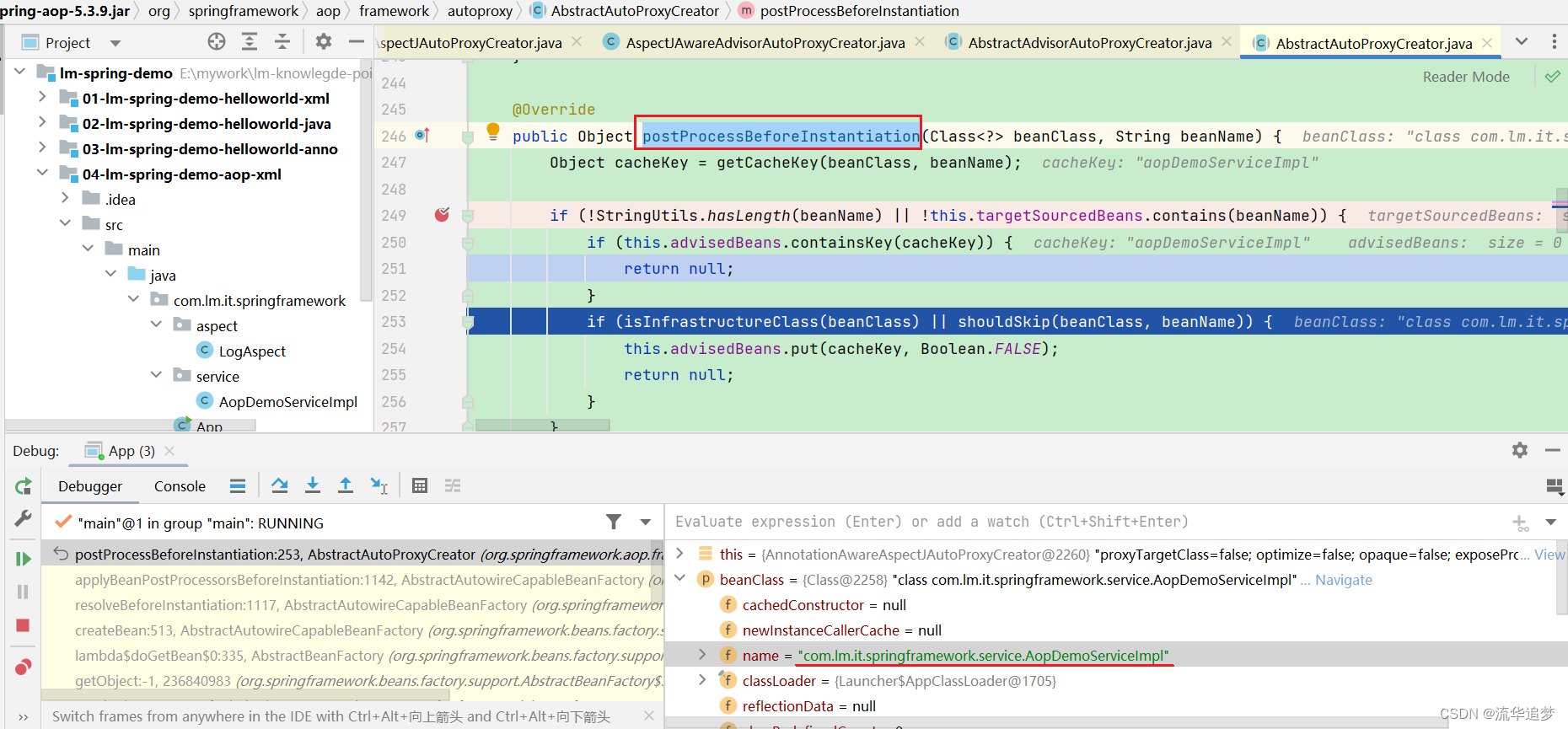
@Override
public Object postProcessBeforeInstantiation(Class<?> beanClass, String beanName) {
    Object cacheKey = getCacheKey(beanClass, beanName);

    if (!StringUtils.hasLength(beanName) || !this.targetSourcedBeans.contains(beanName)) {
        // 如果已经在缓存中,则忽略
        if (this.advisedBeans.containsKey(cacheKey)) {
            return null;
        }
        // 是否是aop基础类?是否跳过?
        if (isInfrastructureClass(beanClass) || shouldSkip(beanClass, beanName)) {
            this.advisedBeans.put(cacheKey, Boolean.FALSE);
            return null;
        }
    }

    // Create proxy here if we have a custom TargetSource.
    // Suppresses unnecessary default instantiation of the target bean:
    // The TargetSource will handle target instances in a custom fashion.
    TargetSource targetSource = getCustomTargetSource(beanClass, beanName);
    if (targetSource != null) {
        if (StringUtils.hasLength(beanName)) {
            this.targetSourcedBeans.add(beanName);
        }
        Object[] specificInterceptors = getAdvicesAndAdvisorsForBean(beanClass, beanName, targetSource);
        Object proxy = createProxy(beanClass, beanName, specificInterceptors, targetSource);
        this.proxyTypes.put(cacheKey, proxy.getClass());
        return proxy;
    }

    return null;
}
3.2.1. 判断是否是 AOP 基础类
是否是 AOP 基础类的判断方法 isInfrastructureClass 如下:
@Override
protected boolean isInfrastructureClass(Class<?> beanClass) {
    // Previously we setProxyTargetClass(true) in the constructor, but that has too
    // broad an impact. Instead we now override isInfrastructureClass to avoid proxying
    // aspects. I'm not entirely happy with that as there is no good reason not
    // to advise aspects, except that it causes advice invocation to go through a
    // proxy, and if the aspect implements e.g the Ordered interface it will be
    // proxied by that interface and fail at runtime as the advice method is not
    // defined on the interface. We could potentially relax the restriction about
    // not advising aspects in the future.
    // 父类判断它是aop基础类 or 使用@Aspect注解
    return (super.isInfrastructureClass(beanClass) ||
            (this.aspectJAdvisorFactory != null && this.aspectJAdvisorFactory.isAspect(beanClass)));
}
父类判断它是否是 AOP 基础类的方法 super.isInfrastructureClass(beanClass),本质上就是判断该类是否实现了 Advice、Pointcut、Advisor 或者 AopInfrastructureBean 接口。
protected boolean isInfrastructureClass(Class<?> beanClass) {
    // 该类是否实现了Advice, Pointcut, Advisor或者AopInfrastructureBean接口
    boolean retVal = Advice.class.isAssignableFrom(beanClass) ||
            Pointcut.class.isAssignableFrom(beanClass) ||
            Advisor.class.isAssignableFrom(beanClass) ||
            AopInfrastructureBean.class.isAssignableFrom(beanClass);
    if (retVal && logger.isTraceEnabled()) {
        logger.trace("Did not attempt to auto-proxy infrastructure class [" + beanClass.getName() + "]");
    }
    return retVal;
}
3.2.2. 是否应该跳过 shouldSkip
通过断点辅助,candidateAdvisors 就是和 xml 配置的通知是对应的:
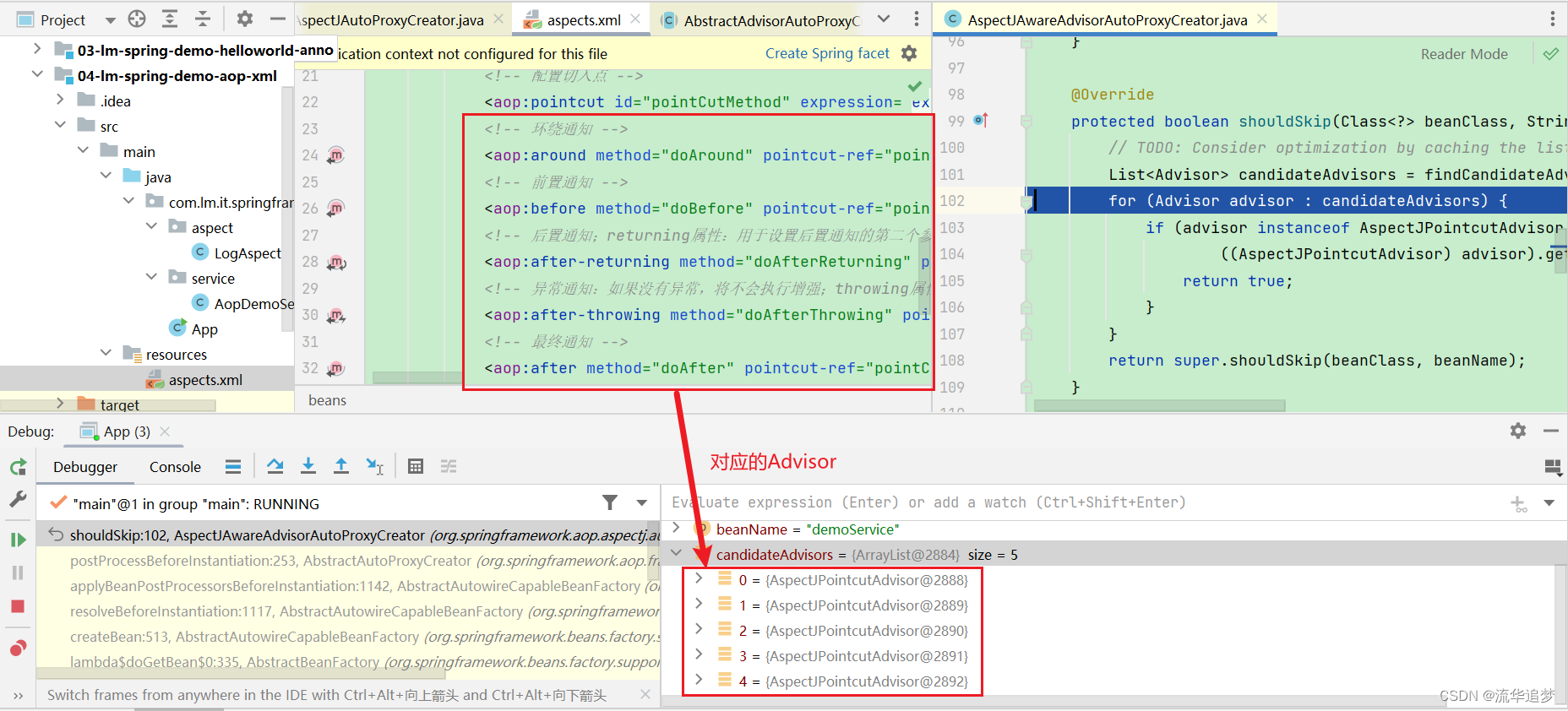
@Override
protected boolean shouldSkip(Class<?> beanClass, String beanName) {
    // TODO: Consider optimization by caching the list of the aspect names
    List<Advisor> candidateAdvisors = findCandidateAdvisors();
    for (Advisor advisor : candidateAdvisors) {
        if (advisor instanceof AspectJPointcutAdvisor &&
                ((AspectJPointcutAdvisor) advisor).getAspectName().equals(beanName)) {
            return true;
        }
    }
    return super.shouldSkip(beanClass, beanName);
}
3.2.3. 切面方法转成 Advisor
findCandidateAdvisors() 方法如下:
@Override
protected List<Advisor> findCandidateAdvisors() {
    // 在父类中找到所有的advisor:基于xml配置的<aop:before/>生成的
    List<Advisor> advisors = super.findCandidateAdvisors();
    // 为bean Factory中AspectJ切面构建advistor:通过AspectJ注解的方式生成Advisor类
    if (this.aspectJAdvisorsBuilder != null) {
        advisors.addAll(this.aspectJAdvisorsBuilder.buildAspectJAdvisors());
    }
    return advisors;
}
在当前的 Bean Factory 中通过 AspectJ 注解的方式生成 Advisor 类,buildAspectJAdvisors() 方法如下:
/**
 * Look for AspectJ-annotated aspect beans in the current bean factory,
 * and return to a list of Spring AOP Advisors representing them.
 * <p>Creates a Spring Advisor for each AspectJ advice method.
 * @return the list of {@link org.springframework.aop.Advisor} beans
 * @see #isEligibleBean
 */
public List<Advisor> buildAspectJAdvisors() {
    List<String> aspectNames = this.aspectBeanNames;

    if (aspectNames == null) {
        synchronized (this) {
            aspectNames = this.aspectBeanNames;
            if (aspectNames == null) {
                List<Advisor> advisors = new ArrayList<>();
                aspectNames = new ArrayList<>();
                String[] beanNames = BeanFactoryUtils.beanNamesForTypeIncludingAncestors(
                        this.beanFactory, Object.class, true, false);
                for (String beanName : beanNames) {
                    if (!isEligibleBean(beanName)) {
                        continue;
                    }
                    // We must be careful not to instantiate beans eagerly as in this case they
                    // would be cached by the Spring container but would not have been weaved.
                    Class<?> beanType = this.beanFactory.getType(beanName, false);
                    if (beanType == null) {
                        continue;
                    }
                    if (this.advisorFactory.isAspect(beanType)) {
                        aspectNames.add(beanName);
                        AspectMetadata amd = new AspectMetadata(beanType, beanName);
                        if (amd.getAjType().getPerClause().getKind() == PerClauseKind.SINGLETON) {
                            MetadataAwareAspectInstanceFactory factory =
                                    new BeanFactoryAspectInstanceFactory(this.beanFactory, beanName);
                            List<Advisor> classAdvisors = this.advisorFactory.getAdvisors(factory);
                            // 单例加到advisorsCache, 非单例加到aspectFactoryCache
                            if (this.beanFactory.isSingleton(beanName)) {
                                this.advisorsCache.put(beanName, classAdvisors);
                            }
                            else {
                                this.aspectFactoryCache.put(beanName, factory);
                            }
                            advisors.addAll(classAdvisors);
                        }
                        else {
                            // Per target or per this.
                            if (this.beanFactory.isSingleton(beanName)) {
                                throw new IllegalArgumentException("Bean with name '" + beanName +
                                        "' is a singleton, but aspect instantiation model is not singleton");
                            }
                            MetadataAwareAspectInstanceFactory factory =
                                    new PrototypeAspectInstanceFactory(this.beanFactory, beanName);
                            this.aspectFactoryCache.put(beanName, factory);
                            // advisorFactory工厂获取advisors
                            advisors.addAll(this.advisorFactory.getAdvisors(factory));
                        }
                    }
                }
                this.aspectBeanNames = aspectNames;
                return advisors;
            }
        }
    }

    if (aspectNames.isEmpty()) {
        return Collections.emptyList();
    }
    List<Advisor> advisors = new ArrayList<>();
    for (String aspectName : aspectNames) {
        List<Advisor> cachedAdvisors = this.advisorsCache.get(aspectName);
        if (cachedAdvisors != null) {
            advisors.addAll(cachedAdvisors);
        }
        else {
            MetadataAwareAspectInstanceFactory factory = this.aspectFactoryCache.get(aspectName);
            advisors.addAll(this.advisorFactory.getAdvisors(factory));
        }
    }
    return advisors;
}
上述方法本质上的思路是:用 DCL(Double Check Lock) 双重锁的单例实现方式,拿到切面类里的切面方法,将其转换成 advisor 并放入缓存中。
转换的成 advisor 的方法是 this.advisorFactory.getAdvisors():
@Override
public List<Advisor> getAdvisors(MetadataAwareAspectInstanceFactory aspectInstanceFactory) {
    Class<?> aspectClass = aspectInstanceFactory.getAspectMetadata().getAspectClass();
    String aspectName = aspectInstanceFactory.getAspectMetadata().getAspectName();
    validate(aspectClass);

    // We need to wrap the MetadataAwareAspectInstanceFactory with a decorator
    // so that it will only instantiate once.
    MetadataAwareAspectInstanceFactory lazySingletonAspectInstanceFactory =
            new LazySingletonAspectInstanceFactoryDecorator(aspectInstanceFactory);

    List<Advisor> advisors = new ArrayList<>();
    for (Method method : getAdvisorMethods(aspectClass)) {
        // Prior to Spring Framework 5.2.7, advisors.size() was supplied as the declarationOrderInAspect
        // to getAdvisor(...) to represent the "current position" in the declared methods list.
        // However, since Java 7 the "current position" is not valid since the JDK no longer
        // returns declared methods in the order in which they are declared in the source code.
        // Thus, we now hard code the declarationOrderInAspect to 0 for all advice methods
        // discovered via reflection in order to support reliable advice ordering across JVM launches.
        // Specifically, a value of 0 aligns with the default value used in
        // AspectJPrecedenceComparator.getAspectDeclarationOrder(Advisor).
        Advisor advisor = getAdvisor(method, lazySingletonAspectInstanceFactory, 0, aspectName);
        if (advisor != null) {
            advisors.add(advisor);
        }
    }

    // If it's a per target aspect, emit the dummy instantiating aspect.
    if (!advisors.isEmpty() && lazySingletonAspectInstanceFactory.getAspectMetadata().isLazilyInstantiated()) {
        Advisor instantiationAdvisor = new SyntheticInstantiationAdvisor(lazySingletonAspectInstanceFactory);
        advisors.add(0, instantiationAdvisor);
    }

    // Find introduction fields.
    for (Field field : aspectClass.getDeclaredFields()) {
        Advisor advisor = getDeclareParentsAdvisor(field);
        if (advisor != null) {
            advisors.add(advisor);
        }
    }

    return advisors;
}
getAdvisor() 方法如下:
@Override
@Nullable
public Advisor getAdvisor(Method candidateAdviceMethod, MetadataAwareAspectInstanceFactory aspectInstanceFactory,
        int declarationOrderInAspect, String aspectName) {

    validate(aspectInstanceFactory.getAspectMetadata().getAspectClass());

    AspectJExpressionPointcut expressionPointcut = getPointcut(
            candidateAdviceMethod, aspectInstanceFactory.getAspectMetadata().getAspectClass());
    if (expressionPointcut == null) {
        return null;
    }

    // 封装成advisor
    return new InstantiationModelAwarePointcutAdvisorImpl(expressionPointcut, candidateAdviceMethod,
            this, aspectInstanceFactory, declarationOrderInAspect, aspectName);
}
3.2.4. 获取表达式的切点
获取表达式的切点的方法 getPointcut() 如下:
@Nullable
private AspectJExpressionPointcut getPointcut(Method candidateAdviceMethod, Class<?> candidateAspectClass) {
    AspectJAnnotation<?> aspectJAnnotation =
            AbstractAspectJAdvisorFactory.findAspectJAnnotationOnMethod(candidateAdviceMethod);
    if (aspectJAnnotation == null) {
        return null;
    }

    AspectJExpressionPointcut ajexp =
            new AspectJExpressionPointcut(candidateAspectClass, new String[0], new Class<?>[0]);
    ajexp.setExpression(aspectJAnnotation.getPointcutExpression());
    if (this.beanFactory != null) {
        ajexp.setBeanFactory(this.beanFactory);
    }
    return ajexp;
}
AbstractAspectJAdvisorFactory.findAspectJAnnotationOnMethod() 的方法如下:
private static final Class<?>[] ASPECTJ_ANNOTATION_CLASSES = new Class<?>[] {
        Pointcut.class, Around.class, Before.class, After.class, AfterReturning.class, AfterThrowing.class};

/**
 * Find and return the first AspectJ annotation on the given method
 * (there <i>should</i> only be one anyway...).
 */
@SuppressWarnings("unchecked")
@Nullable
protected static AspectJAnnotation<?> findAspectJAnnotationOnMethod(Method method) {
    for (Class<?> clazz : ASPECTJ_ANNOTATION_CLASSES) {
        AspectJAnnotation<?> foundAnnotation = findAnnotation(method, (Class<Annotation>) clazz);
        if (foundAnnotation != null) {
            return foundAnnotation;
        }
    }
    return null;
}
findAnnotation() 方法如下:
@Nullable
private static <A extends Annotation> AspectJAnnotation<A> findAnnotation(Method method, Class<A> toLookFor) {
    A result = AnnotationUtils.findAnnotation(method, toLookFor);
    if (result != null) {
        return new AspectJAnnotation<>(result);
    }
    else {
        return null;
    }
}
AnnotationUtils.findAnnotation() 获取注解方法如下:
/**
 * Find a single {@link Annotation} of {@code annotationType} on the supplied
 * {@link Method}, traversing its super methods (i.e. from superclasses and
 * interfaces) if the annotation is not <em>directly present</em> on the given
 * method itself.
 * <p>Correctly handles bridge {@link Method Methods} generated by the compiler.
 * <p>Meta-annotations will be searched if the annotation is not
 * <em>directly present</em> on the method.
 * <p>Annotations on methods are not inherited by default, so we need to handle
 * this explicitly.
 * @param method the method to look for annotations on
 * @param annotationType the annotation type to look for
 * @return the first matching annotation, or {@code null} if not found
 * @see #getAnnotation(Method, Class)
 */
@Nullable
public static <A extends Annotation> A findAnnotation(Method method, @Nullable Class<A> annotationType) {
    if (annotationType == null) {
        return null;
    }

    // Shortcut: directly present on the element, with no merging needed?
    if (AnnotationFilter.PLAIN.matches(annotationType) ||
            AnnotationsScanner.hasPlainJavaAnnotationsOnly(method)) {
        return method.getDeclaredAnnotation(annotationType);
    }

    // Exhaustive retrieval of merged annotations...
    return MergedAnnotations.from(method, SearchStrategy.TYPE_HIERARCHY, RepeatableContainers.none())
            .get(annotationType).withNonMergedAttributes()
            .synthesize(MergedAnnotation::isPresent).orElse(null);
}
3.2.5. 封装成 Advisor
Advisor 是 advice的包装器,包含了 advice 及其它信息。
由 InstantiationModelAwarePointcutAdvisorImpl 构造完成:
public InstantiationModelAwarePointcutAdvisorImpl(AspectJExpressionPointcut declaredPointcut,
        Method aspectJAdviceMethod, AspectJAdvisorFactory aspectJAdvisorFactory,
        MetadataAwareAspectInstanceFactory aspectInstanceFactory, int declarationOrder, String aspectName) {

    this.declaredPointcut = declaredPointcut;
    this.declaringClass = aspectJAdviceMethod.getDeclaringClass();
    this.methodName = aspectJAdviceMethod.getName();
    this.parameterTypes = aspectJAdviceMethod.getParameterTypes();
    this.aspectJAdviceMethod = aspectJAdviceMethod;
    this.aspectJAdvisorFactory = aspectJAdvisorFactory;
    this.aspectInstanceFactory = aspectInstanceFactory;
    this.declarationOrder = declarationOrder;
    this.aspectName = aspectName;

    if (aspectInstanceFactory.getAspectMetadata().isLazilyInstantiated()) {
        // Static part of the pointcut is a lazy type.
        Pointcut preInstantiationPointcut = Pointcuts.union(
                aspectInstanceFactory.getAspectMetadata().getPerClausePointcut(), this.declaredPointcut);

        // Make it dynamic: must mutate from pre-instantiation to post-instantiation state.
        // If it's not a dynamic pointcut, it may be optimized out
        // by the Spring AOP infrastructure after the first evaluation.
        this.pointcut = new PerTargetInstantiationModelPointcut(
                this.declaredPointcut, preInstantiationPointcut, aspectInstanceFactory);
        this.lazy = true;
    }
    else {
        // A singleton aspect.
        this.pointcut = this.declaredPointcut;
        this.lazy = false;
        this.instantiatedAdvice = instantiateAdvice(this.declaredPointcut);
    }
}
通过 pointcut 获取 advice:
private Advice instantiateAdvice(AspectJExpressionPointcut pointcut) {
    Advice advice = this.aspectJAdvisorFactory.getAdvice(this.aspectJAdviceMethod, pointcut,
            this.aspectInstanceFactory, this.declarationOrder, this.aspectName);
    return (advice != null ? advice : EMPTY_ADVICE);
}
交给 aspectJAdvisorFactory 获取:
@Override
@Nullable
public Advice getAdvice(Method candidateAdviceMethod, AspectJExpressionPointcut expressionPointcut,
        MetadataAwareAspectInstanceFactory aspectInstanceFactory, int declarationOrder, String aspectName) {

    // 获取切面类
    Class<?> candidateAspectClass = aspectInstanceFactory.getAspectMetadata().getAspectClass();
    validate(candidateAspectClass);

    // 获取切面注解
    AspectJAnnotation<?> aspectJAnnotation =
            AbstractAspectJAdvisorFactory.findAspectJAnnotationOnMethod(candidateAdviceMethod);
    if (aspectJAnnotation == null) {
        return null;
    }

    // If we get here, we know we have an AspectJ method.
    // Check that it's an AspectJ-annotated class
    if (!isAspect(candidateAspectClass)) {
        throw new AopConfigException("Advice must be declared inside an aspect type: " +
                "Offending method '" + candidateAdviceMethod + "' in class [" +
                candidateAspectClass.getName() + "]");
    }

    if (logger.isDebugEnabled()) {
        logger.debug("Found AspectJ method: " + candidateAdviceMethod);
    }

    // 切面注解转换成advice
    AbstractAspectJAdvice springAdvice;

    switch (aspectJAnnotation.getAnnotationType()) {
        case AtPointcut: // AtPointcut忽略
            if (logger.isDebugEnabled()) {
                logger.debug("Processing pointcut '" + candidateAdviceMethod.getName() + "'");
            }
            return null;
        case AtAround:
            springAdvice = new AspectJAroundAdvice(
                    candidateAdviceMethod, expressionPointcut, aspectInstanceFactory);
            break;
        case AtBefore:
            springAdvice = new AspectJMethodBeforeAdvice(
                    candidateAdviceMethod, expressionPointcut, aspectInstanceFactory);
            break;
        case AtAfter:
            springAdvice = new AspectJAfterAdvice(
                    candidateAdviceMethod, expressionPointcut, aspectInstanceFactory);
            break;
        case AtAfterReturning:
            springAdvice = new AspectJAfterReturningAdvice(
                    candidateAdviceMethod, expressionPointcut, aspectInstanceFactory);
            AfterReturning afterReturningAnnotation = (AfterReturning) aspectJAnnotation.getAnnotation();
            if (StringUtils.hasText(afterReturningAnnotation.returning())) {
                springAdvice.setReturningName(afterReturningAnnotation.returning());
            }
            break;
        case AtAfterThrowing:
            springAdvice = new AspectJAfterThrowingAdvice(
                    candidateAdviceMethod, expressionPointcut, aspectInstanceFactory);
            AfterThrowing afterThrowingAnnotation = (AfterThrowing) aspectJAnnotation.getAnnotation();
            if (StringUtils.hasText(afterThrowingAnnotation.throwing())) {
                springAdvice.setThrowingName(afterThrowingAnnotation.throwing());
            }
            break;
        default:
            throw new UnsupportedOperationException(
                    "Unsupported advice type on method: " + candidateAdviceMethod);
    }

    // 最后将其它切面信息配置到advice
    springAdvice.setAspectName(aspectName);
    springAdvice.setDeclarationOrder(declarationOrder);
    String[] argNames = this.parameterNameDiscoverer.getParameterNames(candidateAdviceMethod);
    if (argNames != null) {
        springAdvice.setArgumentNamesFromStringArray(argNames);
    }
    springAdvice.calculateArgumentBindings();

    return springAdvice;
}
3.2.6. 小结
回头看,主要是处理使用了 @Aspect 注解的切面类,然后将切面类的所有切面方法根据使用的注解生成对应 Advice,并将 Advice 连同切入点匹配器和切面类等信息一并封装到 Advisor 的过程。
3.3. postProcessAfterInitialization() 方法
有了 Adisor,注入到合适的位置并交给代理(JDK 或 CGLIB )实现了。
/**
 * Create a proxy with the configured interceptors if the bean is
 * identified as one to proxy by the subclass.
 * @see #getAdvicesAndAdvisorsForBean
 */
@Override
public Object postProcessAfterInitialization(@Nullable Object bean, String beanName) {
    if (bean != null) {
        Object cacheKey = getCacheKey(bean.getClass(), beanName);
        if (this.earlyProxyReferences.remove(cacheKey) != bean) {
            return wrapIfNecessary(bean, beanName, cacheKey);
        }
    }
    return bean;
}
后续文章将分别介绍代理的创建和实现:
《(三)Spring 核心之面向切面编程(AOP)—— 代理的创建》;
《Spring AOP 实现原理详解之 JDK 动态代理》;
《Spring AOP 实现原理详解之 CGLIB 动态代理》。
四. 总结
通过本文的分析,我们总结如下:
- 由 IoC Bean 加载方法栈中找到 parseCustomElement 方法,找到 parse <aop:aspectj-autoproxy> 的 handler(org.springframework.aop.config.AopNamespaceHandler);
- AopNamespaceHandler 注册了 <aop:aspectj-autoproxy/> 的解析类是AspectJAutoProxyBeanDefinitionParser;
- AspectJAutoProxyBeanDefinitionParser 的 parse() 方法通过AspectJAwareAdvisorAutoProxyCreator 类去创建;
- AspectJAwareAdvisorAutoProxyCreator 实现了两类接口,BeanFactoryAware 和BeanPostProcessor。根据 Bean 生命周期方法找到两个核心方法 postProcessBeforeInstantiation() 和 postProcessAfterInitialization()
- postProcessBeforeInstantiation():主要是处理使用了 @Aspect 注解的切面类,然后将切面类的所有切面方法根据使用的注解生成对应 Advice,并将 Advice 连同切入点匹配器和切面类等信息一并封装到 Advisor;
- postProcessAfterInitialization():主要负责将 Advisor 注入到合适的位置,创建代理(JDK 或 CGLIB),为后面给代理进行增强实现做准备。






 扫一扫
扫一扫


 4245
4245

 被折叠的 条评论
为什么被折叠?
被折叠的 条评论
为什么被折叠?
 到【灌水乐园】发言





