



 该论文提出了一种利用边界信息并结合区域特征和局部图像细节的多级自底向上显著性检测方法。通过构建三级图模型,精确地捕捉区域特征和局部细节,以提高显著性估计的准确性。首先,使用所有四边的超像素粗略确定前景超像素,然后根据平均前景超像素与边界超像素之间的RGB距离,排除距离最长的边界超像素作为背景查询。最后,通过正则化随机游走排名来生成像素级的显著性图。实验结果显示,与7种先进的显著性检测方法相比,该算法的准确性和鲁棒性显著提升。
1 简介
In the fifield of saliency detection, many graph-based algorithms use boundary pixels as background seeds to estimate the background and foreground saliency,which leads to signifificant errors in some of pictures. In addition, local context with high contrast will mislead the algorithms. In this paper, we propose a novel multilevel bottom-up saliency detection
approach that accurately utilizes the boundary information and takes advantage of both region based features and local image details. To provide more accurate saliency estimations, we build a three-level graph model to capture both region-based features and local image details. By
using superpixels of all four boundaries, we fifirst roughly fifigure out the foreground superpixels.After calculating the RGB distances between the average of foreground superpixels and every boundary superpixel, we discard the boundary superpixels with the longest distance to get a set of accurate background boundary queries. Finally, we propose the regularized random walks ranking to formulate pixel-wise saliency maps. Experiment results on two public datasets indicate the signifificantly promoted accuracy and robustness of our proposed algorithm in comparison with
7 state-of-the-art saliency detection approaches.
2 部分代码
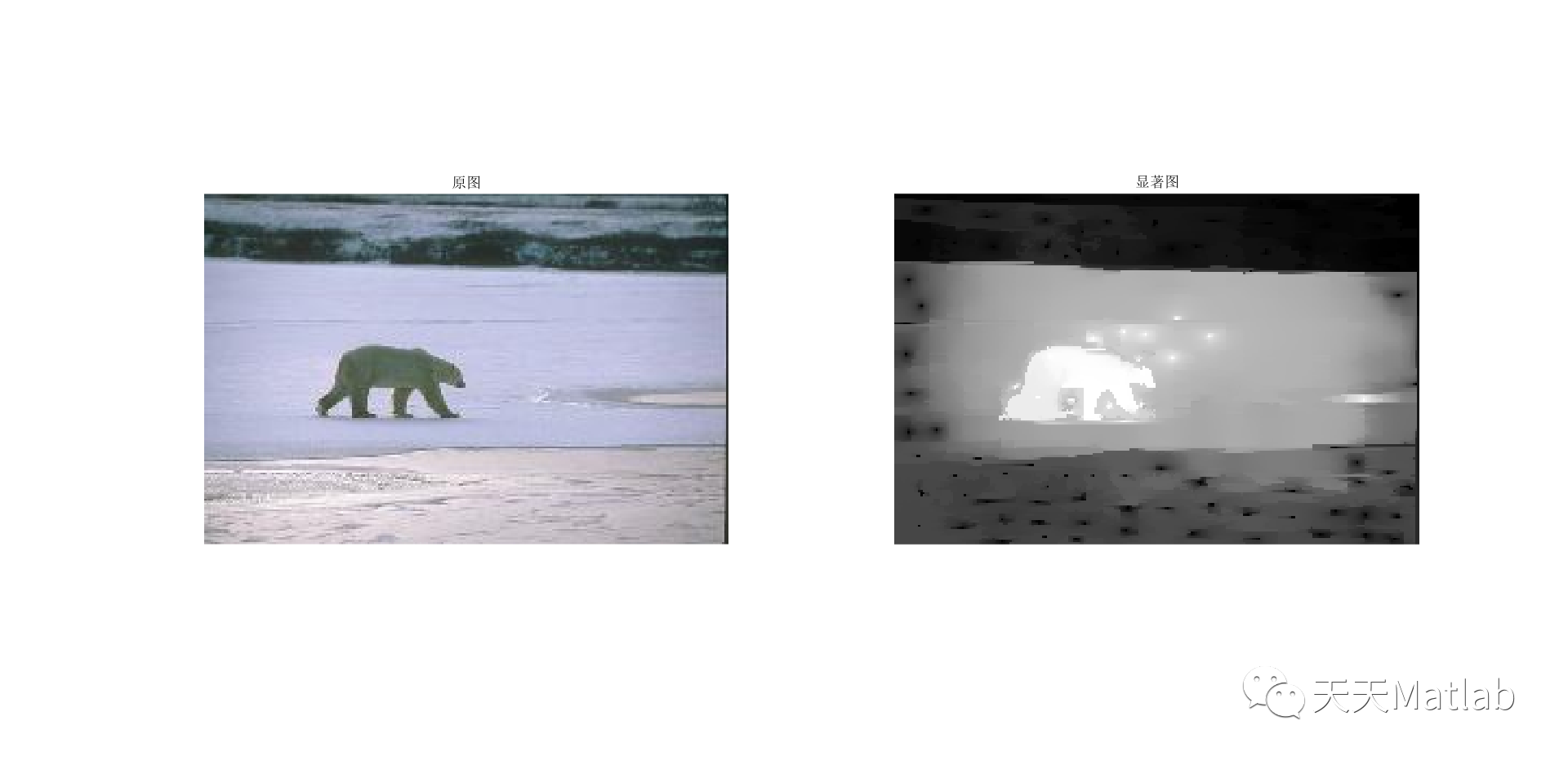
clear allclcclose all%% Initializationaddpath(genpath('./support/'));IMG_DIR = './TestData/data/';% Original image pathSAL_DIR='./TestData/solution/' ;% Output path of the saliency mapif ~exist(SAL_DIR, 'dir')mkdir(SAL_DIR);endimglist=dir([IMG_DIR '*' 'jpg']);%% Algorithm startfor imgno=1:length(imglist)% Load input imagedisp(imgno);disp(imglist(imgno).name);% Calculate saliencyimgnamein=imglist(imgno).name;spn = 200;spnb = 24;itheta = 10;alpha = 0.99;% Step 1 & 2: Saliency Estimationimgname = [IMG_DIR, imgnamein(1:end-4) '.jpg'];imgbmpname = strcat(imgname(1:(end-4)), '.bmp');[img, wid] = removeframe(imgname);img = uint8(img*255);w=fspecial('gaussian',[5,5],15);img2=imfilter(img,w);%%%%%%%%%%%1st gaussianw=fspecial('gaussian',[55,55],15);img3=imfilter(img,w);%%%%%%%%%%%2st gaussian[m, n, ~] = size(img);comm = ['SLIC_SUPPORT' ' ' imgbmpname ' ' int2str(2) ' ' int2str(spn) ' '];evalc('system(comm)');spname = [imgbmpname(1:end-4) '.dat'];superpixels = ReadDAT([m,n], spname);spno = max(superpixels(:));[salest,W] = Msalestimation(img, superpixels, spno, itheta, alpha,img2,img3);salest= (salest-min(salest))/(max(salest)-min(salest));map=superpixels;for i=1:spnomap(map==i)=salest(i);endmap1=reshape(map',n*m,1);% Step 3: regularized random walk rankingsalest=salest(1:spno,1);th1 = (mean(salest) + max(salest)) / 2;th2 = mean(salest);mu = (1-alpha) / alpha;[seeds, label] = seed4rw(salest, th1, th2);[P] = myrrwr(m,n,img,itheta,superpixels,seeds,label,salest,spno,mu);sal = P(:,1);salmean = (sal+map1)/2;sal = (salmean-min(salmean(:)))/(max(salmean(:))-min(salmean(:)));sal=reshape(sal,n,m)';saloutput = zeros(wid(1),wid(2));saloutput(wid(3):wid(4),wid(5):wid(6)) = sal;saloutput = uint8(saloutput*255);saliency=saloutput;% Output saliency map to fileimwrite(saliency, [SAL_DIR, imglist(imgno).name(1:end-4), '_Saliency.png']);salest=salest(1:spno,1);th1 = (mean(salest) + max(salest)) / 2;th2 = mean(salest);mu = (1-alpha) / alpha;[seeds, label] = seed4rw(salest, th1, th2);[~, probabilities] = rrwr(img, superpixels, salest, seeds, label, mu);sal = probabilities(:,:,1);sal = (sal-min(sal(:)))/(max(sal(:))-min(sal(:)));saloutput = zeros(wid(1),wid(2));saloutput(wid(3):wid(4),wid(5):wid(6)) = sal;saloutput = uint8(saloutput*255);saliency=saloutput;% Output saliency map to filefiguresubplot(121);imshow(img);title('原图')subplot(122);imshow(saliency) ; title('显著图')imwrite(saliency, [SAL_DIR, imglist(imgno).name(1:end-4), '_SaliencyOld.png']);% imwrite(map, [SAL_DIR, imglist(imgno).name(1:end-4), '_sal锟洁级BB.png']);clearvars -except IMG_DIR SAL_DIR imglist imgnoend
3 仿真结果
4 参考文献
[1]Hao, Aimin, Shuai, et al. Structure-Sensitive Saliency Detection via Multilevel Rank Analysis in Intrinsic Feature Space[J]. IEEE Transactions on Image Processing, 2015, 24(8):2303-2316.
博主简介:擅长智能优化算法、神经网络预测、信号处理、元胞自动机、图像处理、路径规划、无人机等多种领域的Matlab仿真,相关matlab代码问题可私信交流。
部分理论引用网络文献,若有侵权联系博主删除。





 扫一扫
扫一扫


 148
148

 被折叠的 条评论
为什么被折叠?
被折叠的 条评论
为什么被折叠?
 到【灌水乐园】发言





