


1. 集合、逻辑、复数
集合
定义
□
a
∈
A
,
a
∉
A
\scriptsize \square\space a\in A, \space a\notin A
□ a∈A, a∈/A
特殊集合
□
N
,
N
∗
,
N
+
□
Q
,
Z
,
R
,
C
\begin{aligned} & \scriptsize \square\space \bold{N}, \space \bold{N^*}, \space \bold{N_+} \\ & \scriptsize \square\space \bold{Q}, \space \bold{Z}, \space \bold{R}, \space \bold{C} \end{aligned}
□ N, N∗, N+□ Q, Z, R, C
集合的关系
□
A
⊆
B
,
包含于
,
子集个数
2
n
□
A
⫋
B
,
真包含于
,
真子集个数
2
n
−
1
□
∅
⊆
A
,
∅
⊆
∅
\begin{aligned} & \scriptsize \square\space A\subseteq B, \space包含于, \space子集个数\space 2^n \\ & \scriptsize \square\space A\subsetneqq B, \space真包含于, \space真子集个数\space 2^{n}-1 \\ & \scriptsize \square\space \emptyset \subseteq A, \space \emptyset \subseteq \emptyset \end{aligned}
□ A⊆B, 包含于, 子集个数 2n□ A⫋B, 真包含于, 真子集个数 2n−1□ ∅⊆A, ∅⊆∅
集合的运算
□
A
∩
B
=
{
x
∣
x
∈
A
且
x
∈
B
}
□
A
∪
B
=
{
x
∣
x
∈
A
或
x
∈
B
}
□
∁
U
A
=
{
x
∣
x
∈
U
且
x
∉
A
}
\begin{aligned} & \scriptsize \square\space A \cap B= \{x|x\in A\space且\space x\in B\} \\ & \scriptsize \square\space A \cup B= \{x|x\in A\space或\space x\in B\} \\ & \scriptsize \square\space \complement_U A = \{x|x\in U\space且\space x\notin A\} \end{aligned}
□ A∩B={x∣x∈A 且 x∈B}□ A∪B={x∣x∈A 或 x∈B}□ ∁UA={x∣x∈U 且 x∈/A}
运算性质
□
∁
U
(
A
∩
B
)
=
∁
U
A
∪
∁
U
B
□
∁
U
(
A
∪
B
)
=
∁
U
A
∩
∁
U
B
□
card
(
A
∪
B
)
=
card
(
A
)
+
card
(
B
)
−
card
(
A
∩
B
)
\begin{aligned} & \scriptsize \square\space \complement_U (A \cap B)=\complement_U A \cup \complement_U B \\ & \scriptsize \square\space \complement_U (A \cup B)=\complement_U A \cap \complement_U B \\ & \scriptsize \square\space \text{card} (A \cup B)=\text{card}(A) + \text{card}(B) \\& \scriptsize \mskip{6.5em}-\text{card} (A \cap B) \end{aligned}
□ ∁U(A∩B)=∁UA∪∁UB□ ∁U(A∪B)=∁UA∩∁UB□ card(A∪B)=card(A)+card(B)−card(A∩B)
命题
定义
□
或
∨
□
且
∧
□
非
¬
□
原命题 若
p
,
则
q
□
逆命题 若
q
,
则
p
□
否命题 若
¬
p
,
则
¬
q
□
逆否命题 若
¬
q
,
则
¬
p
原命题和逆否命题,同真同假
\begin{aligned} & \scriptsize \square\space 或 \space \lor \\ & \scriptsize \square\space 且\space \land \\ & \scriptsize \square\space 非\space \lnot \\ & \scriptsize \square\space 原命题\space 若\space p, \space则\space q \\ & \scriptsize \square\space 逆命题\space 若\space q, \space则\space p \\ & \scriptsize \square\space 否命题\space 若\space\lnot\space p, \space则\space \lnot\space q \\ & \scriptsize \square\space 逆否命题\space 若\space\lnot\space q, \space则\space\lnot\space p \end{aligned} \\ \scriptsize原命题和逆否命题,同真同假
□ 或 ∨□ 且 ∧□ 非 ¬□ 原命题 若 p, 则 q□ 逆命题 若 q, 则 p□ 否命题 若 ¬ p, 则 ¬ q□ 逆否命题 若 ¬ q, 则 ¬ p原命题和逆否命题,同真同假
条件
□
若
p
⇒
q
,
p
是
q
的充分条件
□
若
q
⇒
p
,
p
是
q
的必要条件
\begin{aligned} & \scriptsize\square\space 若p \Rightarrow q,\space p\space是\space q \space 的充分条件 \\ & \scriptsize\square\space 若q \Rightarrow p,\space p\space是 \space q \space 的必要条件 \end{aligned}
□ 若p⇒q, p 是 q 的充分条件□ 若q⇒p, p 是 q 的必要条件
量词
□
全称量词
∀
□
存在量词
∃
命题的
否定
□
“
∀
x
∈
A
,
命题
p
成立
"
的否定形式
为 “
∃
x
∈
A
,
命题
¬
p
成立”
□
“
∃
x
∈
A
,
命题
p
成立” 的否定形式
为“
∀
x
∈
A
,
命题
¬
p
成立
"
\begin{aligned} & \scriptsize\square\space 全称量词 \space \forall \\ & \scriptsize\square\space 存在量词\space \exists \end{aligned} \\ \scriptsize命题的\red{否定} \\ \scriptsize\quad \\ \begin{aligned} & \scriptsize\square\space “\space\forall \space x\in A, \space 命题\space p \space 成立"\space 的否定形式 \\ & \scriptsize\quad \\ & \scriptsize\quad 为\space “ \space \exists \space x\in A, \space 命题\space\lnot \space p \space成立” \\ & \scriptsize\quad \\ & \scriptsize\square\space “\space \exists \space x\in A, \space 命题\space p \space成立” \space 的否定形式 \\ & \scriptsize\quad \\ & \scriptsize\quad 为“\space\forall \space x\in A, \space 命题\space\lnot\space p\space成立" \end{aligned}
□ 全称量词 ∀□ 存在量词 ∃命题的否定□ “ ∀ x∈A, 命题 p 成立" 的否定形式为 “ ∃ x∈A, 命题 ¬ p 成立”□ “ ∃ x∈A, 命题 p 成立” 的否定形式为“ ∀ x∈A, 命题 ¬ p 成立"
复数
定义
□
z
=
a
+
b
i
其中
a
为实部
,
b
为虚部
,
i
2
=
−
1
\begin{aligned} & \scriptsize\square\space z=a+bi \space \\ & \scriptsize\quad 其中a为实部, \space b为虚部, \space i^2=-1 \end{aligned}
□ z=a+bi 其中a为实部, b为虚部, i2=−1
模
□
∣
z
∣
=
a
2
+
b
2
\scriptsize\square\space |z|=\sqrt{a^2+b^2}
□ ∣z∣=a2+b2
共轭复数
□
z
‾
=
a
−
b
i
□
z
z
‾
=
∣
z
∣
2
\begin{aligned} & \scriptsize\square\space \overline{z}=a-bi \space \\ & \scriptsize\square\space z\overline{z}=|z|^2 \end{aligned}
□ z=a−bi □ zz=∣z∣2
运算
设
z
1
=
a
1
+
b
1
i
,
z
2
=
a
2
+
b
2
i
□
z
1
+
z
2
=
(
a
1
+
a
2
)
+
(
b
1
+
b
2
)
i
□
z
1
−
z
2
=
(
a
1
−
a
2
)
+
(
b
1
−
b
2
)
i
□
z
1
z
2
=
(
a
1
+
b
1
i
)
(
a
2
+
b
2
i
)
=
(
a
1
a
2
−
b
1
b
2
)
+
(
a
1
b
2
+
a
2
b
1
)
i
□
z
1
z
2
=
z
1
z
2
‾
z
2
z
2
‾
=
z
1
z
2
‾
∣
z
2
∣
2
\scriptsize设z_1=a_1+b_1i,\space z_2=a_2+b_2i \\ \begin{aligned} \\& \scriptsize\square\space z_1+z_2=(a_1+a_2)+(b_1+b_2)i \\ & \scriptsize\square\space z_1-z_2=(a_1-a_2)+(b_1-b_2)i \\ & \scriptsize\square\space z_1z_2=(a_1+b_1i)(a_2+b_2i) \\ & \scriptsize\mskip{2.3em} =(a_1a_2-b_1b_2)+(a_1b_2+a_2b_1)i \\ & \scriptsize\square\space \frac {z_1}{z_2}=\frac {z_1\overline{z_2}}{z_2\overline{z_2}}=\frac {z_1\overline{z_2}}{|z_2|^2} \end{aligned}
设z1=a1+b1i, z2=a2+b2i□ z1+z2=(a1+a2)+(b1+b2)i□ z1−z2=(a1−a2)+(b1−b2)i□ z1z2=(a1+b1i)(a2+b2i)=(a1a2−b1b2)+(a1b2+a2b1)i□ z2z1=z2z2z1z2=∣z2∣2z1z2
三角形式
□
z
=
a
+
b
i
其中
a
为实部
,
b
为虚部
,
i
2
=
−
1
□
z
=
r
(
cos
θ
+
i
sin
θ
)
其中
r
为
模
,
θ
为
辐角
设
z
1
=
r
1
(
cos
θ
1
+
i
sin
θ
1
)
,
z
2
=
r
2
(
cos
θ
2
+
i
sin
θ
2
)
,
z
=
r
(
cos
θ
+
i
sin
θ
)
□
z
1
⋅
z
2
=
r
1
r
2
[
cos
(
θ
1
+
θ
2
)
+
i
sin
(
θ
1
+
θ
2
)
]
z
1
z
2
=
r
1
r
2
[
cos
(
θ
1
−
θ
2
)
+
i
sin
(
θ
1
−
θ
2
)
]
z
n
=
r
n
[
cos
(
n
θ
)
+
i
sin
(
n
θ
)
]
\begin{aligned} & \scriptsize\square\space z=a+bi \space \\ & \scriptsize\mskip{0.8em} 其中a为实部, \space b为虚部, \space i^2=-1 \\& \scriptsize\square\space z=r\space (\cos\theta +i\sin\theta) \\ & \scriptsize\mskip{0.8em} 其中\space r \space 为\red{模}, \space \theta为\red{辐角} \\& \scriptsize\space 设z_1=r_1(\cos\theta_1 +i\sin\theta_1), \space z_2=r_2\space(\cos\theta_2+i\sin\theta_2), \\& \scriptsize\mskip {1.0em} z=r(\cos\theta +i\sin\theta) \\& \scriptsize\square\space z_1 \cdot z_2=r_1 r_2\space[\cos(\theta_1+\theta_2) +i\sin(\theta_1+\theta_2)] \\ & \scriptsize\space \mskip{0.5em} \frac {z_1}{ z_2}=\frac {r_1}{r_2}\space[\cos(\theta_1-\theta_2) +i\sin(\theta_1-\theta_2)] \\ & \scriptsize\space \mskip{0.6em} z^n=r^n\space[\cos (n\theta) +i\sin (n\theta)] \end{aligned}
□ z=a+bi 其中a为实部, b为虚部, i2=−1□ z=r (cosθ+isinθ)其中 r 为模, θ为辐角 设z1=r1(cosθ1+isinθ1), z2=r2 (cosθ2+isinθ2),z=r(cosθ+isinθ)□ z1⋅z2=r1r2 [cos(θ1+θ2)+isin(θ1+θ2)] z2z1=r2r1 [cos(θ1−θ2)+isin(θ1−θ2)] zn=rn [cos(nθ)+isin(nθ)]
指数形式
□
z
=
r
e
i
θ
其中
r
为
模
,
θ
为
辐角
\begin{aligned} & \scriptsize\square\space z=r\space e^{i\space \theta} \\ & \scriptsize\mskip{0.8em} 其中\space r \space为\red{模}, \space \theta \space 为\red{辐角} \end{aligned}
□ z=r ei θ其中 r 为模, θ 为辐角
2. 函数、导数
函数
自变量、因变量、对应法则、复合函数
y
=
f
(
x
)
,
y
=
g
(
x
)
□
自变量
x
,
其范围为
定义域
□
因变量
y
,
其范围为
值域
□
对应法则
f
,
g
□
复合函数
y
=
f
(
g
(
x
)
)
\scriptsize y=f(x), \space y=g(x) \\ \\ \begin{aligned} \\ & \scriptsize\square\space 自变量x, \space 其范围为\red{定义域} \\ \\ & \scriptsize\square\space 因变量y, \space 其范围为\red{值域} \\ \\ & \scriptsize\square\space 对应法则f, \space g \\ \\ & \scriptsize\square\space 复合函数y=f(g(x)) \end{aligned}
y=f(x), y=g(x)□ 自变量x, 其范围为定义域□ 因变量y, 其范围为值域□ 对应法则f, g□ 复合函数y=f(g(x))
单调性
单调性的
定义
:
∀
x
1
,
x
2
∈
D
□
若
x
1
<
x
2
,
f
(
x
1
)
<
f
(
x
2
)
,
则
f
(
x
)
在
D
内单调递增
□
若
x
1
<
x
2
,
f
(
x
1
)
>
f
(
x
2
)
,
则
f
(
x
)
在
D
内单调递减
单调性的
判定
□
增函数
+
增函数
=
增函数
□
减函数
+
减函数
=
减函数
□
−
增函数
=
减函数
□
−
减函数
=
增函数
□
复合函数同增异减
\scriptsize 单调性的\red{定义}: \space \forall x_1, \space x_2\in D \\ \\ \begin{aligned} \\ & \scriptsize\square\space 若x_1<x_2, \space f(x_1)<f(x_2), \\ \\& \scriptsize\quad 则f(x)在D内单调递增 \\ \\ & \scriptsize\square\space 若x_1<x_2, \space f(x_1)>f(x_2), \\ \\& \scriptsize\quad 则f(x)在D内单调递减 \\ \end{aligned} \\ \\ \begin{aligned} \\& \scriptsize 单调性的\red{判定} \\ \\& \scriptsize\square\space 增函数+增函数=增函数 \\ \\ & \scriptsize\square\space减函数+减函数=减函数 \\ \\ & \scriptsize\square\space -增函数=减函数 \\ \\ & \scriptsize\square\space-减函数=增函数 \\ \\ & \scriptsize\square\space 复合函数同增异减 \end{aligned}
单调性的定义: ∀x1, x2∈D□ 若x1<x2, f(x1)<f(x2),则f(x)在D内单调递增□ 若x1<x2, f(x1)>f(x2),则f(x)在D内单调递减单调性的判定□ 增函数+增函数=增函数□ 减函数+减函数=减函数□ −增函数=减函数□ −减函数=增函数□ 复合函数同增异减
对称性
□
若
f
(
x
+
a
)
=
f
(
−
x
+
b
)
,
则
f
(
x
)
关于
x
=
a
+
b
2
轴对称
□
若
f
(
x
)
=
f
(
−
x
)
,
则对称轴为
y
轴
,
f
(
x
)
为
偶函数
□
若
f
(
x
+
a
)
+
f
(
−
x
+
b
)
=
c
,
则
f
(
x
)
关于
(
a
+
b
2
,
c
2
)
中心对称
□
若
f
(
x
)
=
−
f
(
−
x
)
,
则对称中心为原点
,
f
(
x
)
为
奇函数
\begin{aligned} & \scriptsize\square\space 若f(x+a)=f(-x+b),\space \\& \scriptsize\quad 则f(x)关于x=\frac {a+b}{2}轴对称 \\ & \scriptsize\square\space 若f(x)=f(-x),\space \\& \scriptsize\quad 则对称轴为y轴, \space f(x)为\red{偶函数} \\ & \scriptsize\square\space 若f(x+a)+f(-x+b)=c,\space \\& \scriptsize\quad 则f(x)关于(\frac {a+b}{2},\frac c 2)中心对称 \\ & \scriptsize\square\space 若f(x)=-f(-x),\space \\& \scriptsize\quad 则对称中心为原点, \space f(x)为\red{奇函数} \end{aligned}
□ 若f(x+a)=f(−x+b), 则f(x)关于x=2a+b轴对称□ 若f(x)=f(−x), 则对称轴为y轴, f(x)为偶函数□ 若f(x+a)+f(−x+b)=c, 则f(x)关于(2a+b,2c)中心对称□ 若f(x)=−f(−x), 则对称中心为原点, f(x)为奇函数
周期性
□
f
(
x
+
T
)
=
f
(
x
)
f
(
x
)
的周期为
T
□
f
(
x
+
T
)
=
−
f
(
x
)
f
(
x
)
的周期为
2
T
□
f
(
x
+
m
)
=
f
(
x
+
n
)
f
(
x
)
的周期为
∣
m
−
n
∣
□
f
(
x
+
m
)
=
−
1
f
(
x
)
f
(
x
)
的周期为
∣
m
∣
\begin{aligned} & \scriptsize\square\space f(x+T)=f(x) \\ & \scriptsize\quad f(x)的周期为\space T \\ & \scriptsize\square\space f(x+T)=-f(x) \\ & \scriptsize\quad f(x)的周期为\space 2T \\ & \scriptsize\square\space f(x+m)=f(x+n) \\ & \scriptsize\quad f(x)的周期为\space |m-n| \\ & \scriptsize\square\space f(x+m)=-\frac {1}{f(x)} \\ & \scriptsize\quad f(x)的周期为\space |m| \end{aligned}
□ f(x+T)=f(x)f(x)的周期为 T□ f(x+T)=−f(x)f(x)的周期为 2T□ f(x+m)=f(x+n)f(x)的周期为 ∣m−n∣□ f(x+m)=−f(x)1f(x)的周期为 ∣m∣
指数的定义、性质
□
a
m
⋅
a
n
=
a
m
+
n
□
a
m
a
n
=
a
m
−
n
□
(
a
m
)
n
=
a
m
n
□
a
−
m
=
1
a
m
□
a
m
n
=
a
m
n
□
a
0
=
1
(
a
≠
0
)
\begin{aligned} & \scriptsize\square\space a^m \cdot a^n= a^{m+n} \\ & \scriptsize\square\space \frac {a^m}{a^n}= a^{m-n} \\ & \scriptsize\square\space (a^m)^n= a^{mn} \\ & \scriptsize\square\space a^{-m}= \frac {1}{a^m} \\ & \scriptsize\square\space a^{\frac {m}{n}}= \sqrt[n]{a^m} \\ & \scriptsize\square\space a^0= 1 \space (a \neq 0) \end{aligned}
□ am⋅an=am+n□ anam=am−n□ (am)n=amn□ a−m=am1□ anm=nam□ a0=1 (a=0)
对数的定义、性质
□
a
b
=
c
⇒
b
=
log
a
c
,
a
log
a
c
=
c
□
log
a
(
m
n
)
=
log
a
m
+
log
a
n
□
log
a
(
m
n
)
=
log
a
m
−
log
a
n
□
log
a
m
(
b
n
)
=
n
m
log
a
b
□
log
a
b
=
log
c
b
log
c
a
=
1
log
b
a
□
log
a
1
=
0
,
log
a
a
=
1
\begin{aligned} & \scriptsize\square\space a^b=c \Rightarrow b=\log_a c,\space a^{\log_a c}= c \\ & \scriptsize\square\space \log_a (mn)=\log_a m+\log_a n \\ & \scriptsize\square\space \log_a (\frac {m}{n})=\log_a m-\log_a n \\ & \scriptsize\square\space \log_{a^m} (b^n)=\frac {n}{m}\log_a b \\ & \scriptsize\square\space \log_{a}b=\frac {\log_c b}{\log_c a}=\frac {1}{\log_b a} \\ & \scriptsize\square\space \log_a 1=0,\space \log_a a=1 \end{aligned}
□ ab=c⇒b=logac, alogac=c□ loga(mn)=logam+logan□ loga(nm)=logam−logan□ logam(bn)=mnlogab□ logab=logcalogcb=logba1□ loga1=0, logaa=1
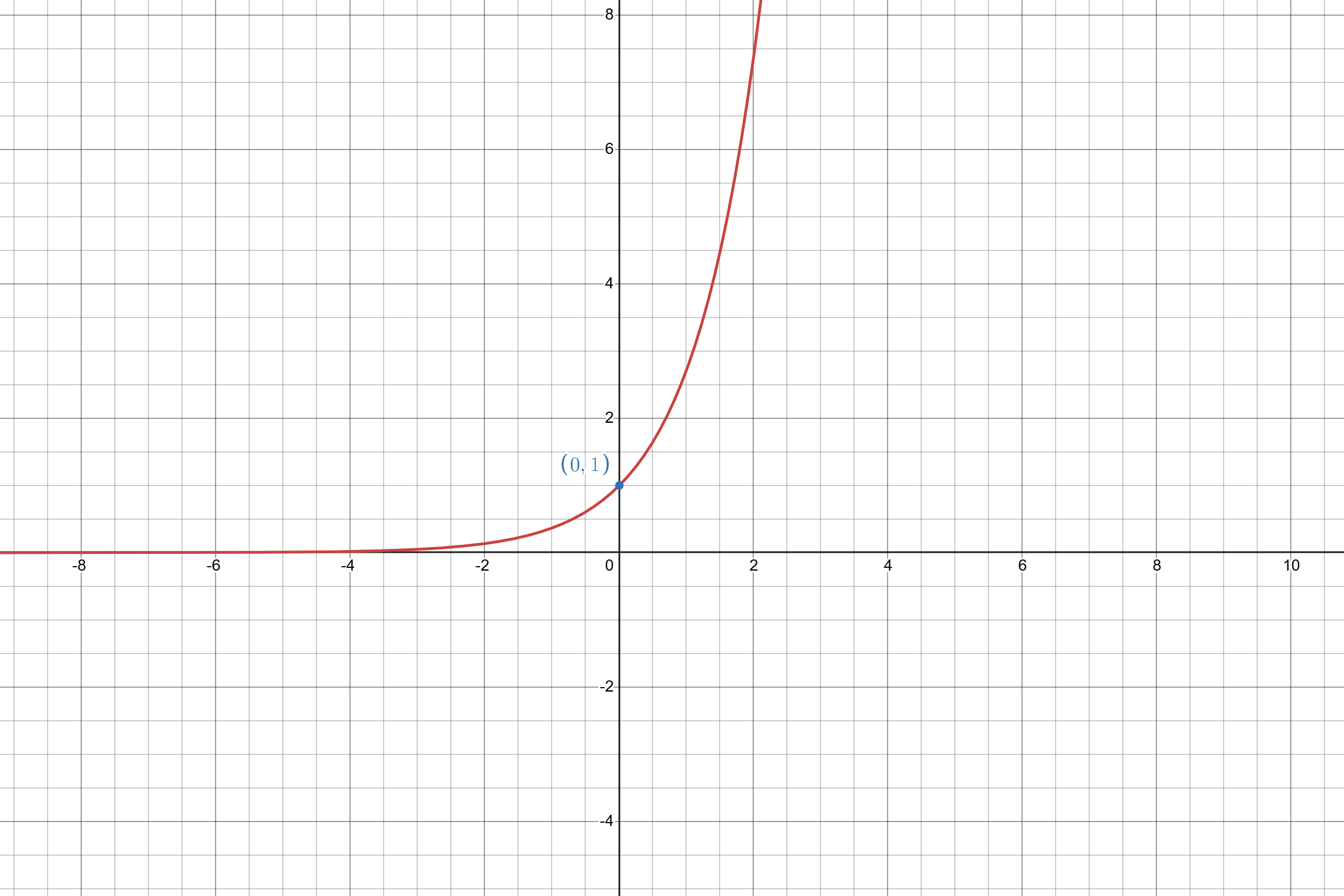
指数函数
指数函数
f
(
x
)
=
a
x
(
a
≠
1
)
□
定义域
R
□
值域
(
0
,
+
∞
)
□
当
a
>
1
时
,
f
(
x
)
=
a
x
为增函数
□
当
0
<
a
<
1
时
,
f
(
x
)
=
a
x
为减函数
□
函数过定点
(
0
,
1
)
\begin{aligned} & \scriptsize 指数函数\space f(x)=a^x \space(a \neq 1) \\& \scriptsize\square\space 定义域\space\bold{R} \\ & \scriptsize\square\space 值域\space(0,+\infty) \\ & \scriptsize\square\space 当\space a>1\space时, \space f(x)=a^x\space为增函数 \\ & \scriptsize\square\space 当\space 0<a<1\space时, \space f(x)=a^x\space为减函数 \\ & \scriptsize\square\space 函数过定点\space(0,1) \end{aligned}
指数函数 f(x)=ax (a=1)□ 定义域 R□ 值域 (0,+∞)□ 当 a>1 时, f(x)=ax 为增函数□ 当 0<a<1 时, f(x)=ax 为减函数□ 函数过定点 (0,1)

对数函数
对数函数
f
(
x
)
=
log
a
x
(
a
>
0
且
a
≠
1
)
□
定义域
(
0
,
+
∞
)
□
值域
R
□
当
a
>
1
时
,
f
(
x
)
=
log
a
x
为增函数
□
当
0
<
a
<
1
时
,
f
(
x
)
=
log
a
x
为减函数
□
函数过定点
(
1
,
0
)
\begin{aligned} & \scriptsize 对数函数\space f(x)=\log_a x \space(a>0 且 a \neq 1) \\& \scriptsize\square\space 定义域\space (0,+\infty) \\ & \scriptsize\square\space 值域\space\bold{R} \\ & \scriptsize\square\space 当\space a>1\space时, \space f(x)=\log_a x\space为增函数 \\ & \scriptsize\square\space 当\space 0<a<1\space时, \space f(x)=\log_a x\space为减函数 \\ & \scriptsize\square\space 函数过定点\space (1,0) \end{aligned}
对数函数 f(x)=logax (a>0且a=1)□ 定义域 (0,+∞)□ 值域 R□ 当 a>1 时, f(x)=logax 为增函数□ 当 0<a<1 时, f(x)=logax 为减函数□ 函数过定点 (1,0)
幂函数
幂函数
f
(
x
)
=
x
a
□
当
a
>
0
时
,
f
(
x
)
在
(
0
,
+
∞
)
为增函数
□
函数过定点
(
1
,
1
)
□
对号函数
f
(
x
)
=
x
+
1
x
(
右图中蓝色
)
f
(
x
)
=
x
−
1
x
(
右图中绿色
)
f
(
x
)
=
−
x
+
1
x
(
右图中紫色
)
f
(
x
)
=
−
x
−
1
x
(
右图中黑色
)
\begin{aligned} & \scriptsize 幂函数f(x)=x^a \\ & \scriptsize\square\space 当\space a>0\space 时, \space f(x)\space 在\space(0,+\infty)\space 为增函数 \\ & \scriptsize\square\space 函数过定点(1,1) \\& \scriptsize\square\space 对号函数 \\& \scriptsize \mskip {1.0 em} f(x)=x+\frac {1}{x}\space (右图中蓝色) \\& \scriptsize \mskip {1.0 em} f(x)=x-\frac {1}{x}\space (右图中绿色) \\& \scriptsize \mskip {1.0 em} f(x)=-x+\frac {1}{x} \space (右图中紫色) \\& \scriptsize \mskip {1.0 em} f(x)=-x-\frac {1}{x} \space (右图中黑色) \end{aligned}
幂函数f(x)=xa□ 当 a>0 时, f(x) 在 (0,+∞) 为增函数□ 函数过定点(1,1)□ 对号函数f(x)=x+x1 (右图中蓝色)f(x)=x−x1 (右图中绿色)f(x)=−x+x1 (右图中紫色)f(x)=−x−x1 (右图中黑色)
导数
定义
□
f
′
(
x
0
)
=
lim
x
→
x
0
f
(
x
)
−
f
(
x
0
)
x
−
x
0
f
(
x
)
在点
(
x
0
,
y
0
)
处切线斜率为
f
′
(
x
0
)
□
f
(
x
)
在点
(
x
0
,
y
0
)
处切线方程
y
−
f
(
x
0
)
=
f
′
(
x
0
)
(
x
−
x
0
)
\begin{aligned} & \scriptsize\square\space f'(x_0)=\lim\limits_{x \rightarrow x_{0}}\frac {f(x)-f(x_0)}{x-x_0} \\ & \scriptsize\quad f(x)在点(x_0,y_0)处切线斜率为f'(x_0) \\ & \scriptsize\square\space f(x)在点(x_0,y_0)处切线方程 \\ & \scriptsize\quad y-f(x_0)=f'(x_0)(x-x_0) \end{aligned}
□ f′(x0)=x→x0limx−x0f(x)−f(x0)f(x)在点(x0,y0)处切线斜率为f′(x0)□ f(x)在点(x0,y0)处切线方程y−f(x0)=f′(x0)(x−x0)
运算法则
□
(
C
)
′
=
0
□
(
x
n
)
′
=
n
x
n
−
1
□
(
e
x
)
′
=
e
x
□
(
a
x
)
′
=
a
x
ln
a
□
(
ln
x
)
′
=
1
x
□
(
log
a
x
)
′
=
1
x
ln
a
□
(
sin
x
)
′
=
cos
x
□
(
cos
x
)
′
=
−
sin
x
□
[
f
(
x
)
+
g
(
x
)
]
′
=
f
′
(
x
)
+
g
′
(
x
)
□
[
f
(
x
)
−
g
(
x
)
]
′
=
f
′
(
x
)
−
g
′
(
x
)
□
[
f
(
x
)
g
(
x
)
]
′
=
f
′
(
x
)
g
(
x
)
+
f
(
x
)
g
′
(
x
)
□
[
f
(
x
)
g
(
x
)
]
′
=
f
′
(
x
)
g
(
x
)
−
f
(
x
)
g
′
(
x
)
g
2
(
x
)
□
[
f
(
g
(
x
)
)
]
′
=
f
′
(
g
(
x
)
)
g
′
(
x
)
\begin{aligned} & \scriptsize\square\space (C)'=0 \\ & \scriptsize\square\space (x^n)'=nx^{n-1} \\ & \scriptsize\square\space (e^x)'=e^{x} \\ & \scriptsize\square\space (a^x)'=a^{x}\ln a \\ & \scriptsize\square\space (\ln x)'=\frac {1}{x} \\ & \scriptsize\square\space (\log_a x)'=\frac {1}{x \ln a} \\ & \scriptsize\square\space (\sin x)'=\cos x \\ & \scriptsize\square\space (\cos x)'=-\sin x \\ & \scriptsize\square\space [f(x)+g(x)]'=f'(x)+g'(x) \\ & \scriptsize\square\space [f(x)-g(x)]'=f'(x)-g'(x) \\ & \scriptsize\square\space [f(x)g(x)]'=f'(x)g(x)+f(x)g'(x) \\ & \scriptsize\square\space [\frac {f(x)}{g(x)}]'=\frac {f'(x)g(x)-f(x)g'(x)}{g^2(x)} \\ & \scriptsize\square\space [f(g(x))]'=f'(g(x))g'(x) \end{aligned}
□ (C)′=0□ (xn)′=nxn−1□ (ex)′=ex□ (ax)′=axlna□ (lnx)′=x1□ (logax)′=xlna1□ (sinx)′=cosx□ (cosx)′=−sinx□ [f(x)+g(x)]′=f′(x)+g′(x)□ [f(x)−g(x)]′=f′(x)−g′(x)□ [f(x)g(x)]′=f′(x)g(x)+f(x)g′(x)□ [g(x)f(x)]′=g2(x)f′(x)g(x)−f(x)g′(x)□ [f(g(x))]′=f′(g(x))g′(x)
导数应用
□
f
′
(
x
)
>
0
⇒
f
(
x
)
单调递增
f
(
x
)
单调递增
⇒
f
′
(
x
)
⩾
0
□
f
′
(
x
)
<
0
⇒
f
(
x
)
单调递减
f
(
x
)
单调递减
⇒
f
′
(
x
)
⩽
0
□
f
′
(
x
0
)
=
0
,
且
f
(
x
)
在点
x
=
x
0
先增后减
x
=
x
0
为
f
(
x
)
的极大值点
,
f
(
x
0
)
为
f
(
x
)
的极大值
□
f
′
(
x
0
)
=
0
,
且
f
(
x
)
在点
x
=
x
0
先减后增
x
=
x
0
为
f
(
x
)
的极小值点
,
f
(
x
0
)
为
f
(
x
)
的极小值
\begin{aligned} & \scriptsize\square\space f'(x)>0 \Rightarrow f(x)单调递增 \\ & \scriptsize\quad f(x)单调递增 \Rightarrow f'(x)\geqslant0 \\ & \scriptsize\square\space f'(x)<0 \Rightarrow f(x)单调递减 \\ & \scriptsize\quad f(x)单调递减 \Rightarrow f'(x)\leqslant0 \\ & \scriptsize\square\space f'(x_0)=0, \space 且 f(x)在点x=x_0先增后减 \\ & \scriptsize\quad x=x_0为f(x)的极大值点, \space f(x_0)为f(x)的极大值 \\ & \scriptsize\square\space f'(x_0)=0, \space 且 f(x)在点x=x_0先减后增 \\ & \scriptsize\quad x=x_0为f(x)的极小值点, \space f(x_0)为f(x)的极小值 \end{aligned}
□ f′(x)>0⇒f(x)单调递增f(x)单调递增⇒f′(x)⩾0□ f′(x)<0⇒f(x)单调递减f(x)单调递减⇒f′(x)⩽0□ f′(x0)=0, 且f(x)在点x=x0先增后减x=x0为f(x)的极大值点, f(x0)为f(x)的极大值□ f′(x0)=0, 且f(x)在点x=x0先减后增x=x0为f(x)的极小值点, f(x0)为f(x)的极小值
3. 三角函数、向量
三角函数
任意角:逆正顺负
弧度制、弧长公式、扇形面积公式
□
θ
=
l
r
(
rad
)
□
l
=
θ
r
□
S
扇
=
1
2
l
r
=
1
2
θ
r
2
\begin{aligned} & \scriptsize\square\space \theta= \dfrac{l}{r}\space (\red {\text{rad}}) \\ & \scriptsize\square\space l=\theta r \\ & \scriptsize\square\space S_扇 = \frac 1 2 l r = \frac 1 2 \theta r^2 \end{aligned}
□ θ=rl (rad)□ l=θr□ S扇=21lr=21θr2
三角函数定义
□
sin
θ
=
y
0
x
0
2
+
y
0
2
□
cos
θ
=
x
0
x
0
2
+
y
0
2
□
tan
θ
=
y
0
x
0
□
cot
θ
=
x
0
y
0
□
sin
2
θ
+
cos
2
θ
=
1
□
tan
θ
cot
θ
=
1
□
tan
θ
=
sin
θ
cos
θ
\begin{aligned} & \scriptsize\square\space \sin\theta=\frac {y_0}{\sqrt{\smash[b]{x_0^2+y_0^2}}} \\& \scriptsize\square\space \cos\theta=\frac {x_0}{\sqrt{\smash[b]{x_0^2+y_0^2}}} \\& \scriptsize\square\space \tan\theta=\frac {y_0}{x_0} \\& \scriptsize\square\space \cot\theta=\frac {x_0}{y_0} \\& \scriptsize\square\space \sin^2\theta+\cos^2\theta=1 \\& \scriptsize\square\space \tan\theta\cot\theta=1 \\& \scriptsize\square\space \tan\theta=\frac {\sin\theta}{\cos\theta} \end{aligned}
□ sinθ=x02+y02y0□ cosθ=x02+y02x0□ tanθ=x0y0□ cotθ=y0x0□ sin2θ+cos2θ=1□ tanθcotθ=1□ tanθ=cosθsinθ
诱导公式
□
奇变偶不变,符号看象限
一全正、二正弦、三两切、四余弦
由锐角得到的结论对任意角都成立
□
sin
(
π
2
+
θ
)
=
cos
θ
□
sin
(
π
2
−
θ
)
=
cos
θ
□
sin
(
π
+
θ
)
=
−
sin
θ
□
sin
(
π
−
θ
)
=
sin
θ
□
sin
(
3
π
2
+
θ
)
=
−
cos
θ
□
sin
(
3
π
2
−
θ
)
=
−
cos
θ
□
sin
(
2
π
+
θ
)
=
sin
θ
□
sin
(
2
π
−
θ
)
=
−
sin
θ
□
sin
(
−
θ
)
=
−
sin
θ
□
cos
(
π
2
+
θ
)
=
−
sin
θ
□
cos
(
π
2
−
θ
)
=
sin
θ
□
cos
(
π
+
θ
)
=
−
cos
θ
□
cos
(
π
−
θ
)
=
−
cos
θ
□
cos
(
3
π
2
+
θ
)
=
sin
θ
□
cos
(
3
π
2
−
θ
)
=
−
sin
θ
□
cos
(
2
π
+
θ
)
=
cos
θ
□
cos
(
2
π
−
θ
)
=
cos
θ
□
cos
(
−
θ
)
=
cos
θ
□
tan
(
π
2
+
θ
)
=
−
cot
θ
□
tan
(
π
2
−
θ
)
=
cot
θ
□
tan
(
π
+
θ
)
=
tan
θ
□
tan
(
π
−
θ
)
=
−
tan
θ
□
tan
(
3
π
2
+
θ
)
=
−
cot
θ
□
tan
(
3
π
2
−
θ
)
=
cot
θ
□
tan
(
2
π
+
θ
)
=
tan
θ
□
tan
(
2
π
−
θ
)
=
−
tan
θ
□
tan
(
−
θ
)
=
−
tan
θ
\begin{aligned} & \scriptsize\square\space 奇变偶不变,符号看象限 \\& \scriptsize\quad 一全正、二正弦、三两切、四余弦 \\& \scriptsize\quad 由锐角得到的结论对任意角都成立 \\& \scriptsize\square\space \sin(\frac \pi 2 + \theta)=\cos \theta \\& \scriptsize\square\space \sin(\frac \pi 2 - \theta)=\cos \theta \\& \scriptsize\square\space \sin(\pi + \theta)=-\sin \theta \\& \scriptsize\square\space \sin(\pi - \theta)=\sin \theta \\& \scriptsize\square\space \sin(\frac {3\pi} {2} + \theta)=-\cos \theta \\& \scriptsize\square\space \sin(\frac {3\pi} {2} - \theta)=-\cos \theta \\& \scriptsize\square\space \sin(2\pi + \theta)=\sin \theta \\& \scriptsize\square\space \sin(2\pi - \theta)=-\sin \theta \\& \scriptsize\square\space \sin(- \theta)=-\sin \theta \\& \scriptsize\square\space \cos(\frac \pi 2 +\theta)=-\sin \theta \\& \scriptsize\square\space \cos(\frac \pi 2 -\theta)=\sin \theta \\& \scriptsize\square\space \cos(\pi + \theta)=-\cos \theta \\& \scriptsize\square\space \cos(\pi - \theta)=-\cos \theta \\& \scriptsize\square\space \cos(\frac {3\pi} {2} + \theta)=\sin \theta \\& \scriptsize\square\space \cos(\frac {3\pi} {2} - \theta)=-\sin \theta \\& \scriptsize\square\space \cos(2\pi + \theta)=\cos \theta \\& \scriptsize\square\space \cos(2\pi - \theta)=\cos \theta \\& \scriptsize\square\space \cos(- \theta)=\cos \theta \\& \scriptsize\square\space \tan(\frac \pi 2 +\theta)=-\cot \theta \\& \scriptsize\square\space \tan(\frac \pi 2 -\theta)=\cot \theta \\& \scriptsize\square\space \tan(\pi + \theta)=\tan \theta \\& \scriptsize\square\space \tan(\pi - \theta)=-\tan \theta \\& \scriptsize\square\space \tan(\frac {3\pi} {2} + \theta)=-\cot \theta \\& \scriptsize\square\space \tan(\frac {3\pi} {2} - \theta)=\cot \theta \\& \scriptsize\square\space \tan(2\pi + \theta)=\tan \theta \\& \scriptsize\square\space \tan(2\pi - \theta)=-\tan \theta \\& \scriptsize\square\space \tan(- \theta)=-\tan \theta \end{aligned}
□ 奇变偶不变,符号看象限一全正、二正弦、三两切、四余弦由锐角得到的结论对任意角都成立□ sin(2π+θ)=cosθ□ sin(2π−θ)=cosθ□ sin(π+θ)=−sinθ□ sin(π−θ)=sinθ□ sin(23π+θ)=−cosθ□ sin(23π−θ)=−cosθ□ sin(2π+θ)=sinθ□ sin(2π−θ)=−sinθ□ sin(−θ)=−sinθ□ cos(2π+θ)=−sinθ□ cos(2π−θ)=sinθ□ cos(π+θ)=−cosθ□ cos(π−θ)=−cosθ□ cos(23π+θ)=sinθ□ cos(23π−θ)=−sinθ□ cos(2π+θ)=cosθ□ cos(2π−θ)=cosθ□ cos(−θ)=cosθ□ tan(2π+θ)=−cotθ□ tan(2π−θ)=cotθ□ tan(π+θ)=tanθ□ tan(π−θ)=−tanθ□ tan(23π+θ)=−cotθ□ tan(23π−θ)=cotθ□ tan(2π+θ)=tanθ□ tan(2π−θ)=−tanθ□ tan(−θ)=−tanθ
三角函数
正弦函数
f
(
x
)
=
sin
x
□
定义域
R
□
值域
[
−
1
,
1
]
□
周期
T
=
2
π
□
递增区间
[
−
π
2
+
2
k
π
,
π
2
+
2
k
π
]
k
∈
Z
□
递减区间
[
π
2
+
2
k
π
,
3
π
2
+
2
k
π
]
k
∈
Z
□
对称轴
x
=
−
π
2
+
k
π
k
∈
Z
□
对称中心
(
k
π
,
0
)
k
∈
Z
\scriptsize 正弦函数f(x)=\sin x \\ \begin{aligned} & \scriptsize\square\space 定义域\bold{R} \\ & \scriptsize\square\space 值域[-1,1] \\ & \scriptsize\square\space 周期T=2\pi \\ & \scriptsize\square\space 递增区间[-\frac {\pi}{2}+2k\pi,\frac {\pi}{2}+2k\pi]\space k\in \bold{Z} \\ & \scriptsize\square\space 递减区间[\frac {\pi}{2}+2k\pi,\frac {3\pi}{2}+2k\pi]\space k\in \bold{Z} \\ & \scriptsize\square\space 对称轴x=-\frac {\pi}{2}+k\pi \space k\in \bold{Z} \\ & \scriptsize\square\space 对称中心(k\pi,0) \space k\in \bold{Z} \end{aligned}
正弦函数f(x)=sinx□ 定义域R□ 值域[−1,1]□ 周期T=2π□ 递增区间[−2π+2kπ,2π+2kπ] k∈Z□ 递减区间[2π+2kπ,23π+2kπ] k∈Z□ 对称轴x=−2π+kπ k∈Z□ 对称中心(kπ,0) k∈Z
余弦函数
f
(
x
)
=
cos
x
□
定义域
R
□
值域
[
−
1
,
1
]
□
周期
T
=
2
π
□
递增区间
[
−
π
+
2
k
π
,
2
k
π
]
k
∈
Z
□
递减区间
[
2
k
π
,
π
+
2
k
π
]
k
∈
Z
□
对称轴
x
=
k
π
k
∈
Z
□
对称中心
(
π
2
+
k
π
,
0
)
k
∈
Z
\scriptsize 余弦函数f(x)=\cos x \\ \begin{aligned} & \scriptsize\square\space 定义域\bold{R} \\ & \scriptsize\square\space 值域[-1,1] \\ & \scriptsize\square\space 周期T=2\pi \\ & \scriptsize\square\space 递增区间[-\pi +2k\pi, 2k\pi]\space k\in \bold{Z} \\ & \scriptsize\square\space 递减区间[2k\pi, \pi +2k\pi]\space k\in \bold{Z} \\ & \scriptsize\square\space 对称轴x=k\pi \space k\in \bold{Z} \\ & \scriptsize\square\space 对称中心(\frac {\pi}{2}+k\pi,0) \space k\in \bold{Z} \end{aligned}
余弦函数f(x)=cosx□ 定义域R□ 值域[−1,1]□ 周期T=2π□ 递增区间[−π+2kπ,2kπ] k∈Z□ 递减区间[2kπ,π+2kπ] k∈Z□ 对称轴x=kπ k∈Z□ 对称中心(2π+kπ,0) k∈Z
正切函数
f
(
x
)
=
tan
x
□
定义域
{
x
∣
x
≠
π
2
+
k
π
,
k
∈
Z
}
□
值域
R
□
周期
T
=
π
□
递增区间
(
−
π
2
+
k
π
,
π
2
+
k
π
)
k
∈
Z
□
对称中心
(
π
2
+
k
π
,
0
)
,
(
k
π
,
0
)
⏟
(
k
π
2
,
0
)
k
∈
Z
\scriptsize 正切函数f(x)=\tan x \\ \begin{aligned} & \scriptsize\square\space 定义域\{x|x\not =\frac {\pi}{2}+k\pi,k\in \bold{Z}\} \\ & \scriptsize\square\space 值域\bold{R} \\ & \scriptsize\square\space 周期T=\pi \\ & \scriptsize\square\space 递增区间(-\frac {\pi}{2} +k\pi, \frac {\pi}{2}+k\pi)\space k\in \bold{Z} \\ & \scriptsize\square\space 对称中心\underbrace{(\frac {\normalsize\pi}{\normalsize 2}+k\pi,0), (k\pi,0)}_{{\scriptsize(\dfrac {\scriptsize k\pi}{2},0)}}\space k\in \bold{Z} \end{aligned}
正切函数f(x)=tanx□ 定义域{x∣x=2π+kπ,k∈Z}□ 值域R□ 周期T=π□ 递增区间(−2π+kπ,2π+kπ) k∈Z□ 对称中心(2kπ,0)
(2π+kπ,0),(kπ,0) k∈Z
恒等变换
□
sin
(
α
+
β
)
=
sin
α
cos
β
+
cos
α
sin
β
□
sin
(
α
−
β
)
=
sin
α
cos
β
−
cos
α
sin
β
□
cos
(
α
+
β
)
=
cos
α
cos
β
−
sin
α
sin
β
□
cos
(
α
−
β
)
=
cos
α
cos
β
+
sin
α
sin
β
□
tan
(
α
+
β
)
=
tan
α
+
tan
β
1
−
tan
α
tan
β
□
tan
(
α
−
β
)
=
tan
α
−
tan
β
1
+
tan
α
tan
β
□
sin
(
2
θ
)
=
2
sin
θ
cos
θ
□
cos
(
2
θ
)
=
cos
2
θ
−
sin
2
θ
=
2
cos
2
θ
−
1
=
1
−
2
sin
2
θ
□
tan
(
2
θ
)
=
2
tan
θ
1
−
tan
2
θ
□
sin
(
3
θ
)
=
3
sin
θ
−
4
sin
3
θ
□
cos
(
3
θ
)
=
4
cos
3
θ
−
3
cos
θ
□
sin
2
θ
2
=
1
−
cos
θ
2
□
cos
2
θ
2
=
1
+
cos
θ
2
\begin{aligned} & \scriptsize\square\space \sin(\alpha+\beta)=\sin\alpha \cos\beta + \cos\alpha \sin\beta \\ & \scriptsize\square\space \sin(\alpha-\beta)=\sin\alpha \cos\beta - \cos\alpha \sin\beta \\ & \scriptsize\square\space \cos(\alpha+\beta)=\cos\alpha \cos\beta - \sin\alpha \sin\beta \\ & \scriptsize\square\space \cos(\alpha-\beta)=\cos\alpha \cos\beta + \sin\alpha \sin\beta \\ & \scriptsize\square\space \tan(\alpha+\beta)=\frac{\tan\alpha + \tan\beta}{1-\tan\alpha \tan\beta} \\ & \scriptsize\square\space \tan(\alpha-\beta)=\frac{\tan\alpha - \tan\beta}{1+\tan\alpha \tan\beta} \\ & \scriptsize\square\space \sin(2\theta)=2\sin\theta \cos\theta \\ & \scriptsize\square\space \cos(2\theta)=\cos^2\theta - \sin^2\theta \\ & \scriptsize\mskip{3.6 em} =2\cos^2\theta - 1 \\ & \scriptsize\mskip{3.6 em} =1 - 2\sin^2\theta \\ & \scriptsize\square\space \tan(2\theta)=\frac{2\tan\theta}{1-\tan^2\theta} \\ & \scriptsize\square\space \sin(3\theta)=3\sin\theta -4 \sin^3\theta \\ & \scriptsize\square\space \cos(3\theta)=4 \cos^3\theta-3\cos\theta \\ & \scriptsize\square\space \sin^2 \frac {\theta}{2}=\frac {1-\cos \theta}{2} \\ & \scriptsize\square\space \cos^2 \frac {\theta}{2}=\frac {1+\cos \theta}{2} \end{aligned}
□ sin(α+β)=sinαcosβ+cosαsinβ□ sin(α−β)=sinαcosβ−cosαsinβ□ cos(α+β)=cosαcosβ−sinαsinβ□ cos(α−β)=cosαcosβ+sinαsinβ□ tan(α+β)=1−tanαtanβtanα+tanβ□ tan(α−β)=1+tanαtanβtanα−tanβ□ sin(2θ)=2sinθcosθ□ cos(2θ)=cos2θ−sin2θ=2cos2θ−1=1−2sin2θ□ tan(2θ)=1−tan2θ2tanθ□ sin(3θ)=3sinθ−4sin3θ□ cos(3θ)=4cos3θ−3cosθ□ sin22θ=21−cosθ□ cos22θ=21+cosθ
辅助角公式
□
a
sin
θ
+
b
cos
θ
=
a
2
+
b
2
(
a
a
2
+
b
2
sin
θ
+
b
a
2
+
b
2
cos
θ
)
=
a
2
+
b
2
sin
(
θ
+
φ
)
tan
φ
=
b
a
\begin{aligned} & \scriptsize\square\space a\sin\theta+b\cos\theta \\ & \scriptsize\quad =\sqrt{a^2+b^2}(\frac{a}{\sqrt{a^2+b^2}}\sin\theta+\frac{b}{\sqrt{a^2+b^2}}\cos\theta) \\ & \scriptsize\quad =\sqrt{a^2+b^2}\sin(\theta+\varphi) \end{aligned} \\ \scriptsize\tan\varphi=\frac{b}{a}
□ asinθ+bcosθ=a2+b2(a2+b2asinθ+a2+b2bcosθ)=a2+b2sin(θ+φ)tanφ=ab
平移和伸缩
平移
□
对于
x
和
y
的本身来说
,
向正方向平移做减法
,
向负方向平移做加法
.
例
:
3
x
+
4
y
+
5
=
0
向上移
2
个单位
,
向右移
3
个单位
3
(
x
−
3
)
+
4
(
y
−
2
)
+
5
=
0
伸缩
□
对于
x
和
y
的本身来说
,
变成原来的
k
倍
,
就在本身前面乘
1
k
.
例
:
3
x
+
4
y
+
5
=
0
横方向变成原来的
2
倍
,
纵方向变成原来的
3
倍
3
⋅
(
1
2
x
)
+
4
⋅
(
1
3
y
)
+
5
=
0
\begin{aligned} & \scriptsize 平移 \\ & \scriptsize\square\space 对于\space x \space 和\space y \space 的本身来说, \space 向正方向平移做减法, \space \\ & \scriptsize\quad 向负方向平移做加法. \\ & \scriptsize\quad \red{例}: 3x+4y+5=0向上移2个单位, \\ & \scriptsize\quad 向右移3个单位 \\ & \scriptsize\quad 3(x-3)+4(y-2)+5=0 \\ & \scriptsize 伸缩 \\ & \scriptsize\square\space 对于\space x \space 和\space y \space 的本身来说, \space 变成原来的k倍, \space \\ & \scriptsize\quad 就在本身前面乘\frac {1}{k}. \\ & \scriptsize\quad \red{例}: 3x+4y+5=0横方向变成原来的2倍, \\ & \scriptsize\quad 纵方向变成原来的3倍 \\ & \scriptsize\quad 3\cdot (\frac {1}{2}x)+4\cdot (\frac {1}{3}y)+5=0 \end{aligned}
平移□ 对于 x 和 y 的本身来说, 向正方向平移做减法, 向负方向平移做加法.例:3x+4y+5=0向上移2个单位,向右移3个单位3(x−3)+4(y−2)+5=0伸缩□ 对于 x 和 y 的本身来说, 变成原来的k倍, 就在本身前面乘k1.例:3x+4y+5=0横方向变成原来的2倍,纵方向变成原来的3倍3⋅(21x)+4⋅(31y)+5=0
解三角形
正弦定理
□
a
sin
A
=
b
sin
B
=
c
sin
C
=
2
R
其中
R
为外接圆半径
\begin{aligned} & \scriptsize\square\space \frac{a}{\sin A}=\frac{b}{\sin B}=\frac{c}{\sin C}=2R \\ & \scriptsize\quad 其中R为外接圆半径 \end{aligned}
□ sinAa=sinBb=sinCc=2R其中R为外接圆半径
余弦定理
□
a
2
=
b
2
+
c
2
−
2
b
c
cos
A
□
b
2
=
a
2
+
c
2
−
2
a
c
cos
B
□
c
2
=
a
2
+
b
2
−
2
a
b
cos
C
□
cos
A
=
b
2
+
c
2
−
a
2
2
b
c
□
cos
B
=
a
2
+
c
2
−
b
2
2
a
c
□
cos
C
=
a
2
+
b
2
−
c
2
2
a
b
\begin{aligned} & \scriptsize\square\space a^2=b^2+c^2-2bc\cos A \\ & \scriptsize\square\space b^2=a^2+c^2-2ac\cos B \\ & \scriptsize\square\space c^2=a^2+b^2-2ab\cos C \\ & \scriptsize\square\space \cos A=\frac{b^2+c^2-a^2}{2bc} \\ & \scriptsize\square\space \cos B=\frac{a^2+c^2-b^2}{2ac} \\ & \scriptsize\square\space \cos C=\frac{a^2+b^2-c^2}{2ab} \end{aligned}
□ a2=b2+c2−2bccosA□ b2=a2+c2−2accosB□ c2=a2+b2−2abcosC□ cosA=2bcb2+c2−a2□ cosB=2aca2+c2−b2□ cosC=2aba2+b2−c2
面积公式
□
S
△
A
B
C
=
1
2
b
c
sin
A
=
1
2
a
c
sin
B
=
1
2
a
b
sin
C
\begin{aligned} \scriptsize\square\space S_{\vartriangle ABC} & \scriptsize= \frac{1}{2} bc \sin A \\ & \scriptsize=\frac{1}{2} ac \sin B \\ & \scriptsize=\frac{1}{2} ab \sin C \end{aligned}
□ S△ABC=21bcsinA=21acsinB=21absinC
□
S
△
A
B
C
=
1
2
∣
B
C
∣
h
a
=
1
2
∣
A
C
∣
h
b
=
1
2
∣
A
B
∣
h
c
\begin{aligned} \scriptsize\square\space S_{\vartriangle ABC} & \scriptsize= \frac{1}{2} |BC|h_a \\ & \scriptsize=\frac{1}{2} |AC|h_b \\ & \scriptsize=\frac{1}{2} |AB|h_c \end{aligned}
□ S△ABC=21∣BC∣ha=21∣AC∣hb=21∣AB∣hc
三角形性质
□
大角对大边
,
小角对小边
sin
A
>
sin
B
⇔
A
>
B
⇔
a
>
b
□
A
+
B
+
C
=
π
sin
A
=
sin
(
B
+
C
)
cos
A
=
−
cos
(
B
+
C
)
tan
A
=
−
tan
(
B
+
C
)
tan
A
+
tan
B
+
tan
C
=
tan
A
⋅
tan
B
⋅
tan
C
\begin{aligned} & \scriptsize\square\space 大角对大边, \space 小角对小边 \\ & \scriptsize\quad \sin A >\sin B \Leftrightarrow A>B \Leftrightarrow a>b \\ & \scriptsize\quad \\& \scriptsize\square\space A+B+C=\pi \\ & \scriptsize\quad \sin A =\sin (B+C) \\ & \scriptsize\quad \cos A =-\cos (B+C) \\ & \scriptsize\quad \tan A =-\tan (B+C) \\ & \scriptsize\quad \tan A + \tan B + \tan C=\tan A \cdot \tan B \cdot \tan C \end{aligned}
□ 大角对大边, 小角对小边sinA>sinB⇔A>B⇔a>b□ A+B+C=πsinA=sin(B+C)cosA=−cos(B+C)tanA=−tan(B+C)tanA+tanB+tanC=tanA⋅tanB⋅tanC
向量
定义、表示、模
□
A
B
→
,
∣
A
B
→
∣
,
a
→
,
∣
a
→
∣
\scriptsize\square\space \overrightarrow{AB},\space |\overrightarrow{AB}|,\space \overrightarrow{a},\space | \overrightarrow{a}|
□ AB, ∣AB∣, a, ∣a∣
向量的加法、减法:平行四边形法则、三角形法则
□
A
B
→
+
B
C
→
=
A
C
→
□
A
B
→
−
A
C
→
=
C
B
→
\begin{aligned} & \scriptsize\square\space \overrightarrow{AB}+\overrightarrow{BC}=\overrightarrow{AC} \\ & \scriptsize\square\space \overrightarrow{AB}-\overrightarrow{AC}=\overrightarrow{CB} \end{aligned}
□ AB+BC=AC□ AB−AC=CB
向量的数乘
□
k
A
B
→
=
{
同向
,
模为
∣
k
∣
倍
当
k
>
0
反向
,
模为
∣
k
∣
倍
当
k
<
0
零向量
0
→
当
k
=
0
\scriptsize\square\space k\overrightarrow{AB} = \begin{cases} 同向, 模为|k|倍 &\text{当} k>0 \\ 反向, 模为|k|倍 &\text{当} k<0 \\ 零向量\overrightarrow{0} &\text{当} k=0 \end{cases}
□ kAB={同向,模为∣k∣倍反向,模为∣k∣倍零向量0当k>0当k<0当k=0
向量的数量积
□
A
B
→
⋅
A
C
→
=
∣
A
B
→
∣
∣
A
C
→
∣
cos
<
A
B
→
,
A
C
→
>
□
cos
<
A
B
→
,
A
C
→
>
=
A
B
→
⋅
A
C
→
∣
A
B
→
∣
∣
A
C
→
∣
\begin{aligned} & \scriptsize\square\space \overrightarrow{AB} \cdot \overrightarrow{AC}=|\overrightarrow{AB}||\overrightarrow{AC}| \cos<\overrightarrow{AB},\overrightarrow{AC}> \\ & \scriptsize\square\space \cos<\overrightarrow{AB},\overrightarrow{AC}>= \frac {\overrightarrow{AB} \cdot \overrightarrow{AC}}{|\overrightarrow{AB}||\overrightarrow{AC}| } \end{aligned}
□ AB⋅AC=∣AB∣∣AC∣cos<AB,AC>□ cos<AB,AC>=∣AB∣∣AC∣AB⋅AC
向量的坐标表示
□
A
B
→
=
(
x
B
−
x
A
,
y
B
−
y
A
)
□
∣
A
B
→
∣
=
(
x
B
−
x
A
)
2
+
(
y
B
−
y
A
)
2
\begin{aligned} & \scriptsize\square\space \overrightarrow{AB}=(x_B-x_A, y_B-y_A) \\ & \scriptsize\square\space |\overrightarrow{AB}|=\sqrt{(x_B-x_A)^2+(y_B-y_A)^2} \end{aligned}
□ AB=(xB−xA,yB−yA)□ ∣AB∣=(xB−xA)2+(yB−yA)2
设
a
1
→
=
(
x
1
,
y
1
)
,
a
2
→
=
(
x
2
,
y
2
)
,
a
0
→
=
(
x
0
,
y
0
)
□
a
1
→
+
a
2
→
=
(
x
1
+
x
2
,
y
1
+
y
2
)
□
a
1
→
−
a
2
→
=
(
x
1
−
x
2
,
y
1
−
y
2
)
□
a
1
→
⋅
a
2
→
=
x
1
x
2
+
y
1
y
2
□
k
a
0
→
=
(
k
x
0
,
k
y
0
)
\scriptsize 设\overrightarrow{a_1}=(x_1,y_1), \space \overrightarrow{a_2}=(x_2,y_2) , \space \overrightarrow{a_0}=(x_0,y_0) \\ \begin{aligned} & \scriptsize\square\space \overrightarrow{a_1}+\overrightarrow{a_2}=(x_1+x_2, y_1+y_2) \\ & \scriptsize\square\space \overrightarrow{a_1}-\overrightarrow{a_2}=(x_1-x_2, y_1-y_2) \\ & \scriptsize\square\space \overrightarrow{a_1} \cdot \overrightarrow{a_2}=x_1x_2 + y_1y_2 \\ & \scriptsize\square\space k\overrightarrow{a_0}=(kx_0, ky_0) \end{aligned}
设a1=(x1,y1), a2=(x2,y2), a0=(x0,y0)□ a1+a2=(x1+x2,y1+y2)□ a1−a2=(x1−x2,y1−y2)□ a1⋅a2=x1x2+y1y2□ ka0=(kx0,ky0)
向量的关系
设
a
1
→
=
(
x
1
,
y
1
)
,
a
2
→
=
(
x
2
,
y
2
)
□
平行关系
{
a
1
→
=
k
a
2
→
x
1
x
2
=
y
1
y
2
□
垂直关系
{
a
1
→
⋅
a
2
→
=
0
x
1
x
2
+
y
1
y
2
=
0
\scriptsize 设\overrightarrow{a_1}=(x_1,y_1), \space \overrightarrow{a_2}=(x_2,y_2) \\ \scriptsize\quad \\ \begin{aligned} & \scriptsize\square\space 平行关系\begin{cases} \overrightarrow{a_1}=k\overrightarrow{a_2} \\ \normalsize\frac {x_1}{x_2}=\frac {y_1}{y_2} \end{cases} \\ & \scriptsize\quad \\ & \scriptsize\square\space 垂直关系\begin{cases} \overrightarrow{a_1}\cdot\overrightarrow{a_2}=0 \\ x_1x_2+y_1y_2=0 \end{cases} \end{aligned}
设a1=(x1,y1), a2=(x2,y2)□ 平行关系{a1=ka2x2x1=y2y1□ 垂直关系{a1⋅a2=0x1x2+y1y2=0
平面向量基本定理
□
若
e
1
→
,
e
2
→
为不共线的非零向量
,
则
a
→
=
λ
e
1
+
μ
e
1
,
且
λ
和
μ
取值唯一
.
\begin{aligned} & \scriptsize\square\space 若\overrightarrow{e_1}, \space \overrightarrow{e_2}为不共线的非零向量, \space \\ & \scriptsize \quad 则 \overrightarrow{a}=\lambda e_1+\mu e_1, \\ & \scriptsize \quad 且 \lambda 和 \mu 取值唯一. \end{aligned}
□ 若e1, e2为不共线的非零向量, 则a=λe1+μe1,且λ和μ取值唯一.
共线定理
设
A
,
B
,
C
三点共线
□
O
A
→
=
λ
O
B
→
+
μ
O
C
→
⇒
λ
+
μ
=
1
\scriptsize 设A,\space B,\space C 三点共线 \\ \scriptsize\quad \\ \begin{aligned} & \scriptsize\square\space \overrightarrow{OA}=\lambda\overrightarrow{OB}+\mu\overrightarrow{OC} \Rightarrow \lambda + \mu=1 \end{aligned}
设A, B, C三点共线□ OA=λOB+μOC⇒λ+μ=1
4. 数列、不等式
等差数列
递推公式
□
a
n
−
a
n
−
1
=
d
\scriptsize\square\space a_n-a_{n-1}=d
□ an−an−1=d
通项公式
□
a
n
=
a
1
+
(
n
−
1
)
d
=
d
n
+
a
1
−
d
\begin{aligned} \scriptsize\square\space a_n & \scriptsize= a_1+(\red{n}-1)d \\ & \scriptsize= d\red{n}+a_1-d \end{aligned}
□ an=a1+(n−1)d=dn+a1−d
项数性质
□
a
n
−
a
m
=
(
n
−
m
)
d
\scriptsize\square\space a_n-a_m=(n-m)d
□ an−am=(n−m)d
中项公式
□
2
a
m
=
a
m
−
k
+
a
m
+
k
\scriptsize\square\space 2a_m=a_{m-k}+a_{m+k}
□ 2am=am−k+am+k
前
n
n
n项和公式
□
S
n
=
n
(
a
1
+
a
n
)
2
=
n
a
1
+
n
(
n
−
1
)
2
d
=
d
2
n
2
+
(
a
1
−
d
2
)
n
\begin{aligned} \scriptsize\square\space S_n & \scriptsize= \dfrac{n(a_1+a_n)}{2} \\ & \scriptsize=na_1+\dfrac{n(n-1)}{2}d \\ & \scriptsize=\dfrac{d}{2} \red {n^2}+(a_1-\dfrac{d}{2})\red n \end{aligned}
□ Sn=2n(a1+an)=na1+2n(n−1)d=2dn2+(a1−2d)n





 扫一扫
扫一扫


 1590
1590

 被折叠的 条评论
为什么被折叠?
被折叠的 条评论
为什么被折叠?
 到【灌水乐园】发言





