


Brute-force Algorithm
Time Limit: 2000/1000 MS (Java/Others) Memory Limit: 32768/32768 K (Java/Others)
Total Submission(s): 1825 Accepted Submission(s): 444
Problem Description
Professor Brute is not good at algorithm design. Once he was asked to solve a path finding problem. He worked on it for several days and finally came up with the following algorithm:
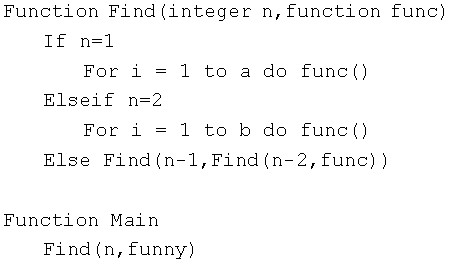
Any fool but Brute knows that the function “funny” will be called too many times. Brute wants to investigate the number of times the function will be called, but he is too lazy to do it.
Now your task is to calculate how many times the function “funny” will be called, for the given a, b and n. Because the answer may be too large, you should output the answer module by P.
Input
There are multiple test cases. The first line of the input contains an integer T, meaning the number of the test cases.
For each test cases, there are four integers a, b, P and n in a single line.
You can assume that 1≤n≤1000000000, 1≤P≤1000000, 0≤a, b<1000000.
For each test cases, there are four integers a, b, P and n in a single line.
You can assume that 1≤n≤1000000000, 1≤P≤1000000, 0≤a, b<1000000.
Output
For each test case, output the answer with case number in a single line.
Sample Input
3
3 4 10 3
4 5 13 5
3 2 19 100
Sample Output
Case #1: 2
Case #2: 11
Case #3: 12
分析:见hdu4550
#include<cstdio>
#include<cmath>
#define ll __int64
ll a,b,p,n;
struct Matrix{
	ll v[2][2];
};
Matrix A={0,1,1,1},B={1,0,0,1};
ll euler(ll x){
	ll i,ans=x,t=(ll)sqrt(x*10.0);
	for(i=2;i<=t;i++)if(x%i==0){
		ans=ans/i*(i-1);
		while(x%i==0)x/=i;
	}
	if(x>1)ans=ans/x*(x-1);
	return ans;
}
ll quickpow(ll x,ll n){
	ll ans=1;
	while(n){
		if(n&1)ans=ans*x%p;
		n>>=1;
		x=x*x%p;
	}
	return ans;
}
Matrix mul(Matrix m1,Matrix m2,ll M){
	int i,j,k;
	Matrix c;
	for(i=0;i<2;i++)for(j=0;j<2;j++){
		c.v[i][j]=0;
		for(k=0;k<2;k++)c.v[i][j]+=(m1.v[i][k]*m2.v[k][j])%M;
		c.v[i][j]%=M;
	}
	return c;
}
Matrix Mpow(int n,ll M){
	Matrix x=A,c=B;
	while(n>=1){
		if(n&1)c=mul(c,x,M);
		n>>=1;
		x=mul(x,x,M);
	}
	return c;
}
int main(){
	int T,ca=1,i;
	scanf("%d",&T);
	while(T--){
		scanf("%I64d%I64d%I64d%I64d",&a,&b,&p,&n);
		printf("Case #%d: ",ca++);
		if(n==1){printf("%I64d\n",a%p);continue;}
		if(n==2){printf("%I64d\n",b%p);continue;}
		if(n==3){printf("%I64d\n",((a%p)*(b%p))%p);continue;}
		ll phi=euler(p),f1=0,f2=1,f3,aa,bb;bool j=0;
		for(i=4;i<=n;i++){
			f3=f1+f2;
			if(f3>=phi){f3%=phi;j=1;break;}
			f1=f2,f2=f3;
		}
		if(j){
			Matrix res=Mpow(n-3,phi);
			f1=res.v[1][0],f2=res.v[1][1],f3=f1+f2;
			aa=f2%phi+phi,bb=f3%phi+phi;
		}
		else {aa=f3,bb=f1+f2;}
		printf("%I64d\n",(quickpow(a,aa)*quickpow(b,bb))%p);
	}
	return 0;
}
 419


 扫一扫


 被折叠的 条评论
为什么被折叠?
 到【灌水乐园】发言


