


 本文介绍了一种用于判断两个立方体是否通过旋转可以互相匹配的算法。算法接收两个字符串作为输入,每个字符串代表一个立方体六个面的颜色,通过比较和旋转操作,确定两个立方体的涂色方式是否相同。
We have a machine for painting cubes. It is supplied with three different colors: blue, red and green. Each face of the cube gets one of these colors.
The cube’s faces are numbered as in Figure 1.
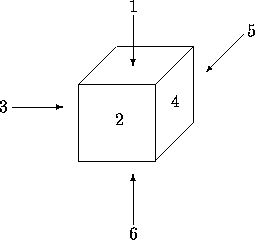
Since a cube has 6 faces, our machine can paint a face-numbered cube in different ways. When ignoring the face
numbers, the number of different paintings is much less, because a cube can be rotated. See example below. We denote a painted cube by a string of 6
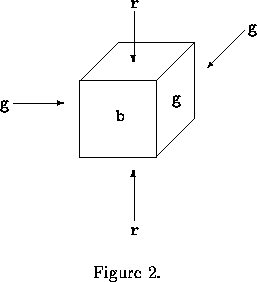
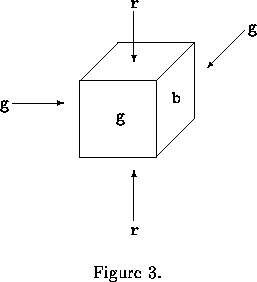
characters,where each character is a b, r, or g. The character ( ) from the left gives the color of face i. For example, Figure 2 is a picture of rbgggr and
Figure 3 corresponds to rggbgr. Notice that both cubes are painted in the same way: by rotating it around the vertical axis by 90 , the one changes into the other.
Input
The input of your program is a textfile that ends with the standard end-of
file marker. Each line is a string of 12 characters. The first 6 characters of this string are the representation of a painted cube, the remaining 6 characters
give you the representation of another cube. Your program determines whether these two cubes are painted in the same way, that is, whether by any
combination of rotations one can be turned into the other. (Reflections are not allowed.)
Output
The output is a file of boolean. For each line of input, output contains TRUE if the second half can be obtained from the first half by rotation
as describes above, FALSE otherwise.
Sample Input
rbgggrrggbgr
rrrbbbrrbbbr
rbgrbgrrrrrg
Sample Output
TRUE
FALSE
FALSE
#include<stdio.h>
int main()
{
    char a[20],b[10];
    int sum=0;
    while(~scanf("%s",a))
    {
  	for(int i=6;i<12;i++)
  	{
            b[i-6]=a[i];
  	}
  	sum=0;
  	for(int i=0;i<3;i++)
  	{
            for(int j=0;j<6;j++)
            {
    		if(a[i]==b[j]&&a[5-i]==b[5-j])
                {
     		    a[i]=a[5-i]='0';
                    b[j]=b[5-j]='1';
                    sum++;
    		}
                else
                {
     		     continue;
                }
   	    }
        }
        if(sum==3)
        {
   	     printf("TRUE\n");
        }
        else
        {
             printf("FALSE\n");
        }
    }
}





 扫一扫
扫一扫


 被折叠的 条评论
为什么被折叠?
被折叠的 条评论
为什么被折叠?
 到【灌水乐园】发言




