


0.1.1. 读取图像形式的MNIST
#划分为train/test
#对数据进行归一化,即0-1之间,数据要变成float类型
#把数据顺序打乱
#注:若训练慢,可以减少训练图像数量
### 题目1:定义并训练一个由3层线性分类器组成的神经网络
#定义网络
#L2损失函数
#中间层激活函数sigmoid
#使用0-1之间的数随机初始化网络
#使用L2正则化项
import os
from PIL import Image
import numpy as np
import matplotlib.pyplot as plt


'''
绘图
'''
def drawing(x,y,title):
    plt.plot(x,y)
    plt.title(title)
    plt.show()
'''
根据名称整出来训练集、测试集和对应的标签
'''
def load_images_and_split(folder):
    train_images = []
    test_images = []
    test_labels = []
    train_labels = []
    for filename in os.listdir(folder):
        if filename.endswith('.jpg'):
            img_path = os.path.join(folder, filename)
            try:
                img = Image.open(img_path)
                img_array = np.array(img)
                label = filename[-5]

                if 'test' in filename:
                    test_images.append(img_array)
                    try:
                        # 尝试将标签转换为整数
                        test_labels.append(int(label))
                    except ValueError:
                        print(f"Invalid label in {filename}: {label}. Skipping this image.")
                elif 'training' in filename:
                    train_images.append(img_array)
                    try:
                        train_labels.append(int(label))
                    except ValueError:
                        print(f"Invalid label in {filename}: {label}. Skipping this image.")
            except Exception as e:
                print(f"Error loading {img_path}: {e}")

    train_images = np.array(train_images)
    test_images = np.array(test_images)
    train_labels = np.array(train_labels)
    test_labels = np.array(test_labels)

    return train_images, train_labels, test_images, test_labels

'''
数据预处理
'''
def preprocess_data(train_images, test_images):
    # 展平图片数据
    train_images_flat = train_images.reshape(train_images.shape[0], -1)
    test_images_flat = test_images.reshape(test_images.shape[0], -1)

    # 归一化处理
    train_images_normalized = train_images_flat / 255.0
    test_images_normalized = test_images_flat / 255.0

    return train_images_normalized, test_images_normalized
folder_path = "E:/Strudy/Data/nearestk/mnist_jpg/mnist_jpg"
train_images, train_labels, test_images, test_labels = load_images_and_split(folder_path)
train_images_normalized, test_images_normalized = preprocess_data(train_images, test_images)
num_classes = len(np.unique(train_labels))

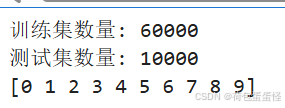
print(f"训练集数量: {len(train_images)}")
print(f"测试集数量: {len(test_images)}")
print(np.unique(test_labels))
#定义参数矩阵w1\w2的梯度计算方法
print('running')
'''
onehot编码方便交叉熵损失计算
'''
def one_hot_encode(labels, num_classes):
    one_hot = np.zeros((labels.shape[0], num_classes))
    one_hot[np.arange(labels.shape[0]), labels] = 1
    return one_hot

'''
两层模型评估
'''
# test_images_normalized, test_labels, best_weights1, best_bias1,best_weights2,best_bias2, x_row)

def two_evaluate_model(test_images, test_labels, weights1, bias1,weights2,bias2,weights3,bias3,x_row):
    #隐藏
# 前向传播
            # 第一层y1=W1x+b
    h1 = 1 / (1 + np.exp(-np.dot(test_images, weights1) + bias1))
            #第二层y2=W2y1+b
    h2 = 1/ ( 1 + np.exp(-np.dot(h1, weights2) + bias2))
            #第三层y_pred
    y_pred = np.dot(h2,weights3)+bias3
    predicted_labels = np.argmax(y_pred, axis=1)
    accuracy = np.mean(predicted_labels == test_labels)
    print(f'Accuracy on the test set: {accuracy * 100}%')

    return accuracy

'''
SGD
'''
def SGD(test_images_normalized, test_labels, train_images, train_labels, num_classes, num_trials=1000, batch_size=32):
    input_size = train_images.shape[1]
    x_row = []
    y_loss_row = []
    y_rate_row = []

    # 初始化第一层
    weights1 = np.random.randn(input_size, num_classes)
    bias1 = np.zeros((1, num_classes))

    # 初始化第二层
    weights2 = np.random.randn(num_classes, num_classes)
    bias2 = np.zeros((1, num_classes))

    #初始化第三层
    weights3 = np.random.randn(num_classes, num_classes)
    bias3 = np.zeros((1, num_classes))

    num_samples = train_images.shape[0]

    for trial in range(num_trials):
        # 随机打乱样本顺序
        permutation = np.random.permutation(num_samples)
        shuffled_images = train_images[permutation]
        shuffled_labels = train_labels[permutation]

        for i in range(0, num_samples, batch_size):
            # 取出一个小批量样本
            batch_images = shuffled_images[i:i + batch_size]
            batch_labels = shuffled_labels[i:i + batch_size]

            # 前向传播
            # 第一层y1=W1x+b
            h1 = 1 / (1 + np.exp(-np.dot(batch_images, weights1) + bias1))
            #第二层y2=W2y1+b
            h2 = 1/ ( 1 + np.exp(-np.dot(h1, weights2) + bias2))
            #第三层y_pred
            y_pred = np.dot(h2,weights3)+bias3

            # 计算损失
            y_true = one_hot_encode(batch_labels, num_classes)
            loss = np.square((y_pred - y_true)**2).sum()

            #L2
            lambda_reg=0.01
            l2_reg = lambda_reg * (np.sum(np.square(weights1)) + np.sum(np.square(weights2)) + np.sum(np.square(weights3)))

            # 更新参数
            grad_y_pred = 2 * (y_pred - y_true)

            grad_w3 = np.dot(h2.T, grad_y_pred)+ lambda_reg*weights3/batch_size
            grad_b3 = np.sum(grad_y_pred, axis=0, keepdims=True)

            grad_h2 = np.dot(grad_y_pred, weights3.T) * h2 * (1 - h2)
            grad_w2 = np.dot(h1.T, grad_h2)+ lambda_reg*weights2/batch_size
            grad_b2 = np.sum(grad_h2, axis=0, keepdims=True)

            grad_h1 = np.dot(grad_h2, weights2.T) * h1 * (1 - h1)
            grad_w1 = np.dot(batch_images.T, grad_h1)+ lambda_reg*weights1/batch_size
            grad_b1 = np.sum(grad_h1, axis=0, keepdims=True)

            weights1 -= 1e-4 * grad_w1
            weights2 -= 1e-4 * grad_w2
            weights3-=1e-4 * grad_w3
            bias1 -= 1e-4 * grad_b1
            bias2 -= 1e-4 * grad_b2
            bias3 -= 1e-4 * grad_b3

        x_row.append(trial)
        # 计算当前批次的平均损失
        y_loss_row.append(loss)
        acc = two_evaluate_model(test_images_normalized, test_labels, weights1, bias1, weights2, bias2,weights3,bias3,x_row)
        y_rate_row.append(acc)
        print(f'Trial {trial + 1}, Loss: {loss}')

    drawing(x_row, y_loss_row, 'Loss')
    drawing(x_row, y_rate_row, 'Accuracy')
SGD(test_images_normalized, test_labels,train_images_normalized, train_labels, num_classes)
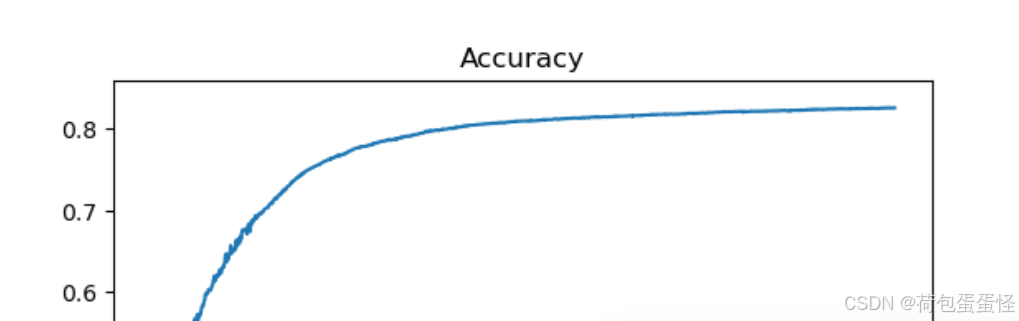
Accuracy on the test set: 82.53%
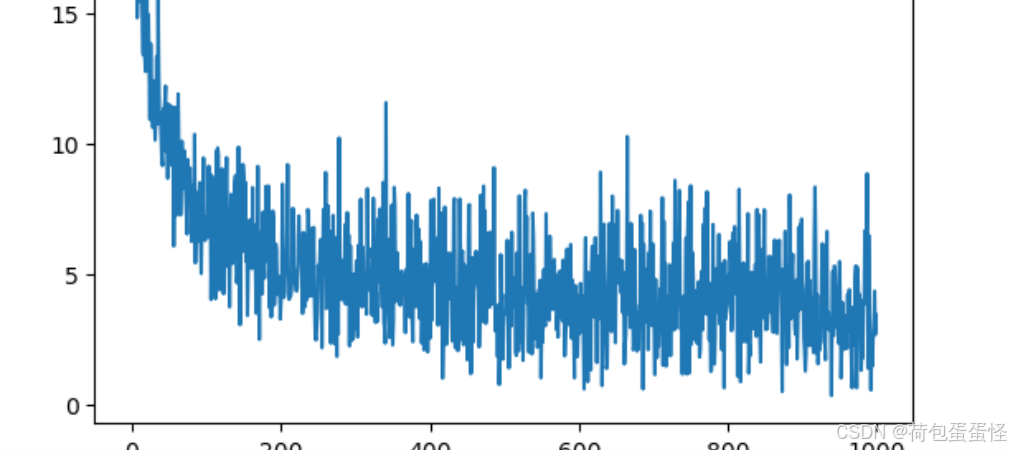
Trial 1000, Loss: 3.421813822563138
损失:
准确率:
实验结果分析:
1、3层的网络精度远高于两层的神经网络,并且模型复杂,因此需要添加正则化
2、正则化系数越大,收敛速度越慢
3、总体上损失不断下降,推测继续加深迭代次数精度还会继续上升
4、200次以后迭代速度变慢,并且发现损失跳变成都越来越大,推测和学习率有关,如果随着迭代降低学习速率应该可以加快迭代速度。
0.1.3. 题目2:参考PPT,添加dropout,再次训练、测试,对比分析dropout的作用
'''
dropout evaluate注意,这个评估函数要变化
'''
def dropout_evaluate(test_images, test_labels, weights1, bias1,weights2,bias2,weights3,bias3,x_row):
    #隐藏
# 前向传播
            # 第一层y1=W1x+b
    p=0.5
    h1 = 1 / (1 + np.exp(-np.dot(test_images, weights1) + bias1))*p
            #第二层y2=W2y1+b
    h2 = 1/ ( 1 + np.exp(-np.dot(h1, weights2) + bias2))*p
            #第三层y_pred
    y_pred = np.dot(h2,weights3)+bias3
    predicted_labels = np.argmax(y_pred, axis=1)
    accuracy = np.mean(predicted_labels == test_labels)
    print(f'Accuracy on the test set: {accuracy * 100}%')

    return accuracy
'''
dropout
'''

def dropout(test_images_normalized, test_labels, train_images, train_labels, num_classes, num_trials=1000, batch_size=32):
    input_size = train_images.shape[1]
    x_row = []
    y_loss_row = []
    y_rate_row = []

    # 初始化第一层
    weights1 = np.random.randn(input_size, num_classes)
    bias1 = np.zeros((1, num_classes))

    # 初始化第二层
    weights2 = np.random.randn(num_classes, num_classes)
    bias2 = np.zeros((1, num_classes))

    #初始化第三层
    weights3 = np.random.randn(num_classes, num_classes)
    bias3 = np.zeros((1, num_classes))

    num_samples = train_images.shape[0]

    for trial in range(num_trials):
        # 随机打乱样本顺序
        permutation = np.random.permutation(num_samples)
        shuffled_images = train_images[permutation]
        shuffled_labels = train_labels[permutation]

        for i in range(0, num_samples, batch_size):
            # 取出一个小批量样本
            batch_images = shuffled_images[i:i + batch_size]
            batch_labels = shuffled_labels[i:i + batch_size]

            # 前向传播
            #dropout
            p=0.5
            # 第一层y1=W1x+b
            h1 = 1 / (1 + np.exp(-np.dot(batch_images, weights1) + bias1))
            u1=np.random.rand(*h1.shape) <p
            h1*=u1
            #第二层y2=W2y1+b
            h2 = 1/ ( 1 + np.exp(-np.dot(h1, weights2) + bias2))
            u2=np.random.rand(*h2.shape) <p
            h2*=u2
            #第三层y_pred
            y_pred = np.dot(h2,weights3)+bias3

            # 计算损失
            y_true = one_hot_encode(batch_labels, num_classes)
            loss = np.square((y_pred - y_true)**2).sum()

            # 更新参数
            grad_y_pred = 2 * (y_pred - y_true)

            grad_w3 = np.dot(h2.T, grad_y_pred)
            grad_b3 = np.sum(grad_y_pred, axis=0, keepdims=True)

            grad_h2 = np.dot(grad_y_pred, weights3.T) * h2 * (1 - h2)
            grad_w2 = np.dot(h1.T, grad_h2)
            grad_b2 = np.sum(grad_h2, axis=0, keepdims=True)

            grad_h1 = np.dot(grad_h2, weights2.T) * h1 * (1 - h1)
            grad_w1 = np.dot(batch_images.T, grad_h1)
            grad_b1 = np.sum(grad_h1, axis=0, keepdims=True)

            weights1 -= 1e-4 * grad_w1
            weights2 -= 1e-4 * grad_w2
            weights3-=1e-4 * grad_w3
            bias1 -= 1e-4 * grad_b1
            bias2 -= 1e-4 * grad_b2
            bias3 -= 1e-4 * grad_b3

        x_row.append(trial)
        # 计算当前批次的平均损失
        y_loss_row.append(loss)
        acc = dropout_evaluate(test_images_normalized, test_labels, weights1, bias1, weights2, bias2,weights3,bias3,x_row)
        y_rate_row.append(acc)
        print(f'Trial {trial + 1}, Loss: {loss}')

    drawing(x_row, y_loss_row, 'Loss')
    drawing(x_row, y_rate_row, 'Accuracy')
dropout(test_images_normalized, test_labels,train_images_normalized, train_labels, num_classes)
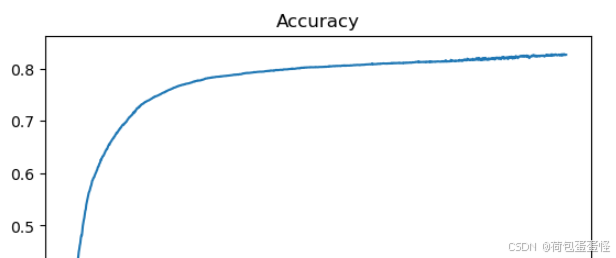
准确率:
损失:
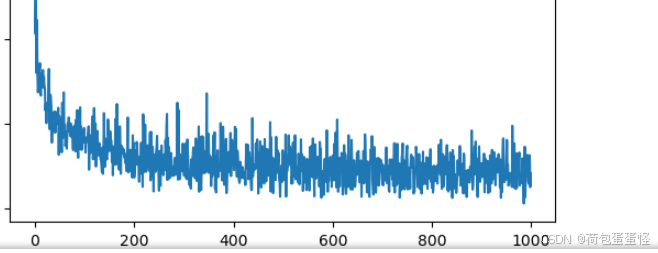
实验结果分析:
1、p=0.5的时候很难收敛,原因是空白的值太多,所以本人悄咪咪改成了0.8
2、从收敛速度上来看,dropout的收敛速度非常慢,并且受到超参数p的影响非常大。p越小越容易不收敛或者收敛速度慢
0.1.4. 题目3:参考PPT进行数据增强,再次训练、测试,对比分析数据增强的作用
#水平翻转
#旋转
本人使用的办法是使用numpy直接对矩阵进行操作。
注意,数据增强是在原有数据集上增加新的数据,所以在增强后数据量是原来的三倍。
'''
数据增强函数
'''
def augment_data(images, labels):
    augmented_images = []
    augmented_labels = []
    for img, label in zip(images, labels):
        # 原始图像
        augmented_images.append(img)
        augmented_labels.append(label)

        # 水平翻转
        img_flipped = np.fliplr(img)
        augmented_images.append(img_flipped)
        augmented_labels.append(label)

        # 旋转 90 度
        img_rotated_90 = np.rot90(img)
        augmented_images.append(img_rotated_90)
        augmented_labels.append(label)

    augmented_images = np.array(augmented_images)
    augmented_labels = np.array(augmented_labels)
    return augmented_images, augmented_labels
folder = "E:/Strudy/Data/nearestk/mnist_jpg/mnist_jpg"
train_images, train_labels, test_images, test_labels = load_images_and_split(folder)
train_images_augmented, train_labels_augmented = augment_data(train_images, train_labels)
train_images_normalized, test_images_normalized = preprocess_data(train_images_augmented, test_images)
SGD(test_images_normalized, test_labels,train_images_normalized, train_labels_augmented, num_classes)
#这里传入的SGD的tiranlabel是要进行修改的,因为trainlabel变化了。
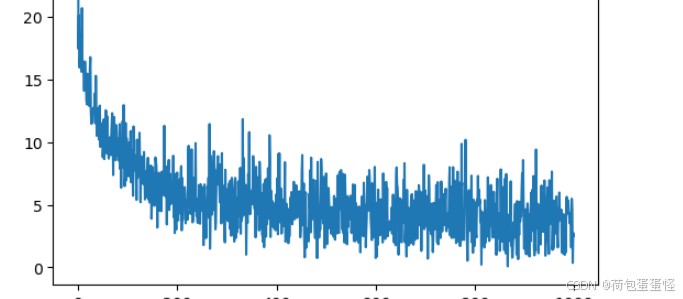
损失:
准确率:
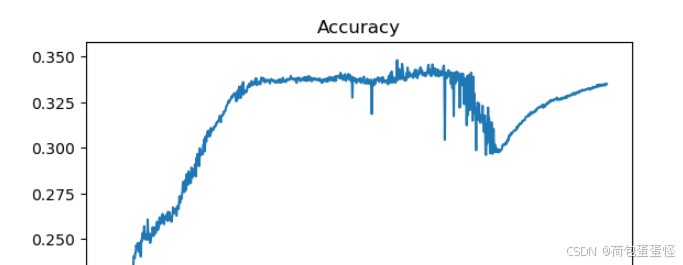
实验结果分析:
数据在增强后,变成了原有数据集的三倍。按照常理而言数据量扩大并且增强,容易得到更为精确的结果。然而本次增强使用的翻转和旋转,可能导致数据样式变化,反而降低准确率。比如数字6翻转后辩证了数字9。
本次实验结果精度大约为30%,也就是三份数据中的一份的准确率。
'''
数据增强函数,由于老师说翻转不行,所以改成平移
'''

def translation_augment_data(images, labels):
    augmented_images = []
    augmented_labels = []
    for img, label in zip(images, labels):
        # 原始图像
        augmented_images.append(img)
        augmented_labels.append(label)

        # 水平向右平移
        shift_right = 3
        img_shifted_right = np.roll(img, shift_right, axis=1)
        img_shifted_right[:, :shift_right] = 0  # 填充空白部分为 0
        augmented_images.append(img_shifted_right)
        augmented_labels.append(label)

        # 水平向左平移
        shift_left = 3
        img_shifted_left = np.roll(img, -shift_left, axis=1)
        img_shifted_left[:, -shift_left:] = 0
        augmented_images.append(img_shifted_left)
        augmented_labels.append(label)

        # 垂直向上平移
        shift_up = 3
        img_shifted_up = np.roll(img, -shift_up, axis=0)
        img_shifted_up[-shift_up:, :] = 0
        augmented_images.append(img_shifted_up)
        augmented_labels.append(label)

        # 垂直向下平移
        shift_down = 3
        img_shifted_down = np.roll(img, shift_down, axis=0)
        img_shifted_down[:shift_down, :] = 0
        augmented_images.append(img_shifted_down)
        augmented_labels.append(label)

    augmented_images = np.array(augmented_images)
    augmented_labels = np.array(augmented_labels)
    return augmented_images, augmented_labels

folder = "E:/Strudy/Data/nearestk/mnist_jpg/mnist_jpg"
train_images, train_labels, test_images, test_labels = load_images_and_split(folder)
train_images_augmented, train_labels_augmented = translation_augment_data(train_images, train_labels)
train_images_normalized, test_images_normalized = preprocess_data(train_images_augmented, test_images)
SGD(test_images_normalized, test_labels,train_images_normalized, train_labels_augmented, num_classes)
ctnnd,这个代码训练的真的慢……





 扫一扫
扫一扫


 9418
9418

 被折叠的 条评论
为什么被折叠?
被折叠的 条评论
为什么被折叠?
 到【灌水乐园】发言





